Monthly Know-How

Explore our monthly Know How articles, your source for actionable insights and expert guidance in powder technology. Each article addresses real-world challenges, offering practical tips to optimize processes and enhance material performance. From blending techniques to flowability testing, our content bridges theory and practice. Download the PDF for easy reference and put these insights to work in your projects.

Featured Monthly Know-How
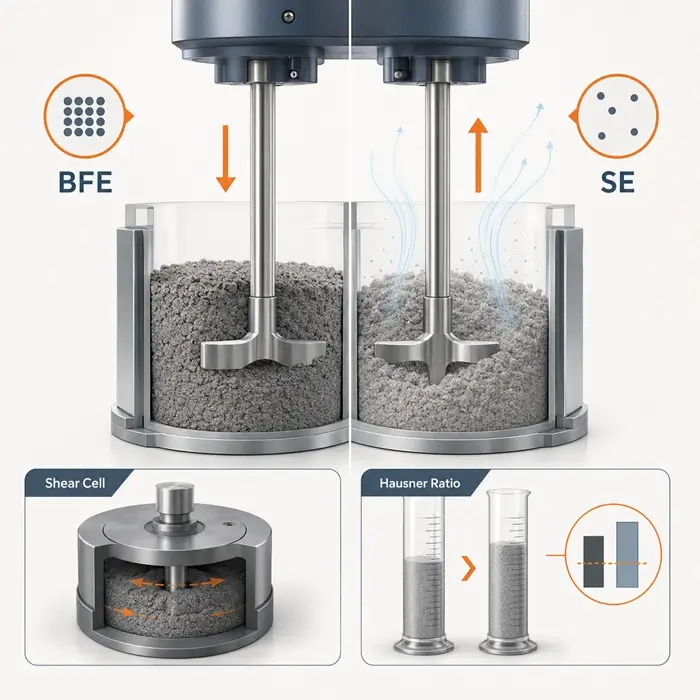
  • Technical infographic showing powder deaeration, permeability, density recovery, air retention, flushing, surging, and feeder instability after filling.

    Powder Deaeration: Flushing, Surging, and Air Retention

    Powder instability after conveying, filling, or transfer is often treated as a feeder, hopper, or flowability problem. Retained air may be part of the mechanism. A powder bed that has not yet deaerated can discharge at a lower bulk density, surge through outlets, pulse through feeders, release dust, or behave differently from [...]

  • Particle size distribution interpretation graphic showing D10, D50, D90, fines, oversize, span, and curve shape in a powder PSD curve.

    Particle Size Distribution Interpretation: Reading D10, D50, D90, Fines, and Oversize in Process Context

    Particle size distribution interpretation has the most value when the curve explains a specific process observation. D10, D50, D90, fines, oversize, span, and curve shape each describe a different part of the material. The median value gives a useful reference point, but changes in the fine tail, coarse tail, or distribution width often [...]

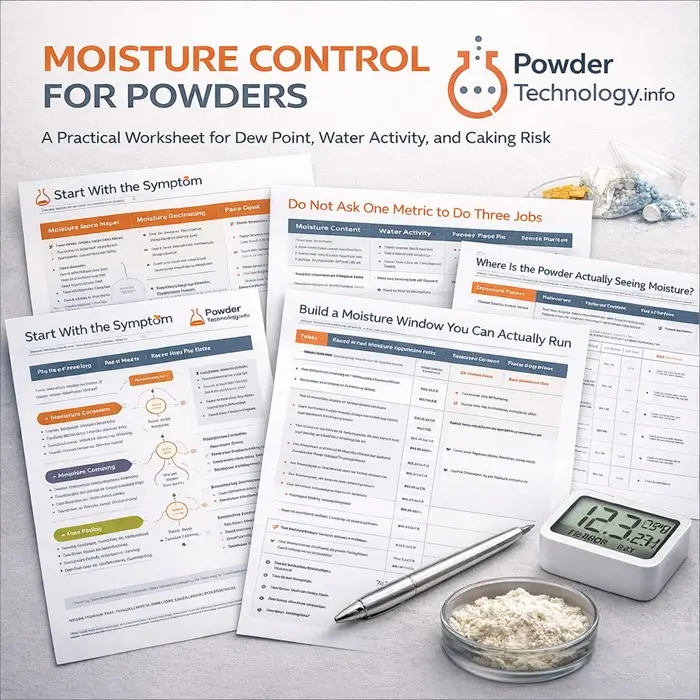
  • Square hero image for Moisture Control for Powders showing the PowderTechnology.info field pack with worksheets, the correct PowderTechnology logo, a hygrometer, a pen, and a powder sample.

    Moisture Control for Powders: Dew Point, Water Activity, and Caking Windows

    Moisture control for powders breaks down when teams treat water as one number. Moisture content, water activity, and dew point answer different questions. Moisture content tells you how much water is present. Water activity shows how available that water is to drive caking, sticking, and flow loss. Dew point shows whether the surrounding [...]

  • Square hero image showing a powder quality release workflow: sampling, test limits, and a one page lot release decision sheet.

    Powder Release Protocol: Sampling Rules and Acceptance Criteria Guide and Check-List

    A powder release protocol is an incoming gate that protects your operating window. It works when you test only what predicts real failure modes and control sampling, so results stay defensible. The output is a one-page lot data pack that drives a clear decision, Released, Conditional Release, or Hold, with no room for [...]

  • LFP black mass pre export workflow infographic showing sampling, testing, review, decision, logistics, and shipping

    Black Mass Powder Quality: Sampling, QA Panel, and Spec Templates

    Black mass powder quality decides yield, buyer acceptance, and dispute risk. First, declare the buyer route and write the spec to match it. Next, sample from a moving stream and split the composite correctly. Then trend moisture, PSD tails, a route-specific fines metric, and key impurities with stable methods. Finally, ship with a [...]

newsletter icon

News And Articles In Your Inbox

Sign up and receive PowderTechnology.info news, articles, and content from our partners in a quick and easy monthly newsletter.

You have been successfully subscribed.
There was an error trying to subscribe. Please try again later.

Editor’s Picks