
Table of contents
Why Powders Fail Even When the Moisture Spec Looks Fine
A powder can leave the dryer in spec, pass release, and still become a handling problem two days later. It cakes in the bag. It feeds less steadily after a refill. It sticks to walls on humid days. Then the team checks moisture content, sees nothing dramatic, and starts looking elsewhere. Often, that is the wrong move.
In many plants, the problem is not the amount of water alone. The problem is the state of that water and the air history around the powder. A product can stay inside a total moisture limit while surface conditions, local exposure, or storage time push it toward higher strength and poorer flow. The literature on bulk powder caking makes this clear. Temperature, humidity, and mechanical history can change bulk behavior over time, even when the release number looks acceptable.
Read more about these phenomina in the ScienceDirect article – Effects of storage conditions, formulation, and particle size on moisture sorption and flowability of powders: A study of deliquescent ingredient blends
Stop Mixing Up Moisture Content, Water Activity, and Dew Point
Moisture content is the total amount of water in the material. It is useful for drying control, yield, and basic release work. However, it is often too blunt for diagnosing caking, sticking, and flow changes driven by storage.
Water activity, written as aw, reflects the energetic state of water in the powder. In practical terms, it tells you how available water is to affect particle contacts, microstructure, and stability. ISO 18787 sets out the principles and requirements for determining water activity, including dew-point-based and sensor-based methods. That makes water activity the more relevant control metric when the question is whether a powder will remain stable during storage and handling.
Dew point belongs to the air, not the powder. It tells you when condensation begins. That matters because powders rarely fail in isolation. They fail at refill points, transfer chutes, storage rooms, bag opening stations, and cold metal surfaces. If the air around the product crosses the wrong dew point condition, the powder can pick up a local moisture insult even when the room average looks acceptable. PowderTechnology.info’s dew point article makes the split clearly. Dew point governs the air, while water activity governs the material.
What Plants Usually Measure Wrong
This is where many teams lose time.
They measure moisture content when the real problem is water availability at particle contacts.
They monitor average room humidity when the actual risk sits at a cold refill point, line opening, or transfer section.
They trust a single release result to predict what will happen after storage, transport, or a weekend shutdown.
They treat moisture as a product specification, when in reality it is a product plus environment system.
That is why recurring moisture issues often survive multiple corrective actions. The plant keeps measuring water, but it does not measure the moisture variable that actually predicts the failure. PowderTechnology.info’s recent moisture articles point to this same pattern across water activity, dew point, and humidity spikes.
Why Water Activity Often Predicts Trouble Better Than Moisture Percentage
A strong external paper supports what many engineers already see in practice. A study on hygroscopic powders found that the flow factor correlated better with water activity than with absolute moisture content. That matters because two powders can hold similar total water, yet respond very differently if the water is more available at the particle surface. In other words, the moisture number may look stable while the handling behavior is already moving in the wrong direction.
That is why moisture control for powders needs a behavior-based mindset. If the powder cakes, sticks, or feeds poorly, the right question is not only, “How much water is in the powder?” The better question is, “Which moisture variable predicts the failure we care about?”
The Failure Modes Moisture Actually Drives
Moisture does not create one problem. It creates a family of problems. It can increase cohesion during rest and promote storage caking. It can change the feeder response after a refill. It can increase wall buildup, reduce discharge consistency, and shift the way a powder responds to consolidation. It can also destabilize moisture-sensitive amorphous materials when temperature and humidity move them closer to a more mobile state. Reviews of powder caking describe these effects through humidity exposure, capillary condensation, liquid bridge formation, and time-dependent structural change.
This matters because operators often label all of these events as “poor flow.” That label is too vague to be useful. A practical moisture strategy starts by deciding which failure mode you are actually trying to prevent.
What to check first
Clumping after storage
Check water activity first. Then compare fresh and conditioned flow or shear behavior. If strength rises with storage time at fixed stress, caking is the likely driver. Check out PowderTechnology.info’s caking page here.
Drift during humid days
Check the local dew point and the exposure point first. Then, verify whether retained samples show a change in water activity. Short humidity spikes can shift surface behavior long before an average room value or final moisture number moves enough to trigger concern.
Product passes moisture spec, but still sticks to walls or screws
Suspect surface moisture effects, condensation risk, or local air history. Do not rely on moisture percentage alone.
Feeding worsens after a refill
Check refill air condition, humidity ingress, and short-term conditioning effects before changing feeder settings.
Two Short Plant Examples
A food or dairy powder may pass total moisture limits and still cake after warehousing. The real shift often happens in water activity, packaging exposure, or temperature cycling during storage, not in the headline moisture percentage measured at release.
A mineral or chemical powder may feed well in the morning and poorly by afternoon. The product itself did not suddenly change. The local air condition did. If the refill point or transfer section sees a different dew point profile than the general room, the powder may respond to that local exposure while the average environmental reading still looks harmless.
Build a Moisture Operating Window You Can Actually Run
Every moisture-sensitive powder should have a defined operating window. A single moisture specification is rarely enough. Start with the behavior limit. What are you trying to prevent: caking, wall buildup, feed drift, loss of redispersion, or poor restart performance?
Next, define the primary control metric. That may be moisture content, water activity, dew point, or a combination. Choose the metric that predicts the observed failure, not the one that is easiest to measure.
Then define the measurement point. Released lab results are useful, but they do not tell the whole story. Measure where the powder is actually exposed. That may be the packaging line, the refill hopper, the warehouse, or the room transition where condensation risk increases.
After that, define the action trigger. What causes a hold? What causes an investigation? What causes a process correction? If the answer depends on the operator’s opinion, the system is still too vague.
Finally, define the verification test. You need a check that proves the chosen limit predicts behavior. That may be a conditioned shear test, a short storage check, or a comparison between fresh and exposed material. Without this step, the operating window is only an assumption.
That is the difference between monitoring moisture and controlling moisture.
When Storage Is the Real Culprit
Many powders get blamed for instability when the real problem is the storage and handling history around them. Packaging breaches matter. So do long dwell times, repeated opening and closing, and movement through colder zones. A product can leave production in good condition, then change during warehousing because the surrounding environment lets it move toward a different equilibrium state. The bulk powder caking literature describes this as a transformation shaped by humidity, temperature, and mechanical conditions over time.
That is why storage mapping belongs in moisture control for powders. Track where the product sits, how long it sits there, what the temperature does, and where it sees air exposure. Without that map, teams often mislabel environment-driven problems as unexplained batch variation.
When Internal Measurements Stop Answering the Right Question
This is the point where outside lab work becomes useful. If a powder keeps failing in production while passing internal moisture checks, the issue is usually no longer routine quality control. It becomes a diagnosis problem. At that point, the plant needs to separate total moisture from water activity effects, identify whether storage history is driving strength growth, and test whether the real control variable sits in the powder, the air, or both.
That is where a lab such as Delft Solids Solutions fits naturally. The goal is not to repeat routine testing. The goal is to build a small mechanism-based test matrix that converts a vague complaint into a working decision rule.
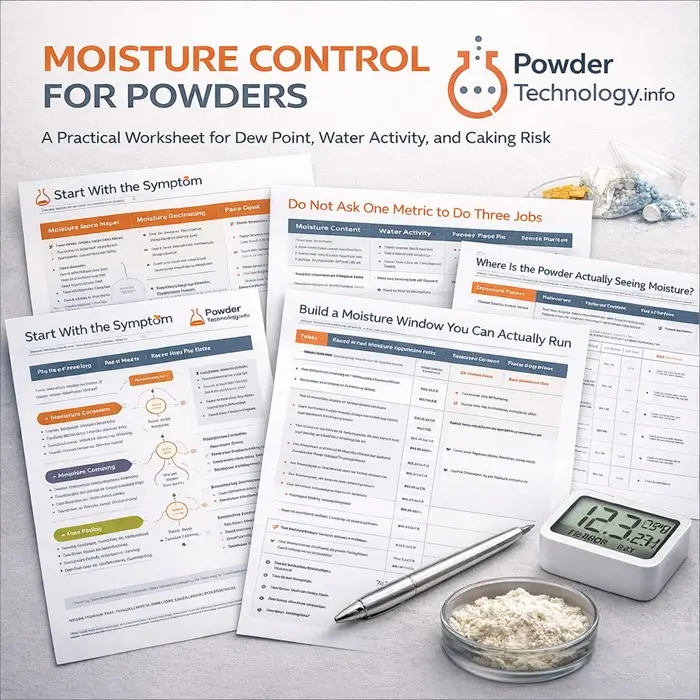
Monthly Know How PDF Pack
This article should explain the logic and decision chain. The PDF turns the method into action.
PDF contents
Page 1, Symptom to metric decision sheet
Clumping, sticking, refill drift, storage failure, likely driver, first metric, next test.
Page 2, Moisture operating window template
Failure mode, primary control metric, sample point, limit, band, action.
Page 3, Exposure point audit checklist
Refill point, transfer section, bag opening, packaging, warehouse, cold surfaces.
Page 4, Hold versus investigate guide
Immediate hold, conditional run, retest trigger, lab escalation.
Page 5, Test selection sheet
Moisture content, water activity, dew point, conditioned shear, storage check, what each one tells you.
Page 6, One-page moisture control worksheet
A fillable summary sheet for each material.
FAQ
Conclusion
Moisture problems in powders persist because many plants monitor water without defining which moisture risk they are trying to control. If the failure happens in storage, handling, or feeding, the moisture percentage alone is often too blunt. Moisture control for powders gets stronger when teams separate the questions properly. Use the moisture content for quantity. Use water activity for material behavior. Use the dew point for environmental exposure. Then connect those measurements to the failure mode that matters.
Once that logic is in place, moisture stops being a vague background factor. It becomes an operating window you can publish, monitor, and defend.