Plastics and Polymers Industry

The plastics and polymers industry heavily relies on powder technology for material formulation and processing. From optimizing particle size distribution in polymer additives to enhancing flowability during molding and extrusion, powder technology plays a critical role. Innovations in this field drive the development of lightweight, durable, and sustainable materials for applications ranging from packaging and automotive components to medical devices and electronics.

Featured Plastics and Polymers Industry articles
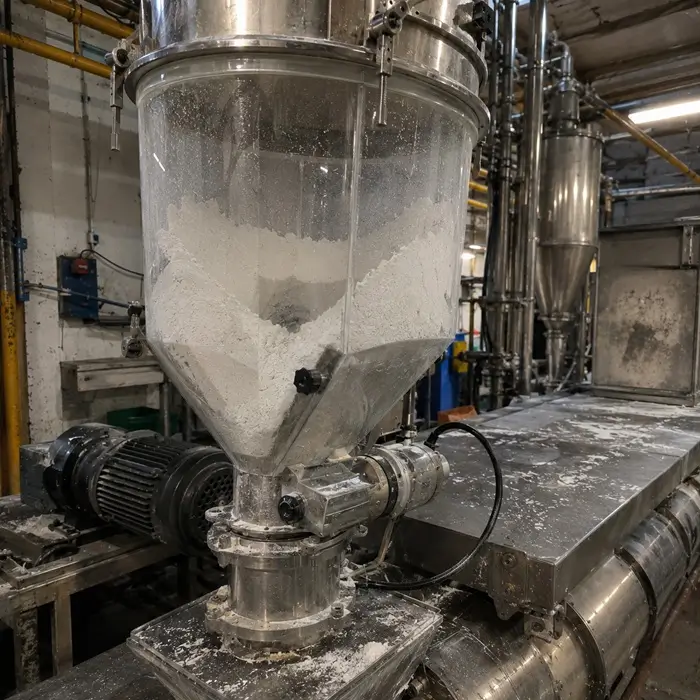
  • Plastic pellet loss prevention diagram showing pellet ejection from a filter receiver and a pellet puff at a diverter valve, with drain protection.

    Plastic pellet loss prevention is now a compliance KPI (and a bulk solids design problem)

    Regulation (EU) 2025/2365 makes plastic pellet loss prevention a documented operational control item across the EU pellet supply chain, including transport. Treat pellet losses like any other bulk solids failure mode: locate the release point, fix the interface, verify control with repeatable checks, then keep records that survive audits. Large and medium companies [...]

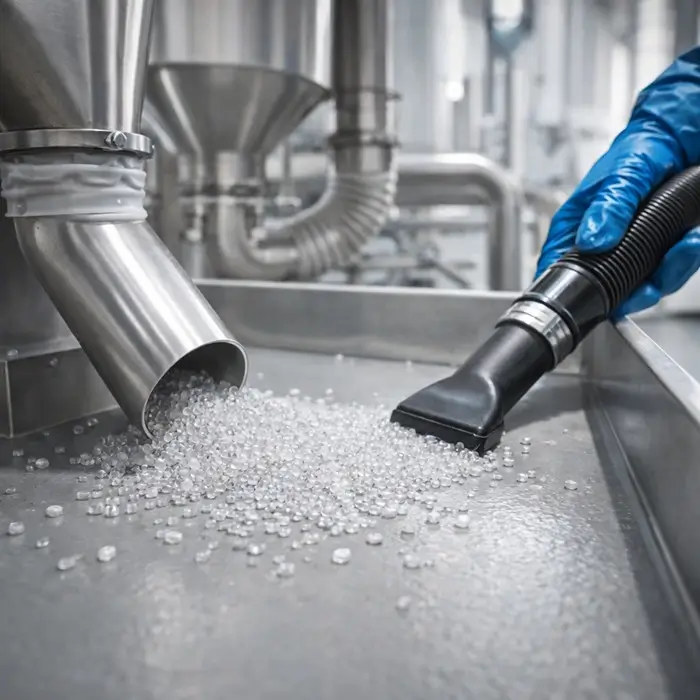
  • EU plastic pellet loss regulation, spill containment and vacuum recovery at a pellet transfer point in a bulk handling area.

    EU Plastic Pellet Loss Regulation: Bulk Plant Compliance

    EU plastic pellet loss regulation (EU) 2025/2365 makes spill prevention and documented loss estimates mandatory for most pellet handlers. Map transfer points, control releases, and keep records, because audits will check your risk plan and annual loss budget. Plastic pellets rarely feel like a powder risk. Yet the [...]

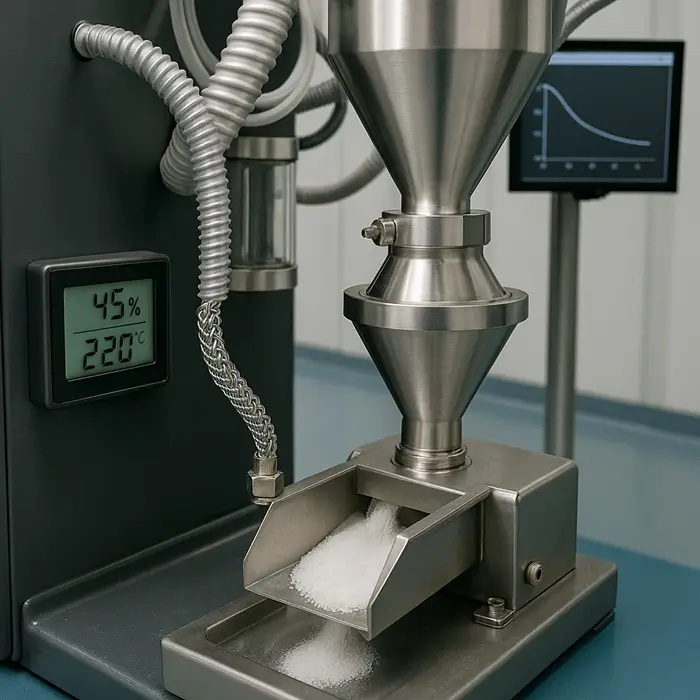
  • Loss-in-weight feeder with anti-static hoses and RH display, used to link settings to charge decay time.

    Charge Decay Time: A Fast Predictor of Powder Handling Risk

    Charge decay time turns electrostatics into a practical control knob. Measure it under controlled humidity, log it with charge-to-mass, and link it to plant outcomes. Then tune humidity and materials to stabilize feeding and discharge. Charge Decay Time: The One Metric That Predicts Trouble Electrostatic charge and [...]

  • Three Petri dishes with metal, ceramic, and polymer powders, plus a spatula pouring metallic powder, illustrating powder testing circular economy.

    Powder Technologies Within Circular Systems

    The relevance of powder testing for circular economy powder usage. Circular production changes powder behavior across cycles. Therefore, measure oxidation, moisture, morphology, and flow every loop. Set clear release criteria. Track energy and carbon per cycle to keep quality stable. Table of contents The circular [...]

  • Deep-sea particle dynamics for powder engineering: marine snow with diatom chains sinking.

    Deep-Sea Particle Dynamics, Through a Powder Lens

    vDeep-sea particle dynamics show powder engineering mechanics in powder dynamics. Deep trenches act as natural particle processors. Marine snow, fecal pellets, and mineral dust form fast-sinking aggregates that carry microplastics and fines to the seafloor. The same physics governs industrial powders. Shape, density contrast, aggregation, and turbulence set fate and wear. Engineers can [...]

newsletter icon

News And Articles In Your Inbox

Sign up and receive PowderTechnology.info news, articles, and content from our partners in a quick and easy monthly newsletter.

You have been successfully subscribed.
There was an error trying to subscribe. Please try again later.

More Plastics and Polymers Industry Articles

Editor’s Picks