

Powder property
Porosity and surface area
Pore accessibility and surface exposure control
different material functions
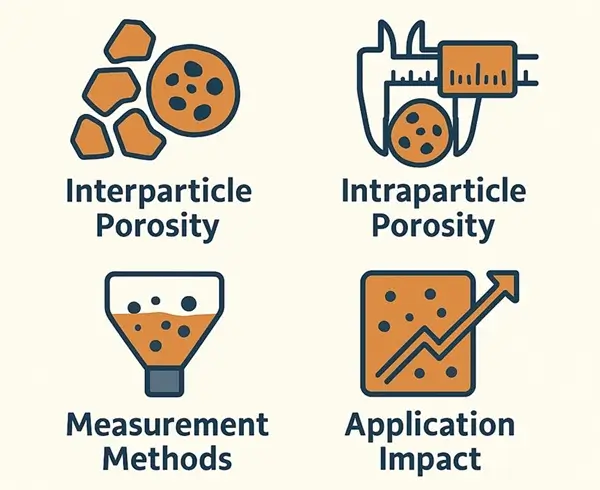
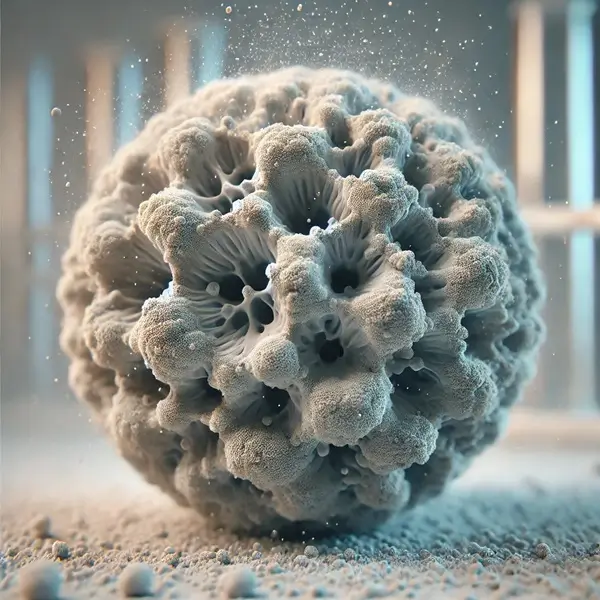
Porosity describes void space within particles or agglomerates, while bed
voidage describes the interparticle space in a powder bed. Specific surface area
describes the surface accessible to a defined probe under defined conditions.
Pore size, connectivity, accessibility, and surface chemistry determine how
these measurements relate to adsorption, wetting, dissolution, reaction,
and transport.




Core concept
Porosity and surface area are related, not interchangeable
A material can have high pore volume without presenting the same accessible surface area to every gas or liquid. Closed pores contribute to some density differences but remain unavailable to adsorption or intrusion measurements. Specific surface area also includes external surface and accessible internal surfaces at the scale reached by the probe molecule. Surface roughness and fine particle size can increase area without creating the same transport network as connected pores. Select the measurement from the functional question: how much void space exists, which pores are connected, or how much surface is accessible under the relevant condition.
What controls it
Six structural and material factors shape porosity and surface-area behavior
Functional behavior depends on where the voids and surfaces are located, whether they are accessible, and how the surrounding phase interacts with them.
States and interpretation
Different probes see different pore and surface states
Match the probe scale, accessibility, and sample preparation to the function under investigation.
| Measurement view | What it describes | What it may miss | Typical decision |
|---|---|---|---|
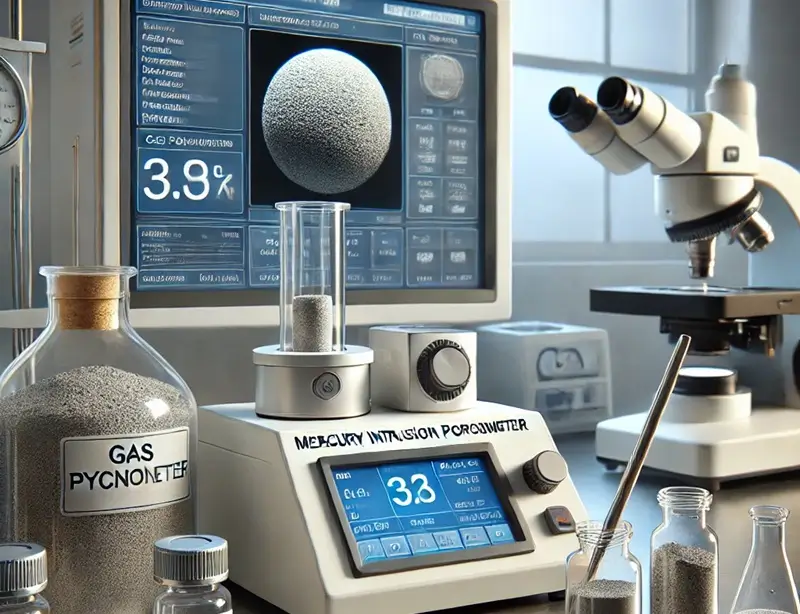
| Gas adsorption | Accessible surface area and model-based micro/mesopore structure | Closed pores and pores inaccessible to the adsorptive | Adsorption, catalysts, dissolution, surface comparison |
| Mercury intrusion | Intrusion-accessible pore-throat distribution | Closed pores; pressure may alter fragile structures | Larger pore networks and intrusion behavior |
| Gas pycnometry | Volume inaccessible to the displacement gas | Direct pore geometry, connectivity, and closed-pore location | Skeletal density and porosity calculations |
| X-ray micro-CT | Resolved three-dimensional pore geometry and connectivity | Pores below voxel resolution | Network structure, closed pores, and spatial distribution |
How to measure it
Choose a measurement by the pore or surface question
Each method sees a different accessible volume or surface range. Combining methods is often necessary when structure spans several scales.
Where it matters
Pore and surface structure become a transport and capacity constraint
Accessible area and connected voids influence how gases, liquids, heat, and reactive species enter, leave, or transform a particulate material.
Go deeper
Three practical routes into porosity and surface area
Explore how pore accessibility, measurement scale, and three-dimensional structure influence material performance.
Need the measurement, not just the guidance?
If the remaining uncertainty concerns surface area, pore-size distribution, pore connectivity, skeletal density, or functional transport through a porous material, select the measurement around the material state and process decision. PowderTechnology.info can help define the test sequence, sample conditions, and interpretation route. For laboratory support, explore our Delft Solids Solutions partner page or visit Delft Solids Solutions directly.
