
Table of contents: Permeability and Deaeration in Powders

Why retained air can look like an equipment problem
Powder deaeration is rarely the first explanation considered when a line starts behaving badly. Some powders behave normally in storage but become unstable immediately after conveying, filling, blending, or transferring. The hopper appears full, yet the discharge rate changes. A feeder pulses after refill. A bagging line shows variable fill weights. Dust release increases after pneumatic conveying. A receiver settles visibly after filling, and the material behaves differently after a short rest.
These symptoms are often handled as separate equipment problems. The feeder is adjusted. The hopper outlet is questioned. The flowability specification is checked again. Those steps may be necessary, but they can miss a central mechanism: the powder may still contain process air.
Powders are assemblies of solid particles, voids, gas pathways, contact points, and changing packing structures. When air enters the bed during conveying, filling, fluidization, vibration, or free fall, the powder may temporarily behave as a lighter, more expanded bulk material. If that air cannot escape quickly enough, the process sees a powder that is still changing.
That transition matters. A recently aerated powder can discharge faster than expected, surge at an outlet, leak through feeder clearances, or produce inconsistent dosing. The same material may behave more predictably after it has settled. A specification can be correct for a rested material state while still missing the condition in which the powder is actually handled.
This Know How explains how powder deaeration, permeability, air retention, and deaeration lag affect powder behavior. It focuses on practical diagnosis: how to recognize air-related instability, where permeability testing fits, which observations matter, which tests can separate retained air from other causes, and which process changes deserve priority.
When Powder Instability Is Really an Air Problem
Air-related powder problems often appear after a specific process event. Pneumatic conveying, rapid filling, high drop height, fluidized discharge, blending, drying, milling, and vibration can all introduce or redistribute air inside a powder bed. The material may then enter the next process step before it has returned to a stable packing state.
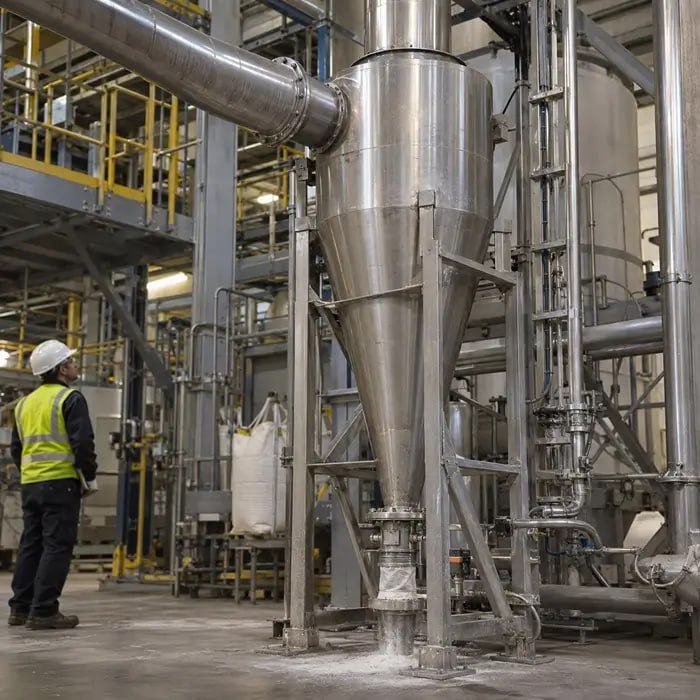
A common example is a receiving hopper after pneumatic conveying. The powder arrives expanded and aerated. The level appears high, but the solids content per unit volume is temporarily lower than it will be after settling. If discharge starts immediately, the feeder receives a changing material. The first portion may be loose, air-rich, and unstable. Later, after settling, the same feeder may see a denser bed with different resistance and a different mass flow rate.
Another example is bag filling. A powder that still contains air can fill by volume but settle later, causing apparent underfill, package deformation, dust release, or poor stacking stability. In a dosing process, the same effect may appear as a change in the dose weight after a refill. The mechanical feeder may be working consistently, while the bulk density above it is changing.
Air-related behavior is especially relevant for fine powders. Fine particles create small pore spaces and longer, more resistant air pathways. Once air enters the bed, it may escape slowly. Cohesive fines can also stabilize expanded structures, causing the powder to remain loose or fluid-like longer than expected. This is why flushing, surging, and feeder pulsing often appear in fine, low-permeability powders after transport or filling. For more background on this behavior, see the article on fine powder fluidization in pneumatic conveying.
What Permeability and Deaeration Mean in Process Terms
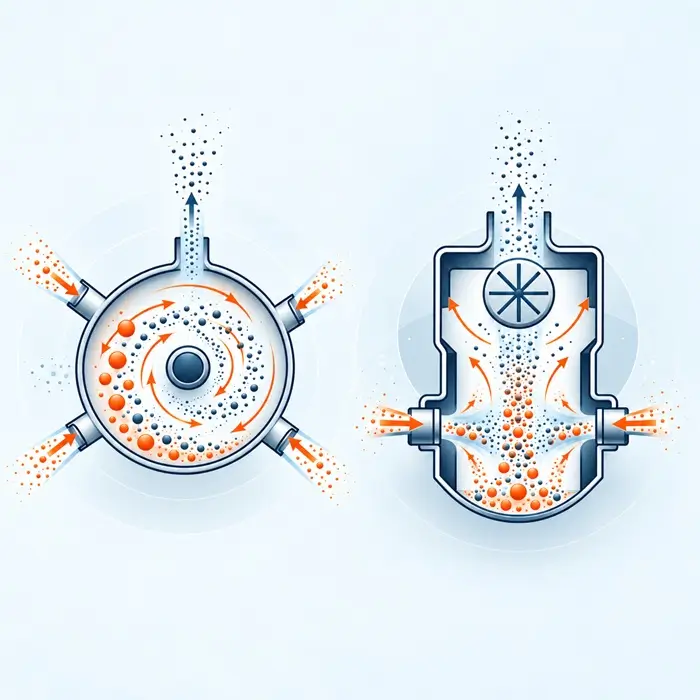
Permeability describes how easily air can pass through a powder bed under a pressure difference. A highly permeable bed allows air to move through relatively easily. A low-permeability bed resists air movement, especially when the pore network is fine, tortuous, or partly blocked by fines.
Deaeration is the process by which entrained or trapped air leaves the powder bed after aeration or disturbance. In process terms, deaeration is a time-dependent behavior shaped by powder properties and equipment conditions.
The practical issue is timing. A powder does not need to be permanently problematic to create trouble. It only needs to remain aerated longer than the process allows. If the powder is conveyed, filled, and discharged in quick sequence, the equipment may be handling the material before it has settled into the state assumed by the design or specification.
This timing mismatch is deaeration lag. In operational terms, deaeration lag is the delay between an aerating process step and the point at which the powder bed has returned to a stable bulk density, discharge behavior, or feed condition.
That definition keeps the focus on the plant. The actual process cycle must give the powder enough time and venting capacity to release air before the next controlled step begins. Permeability testing is useful because it connects that timing problem to the powder bed’s ability to transmit air.
Why Fine Powders Can Retain Air After Conveying or Filling
Fine powders can retain air because their pore spaces are small and their air pathways are restricted. When the bed is expanded by conveying or filling, air is distributed through the void network. For air to escape, it must move through narrow channels between particles. If the powder contains a high fines fraction, those channels may be small, irregular, and sensitive to local packing.
Particle shape also matters. Irregular, plate-like, fibrous, or rough particles can create complex pore structures. Surface forces can hold particles in loose arrangements after aeration. Moisture, electrostatics, surface treatments, and cohesive forces can further stabilize expanded packing states.
The same powder may show different handling states. Immediately after conveying, it may be loose, expanded, and prone to flushing. After rest, it may become denser, less aerated, and more resistant to flow. After a longer shutdown under load, it may consolidate and become harder to restart. These are different operating conditions.
That is why a single flowability test, bulk density value, or feeder setting can be misleading if it does not match the process state. A powder tested after careful preparation may behave differently from the same powder when it reaches a hopper directly after pneumatic conveying. This is closely related to the idea of a <a href=”https://powdertechnology.info/powder-operating-window-why-a-good-powder-fails-in-the-wrong-process/”>powder operating window</a>: a material may perform well under one handling condition and poorly under another.
How Retained Air Changes Bulk Density, Discharge, and Feeder Behavior
Retained air changes the relationship between volume and mass. A recently aerated powder bed can occupy more volume for the same mass. The level in a hopper, receiver, or bag may therefore look normal while the actual solids content is still changing.
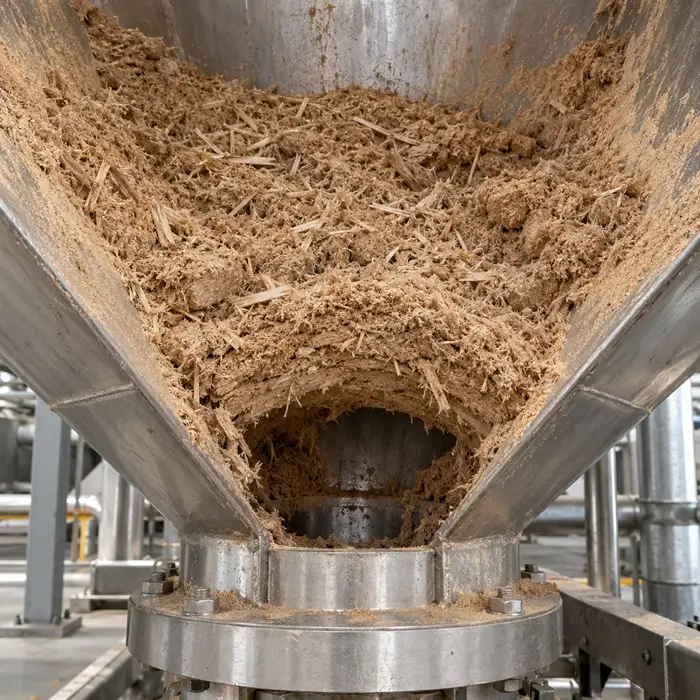
This affects discharge. If the powder near the outlet is loose and air-rich, it may flow more freely than expected. In severe cases, it may behave like a fluid and flush through openings, feeder clearances, or valves. The flow can become difficult to stop because the powder no longer behaves as a stable bulk solid.
Retained air can also cause surging. A powder bed may discharge in waves as local zones collapse, release air, or transition from expanded to denser packing. The outlet receives material with changing density and changing resistance. A feeder below the hopper may then pulse even if the drive speed is constant.
Loss-in-weight feeders are especially sensitive to this behavior. After refill, the material above the screw or feeding element may be temporarily aerated. The controller may respond to a changing apparent feed rate, while the underlying cause is changing bulk density at the feeder inlet. A rational first response is to check refill conditions before adjusting PID parameters: refill speed, venting, hopper level, time between refill and restart, and whether the powder density at the feeder inlet changes during the first minutes after refill. Adjusting the control loop alone may reduce the visible symptom, but it will not remove the air-related mechanism.
Dust release can also increase. When air escapes rapidly through a fines-rich powder bed, it can carry fine particles with it. This can appear during filling, venting, discharge, or packaging. The dust problem may therefore be connected to the same air retention behavior that affects flow and dosing.
Symptoms That Point Toward Deaeration Lag
Deaeration lag should be considered when instability appears soon after a powder has been aerated or disturbed. Useful symptoms include flushing from a hopper outlet, surging after conveying, feeder pulsing after refill, variable fill weight, delayed level settlement, dust release after transfer, and changes in discharge behavior after rest.
A simple field observation can be revealing. If the process behaves poorly immediately after filling but improves after a short hold time, retained air may be involved. If the problem is worse after pneumatic conveying than after manual loading, air entry during transfer may be part of the mechanism. If a receiver level drops visibly after filling without material leaving the system, the powder bed is settling and changing density.
The location of the symptom also matters. Problems at the receiver, hopper outlet, feeder inlet, rotary valve, bag filler, or vent filter can all point to air behavior. A vent filter that blinds quickly, a hopper that discharges in waves, or a feeder that stabilizes after the first minutes of operation may all be connected.
These observations do not make permeability the only explanation. Cohesion, moisture, wall friction, segregation, feeder geometry, poor venting, and control settings can all contribute. The symptom check simply tells the engineer when air behavior belongs in the diagnosis.
Where Permeability Testing Fits in Powder Deaeration
The most useful test program depends on the symptom. For air-related instability, permeability testing is an important candidate because it directly addresses how easily air can move through the powder bed. A low-permeability powder can retain air longer after aeration, especially when the process allows little time for settling.
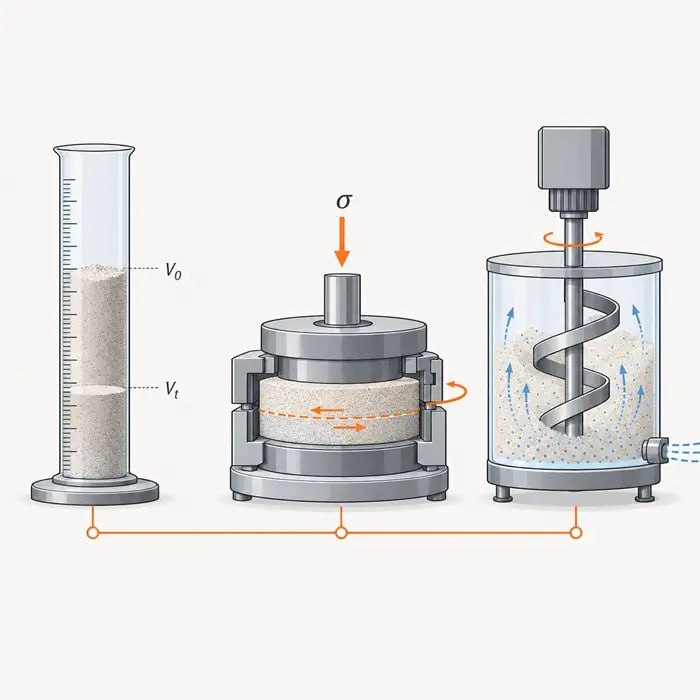
Bulk density testing is also useful, but it must be interpreted carefully. Loose bulk density, settled bulk density, tapped density, and process-sampled bulk density can show how strongly the powder packing state changes with handling. A large difference between loose and settled density suggests that the powder may show significant density changes during filling, resting, vibration, or feeding.
Bulk density differences need a practical threshold. As a screening rule, a repeatable difference of more than about 10 percent between a recently filled or loose condition and a settled condition deserves attention when symptoms are present. Differences above roughly 15 percent are a stronger signal that packing state, air content, or handling history may be affecting the process. These values should not be treated as universal limits, because the result depends on sampling method, vessel geometry, powder preparation, and test procedure. They are best used to decide whether the density state of the powder is large enough to justify further investigation. This logic aligns with established powder flow guidance, such as compressibility index and Hausner ratio interpretation in USP <1174> Powder Flow, while keeping the interpretation process-specific.
Particle size distribution helps explain the pore structure. A small amount of fines can strongly influence air pathways, cohesion, dustiness, and packing. D10, fines fraction, span, and the shape of the lower end of the distribution may be more relevant than D50 alone.
Compressibility or tapped density behavior can show how readily the powder structure changes under mechanical input. Shear cell testing remains important when the problem may involve cohesive strength, arching, ratholing, or consolidation. Wall friction testing is relevant when discharge depends on hopper geometry and surface interaction. Moisture testing may be needed when humidity or drying history changes cohesion, capillary forces, or electrostatic behavior.
For many plant problems, the answer comes from matching observations with a small set of process-relevant measurements. A powder that flushes after conveying may require permeability, bulk density, particle size distribution, and process timing checks. A powder that fails after a shutdown may need shear testing, wall friction, time consolidation, and moisture checks. Similar symptoms can come from different mechanisms.
How to Observe Deaeration Behavior in the Process
A practical observation sheet can help determine whether the process cycle is faster than the powder can settle.
Start by recording the material, batch, process step, transfer method, receiver type, filling rate, drop height, vent configuration, and time between filling and discharge. Then observe the powder immediately after filling and again after defined rest periods, for example after 2, 5, 10, and 20 minutes. The early intervals capture rapid settling or density change soon after filling, while the later interval shows whether the powder continues to change after the process would normally have restarted.
At each point, record visible level settlement, surface behavior, dust release, discharge behavior, feeder stability, and bulk density if a representative sample can be taken safely and consistently. The useful comparison is between process states: immediately after filling, after short rest periods, and at the point where discharge, feeding, or packaging begins.
One useful comparison is density recovery over time. If an initial bulk density after filling is lower than the stable bulk density after rest, the recovery trend shows how quickly the powder approaches its settled condition. Treat this as a process comparison metric, not as a standardized material property.
The practical decision is straightforward. If discharge, feeding, or packaging begins before the powder behavior has stabilized, the process may be operating inside a transient aerated state. A longer hold time, improved venting, reduced filling intensity, lower drop height, adjusted receiver geometry, or different transfer method may be more effective than changing the feeder alone.
Practical Control Measures: Hold, Vent, Slow, Compact, Redesign, or Retest
Control measures should follow the likely path of the air problem. Start with venting when symptoms appear during or immediately after filling, because air that enters the receiver needs a reliable route out. Reduce filling intensity when transfer conditions are clearly aerating the powder. Add hold time when the powder stabilizes after rest. Consider compaction or vibration only after testing, because they can also increase consolidation or segregation. Move to receiver or outlet redesign when timing, venting, and filling changes cannot create a stable operating window. Retest when the available data do not represent the condition in which the powder fails.
The first control measure is often venting. If air enters during filling or conveying, it needs a reliable path out of the receiver. Poor venting can force air through the powder bed, increase dust release, and slow settling. Vent filters, vent line sizing, receiver design, and filter condition should be checked before assuming the powder itself is the only problem.
Reduce filling intensity when the transfer step is adding more air than the process can remove. High filling rates, high drop heights, and aggressive transfer conditions can increase aeration. Reducing drop height, changing inlet direction, using gentler transfer, or controlling filling rate can reduce the amount of air introduced into the bed.
Add hold time when the process observation shows clear improvement after rest. If the feeder, hopper, or bag filler stabilizes after a defined settling period, the process cycle may be too fast for the powder state created by transfer.
Use compaction or vibration carefully. It can help remove air or increase packing density in some systems, but it can also increase consolidation, worsen arching, create segregation, or drive fines migration. Any compaction step should be tested under realistic conditions.
Consider redesign when the same symptoms return despite reasonable venting, gentler filling, and adjusted timing. Receiver volume, outlet geometry, hopper angle, feeder inlet design, air management, and isolation between conveying and dosing steps can all influence whether aerated powder reaches a critical process point.
Retest when the original data do not represent the failure condition. A powder tested only at rest may need testing after aeration, after consolidation, at relevant moisture levels, or under stress conditions closer to the process.
Monthly Know How PDF Pack
The Powder Air Retention and Deaeration Field Sheet supports troubleshooting sessions, plant walkdowns, and technical reviews. It helps engineers move from visible symptoms, such as flushing, surging, feeder pulsing, dust release, fill-weight variation, delayed settling, or poor restart behavior, to a structured review of where the issue appears, how air may be entering or leaving the system, and which follow-up checks deserve priority.
Use the field sheet when powder behavior changes after conveying, filling, transfer, or refill compared with the same material after rest. It is especially useful when several causes remain plausible, including retained air, low permeability, poor venting, cohesion, hopper geometry, feeder control, moisture, wall friction, or consolidation.
The PDF includes:
- Operational definition of deaeration lag.
- Symptom checklist linking observed behavior to location, possible air-related mechanisms, and first checks.
- Test selector matrix connecting symptoms to process observation, venting, permeability testing, loose and settled bulk density, process-sampled bulk density, particle size distribution, fines content, shear or wall friction testing, and moisture content.
- Process step audit for setup, conveying, filling, holding, discharge, feeding, and packaging.
- Observation setup and observation log pages for comparing powder behavior after defined rest periods.
- Density recovery and interpretation notes for documenting whether the powder is still changing when the process normally restarts.
- Worked example and decision guide for feeder pulsing after refill.
This field sheet is not a formal calculation protocol. Its value is practical: it helps document whether a failure appears in a transient aerated state, whether behavior changes after rest, and which checks deserve priority before changing equipment settings or process design.
Conclusion
Permeability and deaeration are often hidden behind more visible symptoms. A feeder pulses, a hopper surges, a bag settles, or a powder flushes through an outlet. The equipment receives attention first because the problem appears at the equipment. The powder condition arriving at that equipment may be the deciding factor.
A reliable diagnosis starts by asking when the symptom appears. If instability follows conveying, filling, transfer, fluidization, or vibration, retained air should be part of the investigation. The next step is to check whether the powder can release that air within the time allowed by the process.
Powder deaeration checks combine process observation, permeability testing, bulk density comparison, particle size analysis, compressibility, shear testing, wall friction, and moisture data. Used together, they help separate air retention from cohesion, poor venting, feeder setup, hopper geometry, or consolidation.
For engineers working with fine powders, the practical lesson is clear. A powder specification is only useful when it reflects the state in which the powder is handled. Recently aerated material, settled material, and consolidated material may behave differently in the same equipment. Permeability and deaeration checks help define those boundaries before troubleshooting turns into repeated adjustment of the wrong process variable.