
🔑 Key Takeaway
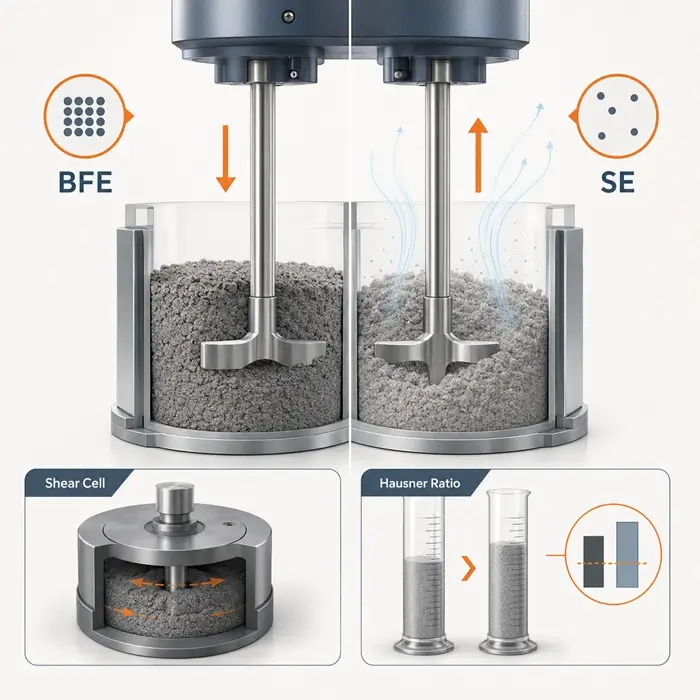
Dynamic powder testing measures the work needed to move a rotating blade through a powder bed under different mechanical states. A confined downward stroke yields basic flow energy (BFE), while an upward, low-confinement stroke yields specific energy (SE); controlled aeration protocols can then show how flow energy changes as air is introduced through the bed. Together, these measurements add low-stress and aeration-sensitive information that neither shear cell testing nor the Hausner ratio directly provides.
Table of contents
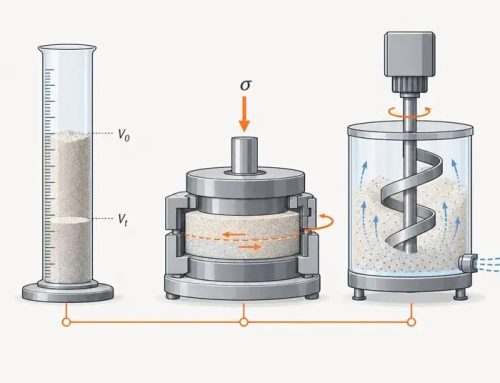
Most powder flow characterization programs are built around two established tools: shear cell testing and the Hausner ratio paired with the Carr index. Between them, these methods cover a large share of routine flowability work, and USP General Chapter 1174 (Powder Flow) lists shear cell testing, the compressibility index and Hausner ratio, angle of repose, and orifice flow rate as the four techniques most commonly used to characterize pharmaceutical powder flow, while noting that no single method captures the full behavior of a powder.
Both established methods characterize static bulk states rather than the actively aerated or dynamically disturbed condition of a moving powder bed. Shear cell tests apply normal stresses closer to what a powder experiences under its own weight in a silo or hopper, and the Hausner ratio compares two static bulk density states without varying the aeration state of the bed during measurement. Neither method places the powder in a lightly aerated or actively disturbed state, and that gap is where dynamic powder testing using a rotating blade rheometer becomes useful. This article explains the mechanism behind basic flow energy and specific energy, where the method complements shear cell and Hausner ratio data rather than replacing it, and when aerated flow energy is the more relevant decision input.
The Operational Problem: Two Established Tests, One Gap
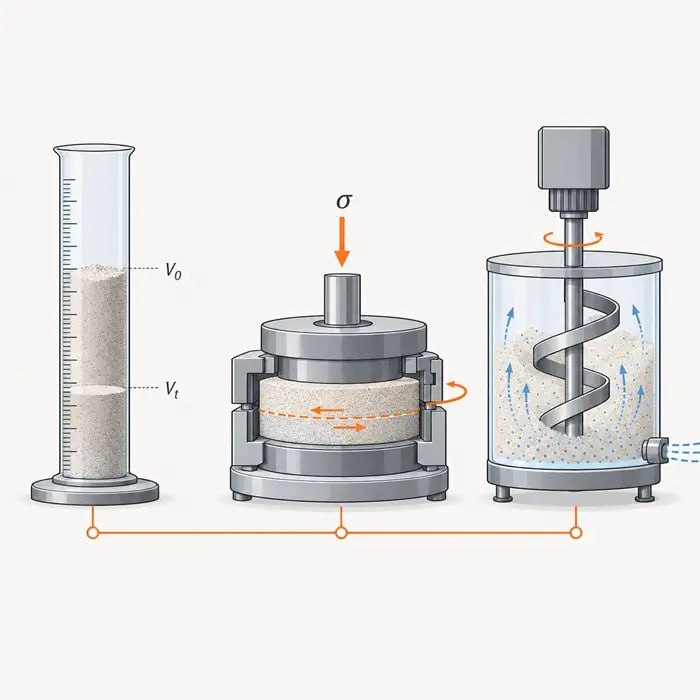
Engineers reaching for a flow test typically default to shear cell testing, which applies a defined normal stress to a consolidated powder bed and measures the shear stress needed to initiate flow, or to the Hausner ratio and Carr index, which compare loose and tapped bulk density as a fast screening indicator of compressibility and cohesion. Both are well established, and both have a defined role in powder flow and flowability testing programs.
The limitation is not that either test is wrong. It is that both represent the powder in a consolidated or static condition, and a growing share of process steps, from fluidized bed processing to rapid hopper refill, hold the powder in a lightly aerated or actively disturbed state instead. A shear cell result measured at typical storage consolidation stresses, or a Hausner ratio measured on settled and tapped powder, does not describe how that same powder behaves once air is present between the particles and confinement is low.
How Dynamic and Aerated Powder Testing Works
Dynamic powder rheometry drives a rotating blade along a helical path through a powder bed and measures the torque and vertical force needed to move it, converting the result into a work value expressed as flow energy. Unlike shear cell testing, which imposes one defined normal stress and measures shear resistance at that stress, a dynamic test measures the total mechanical work involved in displacing powder as the blade travels through the bed. That measurement changes depending on the direction of blade travel, and the contrast between the two directions is the basis of the method’s diagnostic value.
Basic Flow Energy: A Confined, Compacting Measurement
When the blade moves downward through the bed, its geometry pushes powder into the confined space beneath it, generating a locally compacting, higher-resistance flow pattern. The work required for this downward stroke is generally reported as basic flow energy (BFE). Because powder is being displaced into a partially confined space, BFE reflects how a powder resists being moved while consolidation and interparticle contacts are actively increasing during the measurement, a condition involving confined displacement and increasing resistance rather than open, low-stress flow.
Specific Energy: A Low-Confinement, Low-Stress Measurement
When the blade moves upward, its geometry lifts and shears powder with comparatively little confinement. The resulting work value, normalized by sample mass, is reported as specific energy (SE). Because the bed is not being pushed into a confined volume, SE is more sensitive to resistance under low-stress, unconfined conditions than BFE. Controlled aeration measurements are related but distinct: air is introduced through the bed at defined rates so that the change in flow energy with increasing aeration can be measured directly.
Where Dynamic Testing Complements Rather Than Replaces Shear Cell and Hausner Ratio Data
None of BFE, SE, shear cell parameters, or the Hausner ratio fully describes powder flow behavior on its own. Shear cell data remains the stronger input wherever the process holds powder in a consolidated state under its own weight for a meaningful period, such as long-term storage in a silo or gravity discharge through a converging hopper, because the test directly measures resistance to shear at the stress levels the powder experiences there. See wall friction and hopper geometry for how that data feeds into mass-flow versus funnel-flow design decisions.
The Hausner ratio and Carr index remain useful as a fast, low-cost screening step for batch comparison and incoming QC, with the caveat noted in Hausner ratio and Carr index interpretation that the ratio can give similar values for powders with different underlying flow mechanisms. Dynamic and aerated testing adds value specifically where the process state is lightly stressed, actively aerated, or changing quickly, conditions where shear cell consolidation stresses and static bulk density ratios are less representative of what the powder is actually doing at that moment.
When Aerated Flow Energy Becomes the More Relevant Decision Input
The process condition, not the powder alone, decides which test carries more diagnostic weight in a given situation. Two contrasting process types illustrate this: fluidized processing and rapid-refill feeding on one side, and gravity discharge from a mass-flow hopper on the other.
Fluidized Bed Processing
In fluidized bed granulation, coating, and drying, the powder bed spends most of its process time in an aerated or fully fluidized state rather than a consolidated one. A study evaluating powders of varying cohesivity in a fluidized bed with a dynamic powder rheometer found that aerated dynamic energy measurements related to how the bed’s hydrodynamic behavior changed with cohesivity, an association a shear cell result obtained under consolidated stress would not directly capture. That study supports SE and related aerated energy measurements as a useful screening input for fluidized bed suitability, alongside direct behavior checks such as those described for fine powder fluidization in pneumatic conveying and discharge control.
Rapid-Refill and Loss-in-Weight Feeding
Loss-in-weight feeders that refill quickly from an overhead hopper briefly place the powder bed in an aerated, low-consolidation state immediately after refill, before it settles back toward its resting bulk density. Refill shock behavior and the related deaeration lag that follows are aeration-state phenomena rather than consolidated-stress phenomena, and air retention behavior during that window can dominate short-term feeder accuracy. A shear cell result measured at typical hopper consolidation stresses does not describe how the powder behaves in the seconds after refill, while low-confinement and aerated dynamic measurements provide a closer indicator of that transient state than consolidated shear data, although they do not reproduce the refill event itself.
Gravity Discharge from a Mass-Flow Hopper
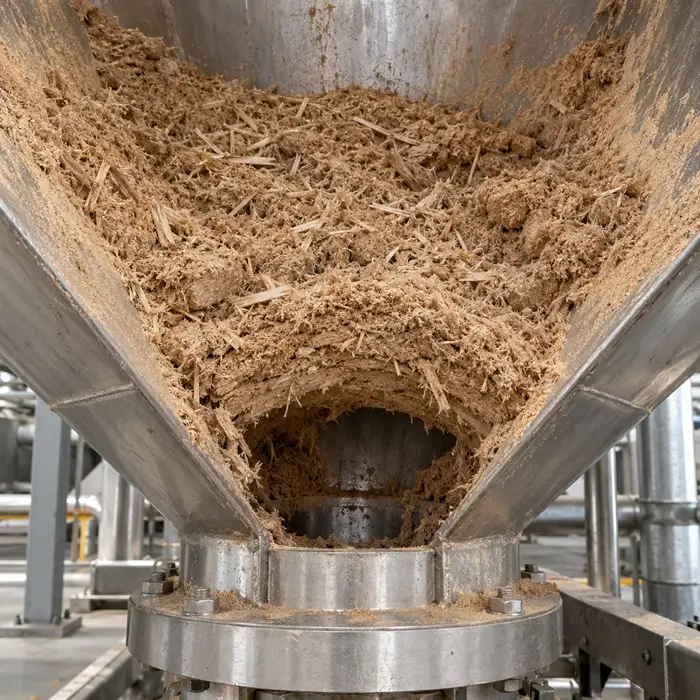
By contrast, a powder discharging by gravity from a well-designed mass-flow hopper spends most of its residence time under consolidation stresses generated by the weight of powder above it, not in an aerated state. Arching and blockage risk in that setting is governed by the powder’s flow function under those consolidation stresses and by wall friction against the hopper wall, both of which shear cell testing measures directly. An aerated SE value measured near zero stress does not represent the consolidation the powder experiences deep in a full silo, so shear cell data remains the primary decision input for hopper angle, outlet sizing, and mass-flow versus funnel-flow selection at that process step.
Test Selection Guidance: Matching Stress and Aeration State to the Method
A practical way to choose between these methods is to first identify the stress and aeration state the powder actually occupies at the process step under review, then select the test whose measurement conditions come closest to that state.
For process steps where the powder is static and consolidated under its own weight for more than a few seconds, such as silo storage, hopper discharge, or a stationary bed pressed against a wall, shear cell testing is the more representative method. For steps where the powder is actively aerated, fluidized, or in a low-confinement transitional state, such as inside a fluidized bed or immediately after rapid hopper refill, dynamic and aerated testing provides the more representative input. For routine incoming QC or batch-to-batch comparison where speed and low cost matter more than mechanistic detail, the Hausner ratio and Carr index remain a reasonable first screen, provided results are not used alone to predict behavior in aerated or fluidized process steps.
Interpreting BFE and SE Together
BFE and SE describe different mechanical states, so comparing the two for a given powder, rather than reading either number alone, is generally where the diagnostic value appears. A powder with a comparatively high BFE and a comparatively low SE resists confined displacement more than it resists open, lightly aerated shear, a pattern consistent with particles that pack and interlock effectively once compacted but separate relatively easily once air is present between them. A powder with a comparatively low BFE and a comparatively high SE behaves the opposite way: it offers little resistance to confined displacement but resists open shear once lightly stressed, which can point toward interparticle cohesion that persists even at low consolidation.
These patterns are contributing evidence, not a stand-alone diagnosis. A high SE result indicates that the powder resists open, lightly aerated shear under the specific test geometry and conditions used; it does not by itself confirm which mechanism is responsible, and it does not replace a direct check of the process behavior in question, such as observed fluidization quality or feeder accuracy after refill. Where BFE and SE results inform a process decision, cross-checking them against shear cell data at the consolidation stress the process actually generates, and where practical against direct observation of the process step, keeps the interpretation proportional to what a rheometer test alone can support.
Practical Checklist for Selecting and Interpreting Dynamic Powder Tests
Before requesting or relying on a dynamic and aerated powder testing result, working through a short set of checks keeps the data usable for the intended decision. Confirm which process step the result is meant to represent, and identify whether that step holds the powder in a consolidated, aerated, or transitional state. Confirm whether the test was run at a stress and aeration condition approximating that state, rather than assuming a single BFE or SE number applies across the whole process. Pair the dynamic result with shear cell data whenever the process also includes a consolidated storage or discharge step, since the two methods typically describe different parts of the same process rather than competing answers. Treat a single dynamic energy value as a screening or comparison result rather than a stand-alone prediction of fluidization quality, feeder accuracy, or discharge reliability, and validate against direct process observation where the decision carries meaningful cost or safety consequences.
Downloadable Decision Aid
The accompanying PDF expands the article into a 10-page interpretation and test-selection guide. It explains what BFE, SE, aerated energy, shear cell data, and Hausner ratio results each represent; checks measurement comparability and starting-state history before interpretation; and provides triage matrices for air retention, conditioning effects, particle interlocking, low-stress cohesion, and process-state mismatch. It also compares how the same test pattern can carry different meanings in a fluidized bed, rapid-refill feeder, and full hopper, then maps common process decisions to the most relevant next measurement and closes with a step-by-step checklist for investigating a changed result.