

SUBJECT
Hoppers
Publications on hopper flow, discharge behavior, wall friction, outlet design, mass flow, funnel flow, and common powder-handling problems.
PUBLICATIONS
Browse publications
Explore PTI articles, Insights, Know How, and technical publications related to this subject.
 3 October 2026
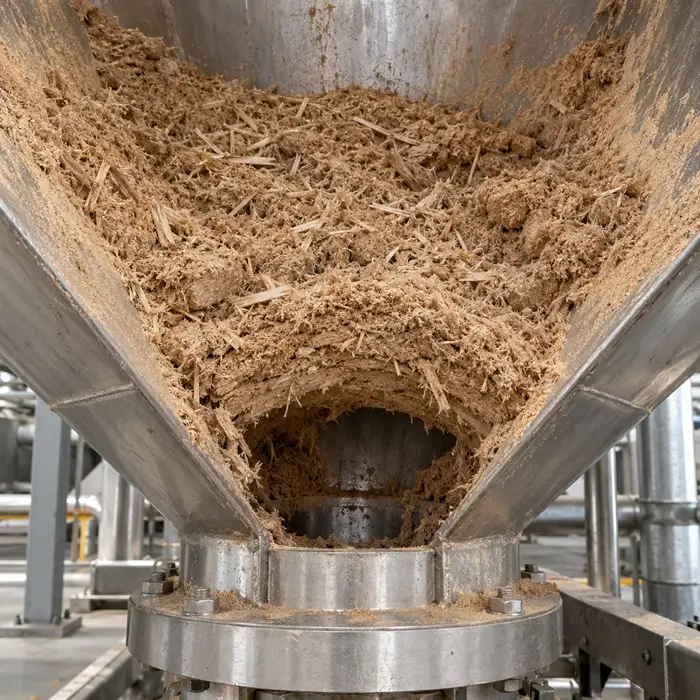
Wood Powder Feeding Problems: Separating Moisture Effects From Particle Interlocking
Wood powder can bridge because fibrous particles mechanically interlock, because moisture increases [...]
Feature Article
 3 October 2026
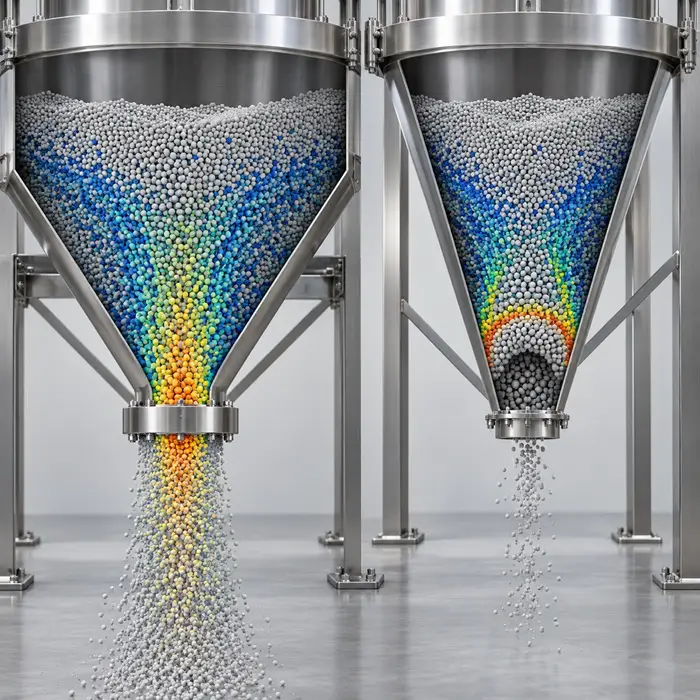
DEM Calibration: Why a Model That Reproduces One Bulk Test Can Still Fail in a Different Hopper Geometry
DEM input parameters are fitted to match a bulk observable, not derived from first principles. A parameter set calibrated against an angle of repose test constrains one point in a multi-dimensional parameter space. When the hopper geometry changes, the stress state changes, and unconstrained parameters become the dominant source of prediction error.
Insights
 5 September 2026
Jenike Shear Cell vs Ring Shear Tester: Matching the Method to the Hopper or Silo Decision
Jenike shear cells and ring shear testers measure the same yield locus through different mechanics. Here is how their sample, stress range, and time differences map onto the mass-flow versus funnel-flow hopper design decision, plus a checklist for choosing between them.
Know How
 8 August 2026
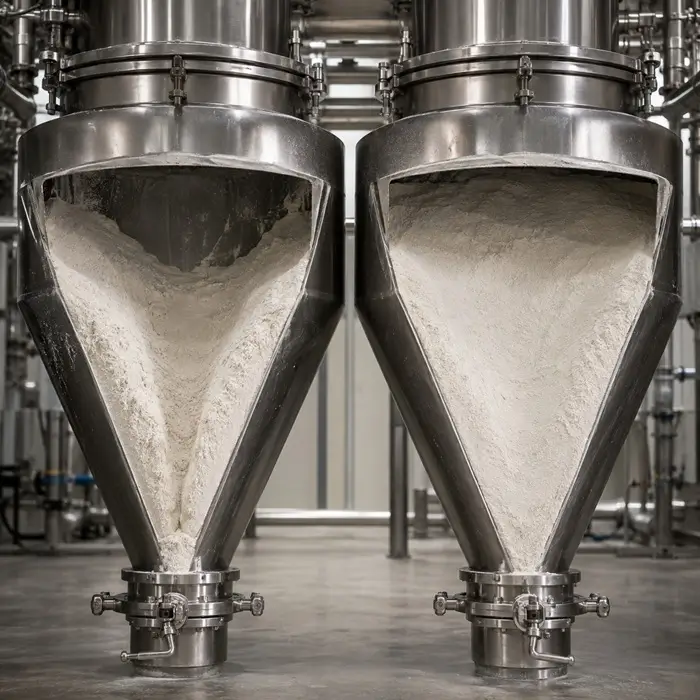
Powder Spreading in Powder Bed Fusion: What Recoater Interaction Reveals About Layer Defects
Powder spreading in powder bed fusion is a recoater-powder interaction shaped by cohesion, particle size distribution, and particle shape. This article maps streaking, short-feeding, and layer non-uniformity back to their underlying mechanisms and separates powder-driven causes from blade wear and spreading speed.
Feature Article
 4 July 2026
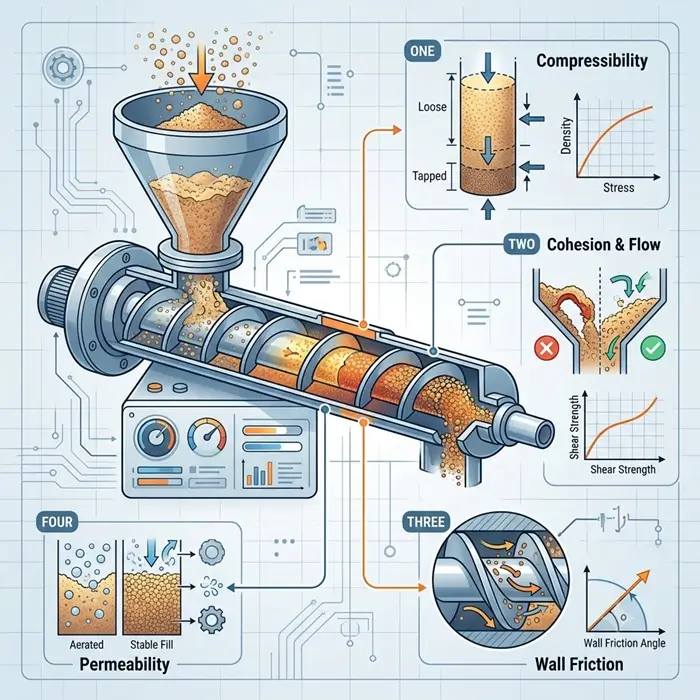
Screw Feeder Dosing Accuracy and Powder Compressibility: Why the Same Screw Behaves Differently on Similar Products
The same screw feeder at the same speed can deliver consistently on one powder and drift by several percent on another. The difference lies in compressibility, wall friction, and cohesion, and in how bulk density shifts as the hopper empties.
Insights
 20 June 2026
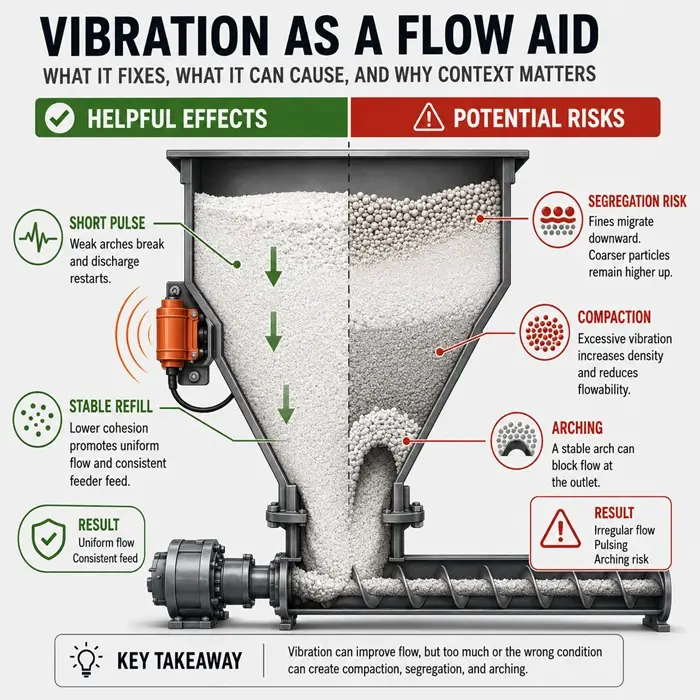
Vibration as a Flow Aid: When It Helps Powder Flow
Vibration can improve powder discharge when it breaks a weak arch or [...]
Insights
 13 June 2026
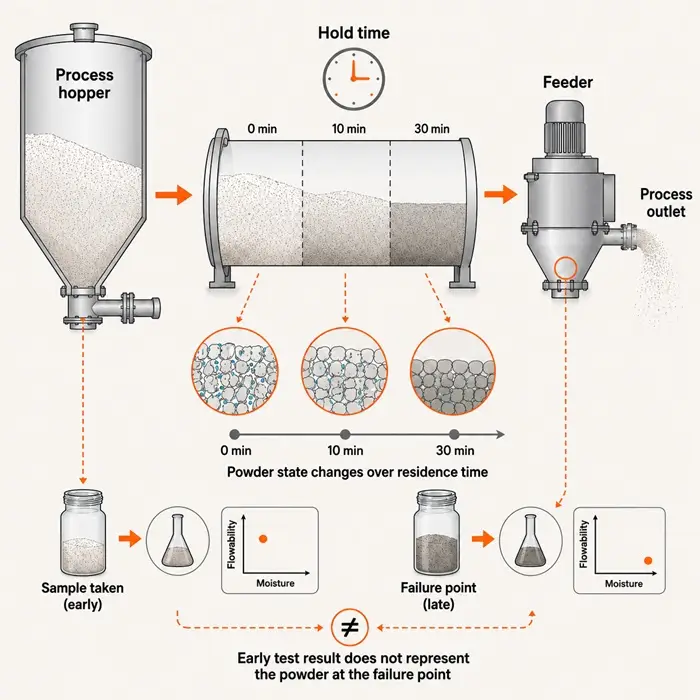
Powder Residence Time Can Make the Test Result Miss the Failure
Powder residence time matters because the sample and the failure often describe [...]
Insights
 6 June 2026
Why Hopper Fill Level Changes Powder Discharge
Do not diagnose a feeder as if the hopper sends it one [...]
Insights
 30 May 2026
Powder Operating Window: Why a Good Powder Fails in the Wrong Process
A powder operating window defines the process conditions in which a [...]
Insights
 18 April 2026
Acoustic Emission for Flow Blockage Prediction
Acoustic emission for flow blockage prediction captures high-frequency stress waves generated by [...]
Feature Article
 16 April 2026
Powder Flowability: Factors and Measurement Techniques
Powder flowability is not one fixed property. A powder can look free-flowing [...]
Insights
 11 April 2026
Why FIBC Discharge Problems Often Start at the Liner-Spout Interface
FIBC discharge problems are often blamed on the powder being discharged too [...]
Insights