
Cosmetics and personal care

Pigment, filler, active
and compact behavior across cosmetics and personal care production

Pigments, mineral fillers, UV filters, absorbents, surfactants, waxes, actives and pressed powders are not one category

Particle size, morphology, surface treatment, moisture, cohesion, bulk density, charge, wettability and compact strength decide whether a material flows, doses accurately, blends uniformly, disperses, presses into a stable compact and delivers the color, coverage and feel the formulation was designed for. This page connects what you are seeing on the line to the mechanism behind it and the measurement that settles it.

Icon representing cosmetics and personal care material routes

By material type

Pigments, mineral fillers, UV filters, absorbents, surfactants, waxes, thickeners, botanicals, actives, deodorant salts, oral-care abrasives, pressed powders.

Icon representing recurring cosmetics and personal care behavior routes

By observed behavior

Flow, caking, dust, dosing variation, segregation, poor wetting, compact cracking, electrostatic charging, adhesion, settling, and moisture sensitivity.

Icon representing cosmetics and personal care measurement routes

By measurement route

The test that clearly separates one likely mechanism from another under realistic material, process, storage, handling, and formulation conditions.

Icon representing process area routes

By process area

Intake, milling, classification, storage, dosing, blending, pressing, wetting, granulation, filling, packaging, rework, recovery, and material reclamation.

Find your route

Start with the material, then the behavior

Cosmetics and personal care materials do not behave as one category. Pick the pigment, filler, UV filter, absorbent, surfactant, wax, thickener, botanical, active, deodorant, oral-care or pressed powder class, then the behavior you are seeing in the process. The result names the mechanisms worth separating, the measurement to start with, and where in the process it usually shows up. It is a triage route, not a diagnosis.

  1. 1Material
  2. 2Behavior
  3. 3Route

Step 1  What are you handling?

Step 2  What are you seeing?

Step 3  Your route

Material routes

Pigments, fillers, actives, structurants and finished powders

Cosmetics and personal care production handles platy mineral fillers, surface treated pigments, coated UV filters, swelling absorbents, hygroscopic surfactants, thermally sensitive waxes, hydrating polymer thickeners, variable botanical powders, low inclusion actives, soluble deodorant salts, hard oral-care abrasives and pressed compacts with very different sensitivities to particle size, morphology, surface treatment, moisture, cohesion, charge, shear and thermal history. Each class has its own behavior profile, so the most useful route starts with the material before moving to the visible process problem.

Representative cosmetic pigment powder in a shallow stainless steel sample dish

Pigments and color-cosmetic powders

Pigments and color-cosmetic powders require controlled size, morphology, and dispersion. Agglomeration, wetting, electrostatics, and segregation influence color strength, opacity, texture, and batch uniformity.

ColorDispersionUniformity
Representative talc, mica, and sensory mineral filler powder in a shallow stainless steel sample dish

Talc, mica, and sensory mineral fillers

Talc, mica, and sensory mineral fillers control slip, coverage, absorbency, and feel. Particle shape, size, surface treatment, moisture, and contamination influence processing and sensory performance.

ShapeSlipCoverage
Representative mineral UV filter and sunscreen powder in a shallow stainless steel sample dish

Mineral UV filters and sunscreen

Mineral UV filters and sunscreen powders require controlled dispersion and condition. Agglomeration, wetting, particle size, coating integrity, and settling influence protection, appearance, and stability.

AgglomeratesCoatingWhitening
Representative starch, cellulose, and absorbent powder in a shallow stainless steel sample dish

Starches, cellulose, and absorbents

Starches, cellulose, and absorbent powders manage oil, moisture, texture, and viscosity. Particle size, porosity, moisture, swelling, and microbial condition directly influence flow and formulation performance.

AbsorptionMoistureTexture
Representative surfactant and cleansing powder in a shallow stainless steel sample dish

Surfactant and cleansing powders

Surfactant and cleansing powders require controlled dissolution and low dust. Hygroscopicity, caking, particle size, attrition, and segregation influence dosing, processing, and cleansing performance.

MoistureCakingDissolution
Representative wax, lipid powder, and structuring agent in a shallow stainless steel sample dish

Waxes, lipids, and structuring agents

Waxes, lipid powders, and structuring agents control consistency, payoff, and stability. Melting behavior, particle size, agglomeration, oxidation, and thermal history influence processing and product structure.

MeltingThermal historyPayoff
Representative polymer thickener and rheology modifier powder in a shallow stainless steel sample dish

Polymers and rheology agents

Polymer thickeners and rheology modifiers require uniform wetting and dispersion. Agglomeration, hydration, electrostatics, particle size, and shear history directly influence viscosity development and stability.

HydrationLumpsViscosity
Representative botanical extract and natural powder in a shallow stainless steel sample dish

Botanical extracts and natural powders

Botanical extracts and natural powders vary in color, moisture, composition, and microbiological condition. Cohesion, oxidation, agglomeration, and source variation influence handling and product consistency.

Source variationMoistureColor
Representative active ingredient and functional additive powder in a shallow stainless steel sample dish

Active ingredients and functional additives

Active ingredients and functional additives often enter at low inclusion. Potency, particle size, moisture, electrostatics, segregation, and carrier choice influence dosing accuracy and uniformity.

PotencyDosingHomogeneity
Representative deodorant and antiperspirant powder in a shallow stainless steel sample dish

Deodorant and antiperspirant powder materials

Deodorant and antiperspirant powders combine mineral salts, absorbents, and functional additives. Hygroscopicity, caking, particle size, dissolution, and segregation influence filling and performance.

HygroscopicityCakingFilling
Representative oral-care abrasive and mineral powder in a shallow stainless steel sample dish

Oral-care abrasives and mineral powders

Oral-care abrasives and powders require controlled hardness, size, and purity. Relative dentin abrasivity depends on hardness and size distribution, while agglomeration, dust, moisture, and contamination influence processing and mouthfeel.

HardnessSizeMouthfeel
Representative pressed and loose powder formulation in a shallow stainless steel sample dish

Pressed and loose powder cosmetic formulations

Pressed and loose powder formulations require stable flow, filling, and compaction. Blend uniformity, air content, binder distribution, compression, and handling influence strength, payoff, and appearance.

FillingCompactionStrength

Quick comparison

Material route, common risk, first measurement

The same symptom points to different mechanisms depending on the material class, particle size, surface treatment, moisture state, formulation and process step. This is the fast bridge between cosmetics and personal care material behavior and the most useful first measurement route. The rows follow the same order as the cards above.

Cosmetics and personal care material routes, the handling or processing risk each one carries most often, and the measurement worth running first.

Material routeCommon handling or processing riskUseful first measurement
Pigments and color-cosmetic powdersAgglomeration, electrostatics, segregation, poor wetting, color variation, and dustingParticle size, morphology, surface area, wettability, and color strength
Talc, mica, and sensory mineral fillersPoor flow, dusting, contamination, inconsistent slip, and uneven surface treatmentParticle size, morphology, flowability, moisture, and surface chemistry
Mineral UV filters and sunscreen powdersAgglomeration, poor dispersion, whitening, settling, and inconsistent protectionParticle size, agglomerate size, surface treatment, wettability, and dispersion stability
Starches, cellulose, and absorbent powdersMoisture uptake, swelling, caking, microbial instability, and inconsistent absorptionMoisture, particle size, porosity, oil absorption, and flowability
Surfactant and cleansing powdersHygroscopicity, caking, dusting, segregation, poor wetting, and slow dissolutionMoisture, particle size, wettability, dissolution behavior, and flowability
Waxes, lipid powders, and structuring agentsAgglomeration, oxidation, melting variation, poor distribution, and thermal degradationParticle size, melting behavior, thermal history, oxidation stability, and morphology
Polymer thickeners and rheology modifiersDusting, electrostatics, poor wetting, lump formation, and incomplete hydrationParticle size, wettability, hydration behavior, electrostatics, and rheology
Botanical extracts and natural powdersSource variation, oxidation, moisture uptake, color drift, and microbial instabilityMoisture, particle size, color, bulk density, and microbiological condition
Active ingredients and functional additivesSegregation, degradation, contamination, electrostatics, and inaccurate microdosingParticle size, potency, moisture, electrostatics, and blend uniformity
Deodorant and antiperspirant powdersHygroscopicity, caking, dusting, dissolution variation, and poor compatibilityMoisture, particle size, solubility, flowability, and composition
Oral-care abrasives and mineral powdersExcessive abrasion, contamination, agglomeration, poor dispersion, and inconsistent mouthfeelParticle size, morphology, hardness, purity, and surface texture
Pressed and loose powder formulationsSegregation, poor flow, inconsistent filling, weak compacts, and variable payoffFlowability, bulk density, compressibility, blend uniformity, and compact strength

One risk per row is the one most often reported, not the only one that occurs. Use the selector above to work a specific combination through to a route.

Recurring problems

Start from the behavior you can see

These eight come from your own route card and continue block: flow, caking, dust, dosing variation, segregation, poor wetting, compact cracking and electrostatic charging. Each is one idea rather than three, so the card and the mechanism list line up. Each card runs back to the mechanisms worth separating and forward to the measurement that confirms which one is governing.

Icon representing poor flow and discharge

Poor flow or discharge

Arching · Bridging · Filling

Icon representing caking and consolidation

Caking or consolidation

Moisture · Load · Storage

Icon representing dust and fines release

Dust and fines release

Fines · Handling · Exposure

Icon representing dosing variation

Dosing variation

Potency · Refill · Feeding

Icon representing segregation

Segregation

Size · Density · Motion

Icon representing poor wetting and dispersion

Poor wetting or dispersion

Wetting · Lumps · Dispersion

Icon representing compact cracking and breakage

Compact cracking or breakage

Compression · Strength · Payoff

Icon representing electrostatic charging

Electrostatic charging

Charge · Adhesion · Filling

Measurement routes

The test that answers your question

Cosmetics and personal care material behavior rarely resolves to one number. Particle size, morphology, surface treatment, moisture, cohesion, bulk density, charge, blend uniformity, wettability, rheology, compact strength and thermal response can all contribute to the same visible process symptom or quality problem. Pick the method by the question, not by the symptom.

Particle size and morphology

Particle size distribution
Fines, oversize, agglomerate size, milling endpoint, color development, and texture consistency.

Microscopy and morphology
Shape, aspect ratio, surface texture, platelets, agglomerates, coatings, crystal form, and particle damage.

Moisture, water activity, and surface condition

Moisture content and sorption behavior
Moisture content, sorption isotherms, hygroscopicity, swelling, and safe storage limits.

Surface chemistry and treatment stability
Surface treatment coverage, coating integrity, hydrophobicity, and compatibility with the continuous phase.

Flow, charge, and discharge

Flowability and shear testing
Cohesion, consolidation, wall friction, hopper and filling head discharge, and refill process stability.

Electrostatic charge testing
Charge generation at transfer, adhesion to contact surfaces, humidity sensitivity, and filling losses.

Caking, density, and compaction

Caking and consolidation testing
Cake strength after storage under load, humidity cycling, anticaking performance, and drum life.

Bulk density and compaction behavior
Packing, aeration, deaeration, compressibility, fill weight, compact strength, and product payoff.

Composition, homogeneity, and contamination

Composition and contamination testing
Composition, trace metals, purity limits, residues, and cross contamination between colors and batches.

Blend uniformity and low-dose distribution
Active and pigment distribution, sampling, carrier choice, rework content, and batch to batch consistency.

Wetting, dispersion, and thermal response

Wettability, rheology, and dispersion
Wetting time, lump formation, hydration, viscosity development, dispersion quality, and suspension stability.

Thermal analysis
Melting behavior, thermal history, polymorph and crystal form changes, oxidation, and process window limits.

Compare every method All test methods on the site, grouped by the question they answer.

Process routes

Where the behavior actually shows up

The same cosmetic or personal care material behaves differently depending on where it sits in the process. Intake, storage, milling, dosing, blending, pressing, wetting, granulation, filling, packaging, rework and cleaning each expose a different property, a different contamination pathway and a different failure mode.

01

Intake and storage

Receiving, sampling, drum and sack storage, humidity, temperature and residence time influence contamination, caking, moisture uptake, color drift and discharge behavior.

02

Milling and particle size control

Milling, micronization, deagglomeration and sieving determine particle size, fines content, heat input, surface area, color strength, texture and downstream dispersion behavior.

03

Dosing and low-inclusion addition

Feeder selection, refill behavior, density variation, electrostatics, minimum inclusion level and control strategy determine dosing accuracy and batch to batch consistency.

04

Blending and pigment dispersion

Particle size, density, order of addition, mixing time, shear intensity, liquid addition and discharge pattern influence homogeneity, color development, segregation and carryover.

05

Pressing and compact formation

Fill uniformity, trapped air, binder level and distribution, compression pressure, dwell time and ejection determine compact strength, cracking, appearance and payoff.

06

Wetting and emulsification

Wetting rate, addition sequence, shear input, temperature, surface treatment and hydration time influence lump formation, dispersion quality, viscosity development and stability.

07

Granulation and agglomeration

Binder choice, liquid distribution, droplet size, drying, cooling and sieving determine granule size, strength, dust, dissolution and handling behavior.

08

Filling and packaging

Transfer, free fall, aeration, vibration, charge buildup, fill weight control and closing can cause dust, density shifts, segregation, adhesion and fill weight variation.

09

Rework, cleaning, and changeover

Collection, sieving, deagglomeration, rework addition limits, color changeover, cleaning validation and contamination control determine consistency, yield and safe reuse.

Go deeper

Guides and articles for cosmetics and personal care materials

Longer reads that work through the mechanisms behind these routes, from the visible handling problem to material properties, measurement choice and interpretation.
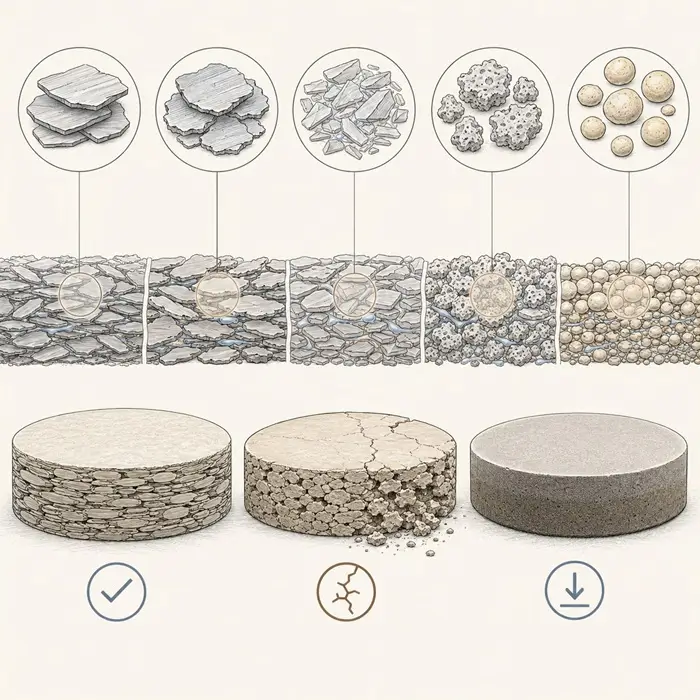
Cosmetic powder alternatives compared for compaction behavior in a pressed powder pan

Matching talc alternatives in cosmetic powders

What changes when talc leaves the formulation, and which properties decide whether a replacement filler presses, feels and performs the same way.

Powder acquiring triboelectric charge during transfer between contact surfaces

Triboelectric charging and why humidity matters

How charge builds at transfer and filling points, why the same powder behaves differently in winter, and what can be measured.

Caked powder sample being examined for consolidation after storage under load

Powder caking and how to prevent it

The mechanisms behind liquid and solid bridging, where critical relative humidity sits, and which storage tests predict cake strength.

Define the material operating window

A cosmetic or personal care material can meet specification and still fail when moisture, temperature, flow, dose, shear, compression pressure, residence time or storage history move outside the range where it behaves reliably.

Choose the test that matches the failure mode

Characterization tests answer different questions. Match the method to the material state, process step, formulation, inclusion level, and actual failure mode rather than treating processability as universal.

Watch fines, agglomerates, and surface treatment

A small change in fines, agglomerate size or surface treatment coverage can alter flow, dust, color strength, wetting, charge, fill weight and compact strength even when the median particle size barely moves.

Treat storage history as a material property

Humidity, temperature, storage load, oxidation, and rework can alter flow, caking, color, dispersion, compact strength, and homogeneity long before any obvious visible change appears in the material itself during processing.

FAQ

Cosmetics and personal care material questions

The most important distinction is usually not the visible symptom itself but the mechanism behind it. Similar symptoms can result from cohesion, particle size variation, moisture, caking, segregation, electrostatics, poor wetting, agglomeration, surface treatment differences, contamination, equipment interaction, or formulation and storage history.
Material behavior depends on the conditions acting on it. Storage time, humidity, consolidation, temperature, shear, liquid addition, compression pressure, transfer history and rework can shift how the same material discharges, doses, blends, disperses, presses, or performs.
The useful method depends on the question. Particle size and morphology measurements may help with color strength, texture, or dispersion, while moisture, flowability, caking, electrostatics, blend uniformity, wettability, rheology, compact strength, thermal response, or contamination screening may be more relevant for other symptoms. A useful test program starts with the suspected mechanism rather than a standard list of measurements.
Start with the information you already have. Use the material route when the material class is known, the behavior route when a visible handling or quality symptom is driving the investigation, and the measurement route when you already know which property or test family needs evaluation.
Laboratory testing is useful when the symptom does not reveal the controlling mechanism, when several causes are plausible, or when a new filler, pigment, surface treatment, active, binder, compact formulation, rework strategy or process condition needs evaluation before implementation. Test conditions should reproduce the relevant humidity, load, temperature, shear, compression and storage environment as closely as practical.
Yes. Poor discharge, caking, dust, dosing error, blend segregation, color variation, lump formation, compact cracking, or inconsistent payoff can result from several interacting factors. Complementary measurements can help separate effects such as particle size, morphology, surface treatment, moisture, cohesion, density, charge, wettability and material history.

Need the measurement, not just the guidance? PowderTechnology.info works closely with Delft Solids Solutions,
a contract research organization specializing in the physical behavior of powders and granules. DSS provides
contract testing and characterization, with its laboratory working in accordance with ISO 17025.
Contact Delft Solids Solutions.

Delft Solids Solutions logo