

SUBJECT
Pharmaceutical Industry
PUBLICATIONS
Browse publications
Explore PTI articles, Insights, Know How, and technical publications related to this subject.
 3 October 2026
Micronization by Jet Milling: How Classification, Milling Intensity, and Time Change Surface Properties
Jet milling micronization reduces particle size through particle-particle impact controlled by classifier wheel speed and feed rate. Pushing the cut point lower can raise amorphous surface content and hygroscopicity in ways a passing PSD result will not reveal. This guide covers the mechanism and the tests that actually diagnose a changed lot.
Know How
 19 September 2026
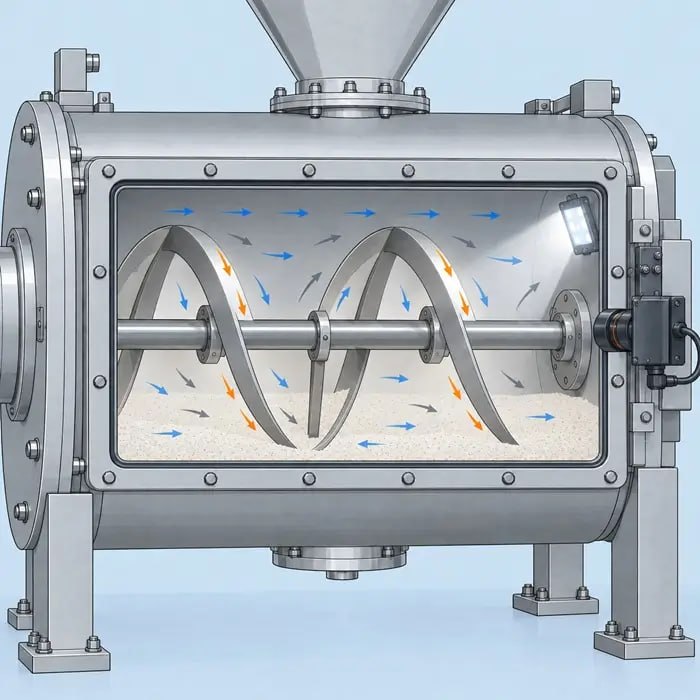
Real-Time Powder Flow Imaging: What LED-Based Particle Image Velocimetry Adds Beyond Static Flowability Tests
LED-based particle image velocimetry (PIV) images the velocity field inside a moving powder bed during blending, adding spatial resolution that static angle of repose, Hausner ratio, and shear cell tests cannot provide. Here is what that resolution can and cannot support for a process decision.
Insights
 19 September 2026
Vacuum Conveying for Fine and Hazardous Powders: Containment, Velocity, and Filter Design
Vacuum conveying contains by default: any breach draws air inward rather than pushing powder out. That containment advantage comes with a fixed pressure budget, and filter design competes directly with conveying velocity for every millibar of available driving force.
Feature Article
 12 September 2026
Co-Processed Excipients in Continuous Manufacturing: How Particle Engineering Changes Powder Flow and Compaction Performance
Co-processing engineers particle morphology, density, and surface structure into a single composite excipient particle. Flow function and compactibility testing show what that buys formulators on continuous direct compression lines, and where it does not.
Feature Article
 5 September 2026
High-Shear Wet Granulation Endpoint Detection: What Power Consumption Signals Actually Tell You
The power or torque trace in high-shear wet granulation rises and plateaus as granules consolidate, but the signal is a supporting process indicator, not a direct particle size measurement, and its interpretation is bounded by batch size, impeller geometry, and formulation.
Insights
 29 August 2026
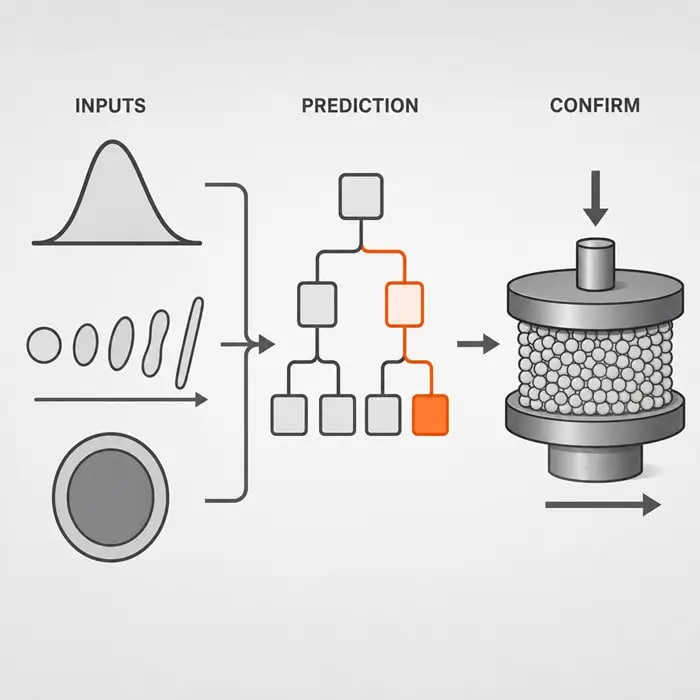
Machine Learning Flowability Prediction: What Constituent-Property Models Can and Can’t Replace
A Pharmaceutical Research study trained Random Forest and XGBoost classifiers on particle size, shape, surface energy, and silica dry-coating data to predict powder blend flowability category. The accuracy holds up as a screening tool and breaks down in specific, predictable places.
Insights
 15 August 2026
FDA’s Proposed Hub-and-Spoke Distributed Manufacturing Rule: What It Means for Blend Uniformity and Granulation Consistency
FDA's proposed hub-and-spoke registration rule treats geographically separate manufacturing units as one establishment. The registration paperwork is new; proving that blend uniformity, granulation endpoints, and moisture behavior actually match between sites is the older, harder problem.
Feature Article
 25 July 2026
Roller Compaction Ribbon Solid Fraction: Why the Same Roll Force Can Produce Different Granules
Two lots that pass the same incoming flowability spec can still granulate differently after roller compaction. The reason usually traces to ribbon density, which responds to roll force, gap width, and feed screw speed as an interacting set, not to roll pressure in isolation.
Insights
 11 July 2026
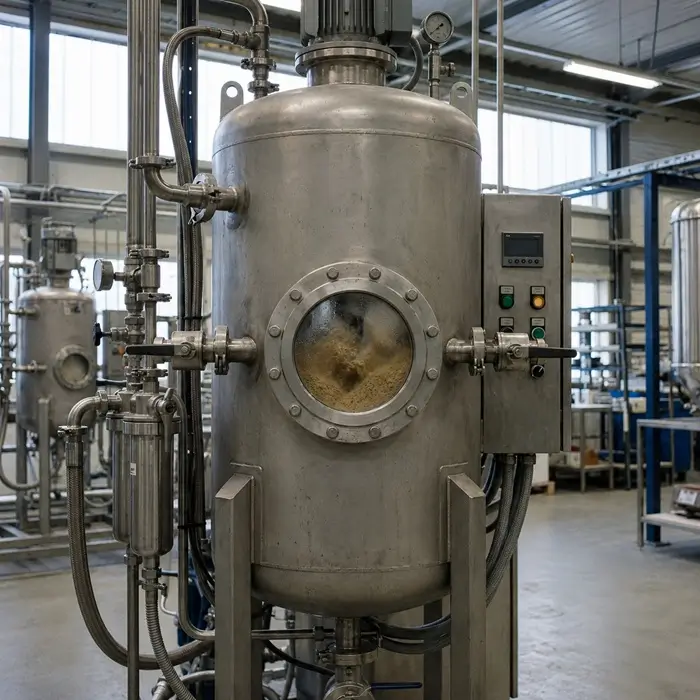
Fluidized Bed Processing in Powder Technology: Granulation, Coating, and Drying Through a Powder Behavior Lens
Geldart classification, minimum fluidization velocity, bubble dynamics, droplet-to-particle size ratio, and permeability all determine whether a fluidized bed process delivers controlled granule growth, uniform coating, or consistent drying at production scale.
Feature Article
 4 July 2026
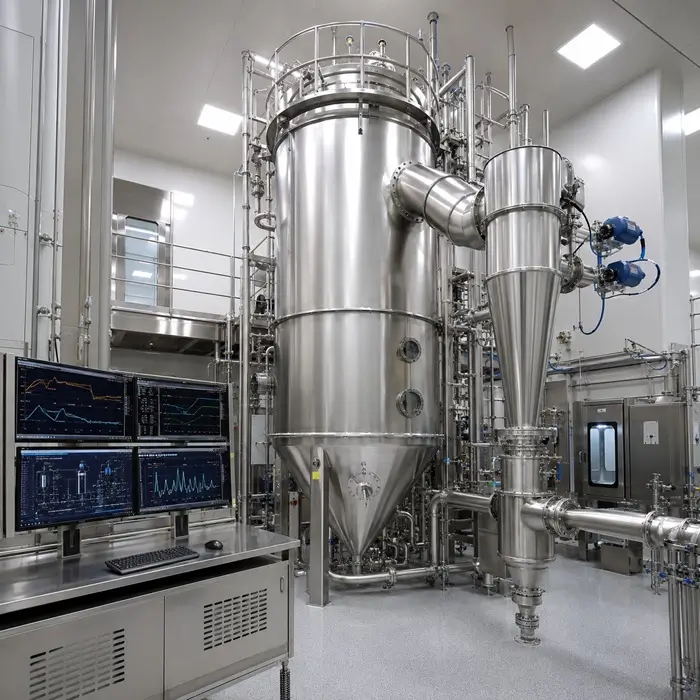
Spray Drying 4.0: Real-Time PAT, AI Process Control, and What Engineers Actually Gain
Process analytical technology combined with machine learning is changing residual moisture control and yield prediction in pharmaceutical and food spray drying. The gains are real but bounded, and the off-line test panel has not been replaced.
Feature Article
 20 June 2026
Poorly Soluble APIs: How Surface Contact Shapes Dissolution and Bioavailability
Poorly soluble APIs now represent the majority of the pharmaceutical development pipeline. Dissolution and oral bioavailability are determined by molecular solubility, surface wetting behavior, solid-state stability, and how the formulation interacts with the GI environment from first contact onward. Amorphous dispersions, lipid systems, nanocrystals, and co-crystals each rely on different surface mechanisms to deliver their intended advantage.
Feature Article
 7 February 2026
The Search for Universal Dust Explosivity Criteria
Universal dust explosivity criteria fail because explosibility depends on dispersion, turbulence, ignition, [...]
Feature Article