Powder property
Attrition
Repeated contact can change particle condition before bulk size results reveal the damage
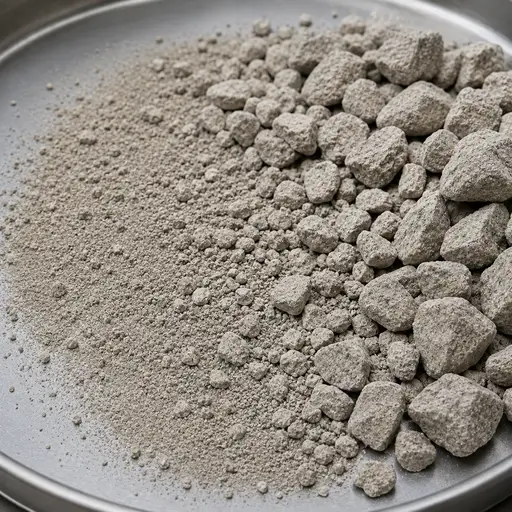
Attrition is the progressive loss of particle material or integrity through repeated impact, abrasion, rubbing, shear, and compression. It can generate fines, round edges, remove coatings, weaken granules, contaminate product, and alter downstream behavior without producing one obvious catastrophic fracture event.
Powder property
Attrition
Repeated contact can change particle condition before bulk size results reveal the damage
Attrition is the progressive loss of particle material or integrity through repeated impact, abrasion, rubbing, shear, and compression. It can generate fines, round edges, remove coatings, weaken granules, contaminate product, and alter downstream behavior without producing one obvious catastrophic fracture event.




Core concept
Attrition is progressive damage from repeated process stress
Attrition may remove small fragments from a surface, round particle edges, strip a functional coating, or progressively weaken a granule until it fragments. Different stress modes can produce the same final percentage of fines while requiring different corrective actions. The damage rate depends on particle strength and defects, but also on contact velocity, angle, surface material, solids concentration, residence time, and the number of repeated events. Product wear and equipment wear can occur together. Measure the complete damage signature, including fines, coarse-particle survival, shape, coating condition, and foreign wear debris. One PSD value may miss important functional loss.
What controls it
Six groups of variables govern attrition
Attrition reflects the interaction between particle resistance and the severity, frequency, and geometry of process contacts.
States and interpretation
Different damage modes create different particle signatures
Use fines, morphology, coating condition, and wear debris together to identify the dominant attrition route.
| Damage mode | Typical signature | Likely stress | Useful confirmation |
|---|---|---|---|
| Surface abrasion | Fine dust, rounding, roughened surfaces, or gradual mass loss | Sliding, rubbing, and repeated glancing contacts | Microscopy, mass loss, and fine-tail growth |
| Chipping | Small angular fragments removed from edges or corners | Localized impact and stress concentration | Fragment morphology and impact comparison |
| Fragmentation | Loss of coarse particles and broad daughter-size distribution | High-energy impact or crushing | PSD mass balance and breakage probability |
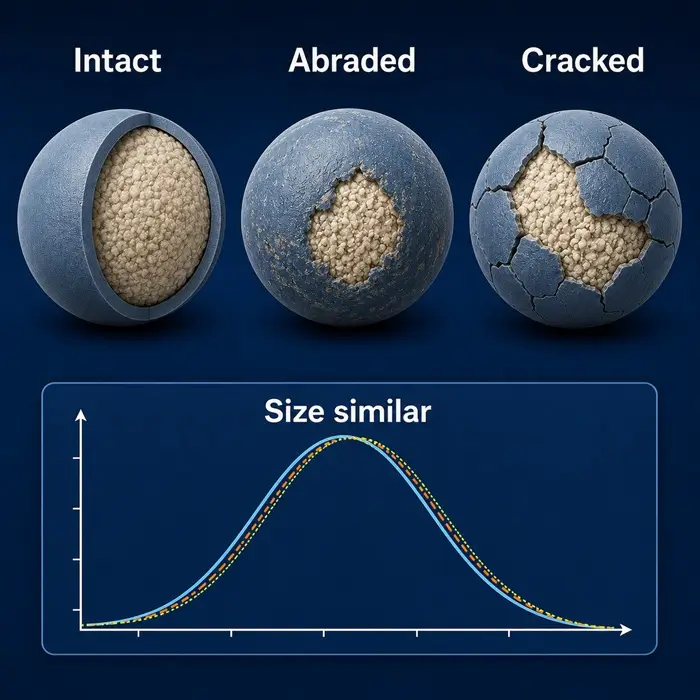
| Coating or shell damage | Functional loss with limited change in equivalent particle size | Abrasion, flexure, interface failure, or fatigue | Surface imaging and coating-specific analysis |
How to measure it
Choose a test by the process contact
Replicate the dominant stress mode and compare all relevant damage outputs before and after exposure.
Where it matters
Attrition becomes a yield, quality, and dust constraint
Damage matters where repeated contacts change particle function or create a downstream handling problem.
Go deeper
Three practical routes into attrition damage
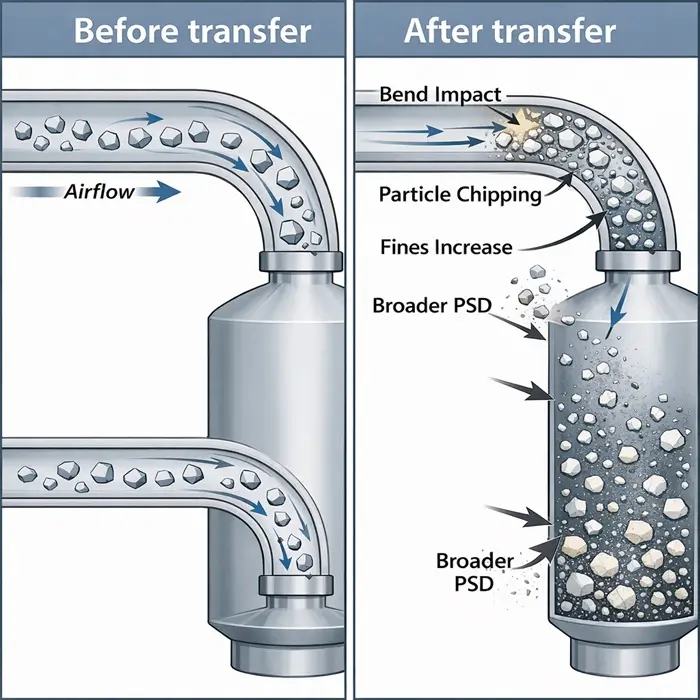
Explore conveying-induced damage, coating failure that precedes a PSD shift, and the effect of conveying regime on attrition risk.

Need the measurement, not just the guidance?
If the remaining uncertainty concerns attrition rate, fines generation, coating damage, impact sensitivity, conveying severity, or equipment-derived contamination, select the measurement around the material state and process decision. PowderTechnology.info can help define the test sequence, sample conditions, and interpretation route. For laboratory support, explore our Delft Solids Solutions partner page or visit Delft Solids Solutions directly.