
Table of contents

Why Plateaus Happen
Powder progress is mostly incremental. Physics and economics set boundaries. Breakthroughs are rare and separated by long optimization cycles. Most powder technologies follow an S-curve. They start slowly, accelerate, then mature. Knowing this helps teams plan research and invest wisely. It also frames expectations for return on effort.
At the physical level, the S-curve reflects particle thermodynamics, cohesion, and energy efficiency. Gravity, van der Waals attraction, and electrostatic forces dominate granular systems. These create a potential well that design alone cannot bypass. Cohesive fine powders below 10 µm illustrate this clearly. Van der Waals adhesion is often 5 to 20 nN per contact. That force exceeds particle weight by orders of magnitude. As a result, dispersion and fluidization become difficult. Even advanced routes must obey these force balances. Therefore, physical limits cap acceleration.
The S-Curve Trajectory in Powder Technology
Phase 1: Foundational research and painful scaling
Typically, new materials and processes begin in the lab. At first, performance is poor and variable. As development moves from grams to kilograms, hidden problems emerge. Consequently, yields stay low and costs remain high. Therefore, investment carries real risk without a clear return. Meanwhile, teams spend years mapping variables and interactions. As a result, commercial viability often takes a decade.
Early bottlenecks: morphology, agglomeration, surface energy
Typically, new materials and processes begin in the lab, and initial performance is poor and variable as fundamentals are tested. As development scales from grams to kilograms, hidden problems emerge across mixing, heat transfer, and control. Consequently, yields remain low and costs rise quickly, tightening budgets and schedules. As a result, investment carries real risk without a clear return, and decision makers grow more cautious. Meanwhile, teams spend years mapping variables and interactions through disciplined trials and validated models. Ultimately, commercial viability often arrives only after a decade of iterative learning, pilot runs, and preproduction experiments.
Case example: spherical silicon powder for anodes
Milling produced fractured, irregular silicon. Packing was poor and the electrodes were unstable. Plasma-assisted CVD enabled spherical particles. Morphology improved, but costs exceeded $1000 per kilogram. Energy use and ultra-clean precursors drove expense. Therefore, early markets stayed niche. In RF plasma, silane decomposes to reactive radicals. Supersaturation triggers nanoparticle nucleation within milliseconds near ~2500 K. Collisions then form aggregates via Brownian dynamics. Surface temperatures near ~1700 K allow softening and rounding. With a ~0.3 s residence time, batch energy can be ~18 to 20 MJ per kilogram under optimistic assumptions. This is illustrative and depends on reactor design.
Phase 2: Optimization and industrialization
Reactor innovations and cost curves
Reactor design advanced. Multistage fluidized beds raised throughput by roughly 400 percent. Heat integration cut energy by about 60 percent. Doped silicon improved cycle life by about 25 percent. Costs fell below $200 per kilogram. No single breakthrough caused this drop. Many small fixes compounded over a decade.
Managing cohesion and flow regimes
Cohesion rises as particles get smaller. At 1 µm, adhesion can be ~10 nN. At 100 nm, it can exceed 200 nN, depending on humidity and material. Flow and fluidization then suffer. Engineers tune gas velocity and add acoustic or mechanical vibration. Switching from fixed to bubbling fluidization can double yield uniformity. These physical tactics quietly enable scale.
Phase 3: Maturity and the plateau
Performance asymptotes and market competition
Eventually, easy gains end. Physics pushes back. Milling cannot shrink particles forever. Electrostatics and quantum effects appear at small scales. Battery chemistries approach their theoretical limits. Silicon anodes now show maturity signals. Capacity retention improves by about 2 percent per year. Cost cuts slow to roughly 5 percent per year. Research shifts toward recycling and composites. The sector may be near 85 percent of theoretical capacity. Further progress demands costly reactors and purer feeds. Firms compete on price and reliability more than performance.
Analytics at the plateau
Analytics intensify at maturity. In-situ sensors track plasma emission and reactive species. Gas-phase SiH₄ conversion often stabilizes near ~80 percent for set conditions. Higher values can cost more energy than they return. Simulations show diminishing returns when thermal gradients fall below ~10 K per centimeter. The process approaches a practical balance between input energy and output quality.
Economic Drivers and the Measurement of Progress
Technical KPIs and characterization
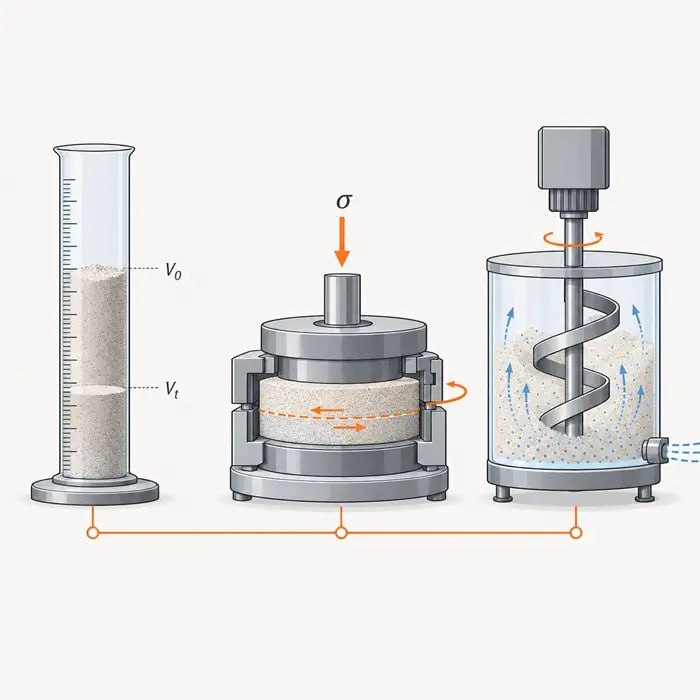
Progress requires both technical and economic gains. Key metrics include PSD tightness, bulk density, and predictable dynamic flow. A five percent compressibility improvement can raise press speed by about twenty percent. That change matters economically. Modern tools make this visible. Dynamic powder rheometry provides flow energy in mJ/g. X-ray tomography shows internal defects without destruction.
Dynamic powder rheometry in practice
Cohesive pharma powders often show 6 to 12 mJ/g. Free-flowing metal powders can sit below ~2 mJ/g. A 10 percent drop in flow energy often yields 10 to 15 percent better die fill. Hausner ratio also tracks filling. A shift from 1.4 to 1.3 can raise filling speed by ~15 percent. In thermal spray, narrowing span from 1.8 to 1.2 can lift deposition efficiency by ~22 percent. Waste drops by about $150 per kilogram of applied coating. These links justify investment in process control and metrology.
Economic metrics and recycling trade-offs
Costs, yield, and supply resilience matter. A granulation route that cuts energy by twenty percent is a win. A coating line that saves three percent API without loss of efficacy is also a win. Such gains lack headlines but drive the industry forward. Consider titanium powder recycling in AM. Virgin powder can sit near $300 per kilogram. Recycled lots sell near $180 per kilogram. Flow and oxide levels may shift properties. The decision balances cost, quality, and testing. Better characterization allows smarter blend ratios.
The Multidisciplinary Nature of Powder Science
Chemical interactions that shape bulk behavior
Surface chemistry steers performance. In metals, passivating oxides form quickly. Aluminum often stabilizes near ~4 nm after air exposure. Reactivity then drops by more than 95 percent. Heat in spraying or sintering can crack or dissolve this layer. Fresh metal becomes available for bonding. In ceramics, surface hydroxylation changes hydrogen bonding. Angle of repose and packing then shift. Chemistry drives bulk behavior.
The force network: van der Waals, capillary, electrostatics
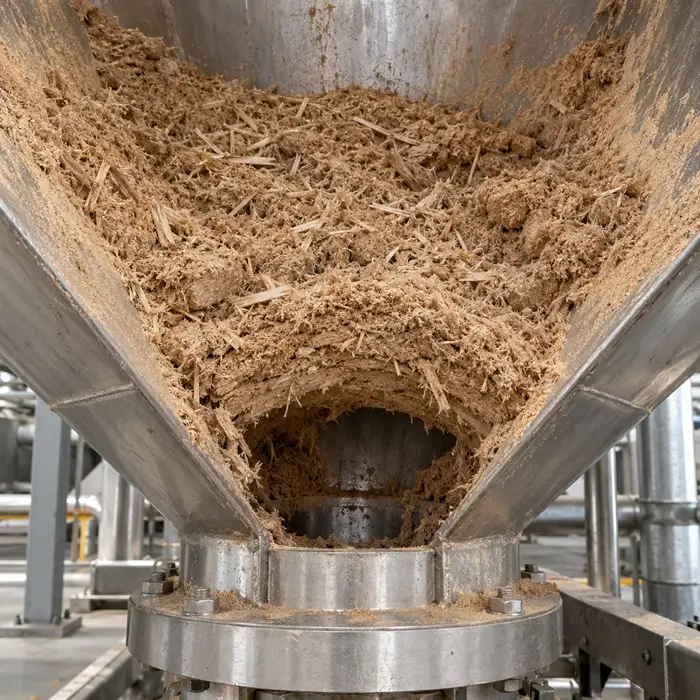
Van der Waals, capillary, and electrostatic forces dominate fine powders. Van der Waals attraction grows with particle radius and drops with separation squared. Two 5 µm silica particles near 10 nm can attract at ~10 nN. Humidity adds capillary bridges that can double or triple adhesion. Tribocharging can reach ~10⁻⁸ C per gram. That level can cause repulsion or clustering. These forces explain hopper stalls and dosing drift.
Simulation and imaging: from trends to decisions
DEM models now include non-linear contacts, van der Waals terms, and capillary bridges. Typical studies use 10⁵ to 10⁶ particles at up to 10⁴ time steps per second. Models simplify reality yet predict segregation trends and void formation well. They capture the shift from free flow to channeling as adhesion surpasses gravitational energy per particle. High-speed X-ray tomography confirms rearrangements during shear and compaction.
Powder Flow and Segregation Phenomena
Classification with the Jenike flow function (ffc)
Flow varies with shape, density, and size. Segregation appears under vibration and discharge. The Brazil nut effect is a classic example. In industry, small gradients can break specifications. The Jenike flow function (ffc) classifies flow. ffc > 10 is free-flowing. 4–10 is easy-flowing. 2–4 is cohesive. < 2 is very cohesive.
Tuning flow by shape and surface modification
Shape and roughness matter. Spheres roll and rearrange. Angular particles interlock. Coatings reduce adhesion without changing chemistry. Dry coating with 1–2 wt% nano-silica can cut flow energy by ~30 percent for some excipients. Plasma grafting of hydrophobic groups reduces humidity clumping. Interparticle energy can drop from ~80 mJ/m² to below ~40 mJ/m². The result is smoother flow and better stability.
Manufacturing Applications and Scaling Realities
Gas atomization for metals
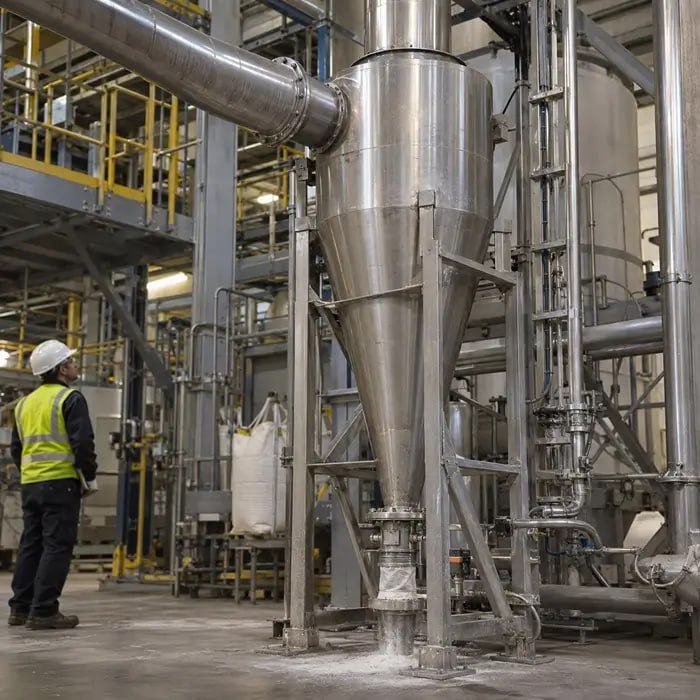
Gas atomization breaks molten metal into droplets that solidify mid-air. PSD depends on jet velocity, gas density, and superheat. Scaling raises output yet can widen PSD due to uneven cooling. At Reynolds numbers above ~10⁶, breakup becomes unstable. Shape quality then drops. Therefore, throughput must balance with uniformity.
Spray drying for pharma
Spray drying follows similar physics. Evaporation competes with solute diffusion. High drying rates create shells and hollows. Low rates yield dense spheres with slow dissolution. The Péclet number guides this balance. Values above 1 favor shells. Values below 1 favor uniform solids. Consistency lives in that balance.
Sintering to densify compacts
Sintering densifies by diffusion across contacts. Grain growth follows Gⁿ – G₀ⁿ = k·t. For surface diffusion, n ≈ 4. For volume diffusion, n ≈ 2. Activation energies for metals are ~120 to 250 kJ/mol. Temperature control is critical. Too hot for too long coarsens grains and harms properties.
Beyond the Plateau and the Potential for a New S-Curve
True step changes are rare. They arrive with order-of-magnitude gains. New S-curves may start with AI-driven inverse design, single-particle engineering, microgravity, or field-directed assembly. However, development cycles are long and capital-heavy. Thus, near-term shifts across entire industries are unlikely.
A dual-track future is probable. One track optimizes today’s plateau. The other explores small, high-value niches with new physics or control. Strategy should fund both tracks with clear gates.
Future Possibilities and Quantitative Perspective
Characterization is moving in-process and in real time. In particular, spatial acoustic methods now map stiffness within moving beds, while digital holography simultaneously tracks thousands of particles in flight. Together, these tools enable earlier corrections before quality drifts and, moreover, they shorten feedback cycles during development.
Looking ahead, the next gains will come from data-driven control, process intensification, and sustainability. Specifically, AI linked to sensors will close loops in granulation, atomization, and coating. In parallel, models trained on large runs will predict flow, segregation, and compressibility. However, physical insight remains vital to avoid model traps. Meanwhile, hybrid powders continue to grow. Engineered cores and shells now enable self-lubricating metals and stable, conductive ceramics. Nevertheless, interfaces remain the challenge.
Accordingly, expect annual gains of about 2 to 5 percent in efficiency and about 1 to 2 percent in yield, with similar reductions in energy use. At those rates, overall efficiency can double in about 25 years. Moreover, microgravity synthesis, laser vapor routes, and electric field agglomeration may grow, yet scale and cost still limit adoption today. In contrast, surface energy control will matter more in the near term. For example, ion-beam functionalization can tune charge sites and lower Hamaker constants; as a result, adhesion drops at the atomic scale.
Practical Checklist: Winning on the Plateau
-
Measure the bottleneck: ffc, flow energy, PSD span, moisture sorption.
-
Stabilize environment: RH ±2 percent, temperature ±1 °C through storage and feed.
-
Improve shape and coatings: roundness up; 1–2 wt% nano-silica where suitable.
-
Tune regimes: fixed to bubbling to turbulent fluidization; record yield by regime.
-
Close the loop: torque, ΔP, acoustics; simple ML for drift alerts.
-
Track costs: energy per kilogram, rework, scrap, usable €/kg. Review monthly.
Conclusion
Sustainability and data-driven control now define advantage on mature plateaux. As a result, waste falls, recycling improves, and energy use drops. Moreover, small gains compound over time. Consequently, these steady improvements power the industry forward.
Even so, meaningful change remains possible. Therefore, balance today’s optimization with focused bets on new physics and control. In addition, treat the powder plateau as real but movable. Ultimately, foundational science ensures it is not permanent.