
Table of contents

Containment failures rarely look dramatic. Most show up as fine residue on a clamp, a dusty glove, or a haze that disappears fast. However, those small releases create real problems. They raise exposure, extend cleaning time, and increase cross-contamination risk. They also turn audits into arguments. Powder containment performance testing gives you a repeatable way to answer three questions. Where does dust escape? How much escapes? Which fix actually changes the result?
SMEPAC is one of the most widely referenced standardized approaches for this type of evaluation. ISPE describes SMEPAC as a standardized methodology that includes airborne sampling and surface deposition assessment using surrogate materials under defined test protocols.
What powder containment performance testing actually measures
Containment is not only an equipment claim. It is a system outcome. Powder, airflow, interfaces, and operator actions all combine.
A good test measures two pathways.
Airborne concentration during the task
Airborne measurement indicates what particles could reach the breathing zone. It also captures short releases that you never notice visually.
You usually want two layers of information.
-
A task average so that you can compare to a target
-
A time trace so you can locate spikes
Surface deposition after the task
Surface deposition tells you what escaped and settled. It also predicts cross-contamination and resuspension during movement.
Many plants under-value surface results. The dust that settles still has to be cleaned. The same dust also migrates into tools, door handles, and carts.
SMEPAC style approaches explicitly include both airborne emissions and surface deposition evaluation.
Powder containment performance testing: define the target before you touch equipment
If you skip the target, you will end up with a report that sounds technical but proves nothing.
Pick the anchor for your target
Use one of these anchors.
-
An OEL, when you have a toxicology-based limit
-
An OEB, when you need banding for early controls
-
An internal corporate standard, when you run a platform line
Even if you use an OEL, you still need a task definition. OELs often assume an 8-hour reference period. EN 689 describes a measurement strategy for demonstrating compliance with OEL values for inhalation exposures, and it highlights the importance of representative measurement strategies.
Translate the anchor into a CPT
Write a single sentence that fixes what you will test.
A practical containment performance target looks like this.
“During drum charging into the mill, airborne concentration at the operator position stays below X µg/m³ as a task average, with no repeat spike above Y µg/m³ during disconnect.”
That sentence forces clarity. It defines the task, the location, and the rule for spikes.
Decide what “pass” means for surfaces
Surface limits vary by industry and risk. The important part is consistency and logic.
Pick three zones.
-
Near source, at the interface
-
Travel surface, where operators touch and move
-
Remote control surface, to test migration
If you already run cleaning verification programs, align your surface thinking with those practices. Keep methods and templates consistent.
Pick the tasks that actually break containment
Plants often test the clean-looking step. The real emissions happen elsewhere.
Start with a simple rule.
If a step moves air, it can move dust.
Those points point you toward these tasks.
-
Bag and drum charging
-
Big bag connect and disconnect
-
Split valve transfer steps
-
Sampling and thief sampling
-
Filter change and liner change
-
Wet wipe and dry wipe cleaning steps that disturb dust
Also include the “last thirty seconds.” Many systems look clean during steady flow and release dust during disconnect.
Choose a surrogate powder that stresses the system
A surrogate powder lets you test without bringing potent material into the room. It also helps you compare one run to the next.
You want a surrogate with predictable analysis and challenging dispersion behavior.
Aim for these traits.
-
Fine enough to challenge interfaces
-
Stable enough for repeat analysis
-
Safe enough for your existing controls
-
Relevant enough to mimic worst case behavior
Document the surrogate properties you know. Particle size distribution and moisture state matter. If you cannot measure PSD, at least record supplier specs and handling notes.
Build the test plan so another team could repeat it
The test plan is not paperwork. It is the only way results stay meaningful.
ISPE describes SMEPAC methodologies as standardized, defined test protocols using surrogate materials. That spirit matters more than the name.
Lock the setup
Record what could change your result.
-
Ventilation state, doors, and airflow direction
-
Filter condition and equipment setpoints
-
Interface hardware, like gaskets and clamps
-
Liner type and thickness
-
Operator PPE and operator position
If you cannot lock it, you cannot compare it.
Define sampling locations and rationale
Use at least these air locations.
-
A point representing the operator breathing zone position
-
A near source point that captures the release plume
-
A background point away from the operation
For surfaces, use fixed templates. A swab without a defined area is a story, not data.
Define timing in task language
Avoid generic sampling times.
Instead, describe task phases.
-
Connect and check
-
Charge or discharge
-
Settle and pause
-
Disconnect and secure
Your sampling should cover the full task. Many spikes live in the last phase.
Instrumentation choices that improve insight
You can run a useful program with basic tools. You just need to know what each tool tells you.
Personal or area air sampling
Filter-based sampling gives you a mass per volume result. It is slow but defensible.
If you care about spikes, add a real-time instrument. Real-time data shows when the release occurs, even if the absolute number needs calibration.
Surface swabbing
Swabs capture deposition and spread. Use the same wipe, solvent, and pressure each time. Use the same template area each time. When swabs show spread to travel surfaces, treat that as a containment failure even if air looks clean. That spread becomes future resuspension.
Run the test like a process study, not a demo
You want reality. That includes awkward operator behavior.
Use repeats
Run at least three repeats of the same task. Repeats separate random events from system behavior.
One clean run proves little. Two similar failures prove a lot.
Log micro events in real time
Write time stamped notes for these actions.
-
Tapping or shaking
-
Clamp release
-
Liner twist
-
Valve close delay
-
Hose sag or hose snap
-
Any visible puff, even small
This step turns a noisy time trace into root cause.
Watch for behavioral drift
Operator technique often shifts under observation. Use one instruction and keep it identical across repeats: run the task as you would in routine production. If you notice unusually cautious handling or extra “showcase” steps, pause and restart the run. You want representative performance, not a best-case demonstration.
Mini case: Bag dump station, the puff happens at the end
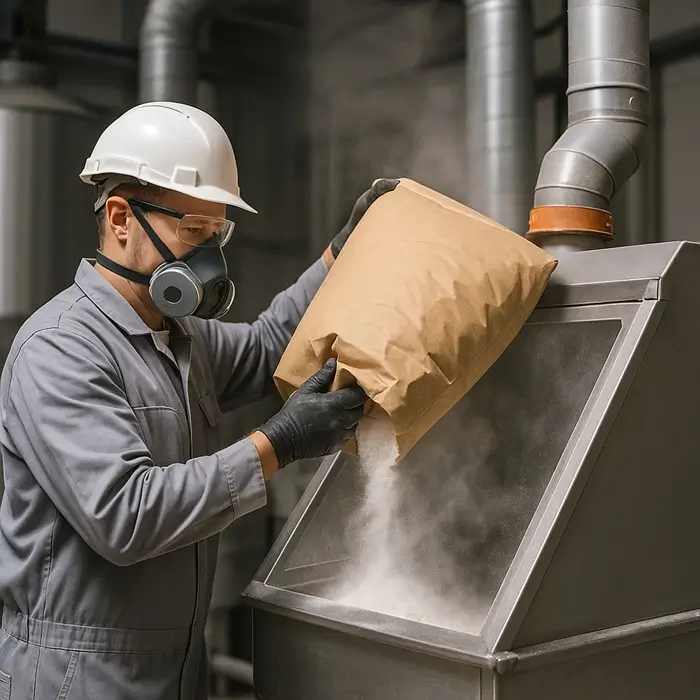
A plant ran powder containment performance testing on a bag dump station with a downflow booth. The charging step looked clean. However, the real-time trace showed repeated spikes during the last minute. Each spike is lined up with the same action. The operator pulled the empty bag liner free and gave it a quick shake before binning it.
The task average still looked acceptable. Yet the peak concentrations were not. Surface swabs also showed deposition on the booth lip and the nearby cart handle.
The fix was simple. First, the team added a “settle and capture” step. The operator waited ten seconds, then held the liner opening inside the booth zone. Second, they banned shaking and added a vacuum pickup for the liner fold. Finally, they changed the bag disposal choreography so the liner stayed inside capture airflow until fully closed.
On retest, peaks dropped sharply, and travel surface deposition fell. The booth was not the problem. The last step was.
Powder containment performance testing: interpret results without fooling yourself
Containment data can lie if you only look at averages.
Separate three emission signatures
Most failures fit three patterns.
Steady leakage
Air looks elevated throughout the task. This points to a poor seal, a poor fit, or a persistent vent path.
Event spikes
Air looks clean, then spikes during a specific action. This points to choreography, disconnected steps, or valve timing.
Secondary resuspension
Air spikes when operators move after the task. This points to surface loading and a poor cleanup sequence.
Each pattern needs a different fix.
Treat spikes as first class results
A single spike near the breathing zone can dominate risk. The task average can still look fine.
Add a spike rule to your acceptance criteria. Keep it simple.
“Repeated spikes above Y during disconnect fail the task.”
Use background to avoid false blame
Background levels can drift. Dust in a room can come from another bay. The BOHS and NVvA guidance stresses that compliance testing needs proper measurement strategy, and that measurement alone does not replace good control practice.
If background rises, do not blame the equipment. Fix the room and repeat.
Fixes that actually move the needle
Containment improvements should target the biggest spike first. That creates fast wins and cleaner data.
Interface fixes
Interfaces create most emissions.
Look at these first.
-
Gasket material and gasket compression
-
Clamp alignment and clamp torque consistency
-
Hose support, so the weight does not deform seals
-
Valve face cleanliness, so surfaces mate correctly
-
Liner removal method, including tie off and fold
If dust sits on the seal face, the next clamp action will aerosolize it.
Mini case: Split valve transfer, repeat spike at valve close
A manufacturer used a split valve to transfer a fine powder from a drum into a contained blender. They expected strong containment, yet powder containment performance testing showed a repeat spike at valve close and clamp release.
Observation notes explained the pattern. The drum side valve head sat slightly off-center after docking. The operator compensated by tightening the clamp more on one side. That created a small gap on the opposite side. During separation, the valve faces dragged and released a short dust puff. Swabs confirmed deposition around the clamp ring and on the operator’s glove.
The team made two changes. They added a simple docking guide to force concentric alignment. They also adjusted the close sequence, so the system paused, then equalized pressure before separation.
The retest showed stable, low airborne levels and a clean clamp ring. The hardware was capable. The setup and sequence were not.
Air path fixes
Air moves dust. That is physics, not opinion.
Common air path mistakes include these.
-
Displaced air vents into the room during filling
-
Equipment breathes during disconnect
-
A local exhaust hood sits too far away to capture the plume
-
A filter pulse event fires during a sensitive step
Fixing airflow often beats adding more PPE.
Operator choreography fixes
Small sequence changes can remove the biggest emission event.
Use a pause step.
-
Stop motion
-
Allow dust to settle
-
Pull a short local exhaust purge
-
Then disconnect
Also, reduce powder handling intensity.
-
Avoid shaking bags as a default behavior
-
Lower drop height
-
Use controlled feed instead of dumping
Cleaning and recovery fixes
If surfaces load heavily, the plant will resuspend dust during cleaning.
Change the cleaning order.
-
Capture loose dust with vacuum rated for fine powder
-
Wipe after vacuuming
-
Avoid dry brushing that lofts dust
Containment testing becomes easier when you reduce surface loading.
Report structure that stands up in audits
A containment report should answer these questions clearly.
-
What task did you test
-
What target did you use and why
-
How did you sample air and surfaces
-
What did you observe during spikes
-
What change did you implement
-
What did the retest show
Do not bury the finding in charts. Put it upfront.
“Disconnect created a repeat spike. Adding a pause and changing clamp sequence removed the spike.”
That sentence matters more than ten pages of numbers.
When to retest
Retest when something changes that could alter emissions.
Typical triggers include these.
-
New liner type or new bag type
-
Changed gasket material or clamp hardware
-
Changed filter media or filter pulsing behavior
-
Changed operator method due to training or staffing
-
Changed ventilation layout in the room
Keep a simple change control rule.
If it changes air path or interface behavior, you retest.
What the PDF toolkit adds and how to use it
The companion PDF provides printable worksheets that make the test repeatable.
It includes these pages.
-
CPT builder worksheet to define target, task boundaries, and pass rules
-
Task map and sampling plan to lock locations, IDs, and times
-
Event and spike log to time-stamp actions that cause releases
-
Root cause and fix planner to link findings to fixes and owners
-
Retest checklist to keep repeat runs comparable
Use it as a field pack. Print only the pages you need for a run.