
Electrostatic Effects

Electrostatic effects occur when materials accumulate electrical charges during handling or processing, influencing particle interactions and material behavior. These effects can impact industries like pharmaceuticals, chemicals, and food, leading to challenges such as clumping, adhesion, or even ignition risks in powder handling.

On this page, explore the principles of electrostatic effects, their impact on material performance, and strategies to manage and mitigate these forces for safer and more efficient operations.

Featured Electrostatic Effects articles
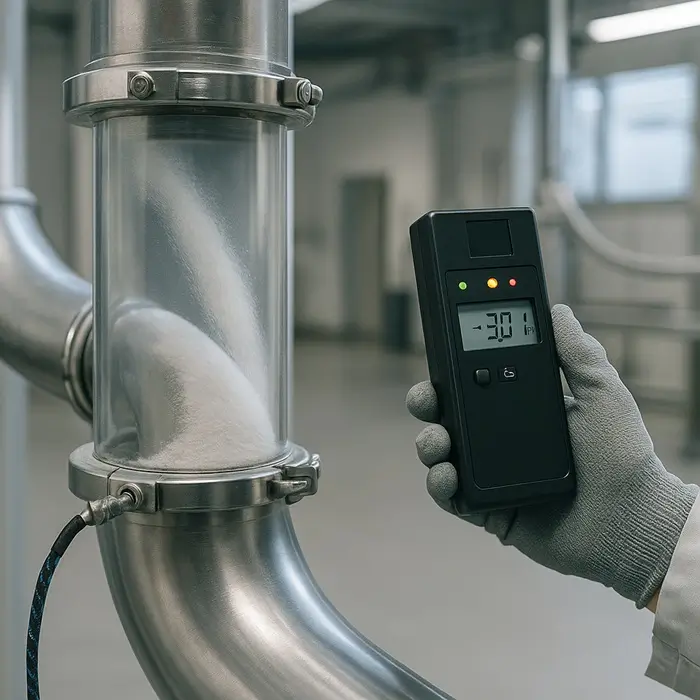
  • Triboelectric charging in powders at a pneumatic conveying transfer point, showing fine powder flow near grounded stainless steel piping and an electrostatic field sensor.

    Triboelectric Charging in Powders: The science, failure modes, and industrial controls

    Triboelectric charging forms when powders contact and separate, creating a shifting charge distribution. It can drive wall coating, segregation, coating drift, and ESD risk. Control it with hotspot measurements, humidity control, dissipative surfaces, ionisation, and KPI checks. Table of contents Why triboelectric charging in powders [...]

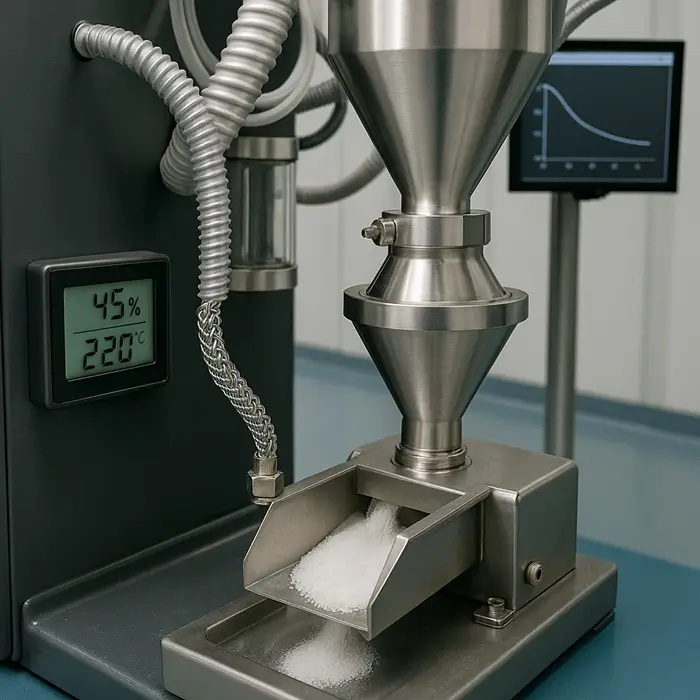
  • Loss-in-weight feeder with anti-static hoses and RH display, used to link settings to charge decay time.

    Charge Decay Time: A Fast Predictor of Powder Handling Risk

    Charge decay time turns electrostatics into a practical control knob. Measure it under controlled humidity, log it with charge-to-mass, and link it to plant outcomes. Then tune humidity and materials to stabilize feeding and discharge. Charge Decay Time: The One Metric That Predicts Trouble Electrostatic charge and [...]

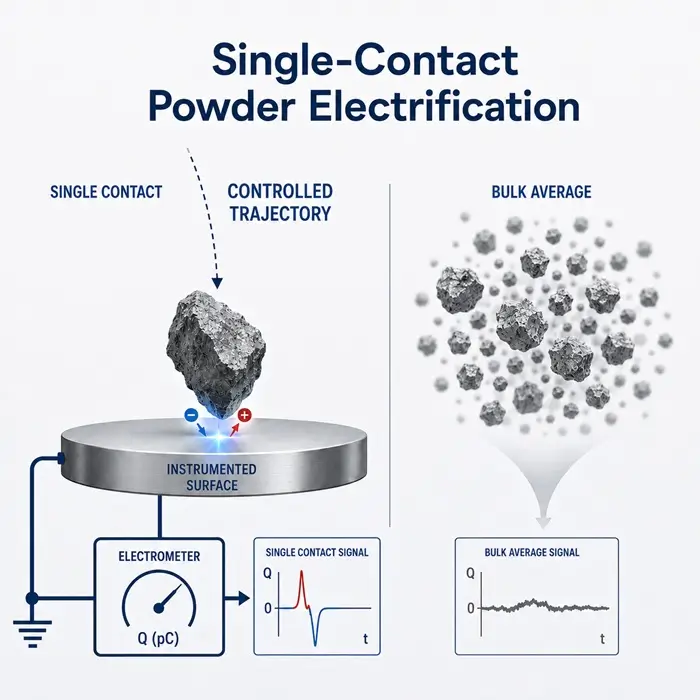
  • Square hero image illustrating hidden charge peaks in powder flows with localized hotspots.

    Hidden Charge Peaks in Powder Flows: Measure What is missed

    Do not accept a safe net charge as proof of safety. Find and reduce hidden charge peaks in powder flows. Validate locally. Then monitor routinely with the right metrics. Electrostatic problems often look random. Lines run fine, then fail without warning. Average charge measurements can look safe. Yet [...]

  • Scientist applying slurry of lithium powders to foil electrode in lab, demonstrating lithium powders energy density research.

    Atomic Fundamentals and the Density–Energy Link

    Lithium’s atomic-scale behavior drives energy density in batteries. Powders are not passive scaffolds but active media where atomic interactions, transport pathways, and degradation processes unfold. Their structure and chemistry evolve with cycling, and that evolution decides whether a cell delivers stability or failure. Table of contents [...]

  • Electrostatic troubleshooting powder handling with silo discharge, warning sign, and charge meter.

    Electrostatic Troubleshooting in Powder handling

    Electrostatic troubleshooting in powder handling addresses particle properties, environmental factors, and equipment design. Structured control improves safety, stabilises flow, and protects product quality across industries. Table of contents Why Electrostatic Troubleshooting in Powder Handling Matters Electrostatics show up in very familiar ways. Powders cling [...]

newsletter icon

News And Articles In Your Inbox

Sign up and receive PowderTechnology.info news, articles, and content from our partners in a quick and easy monthly newsletter.
You have been successfully subscribed.
There was an error trying to subscribe. Please try again later.

More Electrostatic Effects Articles

Editor’s Picks