

A big bag can hold a powder that behaves acceptably in storage, sampling, and even lab checks, then still discharge badly on the line. That is why FIBC discharge problems are so often misread in production. The powder gets blamed first. Sometimes that is fair. But a flexible intermediate bulk container is not a rigid hopper. During emptying, the material only sees the outlet through a deformable liner, a tied spout, a support frame, a receiving hopper, and whatever vent path exists around that opening. Once you look at it that way, the outlet interface becomes the obvious place to start.
Why FIBC discharge problems are often misdiagnosed
The first mistake is to assume that a poor discharge automatically proves poor powder flowability. That is too simplistic. Some discharge failures do come from the material itself, especially when the powder has compacted in the bag or shows high cohesive strength under load. Powders in storage and handling systems should be judged under the conditions that actually matter, not by a casual free-flow impression from a scoop or container.
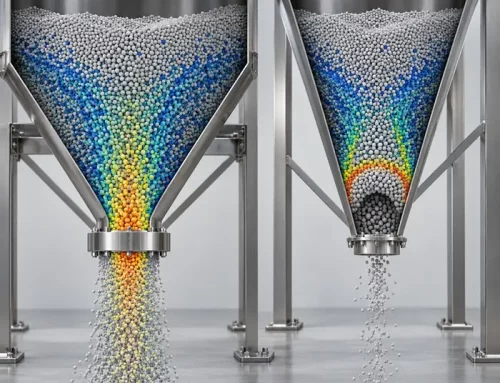
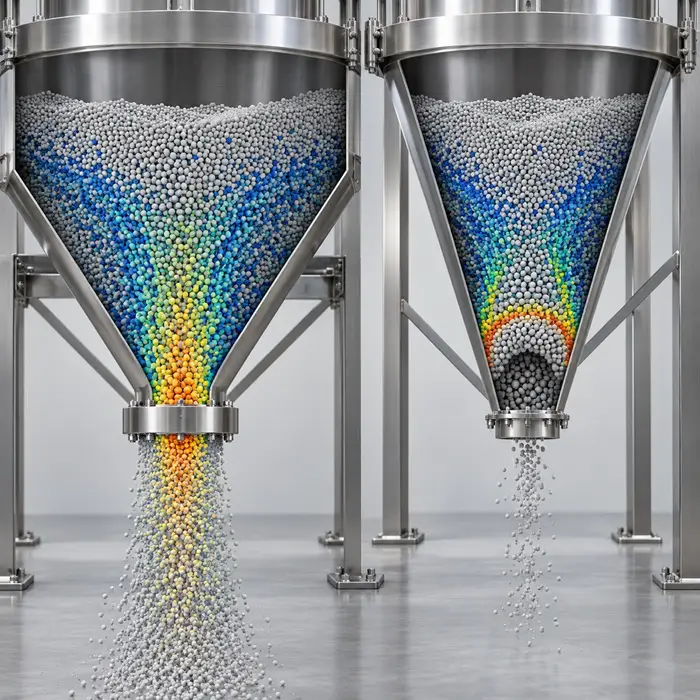
The second mistake is just as common. Teams see arching, rat-holing, surging, or dust release and assume the material property alone explains everything. In reality, the bag outlet and the first receiving step can introduce their own restrictions. In bulk solids terms, arching means the material forms a stable obstruction above the outlet, while rat-holing means only a central flow channel develops and the surrounding material stays stagnant. In a bag discharge station, the trigger for those behaviors can be the local outlet geometry and bag condition just as much as the powder’s confined-flow behavior.
That is why one bag may empty cleanly while the next bag of nominally the same material surges, hangs up, or leaves a large heel. The material may not be conditioned in exactly the same way from bag to bag. But just as often, the bigger mistake is treating the discharge setup as neutral when it is not.
How the liner-spout interface controls FIBC discharge problems
This is the part that matters most in practice.
The powder does not leave the bag through an abstract outlet. It leaves through a real interface made up of the liner, the tied or cinched discharge spout, the clamp or seal, the bag support geometry, and the hopper below. GEA describes its FIBC emptying stations as systems that clamp and seal plastic liners and spouts to the hopper during emptying to contain dust and prevent foreign material ingress. That alone tells you the outlet connection is not a detail. It is part of the process.
Flexicon makes the same point from another angle. Its enclosed bulk bag discharger uses a clamp ring and telescoping tube to create a dust-tight seal, keep tension on the bag spout, and support more complete discharge. That arrangement does more than control dust. It stabilizes the outlet so the bag is not discharging through a loose, collapsing, or partially obstructed opening.
That matters because a loose liner or poorly controlled spout can create problems of its own. The practical issue is simple: if the liner sags into the flow path or the spout is not held and opened in a controlled way, the outlet can become its own restriction. When that happens, operators often call it poor flow, even though the obstruction is mechanical rather than material-driven. Flexicon and Spiroflow both describe discharge systems that actively tension, seal, or support the outlet area to avoid exactly that kind of problem.
Common failure modes at the outlet
The outlet interface can fail in several ways, and it helps to separate them.
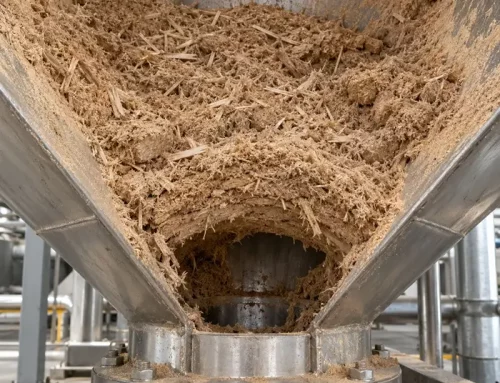
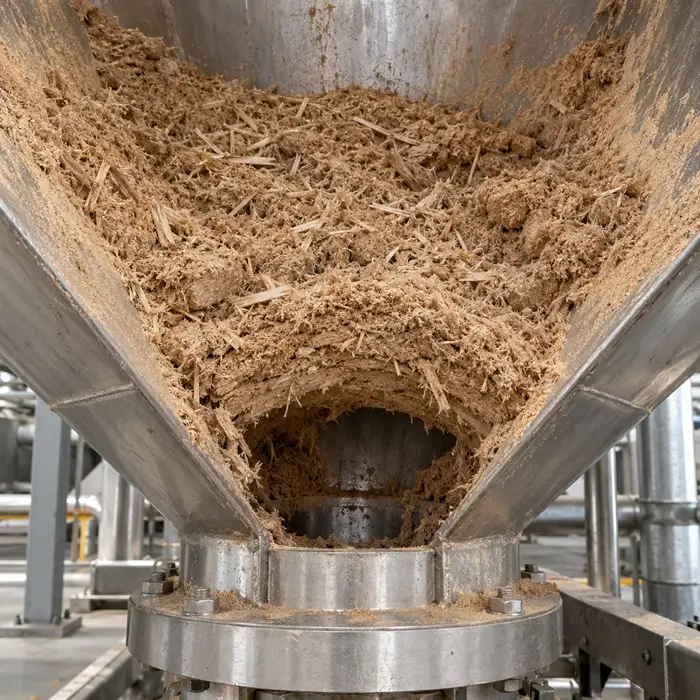
The first is intermittent or blocked discharge. If the bag bottom does not form a stable discharge shape, or if the material has compacted and the support arrangement does not guide it toward the spout, a bridge or rat-hole can develop. Spiroflow’s bulk bag unloading systems explicitly use support geometry, shaped hoppers, and optional vibration to improve flow from poor-flowing materials. That tells you bag support is already treated in industry as a flow variable, not just a structural one.
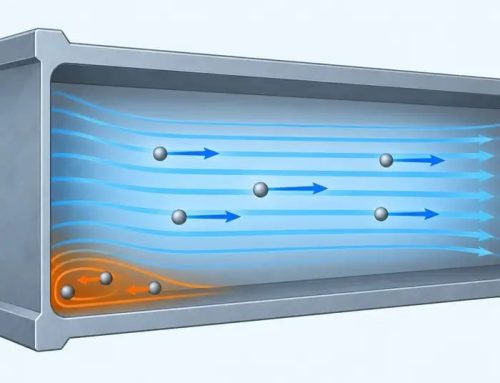
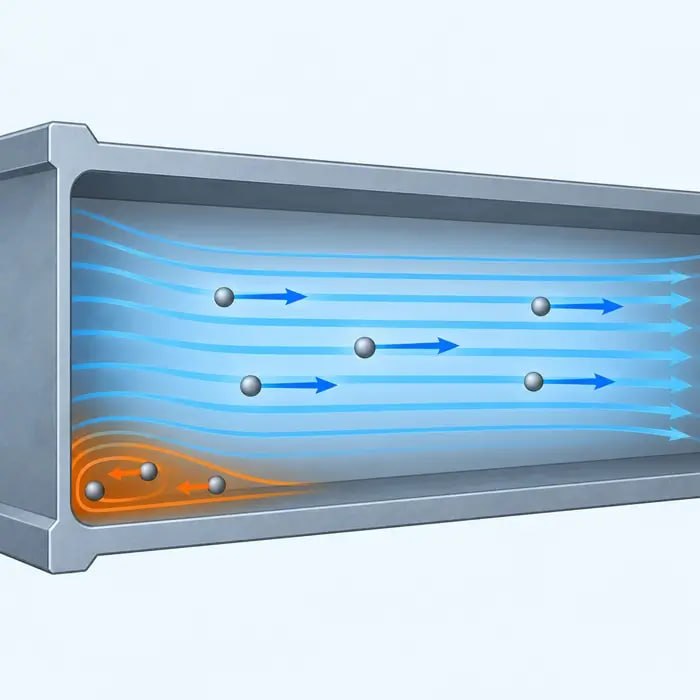
The second is surging or erratic flow. This usually happens when the outlet alternates between restriction and release. In practice, that can come from a tied spout being opened unevenly, a liner collapsing and reopening, a compacted mass breaking suddenly, or an outlet region with poor venting. The powder is not only flowing downward. It is also displacing air. If the local air path is poor, discharge can become unstable even before anyone starts a full material test campaign. Vendor guidance for contained dischargers repeatedly emphasizes sealed docking, controlled spout access, and dust-tight connections for exactly that reason.
The third is dust release. This is not only about whether a dust collector exists. It is also about where the dust is allowed to form and escape. Sealed hopper connections, clamped liners, and controlled spout opening are all used to reduce discharge dust because the outlet interface is where much of the release risk is created. Flexicon and GEA both emphasize dust-tight seals at that point of transfer.
The fourth is residual heel and incomplete emptying. As the bag empties, the stress state changes. Material can remain trapped at the edges or in compacted zones unless the support geometry continues to direct it toward the outlet. That is why systems with tensioning, shaped support, or bag activation are used to improve total evacuation. Spiroflow and Flexicon both describe design features aimed at reducing dead zones and improving emptying consistency.
What to check first when FIBC discharge problems appear
Start at the interface, not at the spec sheet.
First, check the bag configuration. Is it lined or unlined? Does it have a proper outlet spout, a porthole arrangement, or a less controlled bottom? Spiroflow separates bulk bag unloader designs by bag type for a reason. Not every station handles every outlet arrangement equally well.
Second, inspect the liner and spout after discharge. Was the spout held taut, or did it collapse into the outlet path? Did the liner distort into downstream equipment? Was the opening only partially released? Those are practical observations, but they often explain more than the powder specification does.
Third, review the vent path and dust path. If air cannot leave the local region cleanly, discharge may surge, and dust may escape when the system is opened or closed. If the outlet is contained badly, a nominally sealed design can still make a mess at the access point.
Fourth, check the support geometry below the bag. If the bag hangs as a soft square mass over a poor transition, do not expect stable discharge from a cohesive or compacted powder. Steeper supports, shaped hoppers, and controlled tensioning are not cosmetic upgrades. They change the local stress field at the outlet.
What to test before blaming the powder
If the same failure keeps returning, then yes, test the material. But test the right things.
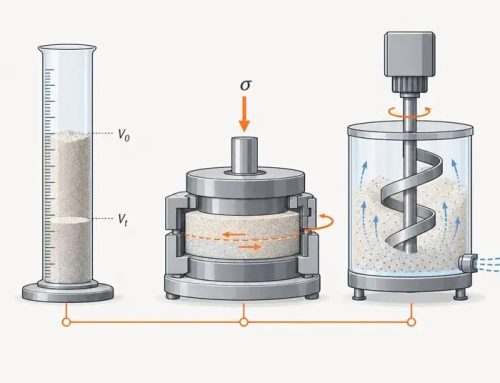
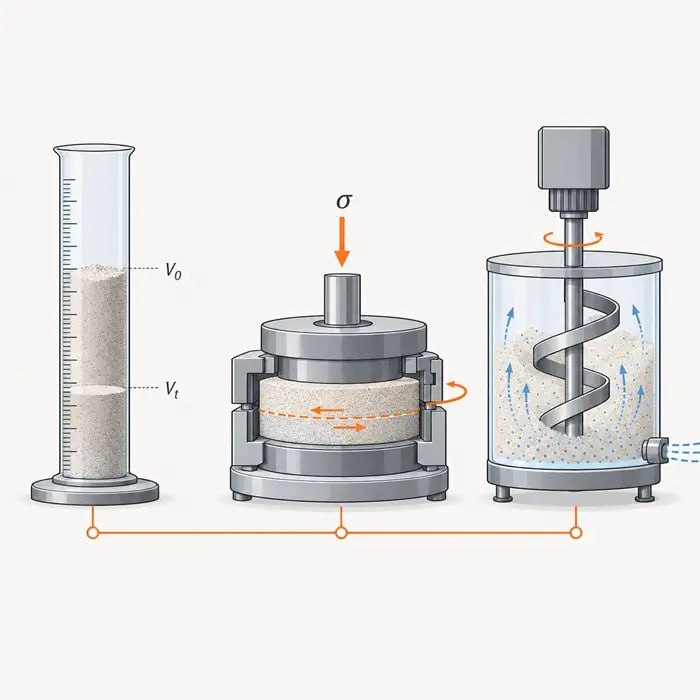
For big bags, confined storage behavior matters. The real question is not whether the powder looked free-flowing in a casual sense. It is how it behaves under the stress state and discharge conditions that actually exist in the system. That is why powder flow properties and compaction matter here.
If dust release is part of the complaint, the question is not only whether the powder flows. It is also how readily it becomes airborne during discharge. If that airborne dust creates exposure or cross-contamination risk, then the problem moves beyond flowability and into containment. At that point, the outlet has to be assessed under real operating conditions, not assumed to be acceptable because the system was designed as enclosed.
If electrostatic risk is relevant, the discharge review should also include bag type and grounding practice. In that case, the outlet issue may not only be a flow problem. It may also be a safety and hazard-control problem.
In conclusion
The main lesson is simple: many FIBC discharge problems start where the bag meets the process.
That is why a bag can contain an acceptable powder and still discharge badly. The controlling restriction may be the liner-spout interface, the vent path, the bag support geometry, or the way the spout is opened and tensioned during emptying. Material properties still matter. However, they are not the whole story.
So the next time a big bag surges, dusts, blocks, or leaves heel, do not jump straight to “bad powder.” Start with a better question: what is the outlet interface actually doing to the discharge?