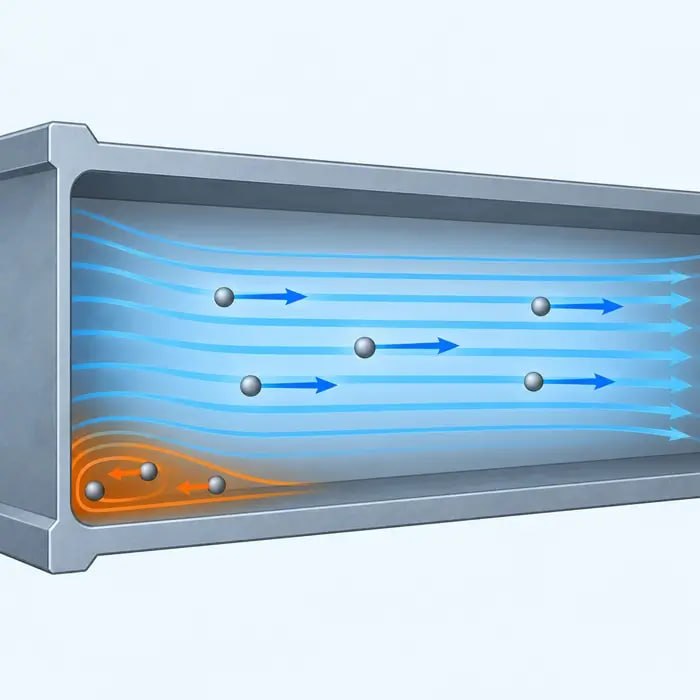

🔑 Key Takeaway
A single-contact electrification apparatus measures the charge transferred during one controlled particle-surface or particle-particle contact, rather than the net charge a bulk powder sample accumulates after many unresolved contacts. This gives researchers a way to isolate contact mechanics, material pairing, and impact conditions from the averaging that bulk triboelectric or charge decay measurements cannot avoid. The method remains a research-stage tool built around specialized apparatus and large repeated-contact datasets, not a routine production-floor diagnostic.
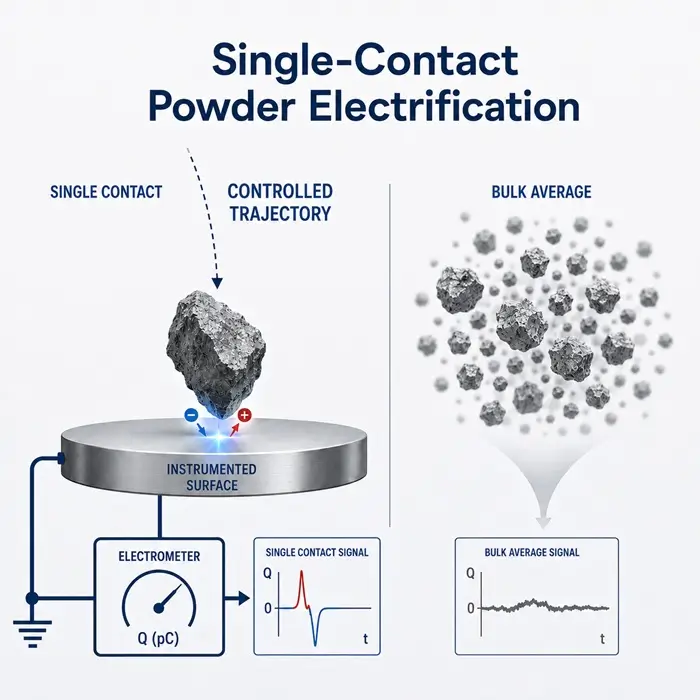
When a process team asks how charged a powder gets during handling, the answer usually comes from a bulk measurement: a Faraday pail reading after fluidization, a charge decay time on a compacted sample, or an in-line charge monitor on a conveying line. Those numbers are genuinely useful, but they report the net result of a large, unresolved population of contacts occurring between particles, equipment surfaces, and each other.
Single-contact electrification apparatus asks a narrower question. Instead of characterizing a bulk sample, it isolates one particle-surface or particle-particle contact under controlled velocity, angle, and material conditions, and measures or infers the charge change associated with that contact. That resolution is not available from bulk testing, and it is also not something a production line can generate on demand, which is part of why this measurement still lives mostly in research settings.
What a Bulk Measurement Averages Away
Bulk triboelectric charging tests report a net charge per unit mass after a powder sample has passed through a large, unresolved population of particle-surface and particle-particle contacts. That single figure is a sum, not an inventory. Some individual contacts transfer charge of one sign, others transfer the opposite sign, and particles of different size or surface state do not necessarily behave the same way during the same handling step.
A comprehensive review of triboelectric charging describes contact electrification as fundamentally a per-contact phenomenon influenced by material pairing, surface states, adsorbed species, prior charge history, and contact mechanics at the level of an individual collision, even though most practical measurements report only the aggregate outcome across a powder mass (Matsusaka et al., Chemical Engineering Science). The bulk number is a useful decision input for handling risk, but it does not reveal which contact type, surface pairing, or impact condition is doing the charging.
What a Single Contact Isolates
Single-contact apparatus typically directs an individual particle onto an instrumented target or creates a controlled collision between two particles, while sensitive electrometry measures or infers the change in charge associated with that contact. Purpose-built particle-particle rigs can control impact velocity, angle, material pairing, and pre-contact charge while keeping the collision physically and electrically isolated from surrounding contacts (Obukohwo et al., Powder Technology).
This design lets a researcher vary one condition at a time, for example impact velocity while holding material pairing and humidity constant, and observe how that single variable shifts the charge transferred. Bulk testing cannot separate variables this way because every contact in a bulk sample happens under a slightly different velocity, angle, and surface history at once, so the bulk result is already a blend of all of them. The purpose is therefore not to establish one universal charge value for a material pair, but to determine how the distribution of contact-level outcomes changes when a controlled variable is altered.
Contrast with Charge Decay Time and Bulk Triboelectric Testing
Charge decay time answers a different question than single-contact testing. It measures how quickly an already-charged bulk sample or surface loses that charge to ground, which speaks to whether charge can persist and accumulate during a handling step. Single-contact testing instead addresses how the charge originated in the first place, at the level of one collision. Neither measurement substitutes for the other; a powder can generate significant charge per contact and still relax quickly, or generate comparatively little charge per contact and still accumulate because it dissipates slowly.
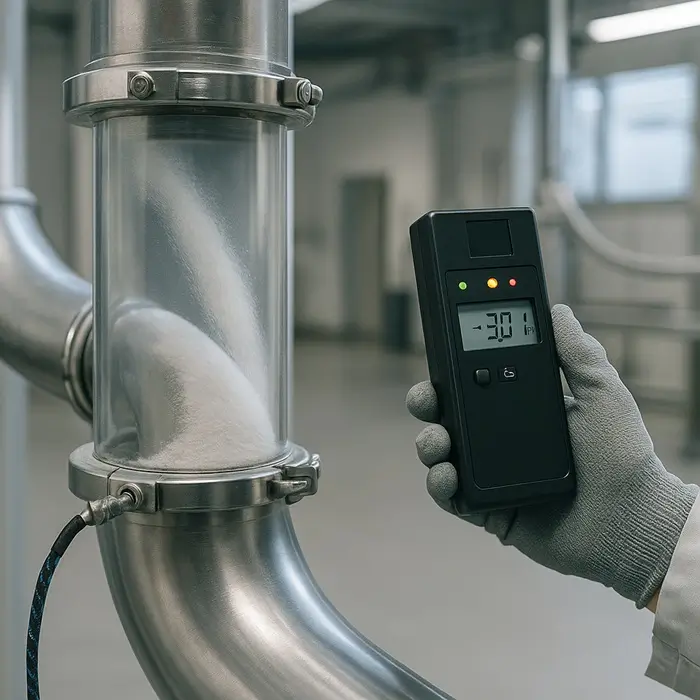
In-line and near-line monitoring approaches, including the kind of charge peak detection used on production equipment, capture a bulk or in-process electrical signal that reflects many simultaneous contacts as the material moves. That signal is a useful early-warning indicator for a process, but it cannot attribute a charge event to a specific contact type or material pairing the way an isolated single-contact measurement can.
Why This Remains a Research-Stage Measurement
Charge transfer from a single contact between two insulating or semi-insulating materials is not a fixed, repeatable number for a given material pair. Studies of particle-particle single contacts report that outcomes are better described as a distribution than a single deterministic value, meaning nominally identical repeated contacts under controlled conditions still produce a spread of results that requires many repeated measurements to characterize statistically, rather than one reading (Obukohwo et al., Powder Technology).
That stochastic behavior is one reason single-contact electrification has not moved onto the production floor as a routine diagnostic. Generating a usable dataset requires isolating individual particles, controlling their trajectory precisely, and running enough repeated contacts to resolve a distribution, all under sensitive electrometry that is easily disturbed by ambient conditions. A bulk triboelectric test or a charge decay measurement can run on a representative sample in minutes; a single-contact dataset that supports a defensible conclusion takes considerably longer to collect and is built around laboratory apparatus, not plant instrumentation.
Interpreting Single-Contact Data Alongside Plant Measurements
A few points are worth keeping in mind when single-contact research findings are used to interpret plant-level electrostatic behavior. First, a reported single-contact charge value from the literature describes a specific material pairing and impact condition; it should not be applied to a different material, particle size, or surface finish without checking whether the underlying contact mechanics still apply.
Second, single-contact findings explain mechanism, not magnitude at the process scale. They can support an explanation for why one material pairing charges more readily than another, but they do not replace a bulk triboelectric or humidity-dependent charging measurement taken on the actual production material and equipment.
Third, when a plant electrostatic problem needs a decision, the appropriate tools remain bulk-level: charge decay time, bulk triboelectric charging, and where relevant, broader electrostatic troubleshooting approaches that connect charge behavior to equipment design and material handling history. Single-contact research is a mechanism-level reference that can sharpen the interpretation of those results, not a substitute for running them.