
Table of contents
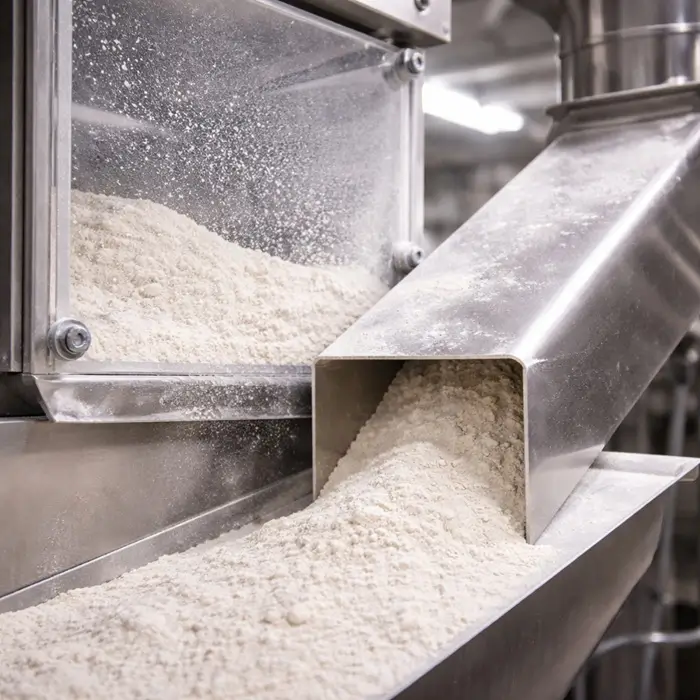
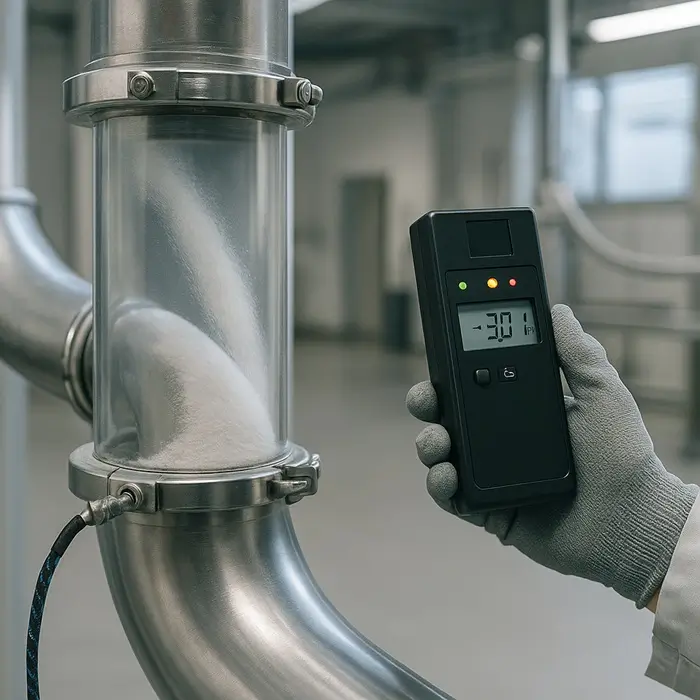
A powder line can behave well for weeks, then become erratic after one dry weather shift. Material starts sticking to polymer sight glasses, build-up appears on stainless steel chutes, and refill behavior becomes inconsistent. Operators often assume the powder has changed. Sometimes it did not. Sometimes the major change was relative humidity. That is why triboelectric charging in powders remains one of the more frustrating plant problems. It sits at the intersection of material properties, surface conditions, and environment.
The science behind contact electrification is still not fully settled. That is not a sign of weak physics. It reflects a real complexity at the interface. Reviews still describe triboelectric charging as an unresolved field, especially once you move beyond clean, ideal materials and into ambient conditions with polymers, oxides, roughness, contamination, and adsorbed water.
For powder engineers, that unresolved status has a practical consequence. A static problem is rarely explained by one neat number. A triboelectric series can point in a direction, but plant behavior depends on more than bulk composition. It depends on what is actually touching the powder, what the surface looks like that day, and what the humidity window is during charging and discharge.
Check out the Nature Communications, “Quantifying and understanding the triboelectric series of inorganic non-metallic materials” — relevant here because it provides a quantitative materials dataset and shows that, in inorganic non-metallic systems, triboelectric output is strongly related to work function.
Why Triboelectric Charging in Powders Is Hard to Predict
In simple systems, the work function can be a useful guide. A 2020 Nature Communications study quantified triboelectric charge density for nearly 30 inorganic nonmetallic materials and found a strong relationship between triboelectric output and work function. That matters because it confirms that electron transfer is not an outdated idea. In some material classes, it remains a powerful predictor.
However, powders in production are not simple systems. Real particles do not present clean textbook surfaces. They carry oxidation, trace residues, absorbed moisture, roughness, surface heterogeneity, and handling history. For polymers and other insulators, that matters even more. Williams argued that the classical work function picture becomes incomplete for insulating polymers because charge transfer depends on localized surface states and occupancy, not one tidy bulk value.
That distinction matters in practice. A plant does not handle “polymer” or “oxide” in the abstract. It handles particles that have been milled, dried, conveyed, stored, blended, and discharged through equipment surfaces with their own histories. Therefore, if you want to understand triboelectric charging in powders, start with the real interface, not the idealized material label.
Surface Chemistry Often Decides the Outcome
Surface chemistry is where the article becomes directly relevant to powder handling. The surface is what touches the chute, the liner, the valve, the filter housing, or the capsule component. If that outer layer changes, the charging behavior can change with it. A comparative powder electrostatics study showed this clearly. Biegaj and co-authors modified glass beads with different surface groups and found major differences in electrostatic behavior. The fluorinated surface accumulated 5.89 times more charge in tribocharging against stainless steel than the hydroxyl-rich surface. That result is useful because particle size and geometry were not the only story. Surface functionality itself strongly changed the charge build-up.
This is exactly why nominally similar powders can behave differently from batch to batch or site to site. One batch may have a more oxidized surface character. Another may have picked up residues during drying or storage. A third may contact a different polymer liner or a worn stainless finish. Those differences can shift how easily charge forms and how long it survives. In plant terms, that can mean the difference between a clean discharge and persistent wall build-up. That last step is an engineering inference from the measured surface-chemistry effects, but it is a well-grounded one.
Humidity Changes the Charging Regime
Humidity is not simply a “more or less static” dial. It changes the interface itself. Schella and co-authors studied polymer granulates shaken in a stainless steel container while controlling humidity from 5% to 100% RH. They found strong charging at low humidity, below roughly 30% RH, and almost no charge accumulation above 80% RH for several materials in that setup. They also found that the transition depended on the material and that the charge sign related to wettability. This is one of the clearest practical demonstrations that relative humidity can move a system into a different charging regime.
Why does that happen? At low RH, electron-transfer arguments often do a reasonable job. As RH increases, adsorbed water alters surface conductivity and charge dissipation. It also changes the local chemistry of the interface. Recent work in Nature Communications argues that thermodynamically driven ion transfer likely influences contact charging of polymers and that interactions involving water and water-ions near the polymer-water interface help explain observed trends.
That shift matters in powder processing. A blend that behaves acceptably during a humid summer week may become far more adhesive during dry winter handling. A grounding improvement may reduce nuisance discharge yet leave wall deposition largely unchanged if the main issue is charge generation at a polymer contact surface. Likewise, a formulation aid that helps at one RH can disappoint at another. Those are engineering implications, but they follow directly from the fact that humidity affects both charge generation and charge relaxation.
Where Triboelectric Charging in Powders Shows Up in Plants
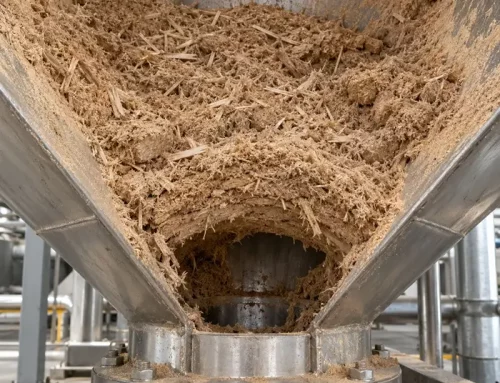
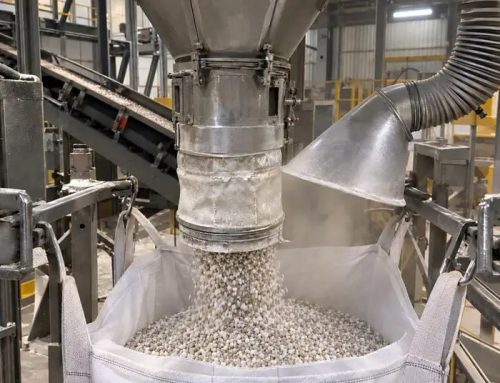
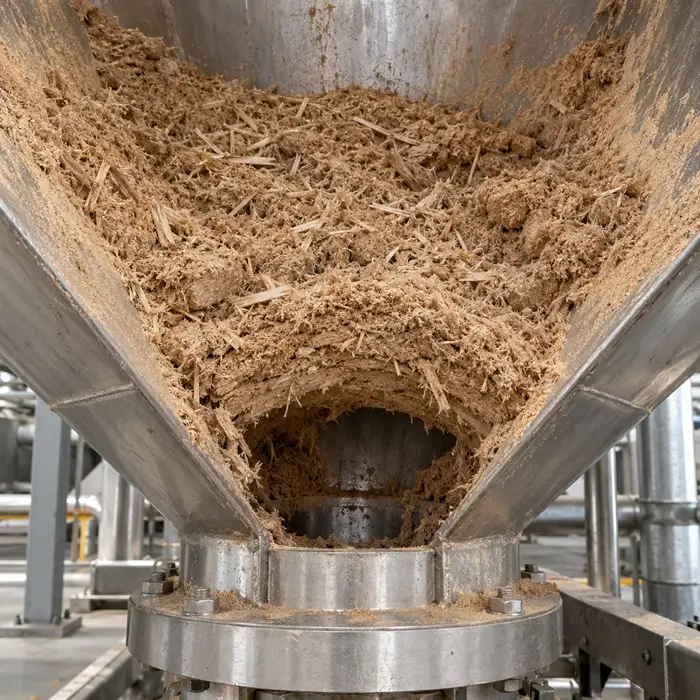
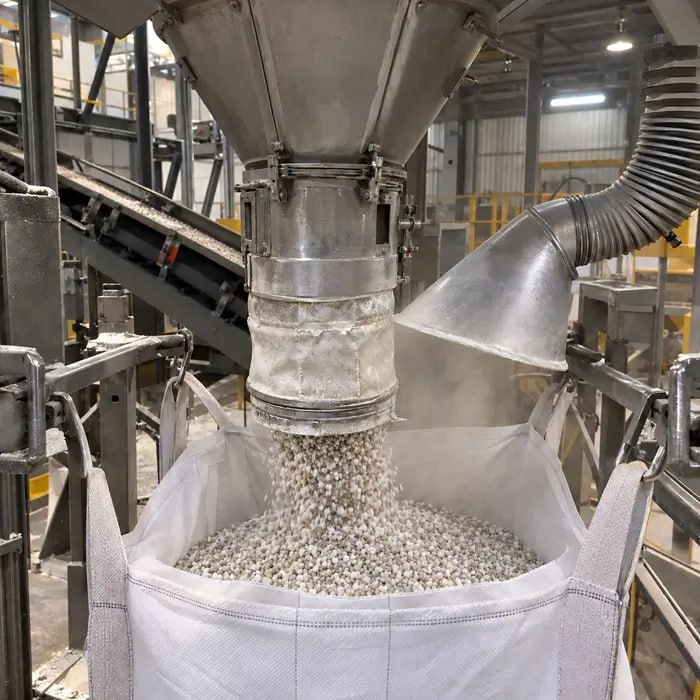
Engineers usually do not first notice triboelectric charging by measuring charge density. They notice symptoms. They see powder clinging to transfer chutes. They see fines collected on polymer guards. They see inconsistent refill behavior in feeders. They see wall build-up in hoppers, erratic discharge from containers, or dust that seems to “seek out” nonconductive surfaces. In more contained operations, they may also see product retention in flexible connections or poor release from plastic contact parts. These plant symptoms are consistent with the mechanisms described above, even though the exact expression depends on process geometry and powder properties.
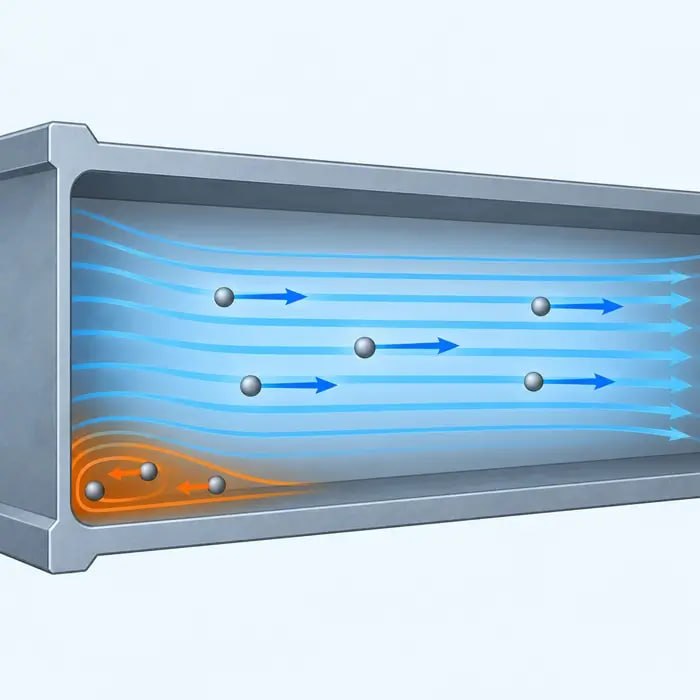
The important point is that those symptoms do not all point to the same fix. If the main issue appears after a refill, fresh contact and separation events may be dominating. If sticking worsens mainly in winter, the RH window may be driving the shift. If problems occur mainly on polymer components rather than grounded stainless steel, the interface itself may be the first thing to challenge. That is a more useful diagnostic mindset than assuming the powder has suddenly become “more static.”
What Engineers Should Check First
When triboelectric charging in powders starts affecting performance, start with four questions.
1. What is the real contact pair?
Powder against stainless steel is one case. Powder against polyethylene, PTFE, polyurethane, acrylic, or coated steel is another. The actual contact pair is often more important than the nominal equipment type.
2. What is the RH window during the failure?
Do not use a building average if the problem happens in a local enclosure, near a dryer, or during winter refill. The relevant RH is the one at the charging interface, during the actual event. Strong humidity sensitivity in charging has been demonstrated experimentally.
3. Has the surface changed?
Cleaning chemistry, oxidation, wear, coatings, residues, and aging can all alter surface chemistry. If the line once behaved and now does not, the surface state is a serious suspect. Surface-functional-group changes are known to shift electrostatic behavior strongly.
4. Where in the process does the charge seem to matter most?
Charging can be generated during conveying, blending, refilling, sieving, dosing, discharge, or packaging. The place where symptoms appear is not always the place where charge is created. However, mapping the worst symptom window often narrows the mechanism quickly. This is an engineering inference, but it is the right one to make from a contact-electrification standpoint.
Why Simple Fixes Often Fail
Grounding helps with charge removal from conductive components. It does not automatically solve a problem that is being generated continuously at insulating interfaces. Raising humidity can reduce charging in some systems, but it may not be acceptable for product stability. Changing one polymer liner can outperform a much broader “antistatic program” if that liner was the dominant charging interface all along. In other cases, a surface treatment or formulation change may matter more than RH alone. That variability is exactly what the literature now points to: multiple mechanisms can coexist, and the dominant one depends on the interface and environment.
So the better rule is this: do not ask for the universal static fix. Ask which interface is producing the troublesome charge under the conditions your process actually sees.
The Direction of the Science
The science is moving in a useful direction. Instead of forcing every case into one universal mechanism, newer reviews describe contact electrification as a system where electron transfer and ion transfer can coexist, with different interfaces favoring different dominant pathways. That is a better fit for plant reality. It explains why one material pair can look predictable in dry conditions yet behave differently when water adsorption becomes part of the interface.
For powder handling, that means the old idea of a static series is not enough. A more useful model links charge behavior to three things at once: the contacting pair, the surface state, and the humidity range. That framework is more demanding, but it is also more actionable. It leads engineers toward the variables they can actually test and change.
Conclusion
Triboelectric charging in powders is an interface problem shaped by the environment.
Work function still matters. Surface chemistry often matters more in practice. Humidity can change both charge generation and charge decay, and in some systems, it can shift the dominant mechanism itself. That is why the same powder can behave differently across plants, across seasons, and across equipment surfaces.
If static is hurting flow, release, dosing, or cleanliness, do not start with a generic triboelectric chart alone. Start with the real contact pair, the RH window, the surface condition, and the process step where symptoms appear. That is where the mechanism becomes visible. That is also where the fix becomes more likely.