
Table of contents: calcium carbonate dosing errors
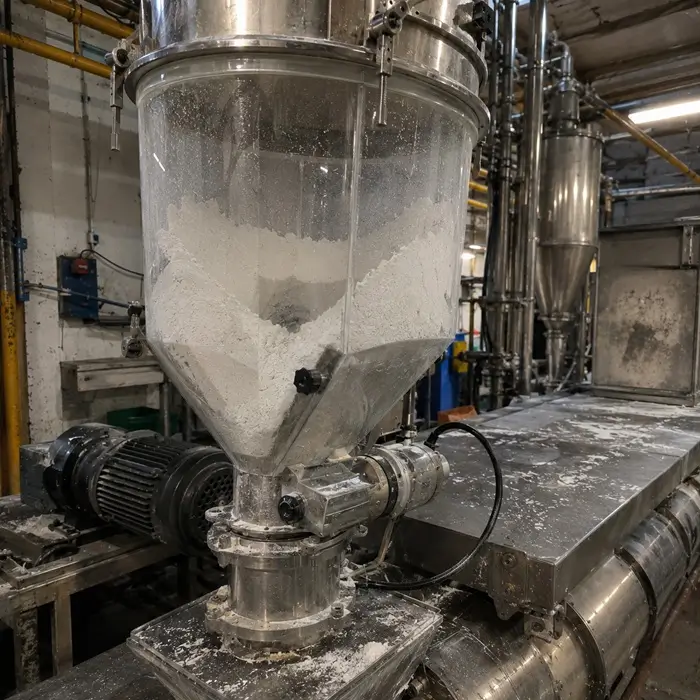
Calcium carbonate is a common mineral filler in polypropylene compounding. It improves stiffness, lowers formulation cost, and supports many routine plastics applications. However, fine calcium carbonate powder can create a dust problem during transfer, storage, refill, and feeding.
Oil-based dust suppression can make that dust problem less visible. It can also change the way the powder behaves in a loss-in-weight feeder.
Dust Control Can Change Feeder Behavior
One practical response to calcium carbonate dust is to spray the powder with mineral oil or another dust suppression liquid. In many plants, this appears to solve the immediate problem. Fine particles become less airborne. Operators see less visible dust around transfer points. Housekeeping improves.
Then another problem appears.
The loss-in-weight feeder starts to behave unevenly. The feeder weight signal trace may show a sawtooth pattern. The feeder refills, the weight signal settles briefly, then begins to drift. The control system corrects screw speed, but the correction does not match the actual material flow. Downstream, the polypropylene compound shows filler-content variation. Mechanical properties become less consistent, and the batch may move outside the specification.
The oil is not bad in a general sense. It simply changes the powder, and that change affects powder flowability, refill behavior, and dosing stability. The same treatment that reduces visible dust can also shift the powder into a more cohesive handling state.
Two Surface Treatments, Two Mechanisms
Calcium carbonate used in plastics is often supplied with a surface treatment. The treatment affects dispersion, powder flowability, moisture sensitivity, powder dustiness, and compatibility with the polymer matrix.
Two common approaches behave very differently.
Stearic Acid Treatment Reduces Friction
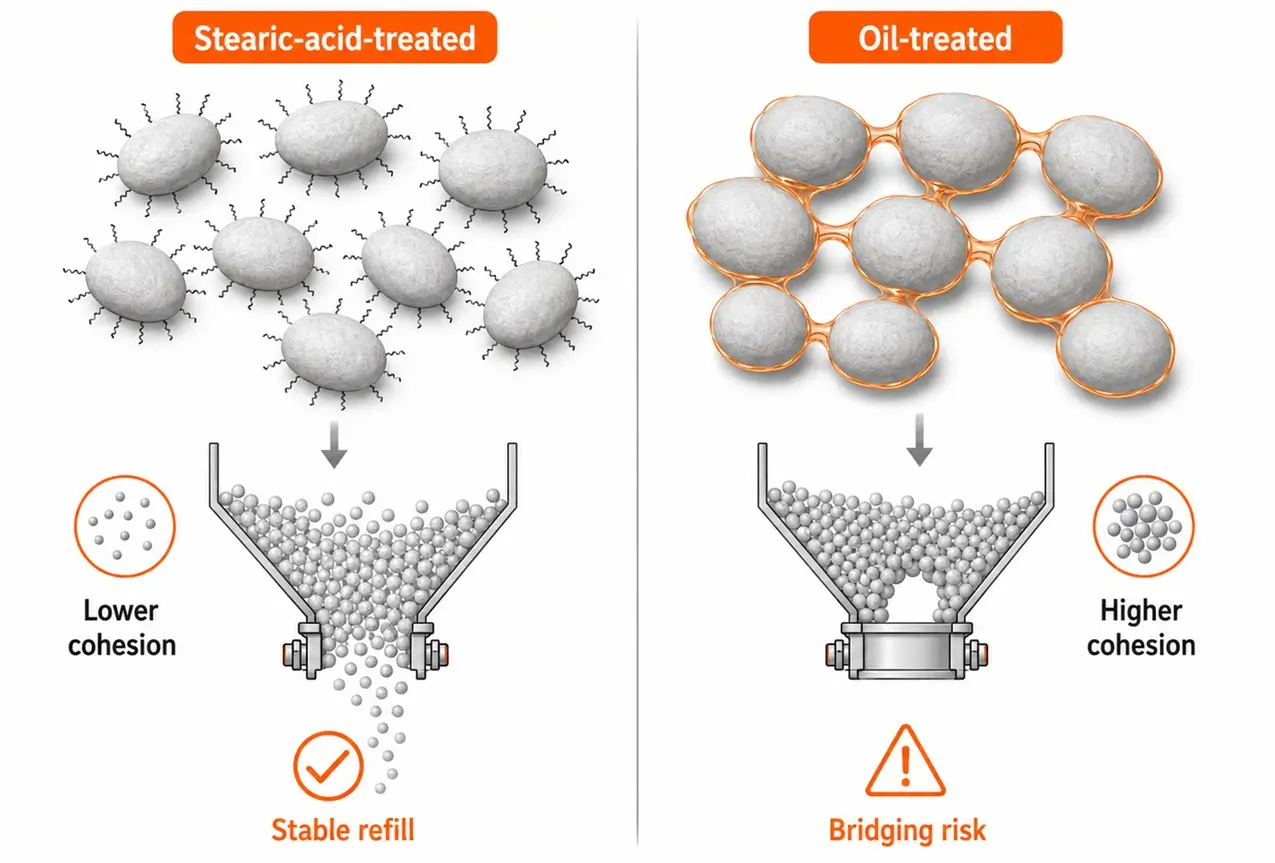
Stearic acid treatment modifies the calcium carbonate surface. The carboxyl group of stearic acid interacts with calcium-rich sites on the particle surface, while the hydrocarbon chain points outward. The treated surface becomes more hydrophobic and generally less adhesive. In plastics compounding, this can improve dispersion and reduce friction between particles [1].
This mechanism has been observed in feeder-relevant research. Kimata, Tsujikawa, and Matsumoto examined aluminum hydroxide and calcium carbonate powders treated with stearic acid in screw feeding. Their 2001 study found that higher stearic acid concentration increased the feed rate and improved the relationship between screw speed and feed rate. They also linked feeder performance to bulk density and powder flowability measurements [1]. That matters because it connects surface treatment to actual feeder behavior, not only to laboratory flow indices.
For feeder performance, the practical result is often better flow. Particles are more likely to move past each other instead of locking into a cohesive structure. Dust tendency may also decrease because fines are less likely to detach freely from the treated surface.
Oil Treatment Can Increase Cohesion
Oil treatment for dust suppression works by a different mechanism. Mineral oil or paraffinic oil is sprayed onto the powder. It wets particle surfaces but does not form the same type of bonded surface layer as a properly applied fatty acid treatment. Fine particles stick to larger particles, which can reduce dust. However, the same liquid film can also increase interparticle attraction.
At low liquid contents, liquid bridges may form at particle contacts. These bridges can increase cohesion, especially after storage, vibration, consolidation, or repeated handling. The powder may still look dry, but its flow behavior has changed.
Dunstan et al. demonstrated the same capillary-structuring principle in a related calcium carbonate suspension system. Their 2018 Langmuir study showed that adding a secondary immiscible oil phase to hydrophobized calcium carbonate suspensions increased viscosity by several orders of magnitude through capillary structuring. A suspension is not the same as a dry feeder hopper, so the result should not be treated as direct proof for every oil-coated calcium carbonate grade. However, it strongly supports the mechanism: small liquid additions can create particle-particle attraction through capillary bridges.
This distinction matters. Stearic acid treatment tends to reduce friction and surface adhesion when correctly applied. Oil-based dust suppression can reduce dust while increasing cohesion through liquid-bridge effects. Both treatments can make a powder look cleaner. They do not create the same feeder behavior.
When particles remain separated, the powder can refill more consistently. When particles form a cohesive contact network, the bed can begin to support itself inside the hopper instead of flowing cleanly through the outlet.
Why Cohesion Disrupts Loss-in-Weight Feeding
A loss-in-weight feeder depends on predictable mass flow. The problem starts when the powder state changes during refill.
How the Refill Cycle Should Work
During normal operation, the feeder hopper sits on load cells. The screw discharges material while the control system tracks the decreasing weight. When the hopper reaches a refill trigger point, a valve opens and new powder drops into the hopper. The system pauses weighing during refill, waits for the weight signal to stabilize, then resumes gravimetric control.
For a free-flowing calcium carbonate powder, refill is usually straightforward. Powder drops into the hopper, the weight signal spikes briefly, and the control system resumes control after a short stabilization delay. The screw receives a consistent powder bed, and feed rate remains stable. Many well-matched loss-in-weight feeder systems are specified or operated around short-term accuracy targets of roughly ±0.5 to 1.0%, depending on material, rate, feeder configuration, and measurement window.
What Changes When the Powder Bridges
For a more cohesive powder, refill can become irregular.
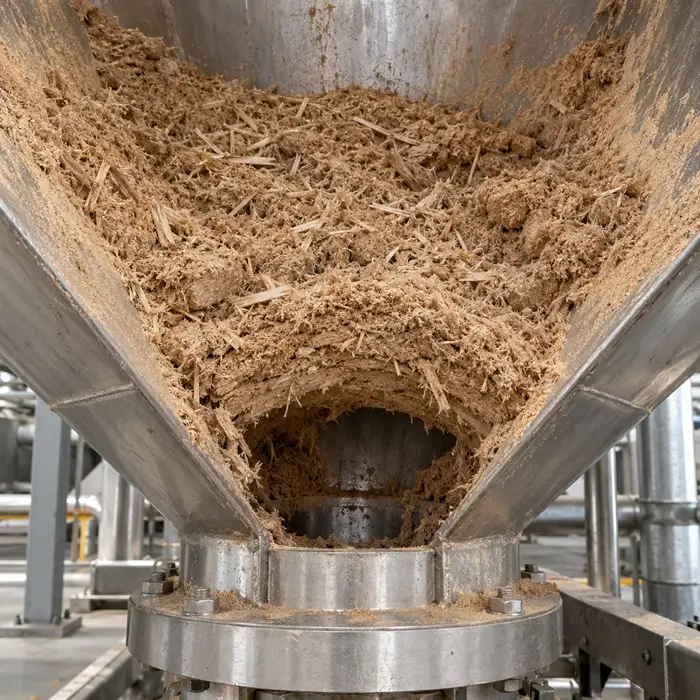
The powder may bridge above the hopper throat. It may rat-hole, with flow continuing through a narrow channel while stagnant material remains near the wall. During refill, part of the powder may hang up instead of dropping cleanly into the weighed hopper. The load cells then register a slower or incomplete mass increase. When the bridge collapses, a surge of powder enters the hopper at once.
This follows the same failure logic described in Why Free-Flowing Powders Still Arch in Hoppers: a powder can look manageable in a simple handling test and still form a stable obstruction under process stress.
Why the Control System Corrects the Wrong Problem
The control system sees a sudden weight change. It pauses, filters, and resumes weighing based on the programmed stabilization delay. If the powder is still settling, aerated, or mechanically unstable when weighing resumes, the control system corrects screw speed using poor information.
That is where the dosing error begins.
The screw may accelerate because the system thinks too little material is being delivered. Then a bridge collapses, and the screw suddenly receives a denser or larger material charge. The system then slows down. The next cycle repeats the same error. The feeder weight signal trace becomes unstable even though the screw, motor, and controller are functioning correctly.
Some refill problems also overlap with air retention. If the powder changes state after filling, the feeder may see alternating dense and aerated material. That mechanism is discussed in Deaeration Lag: Why Easy-Flowing Powders Still Surge.
Why ±3% Variation Matters
In that context, ±3% short-term variation is not just a small drift. It is a three- to six-fold degradation compared with a feeder running near ±0.5 to 1.0%. Strongly cohesive powders, poor refill design, short stabilization delays, or unstable hopper discharge can perform worse.
The exact number still depends on feeder design, hopper geometry, refill strategy, screw selection, control settings, and powder condition. However, the direction is clear: once refill becomes irregular, the feeder loses the stable mass signal it needs for accurate control.
Moisture Can Make the Diagnosis Less Obvious
Mineral oil is not the only variable. Calcium carbonate, oil treatment, and ambient humidity can interact in awkward ways.
A free liquid film may change how moisture reaches the particle surface. In some cases, oil can partly mask short-term moisture pickup by coating contact points or reducing direct exposure of the mineral surface. In other cases, the combination of fine particles, residual moisture, and oil can make cohesion worse because several weak bonding mechanisms act together. The feeder then shows the same symptoms: bridging, delayed settling, refill instability, and output variation.
This is why moisture should not be dismissed just because the powder is oil-treated. A plant may blame oil when humidity is the trigger, or blame humidity when the oil treatment has made the powder more sensitive to storage time and consolidation. Short humidity events can also change powder behavior before average climate data looks unusual, as discussed in When Humidity Spikes Hit Your Powder Flow.
The practical check is simple. Compare incoming powder, day-bin powder, and feeder-hopper powder for moisture content, bulk density, flow behavior, and refill trace stability. If the same grade becomes harder to feed after several hours in the bin, the problem is not only the supplier label. It is the powder state at the point of dosing.
The Dust Suppression Paradox
Oil-based dust suppression is used because it works.
A small liquid addition can reduce visible airborne dust during transfer, filling, and handling. It is also simple to apply. A spray nozzle in a transfer line costs less than changing the powder specification, buying a treated grade, or redesigning the handling system.
The trade-off may not appear immediately.
An oil-treated calcium carbonate powder can handle acceptably during the first part of a production run. After several hours in a day bin, the powder may behave differently. Consolidation increases contact points between particles. Vibration from surrounding equipment can help redistribute the liquid film. Air escapes from the powder bed. Moisture exposure may also change the powder’s response. Bulk density changes. The powder that reaches the feeder in the afternoon may not behave like the powder that entered the bin in the morning.
The operator sees the feeder surging and starts adjusting the feeder. That is understandable. The instability appears at the feeder. However, the feeder may only be revealing a powder-state change that began upstream.
That is the dust suppression paradox: the visible dust problem is solved, while the invisible cohesion problem moves into the dosing step.
When Oil Treatment Remains the Only Practical Option
Some plants cannot immediately switch to stearate-treated calcium carbonate. The supplier may not offer it. The current formulation may be locked. Purchasing contracts, customer approvals, or cost constraints may prevent a rapid change.
In that case, the goal is to reduce the dosing penalty.
First, review the refill stabilization delay.
For a cohesive or slowly settling calcium carbonate powder, a short delay may be too optimistic. Extending the delay gives the powder bed more time to settle before the control system resumes weighing. This does not fix the powder, but it can reduce false screw-speed corrections. The trade-off is slightly less gravimetric control time per hour and, in some cases, lower maximum throughput.
Second, evaluate agitation carefully.
A low-speed agitator can reduce bridging and maintain movement near the screw inlet. However, agitation must match the powder and feeder design. Too much agitation can compact some powders, disturb refill consistency, generate more fines, or create alternating dense and aerated states. The target is controlled movement, not powder disturbance.
Third, check whether the oil level is higher than necessary.
Some plants over-apply dust suppression oil because the original setting became a habit. A controlled trial at lower addition levels may identify a practical operating window: enough dust reduction, but less cohesion penalty. This trial should include both dust observation and feeder data.
How to Check Whether Oil Treatment Is the Problem
Start with the feeder trace, then test the powder. Take calcium carbonate samples from the incoming material, the day bin, and the feeder hopper. Compare them rather than testing only one sample.
Measure the angle of repose using a consistent funnel method. Interpret the result cautiously:
- Below 40°: usually free-flowing or only mildly cohesive.
- 40° to 50°: moderately cohesive; feeder variability becomes more likely.
- Above 50°: strongly cohesive; bridging, rat-holing, and refill instability are more likely.
Then run aerated and tapped bulk density tests. Calculate the Hausner ratio:
Hausner ratio = tapped bulk density / aerated bulk density
A value above 1.4 often indicates cohesive behavior. However, this test is only a screening tool. It does not fully predict feeder behavior, especially when wall friction, liquid bridging, consolidation, or aeration sensitivity are involved.
For a stronger diagnosis, combine several checks:
- Compare incoming powder with day-bin powder after several hours of storage.
- Review the loss-in-weight feeder refill trace.
- Measure moisture before and after bin residence time.
- Ask the supplier for the exact surface treatment and dosage.
- Use shear cell testing if bridging or rat-holing is suspected.
- Measure wall friction if hopper discharge is inconsistent.
- Run a short feeder trial with untreated, oil-treated, and stearate-treated grades if available.
If the powder becomes more cohesive after storage, and the supplier confirms oil-based dust suppression, the likely failure route is clear. The powder specification has changed the feeding condition.
For a practical test-selection framework, see Selecting the Right Powder Flow Test Method and Shear Cell Testing: Mastering Powder Flow Behavior.
What This Means for Polypropylene Compounders
The dosing problem may appear at the feeder, but the cause may sit in the calcium carbonate surface treatment.
Oil-based dust suppression can reduce visible dust. The same liquid film can also increase cohesion, especially after storage, vibration, consolidation, or humidity exposure. That cohesion can disturb refill behavior, delay settling, and create unstable screw feeding.
Before replacing the feeder, changing the screw, or tuning the controller again, check the powder.
Ask what surface treatment was used. Compare flow behavior before and after storage. Review the refill trace. Test for cohesion and moisture. Then decide whether the issue belongs in the feeder settings, the hopper design, or the material specification.
The visible problem may be dust. The process problem may be cohesion. The commercial problem may be rejected compound.
A good fix addresses all three.
FAQ: Calcium Carbonate Dosing Errors
References and Further Reading
[1] Kimata, M., Tsujikawa, H., & Matsumoto, K. (2001). Effect of Bulk Density and Flowability of Powders on the Feed Rate of Screw Feeder. Journal of the Society of Powder Technology, Japan, 38(1), 18–24.
https://doi.org/10.4164/sptj.38.18
[2] Dunstan, T. S., Das, A. A. K., Starck, P., Stoyanov, S. D., & Paunov, V. N. (2018). Capillary-Structured Suspensions from in Situ Hydrophobized Calcium Carbonate Particles Suspended in a Polar Liquid Media. Langmuir, 34(1), 442–452.
https://pubmed.ncbi.nlm.nih.gov/29239178/
[3] Coperion. Conveying and Feeding of Calcium Carbonate in Plastics Compounding.
https://www.coperion.com/media/3690/2013_calciumcarbonate_en.pdf
[4] Coperion. Calcium Carbonate Handling and Feeding.
https://coperion.com/en/industries/minerals/calcium-carbonate