Specialized Powder Processing Techniques

Specialized powder processing techniques push the boundaries of material innovation. From nano-particle processing and 3D printing to cryogenic milling and sol-gel synthesis, these methods enable precise control over powders for advanced applications. Encapsulation techniques add functionality, protecting active ingredients or enabling controlled release. These processes ensure materials meet stringent demands across industries, supporting breakthroughs in technology and performance.

Featured Specialized Powder Processing Techniques Articles

  • Sieve blinding in powder screening showing near-size wedging, fine-particle coating, agglomeration, and bed overload on a vibrating sieve.

    Sieve Blinding: Why Powder Screens Fail Before the Particle Size Spec Does and How to Solve it

    Sieve blinding does more than reduce screening capacity. It changes the material stream. Once particles block, coat, or overload the mesh, the screen no longer applies the intended cut point. That can shift the coarse and fine balance entering the next process step, even when the incoming powder still appears to meet [...]

  • Operator inspecting a stainless-steel process line to minimize changeover losses in continuous powder lines.

    Changeover Losses in Continuous Powder Lines: 5 Fast Wins to Boost Efficiency

    Changeovers can quietly waste hours and tons of product in continuous powder lines. The cause is rarely a single fault. Most losses stem from small oversights that add up—sticky residues, trapped air, timing mistakes, or slow cleanups. Focusing on five targeted actions can reclaim yield, reduce downtime, and improve consistency without incurring new [...]

  • Macro view of laser-assisted bioprinting: a clean ligament ejects a micrometer droplet onto a glass substrate patterned with droplets.

    Case Study: Powder Technology Principles in Laser-Assisted Bioprinting

    Table of contents Executive Summary laser-assisted bioprinting powder principles show the benefits of particle thinking. Treat every printed droplet as a living particle. Then use the same physics that guide powders to design jetting, impact, packing, and maturation. This frame reduces trial and error and gives teams a shared [...]

  • Powder Technology Guide

    The Ultimate Guide to Powder Technology

    Powder technology is the backbone of precision manufacturing and process optimization. Industries that master it, through deep control of particle size, flowability, and morphology, gain critical advantages in processes like mixing, granulation, milling, and blending. Whether developing pharmaceuticals, producing food powders, printing metal parts, or enhancing materials, success hinges on understanding how powders [...]

  • Advanced Powder Characterization

    Advanced Powder Characterization Techniques

    In this article, we will take a glance at the Advanced Powder Characterization techniques, that are currently available. Characterizing powders is a deceptively complex challenge. At first glance, it might seem that measuring particle size, bulk density, or flowability should tell us all we need to know. But anyone working with powders knows better. [...]

newsletter icon

News And Articles In Your Inbox

Sign up and receive PowderTechnology.info news, articles, and content from our partners in a quick and easy monthly newsletter.

You have been successfully subscribed.
There was an error trying to subscribe. Please try again later.
Specialized Powder Processing Techniques - Nano-Particle Processing

Specialized Powder Processing Techniques: Nano Particle Processing

Nano-particle processing focuses on creating and manipulating particles at the nanometer scale to achieve enhanced material properties. By reducing particle size, these techniques increase surface area, reactivity, and functionality, enabling breakthroughs in fields like pharmaceuticals, electronics, and advanced coatings. Nano-particle processing ensures precision and consistency, supporting the development of innovative materials for cutting-edge applications.

Featured Nano Particle Processing Articles

  • Powder percolation threshold measurement setup with probe station, conductive trace, and connected LCR meter in a lab.

    Powder Percolation Threshold and Conductive Networks in Composite Feedstocks

    The powder percolation threshold is the point where conductive particles form a continuous network. Near that point, small changes in dispersion, drying, shear, or oxide growth can swing resistivity by orders of magnitude. Therefore, treat conductivity as a process-controlled property, not only a formulation outcome. Table of contents [...]

  • Core-shell and coated powders on a lab bench in sample vials, prepared for surface analysis and sintering studies.

    Core-Shell and Coated Powders for Controlled Interparticle Chemistry

    Core-shell and coated powders let you engineer surface chemistry, improve handling stability, and control sintering and binder wetting by tuning the outer few nanometers. Table of contents When you think about it, powder manufacturing depends on surfaces. Core-shell and coated powders make that dependence usable. [...]

  • Hand scooping infant formula powders into a baby bottle on a wooden board.

    The complexities of infant formula powders

    Infant formula powders are far more demanding than simple food powders. Safe infant formula powders depend on tight control of formulation, spray drying, agglomeration, emulsion stability, and packaging, so fragile nutrients stay stable and absorbable from production line to feeding bottle. Table of contents Infant [...]

Specialized Powder Processing Techniques: 3D Printing

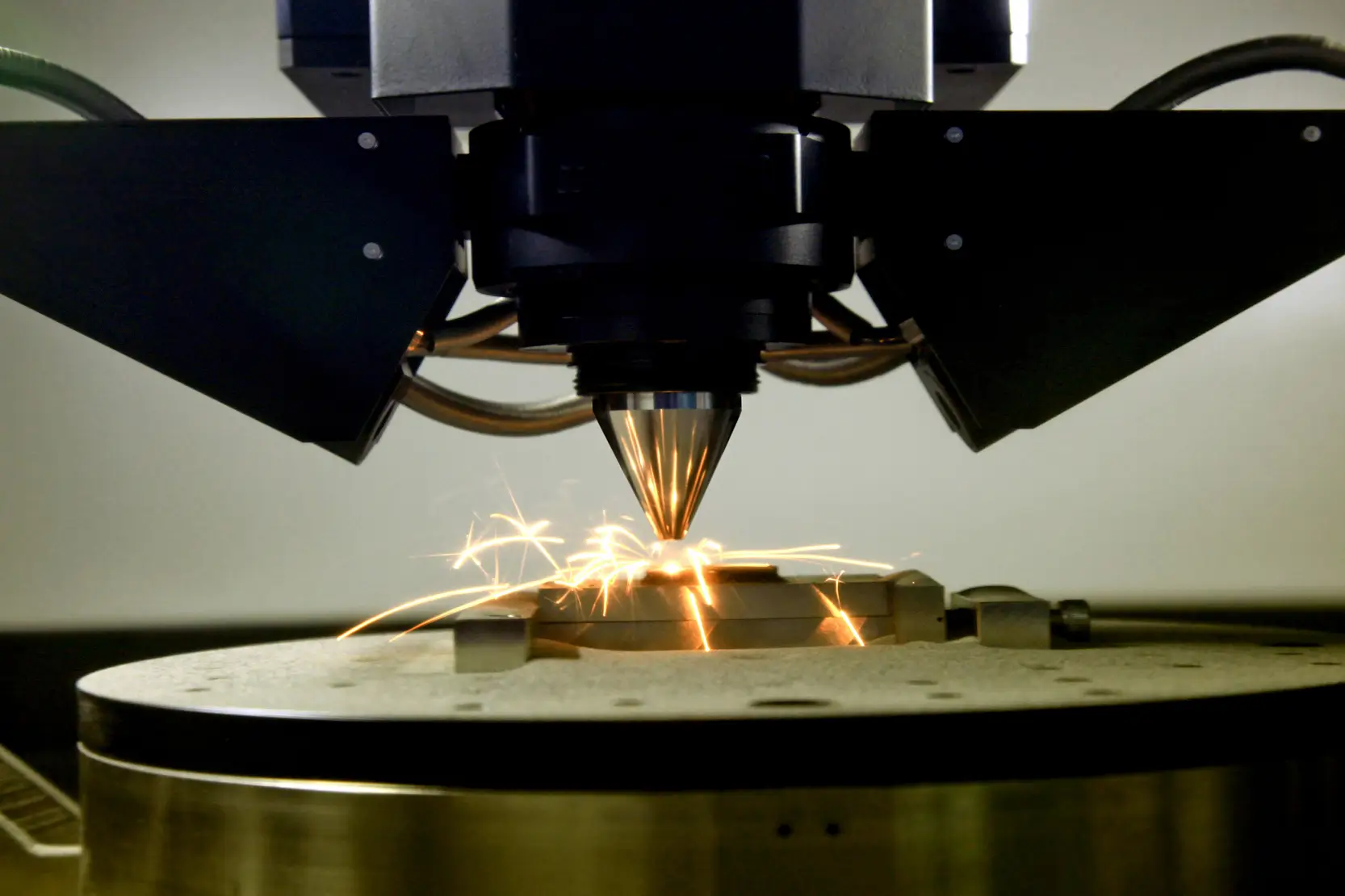
3D printing with powders revolutionizes manufacturing by transforming raw materials into complex, high-precision components. Techniques like powder bed fusion, binder jetting, and direct energy deposition enable the creation of intricate geometries with minimal waste. This process is essential for industries such as aerospace, healthcare, and advanced engineering, where precision and material efficiency are paramount. With powders tailored for flowability, particle size, and composition, 3D printing continues to drive innovation in modern manufacturing.

Specialized Powder Processing Techniques - 3D Printing

Featured 3D Printing Articles
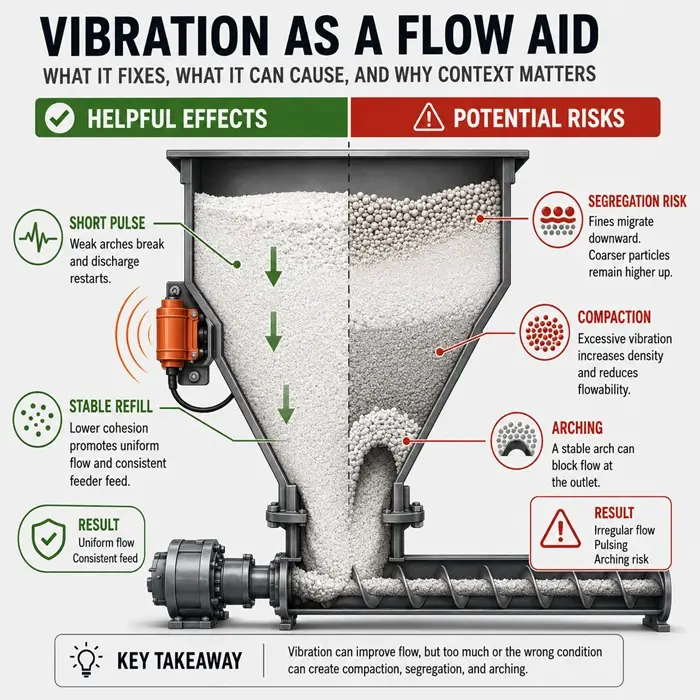
  • Technical diagram of vibration as a flow aid showing hopper discharge, compaction, segregation risk, and feeder stability.

    Vibration as a Flow Aid: When It Helps Powder Flow

    Vibration can improve powder discharge when it breaks a weak arch or releases a local obstruction. However, it can also compact the powder bed, increase segregation, change bulk density, and destabilize feeding. Use vibration as a flow aid only when it matches the failure mechanism. Vibration changes the [...]

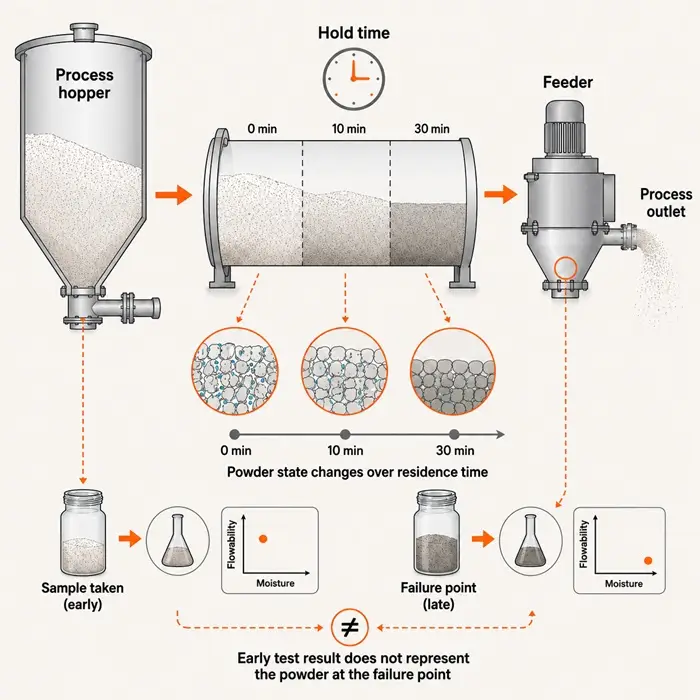
  • Powder residence time diagram showing how an early sample can differ from the powder state at the failure point

    Powder Residence Time Can Make the Test Result Miss the Failure

    Powder residence time matters because the sample and the failure often describe different moments. A powder tested after drying, blending, conveying, or filling may not be the same powder that reaches the feeder, press, filler, or package later. Hold time can change air content, moisture, bulk density, temperature, consolidation, fines distribution, and segregation [...]

  • Technical illustration comparing stable hopper discharge at adequate fill level with unstable powder flow, arching risk, and pulsing at low fill level.

    Why Hopper Fill Level Changes Powder Discharge

    Do not diagnose a feeder as if the hopper sends it one constant powder. After a refill, the powder near the outlet may still be aerated. Minutes later, the same material may be denser, less permeable, and harder to move. A feeder problem usually announces itself at the [...]

More 3D Printing Articles

Specialized Powder Processing Techniques - Cryogenic Processing

Specialized Powder Processing Techniques: Cryogenic Processing

Cryogenic processing utilizes extremely low temperatures to modify the physical properties of materials, making it an essential technique for specialized powder applications. By freezing materials to cryogenic levels, processes such as milling and freeze drying can be performed without altering thermal-sensitive compounds. Cryogenic milling enables fine particle size reduction while preserving material integrity, and freeze drying ensures moisture removal with structural stability. This technique is widely used in pharmaceuticals, food, and advanced materials, offering precision and performance for challenging applications.

Featured Cryogenic Processing Articles
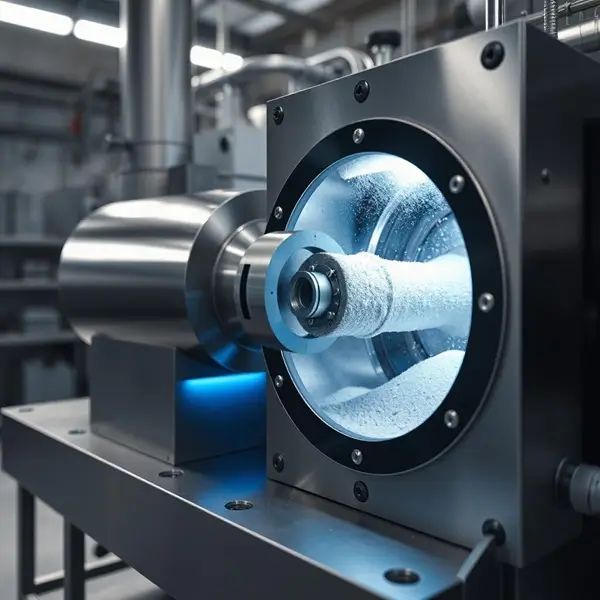
  • Cryogenic grinding of powders

    Cryogenic Grinding of Powders: What You Need to Know

    Unlocking the Potential of Cryogenic grinding of powders Cryogenic grinding is a powerful method for processing heat-sensitive materials, offering unmatched efficiency in particle size reduction while preserving material integrity. By using liquid nitrogen or other cryogenic gases to freeze materials before grinding, this technique mitigates the challenges posed by heat generation in conventional [...]

  • Liquid and Gas Processing Techniques drying

    Processing Techniques Involving Liquids and Gases – Drying (Part 4)

    In this series, we have thoroughly explored key processing techniques involving liquids and gases, delving deep into the intricacies of crystallization, granulation, and atomization. These articles have offered valuable insights into their underlying principles, diverse applications, and recent advancements. Now, as we bring this series to a close, we shift our focus [...]

  • Powder processing in regards to food

    Powder processing in regards to food

    Delft Solids Solutions has developed advanced, lab-scale powder processing methods that replicate industrial conditions, particularly for food applications like cocoa and infant formula. Through optimized cryogenic milling, granulation, high-shear mixing, protective coating, and pneumatic conveying simulations, they enhance product taste, stability, and nutritional quality. Their approach enables precise control over particle size, uniformity, [...]

More Cryogenic Processing Articles

More Cryogenic Processing Articles

Specialized Powder Processing Techniques: Encapsulation Techniques

Encapsulation techniques are transformative processes that enclose active ingredients, particles, or materials within a protective coating or matrix. This innovative approach enhances functionality by enabling controlled release, improving stability, and isolating reactive compounds. Encapsulation is widely used in pharmaceuticals, food, and advanced materials, offering precise delivery and improved performance. Whether through spray drying, microencapsulation, or advanced coating methods, encapsulation ensures materials are protected and perform effectively in their intended applications.

Specialized Powder Processing - Encapsulation Techniques

More Encapsulation Techniques Articles

Featured Encapsulation Techniques Articles

  • FIBC discharge problems technical illustration showing how the liner-spout interface can cause unstable discharge, dust release, and residual heel in a bulk bag emptying station.

    Why FIBC Discharge Problems Often Start at the Liner-Spout Interface

    FIBC discharge problems are often blamed on the powder being discharged too quickly. In many cases, the real issue sits lower down, at the outlet interface between the liner, discharge spout, receiving hopper, vent path, and bag support. That local geometry can decide whether a big bag empties cleanly, surges, releases dust, or [...]

  • Engineer in a powder processing plant reviewing a tablet that visualizes control banding for powders near a ventilated big bag discharge station.

    Control banding for powders: making incomplete data actionable

    Control banding for powders turns incomplete hazard data into a clear exposure control strategy. It links powder properties, task exposure and engineering controls so plants can make consistent, defensible decisions instead of debating “safe enough” for every new material. Why control banding for powders matters now Most [...]

  • Powder discharging from a hopper, showing uneven flow due to prior handling and compaction

    Powder Memory: How Processing History Affects Behavior

    Powder memory explains why a powder’s behavior can change over time. Past handling, storage, or movement alters how powders flow, blend, or compact. By recognizing these changes, you can avoid many common process problems. Most powder issues do not come from size or shape alone. In fact, behavior often [...]

More Encapsulation Techniques Articles

Editor’s Picks