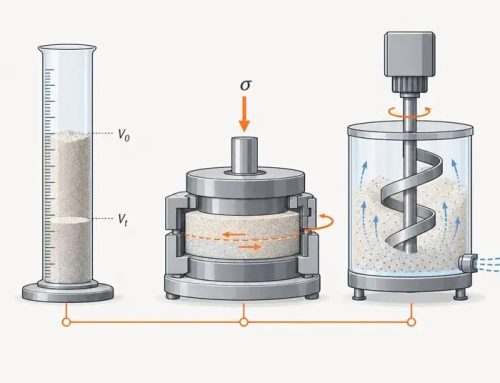

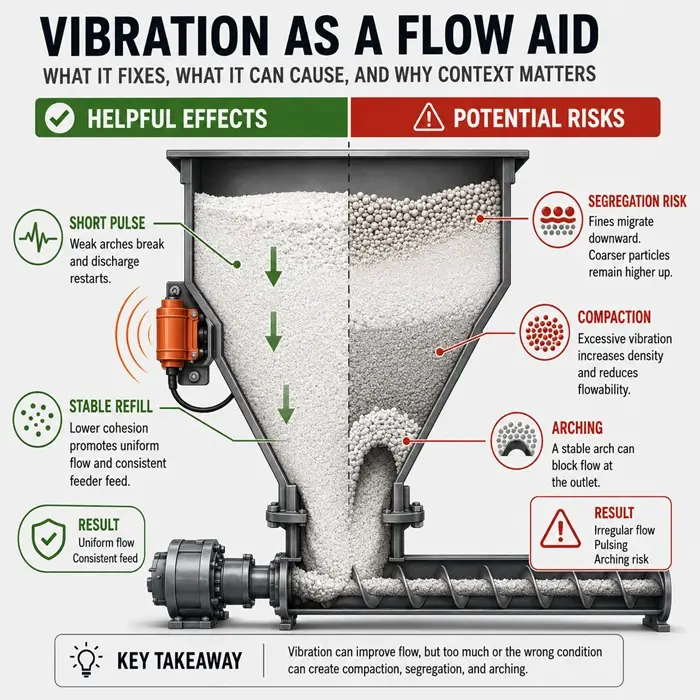
Vibration changes the powder’s mechanical state, not just whether it discharges. It alters stress, packing, contact stability, local particle movement, and the way the powder enters the next process step.
Vibration as a flow aid is often added when powder hangs up, bridges, ratholes, or discharges inconsistently from a hopper, bin, chute, or feeder. In many plants, hopper vibration, bin vibration, or another vibratory flow aid seems like a practical response. If the powder does not move, shake the system until it does.
That logic is understandable, but incomplete. Vibration does not act on powder flowability as a single property. Instead, this mechanical flow aid changes the stress state, packing structure, contact conditions, and local movement of particles inside the powder bed.
Vibration Changes the Powder’s Mechanical State
Those changes may support discharge. However, they can also create a new problem downstream.
A powder that forms a weak local arch may respond well to short, controlled vibration. The applied energy disturbs the contact network and can collapse the obstruction near the outlet. Yet a powder that tends to consolidate may respond differently. Repeated vibration can densify the bed, increase particle contact, and make discharge less reliable over time.
Therefore, vibration should be treated as a process input. It changes the powder condition, and that changed condition must still feed, dose, blend, pack, or discharge reliably.
When Vibration Can Support Discharge
Vibration works best when the flow problem is local, intermittent, and mechanically fragile. In those cases, the powder does not need a complete change in flow pattern. It needs a controlled disturbance at the right point.
Weak Arching Near the Outlet
Weak arching is one of the clearer use cases for vibration. A small arch above the outlet may collapse when vibration reduces the stability of the contact network. However, this is different from a persistent hopper design problem, where outlet size, hopper geometry, and powder strength control the blockage. For that distinction, see Free-Flowing Powder Arching in Hoppers Explained.
For this type of problem, short pulses are usually safer than continuous vibration. Start with low intensity and apply vibration for a few seconds at a time. Then check whether the arch collapses without surging, bulk density drift, segregation, or feeder instability.
If discharge resumes cleanly, vibration may be a useful support measure.
Light Wall Sticking
Vibration can also help when material is only lightly attached to a chute, hopper wall, or transfer surface. In that case, low to moderate vibration may reduce wall contact and help gravity restart movement.
However, sticky, tacky, or moisture-affected powders need a different level of diagnosis. Wall material, surface finish, temperature, humidity, cleaning, and product condition may control the problem more than vibration intensity. If discharge gradually degrades because the wall condition changes, compare the symptom with Wall Friction Drift in Hoppers before increasing vibration.
Stronger vibration is not always the correct next step.
Feeder Inlet Refill
Controlled vibration can sometimes support refill at a feeder inlet. For example, a screw feeder may fill more consistently when vibration helps powder move into the screw or dosing zone.
Even so, the dosing effect needs attention. The feeder may look more stable while the powder entering the screw becomes denser or fills the screw less consistently. With a gravimetric feeder, the control system may correct part of that variation. In a volumetric feeder, the same density or fill-consistency shift can directly change mass output.
As a result, smoother discharge does not always mean more stable dosing. If the symptom follows filling level, settling, or refill timing, also review Why Hopper Fill Level Changes Powder Discharge. That article is a useful companion when vibration appears to help at one fill level but creates drift at another.
When Vibration Can Make Flow Worse
Vibration becomes risky when it changes the powder bed in the wrong direction. The material may leave the hopper more easily for a short time, while the next process step becomes less stable.
Consolidation and Compaction
Fine, cohesive, or moisture-sensitive powders may settle into a denser structure under repeated vibration. Once the bed densifies, the powder may need more stress to yield. Bridging, outlet restriction, or sluggish refill can then become more likely.
Time-consolidated material needs extra caution. A powder that has sat under load in a hopper, bin, or intermediate container may already have gained strength before vibration starts. In that case, vibration is acting on a stressed and partly consolidated structure, not on a loose bed. The response may be delayed, uneven, or unstable.
Continuous vibration is especially risky in this situation. If bulk density rises after vibration, or if refill becomes worse after several vibration cycles, reduce the intensity, shorten the pulse duration, or stop the trial.
The better route may be reduced residence time, changed filling practice, improved hopper geometry, or another flow aid.
Stable Bridging
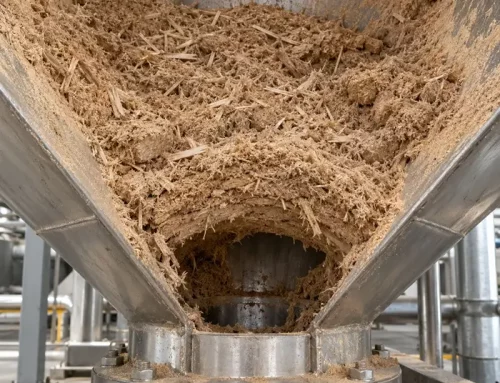
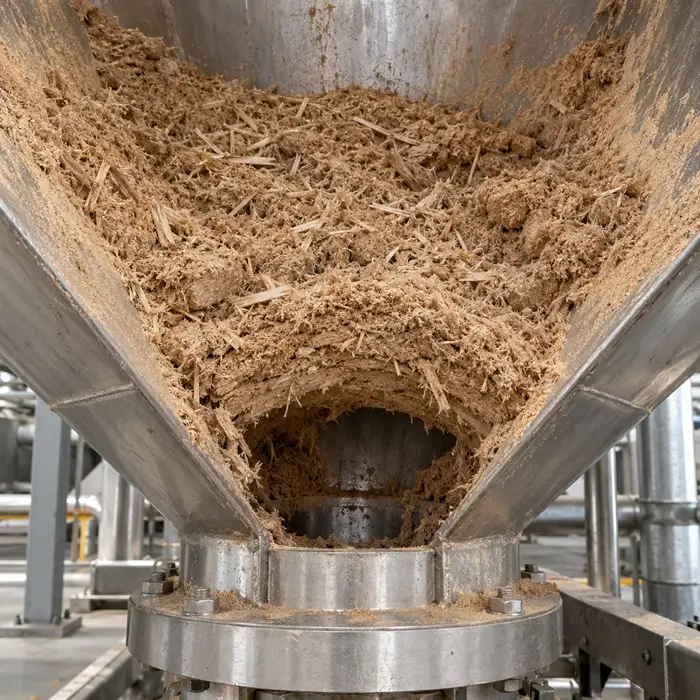
Stable bridging is less suitable for vibration than weak arching. A strong bridge often points to a deeper design or material issue. The outlet may be too small. The powder may have consolidated. The hopper angle or wall friction may also be unsuitable.
In that case, vibration may only delay the next blockage. It may restart flow once, but the same bridge can return after refilling, resting, or consolidation.
Before treating vibration as the main fix, check outlet size, hopper angle, wall friction, consolidation behavior, and residence time.
Ratholing
Ratholing creates a different problem. Vibration alone rarely corrects a poor flow pattern. If the symptom involves air resistance, rathole collapse, or sudden flooding after delayed discharge, compare the observation with Permeability Collapse in Hopper Discharge. That mechanism can make a vibration trial look inconsistent because the powder bed is also controlled by air escape and local permeability.
However, the flow pattern may still be wrong. If a central channel empties while material remains stationary around it, the priority is mass-flow behavior, outlet sizing, wall friction, or controlled-discharge geometry.
Vibration alone rarely corrects a poor flow pattern. If the symptom involves air resistance, rathole collapse, or flooding, compare the observation with Permeability Collapse in Hopper Discharge.
Segregation Under Vibration
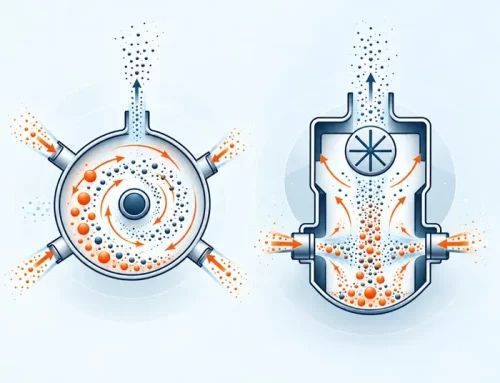
Vibration can increase segregation in broad particle size distributions. Smaller particles may percolate through voids between larger particles. Meanwhile, coarser particles may rise or remain higher in the bed.
This can change the blend reaching the feeder, press, mixer, or packaging line. The material may discharge, but the composition at the next step may no longer match the blend that entered the hopper.
If vibration changes blend uniformity, reduce vibration time, reduce intensity, shorten drop heights, or consider a gentler discharge method. For a broader diagnostic framework, see Powder Segregation Diagnosis During Mixing, Conveying, and Filling. The risk is also consistent with external research on vibration-induced granular segregation, where vibration can drive particle separation through multiple mechanisms.
Aerated or Loose Powders
Aerated powders can shift quickly under vibration. In some cases, vibration helps release air and collapse a loose structure. However, the powder can also change too quickly from a loose, mobile state into a denser, less responsive state.
That shift can affect fill weight, feeder response, dust release, and discharge rate. Therefore, aerated powders should be tested with short pulses and close observation.
The visible discharge rate is not enough. The downstream behavior must remain stable. When retained air, delayed settling, flooding, or unstable discharge is part of the symptom, compare the result with Fine Powder Fluidization in Pneumatic Conveying. Aerated powders may respond strongly to vibration because the intervention changes both particle movement and air release.
Use Operating Windows Before Fixed Settings
Vibration settings should be tested as an operating window rather than copied from another plant. Frequency, amplitude, force, mounting position, vessel stiffness, wall thickness, fill level, and powder condition all influence the result.
Experimental work on granular hopper vibration supports this caution. Vibration can extend flow and reduce jamming, but that does not mean it automatically solves rate stability, feeder consistency, or downstream quality. A successful restart still needs to be checked against bulk density, segregation, dust release, and feeder output.
Hopper Vibration Ranges
As a rough screening range, many external electric hopper vibrators operate around 750 to 3,600 rpm. That equals about 12.5 to 60 Hz.
Fine, dry powders generally belong toward the higher-frequency, lower-amplitude end of the range. Coarser, heavier, damp, or lumpy materials often need lower-frequency and higher-amplitude movement. That direction is consistent with supplier guidance on selecting vibration for bins, hoppers, and silos.
These values should not be treated as design limits. They provide a starting window for controlled trials.
Feeder Vibration Ranges
Feeder-style vibration can use a wider operating envelope. Vibratory feeders and conveyors may operate from a few hundred to several thousand cycles per minute, with amplitudes from about 1 to 40 mm depending on the design.
Those values should not be copied directly to a hopper wall. A rotary vibrator applies continuous centrifugal force, a pneumatic piston vibrator delivers repeated impacts, and a bin activator moves the outlet region more directly as part of the discharge geometry. Each device transfers energy into the powder bed differently, so the same nominal frequency or amplitude can produce a different material response.
Equipment type matters because the powder does not only experience frequency. It experiences the motion transmitted through the structure.
Pulse Duration and Trial Logic
For troubleshooting, start conservatively. Use short pulses of about 2 to 5 seconds. Then observe discharge, bulk density, refill behavior, dust release, and downstream stability.
A single successful pulse is not enough to judge the flow aid. As a practical screening rule, compare at least three similar discharge or refill cycles before drawing a conclusion. If the response is marginal, drifting, or linked to fill level, extend the check to five to ten cycles.
Also include a rest period when time consolidation is part of the real process. Material that has stood under load may respond differently from freshly filled powder.
During the trial, track the same signals each time: discharge restart, refill behavior, bulk density, feeder output, dust release, visible segregation, and downstream stability. If the first cycle improves but later cycles become denser, slower, dustier, or less uniform, vibration is probably shifting the problem rather than solving it.
A useful trial does not only ask whether material leaves the hopper. It asks whether the next process step becomes more stable.
Diagnose Before Increasing Vibration
Before adding or increasing vibration, separate the visible symptom from the controlling mechanism. A hopper that stops discharging may be arching, bridging, ratholing, compacting, sticking to the wall, or receiving powder in an unstable aeration state. In practice, this approach is the same diagnostic principle used in powder flowability testing: the useful test or intervention must match the failure mode.
The first check is where the problem appears. A blockage near the outlet suggests a different mechanism than stagnant material along the walls. The second check is when it appears. A problem after filling, resting, conveying, or repeated vibration gives important clues.
Then compare powder behavior before and after vibration. If vibration improves discharge but increases density variation, dusting, segregation, or feeder instability, the flow aid has moved the problem downstream.
That is the practical test. Vibration has worked only when it improves the process, not just the discharge point.