
A plant problem often starts with a contradiction: the lab result looks acceptable, but the process still behaves badly. Moisture is within limit, or bulk density looks stable. Yet the feeder pulses, the press weight drifts, or the packaged product settles more than expected.
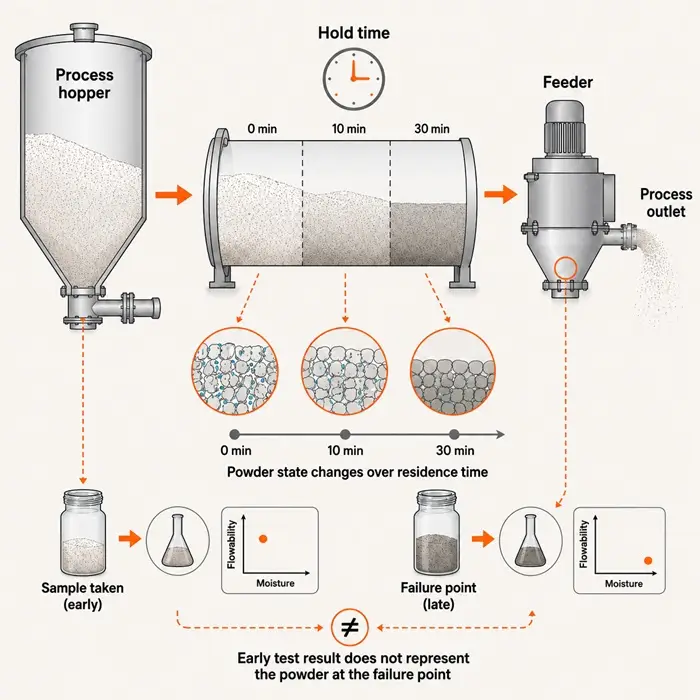
In many cases, the test is not wrong. It describes the powder before residence time changed the condition that reached the next process step.
Residence time is the time between the last reliable measurement and the point where the powder has to perform. That gap matters in hoppers, dryers, receivers, feeders, transfer buffers, compacting lines, filling lines, and packaging systems.
Waiting Changes Different Powders in Different Ways
Residence time does not have one effect. It depends on the material, the vessel, the surrounding air, and the stress history.
A fine, aerated powder may need time to settle before feeding becomes stable, especially after transfer conditions like those described in Fine Powder Fluidization in Pneumatic Conveying. In practical plant checks, the first meaningful bulk density change often appears within the first 5 to 15 minutes after filling. Some highly aerated powders may continue changing for 20 to 40 minutes before the bed approaches a more stable condition.
A hygroscopic powder can move in the opposite direction. It may leave the dryer within specification and then pick up moisture again during hopper storage, transfer, or open handling. For sensitive materials, the relevant difference is not the dryer outlet value. It is the moisture level at the feed throat, especially after exposure to plant air, warm equipment, or delayed processing.
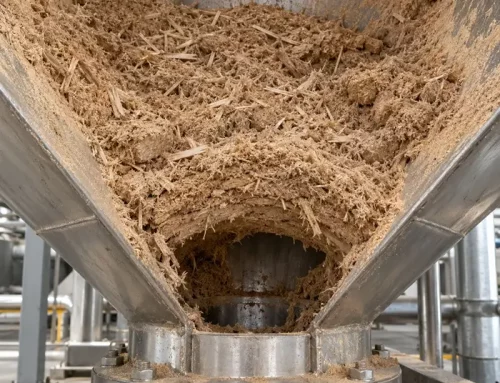
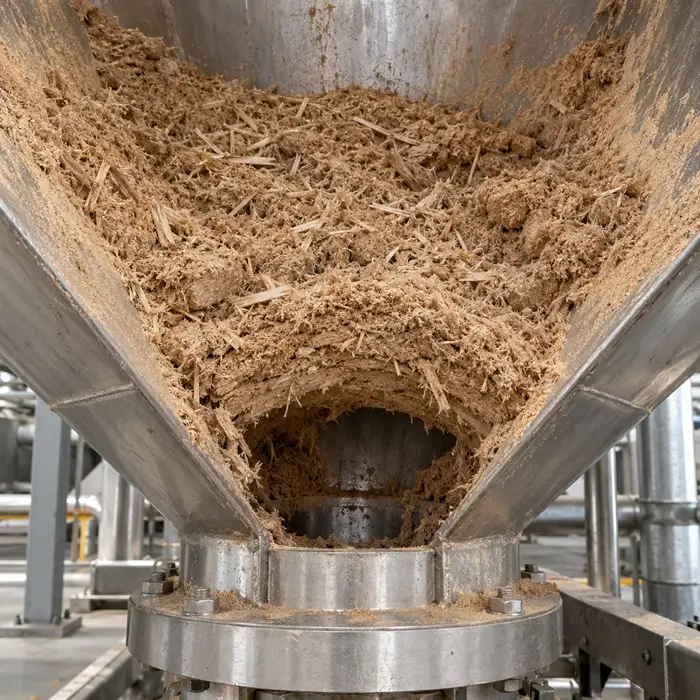
A compressible powder may flow acceptably at first, then densify under its own weight. After 30 minutes, two hours, or an overnight hold, the bottom layer may no longer behave like the material sampled near the top. This can appear as feeder start-up instability, variable fill weight, bridging after restart, or a different discharge pattern at the end of the batch.
A segregating blend can shift during a short production pause or repeated refill cycle. Ten to thirty minutes of vibration near a feeder, filler, or intermediate hopper may be enough for fines, coarse particles, or dense components to move into different zones. The first material discharged after the pause can then differ from the middle or final portion, even when the blend looked uniform at the mixer outlet.
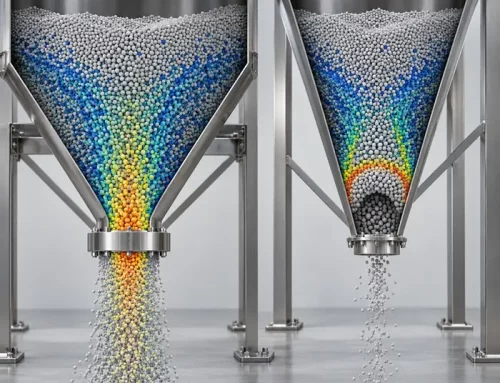
When the timing pattern involves retained air, delayed settling, or changing discharge behavior, the problem connects directly to Deaeration Lag: Why Easy Flowing Powders Still Surge.
Tie Powder Residence Time to the Failure Point
The useful question is not simply how long the powder waited. A more practical process question is this: how long did the powder wait between the last reliable measurement and the point where the failure appeared?
That question changes the investigation.
For feeder pulsing after pneumatic conveying, compare the bulk density immediately after filling, after 10 minutes, and after 30 minutes near the feeder inlet. For moisture-sensitive materials, measure at the dryer outlet and again at the feed throat after the normal waiting period. For compacting, tableting, or packaging problems, compare the first, middle, and last discharge from the vessel instead of relying on a single composite sample.
This does not require complicated testing at the start. Often, a timed observation is enough to reveal the pattern: bulk density recovery, moisture regain, temperature drift, visible settling, fines migration, changing discharge behavior, or a shift in fill-weight consistency.
Restart problems after a pause follow the same logic. If the powder rests in the vessel before the next operation, the state at restart may differ from the state measured earlier, as discussed in Why Powder Flow Often Fails After a Short Shutdown.
Define the Powder Residence-Time Window
Powder processes are often controlled by setpoints: dryer temperature, mixer time, conveying velocity, feeder speed, compaction force, fill volume, or packaging rate. Powder residence time should sit next to those settings.
A practical residence-time window has three parts.
First, define the minimum hold time when the powder needs time to stabilize. Aerated powders may need a short deaeration period before feeding, filling, or weighing becomes repeatable.
Second, define the maximum hold time when waiting creates risk. Hygroscopic, warm, compressible, fragile, reactive, or segregation-prone powders may have a limited period before the measured state no longer represents the process state.
Third, define the measurement location. The most useful test point is usually close to the failure point: hopper outlet, feeder inlet, feed throat, die feed, filler head, or packaging vessel. Upstream measurements still matter, but they cannot always describe the powder after residence time has changed it.
If the timing pattern points toward air release or loss of permeability, compare the observation with the mechanism described in Permeability Collapse in Hopper Discharge.
What to Measure When Time Is Suspected
Start with paired measurements. Test the powder when it leaves the previous step and again when it reaches the failure point. The comparison matters more than a single result.
For aerated or compacting powders, compare poured, aerated, settled, and tapped bulk density where possible. USP <616> Bulk Density and Tapped Density of Powders provides a useful external reference for bulk and tapped density practice.
For cohesive or consolidation-sensitive powders, shear and wall friction data can help show whether storage at rest changes the strength of the bed. ASTM D6128-22 covers shear testing of bulk solids using the Jenike shear tester.
For moisture-sensitive powders, test moisture near the point of use, not only at the dryer outlet. For segregating blends, compare the first, middle, and last material discharged after the normal hold period. For fragile powders, check whether fines content changes after transfer, pause, or repeated refill.
The aim is not to add every test. Instead, match the test to the moment where the powder state changes.
The Hidden Variable Is the Time Between Steps
Residence time is easy to overlook because nothing dramatic appears to happen while powder waits. Yet that waiting period can decide whether the next step receives an aerated powder, a settled powder, a rewetted powder, a consolidated powder, or a partly segregated powder.
That is why powder residence time belongs in troubleshooting. It links the previous process step to the next failure point.
When the lab result and the process behavior disagree, residence time should be checked before the formulation, feeder, dryer, or test method is blamed. The decisive powder state is the one that reaches the failure point, not the one measured earlier in the process.