

SUBJECT
Attrition
Publications on particle attrition, breakage, fines generation, and the effects of mechanical stress during handling, conveying, and processing.
PUBLICATIONS
Browse publications
Explore PTI articles, Insights, Know How, and technical publications related to this subject.
 19 September 2026
Vacuum Conveying for Fine and Hazardous Powders: Containment, Velocity, and Filter Design
Vacuum conveying contains by default: any breach draws air inward rather than pushing powder out. That containment advantage comes with a fixed pressure budget, and filter design competes directly with conveying velocity for every millibar of available driving force.
Feature Article
 25 July 2026
Dense-Phase vs Dilute-Phase Pneumatic Conveying: Matching Conveying Mode to Attrition and Segregation Risk
Dense-phase and dilute-phase pneumatic conveying create different particle contact mechanics, and the resulting attrition and segregation risk depends on velocity, solids loading ratio, and the powder's own attrition sensitivity, not on a fixed assumption about which mode is gentler.
Feature Article
 11 July 2026
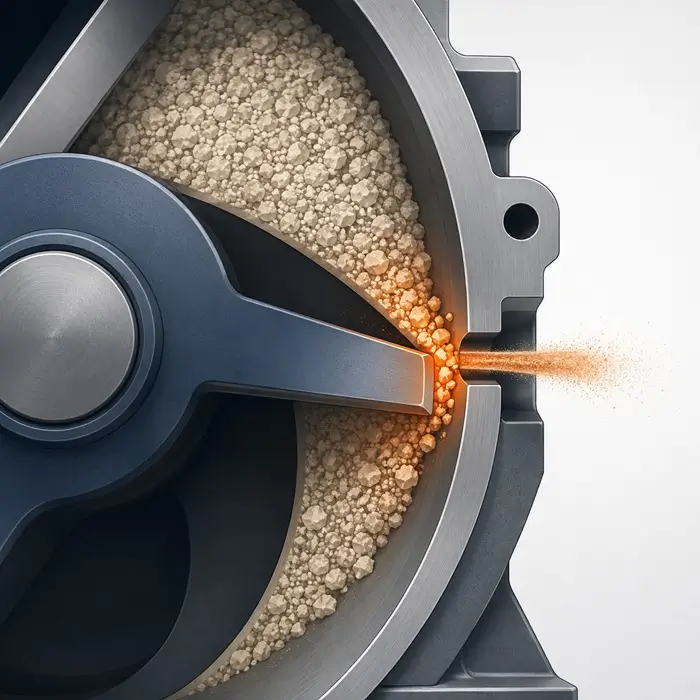
What Rotary Airlocks Actually Do to Powder
Rotary airlocks function as pressure boundaries as much as metering devices. The rotor tip clearance governs particle attrition at the nip zone and the rate of fine-particle bypass under differential pressure. As clearance widens through wear, the downstream particle size distribution shifts in a pattern frequently misread as upstream process variation.
Insights
 4 April 2026
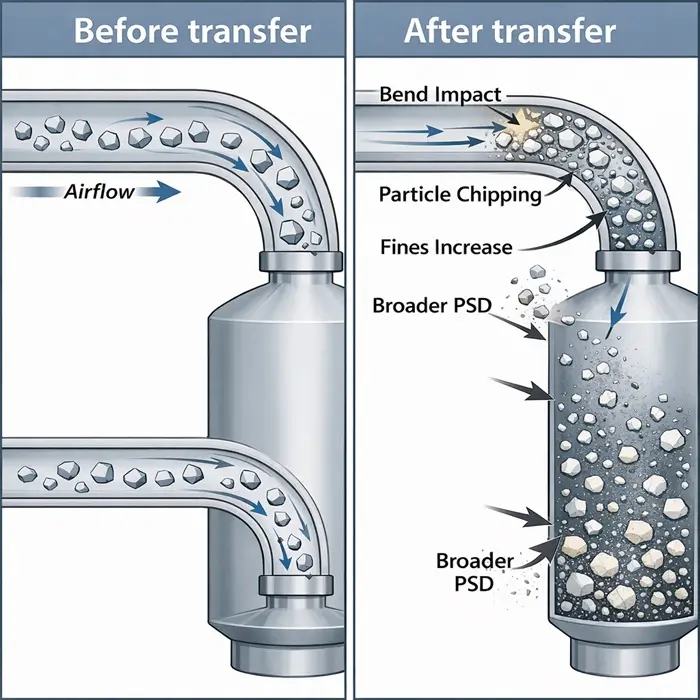
Pneumatic Conveying Attrition: Transfer Quietly Changes Powder
Pneumatic conveying attrition can change a powder even when the transfer looks [...]
Insights
 6 April 2025
Selecting the Right Powder Mixer for your blend
There is no one-size-fits-all powder mixer—the right choice depends entirely on your [...]
Know How
 18 June 2023
Powder processing and their diverse phenomena
The term "atom" originated in ancient Greece around 400 B.C., stemming from [...]
Feature Article
 30 April 2023
Milk Powder and the various stages of processing
In the 1920s and 30s, Sweden faced a dairy surplus. To address this, [...]
Feature Article
 12 June 2022
Wear of the pneumatic pipeline walls: contaminating the conveyed material
In Pneumatic Conveying Systems, particle velocity and bend geometry drive erosion and [...]
 2 February 2022
Key Considerations for Building or Upgrading a Facility
In this article, we will discuss the relevant aspects when working on [...]
 2 February 2022
Introduction to Dustiness
Airborne dust is a common byproduct of both natural and human activities. [...]
 30 January 2022
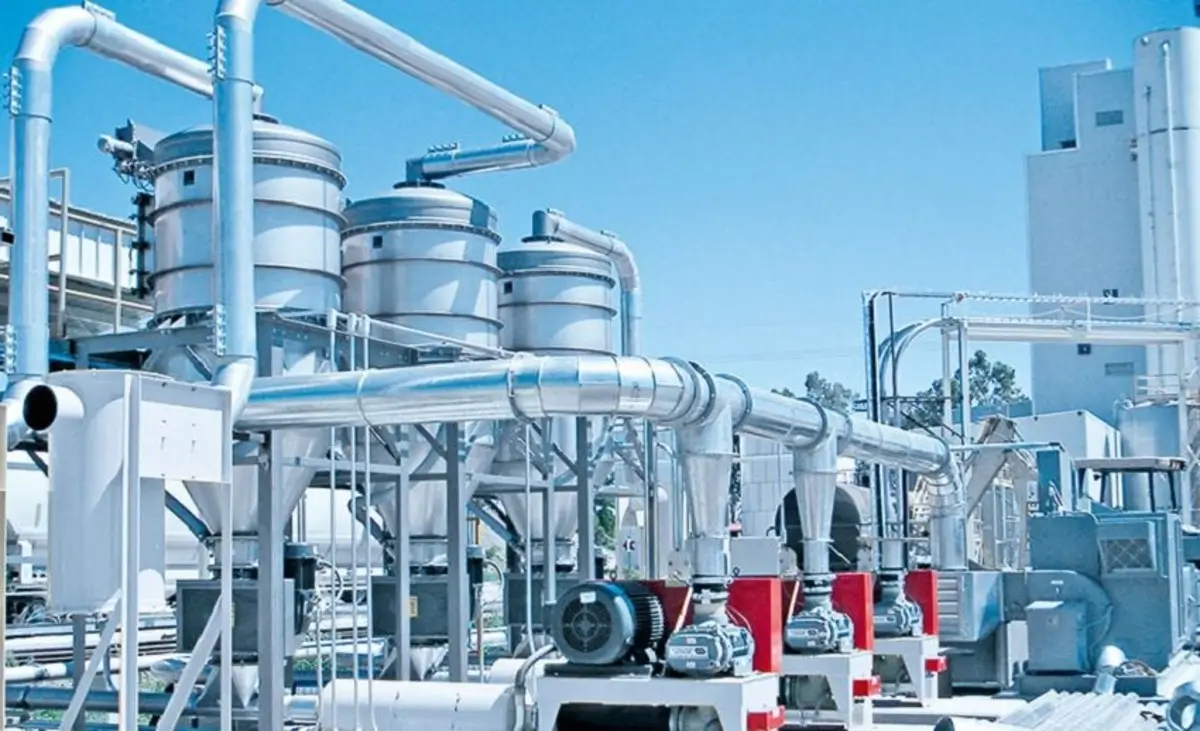
Attrition and abrasion as a result of various types of industrial transport
Industrial transport systems—especially pneumatic conveying—can cause significant attrition and abrasion of particles, [...]
 16 January 2022
Fluid bed testing
Fluidization allows powders to behave like fluids by suspending particles in a gas [...]