
Two powders, similar particle size, matched moisture, and the same screw feeder at the same speed. One delivers consistently across the batch. The other drifts by several percent with no visible cause. The difference may not be the feeder setting. It may be the powder state inside the feeder.
Screw feeders operate on a volumetric principle. The flights sweep a defined volume forward with each revolution, and that volume multiplied by the local bulk density gives mass output. Screw feeder dosing accuracy therefore depends on how consistently the screw channel fills and how predictable the powder density remains within it. When either changes, a delivery error follows. Which powder properties drive those changes is the operative question.
How Fill Factor and Compressibility Affect Screw Feeder Dosing Accuracy
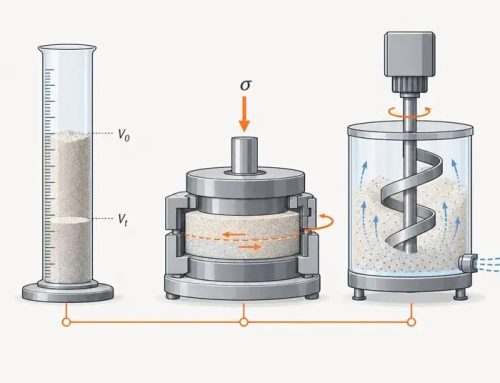
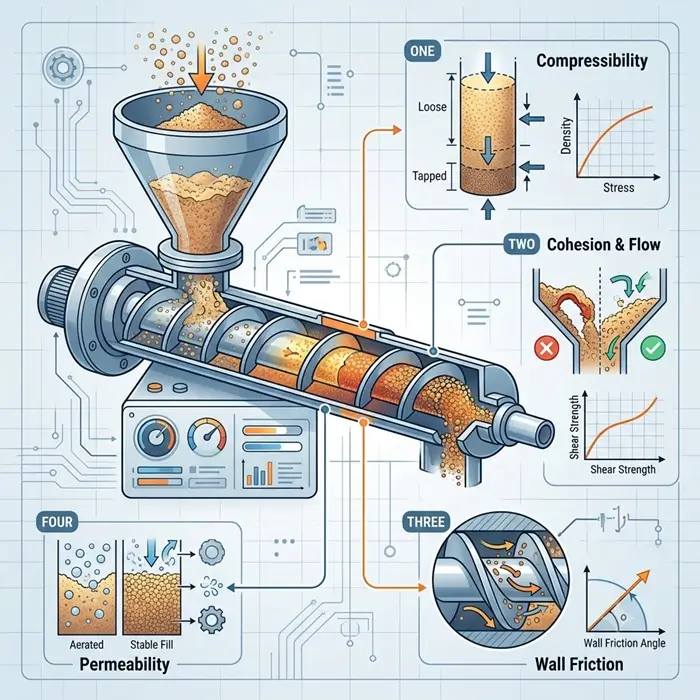
The fill factor of a screw feeder is the fraction of the screw channel volume actually occupied by powder. For compressible powders, this is not stable. Under the weight of the powder column above the inlet and under the mechanical action of the rotating flights, powder consolidates. The density at which it exits falls somewhere between loose bulk density and tapped density, set by the powder’s compressibility and the head pressure at that moment.
Research on screw feeding has confirmed that feed factor increases with powder compressibility: a more compressible powder packs more tightly within the screw flights than loose bulk density predicts. This also makes feed factor sensitive to changes in consolidation, including hopper fill level. Measuring bulk density at multiple consolidation stresses before commissioning maps the density range a feeder will encounter.
Carr’s Index as a Pre-Installation Risk Signal
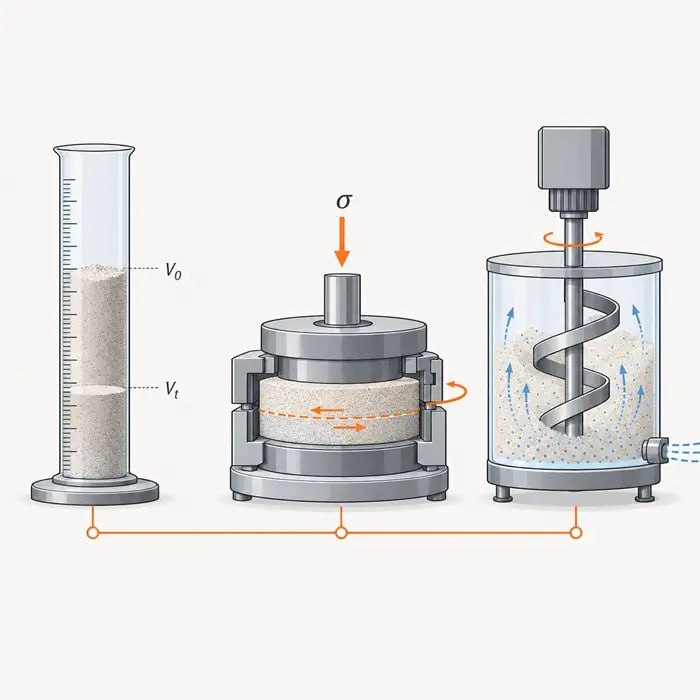
Carr’s Compressibility Index (CI = (tapped density minus bulk density) / tapped density x 100) and the Hausner Ratio (tapped density / bulk density) quantify the gap between loose and consolidated powder states. USP general chapter <1174> on powder flow classifies flowability using these values, with CI below 15% indicating good flow and CI above 25% indicating poor flow.
For a screw feeder, a high CI signals that the powder has a relatively wide density range between loose and consolidated states. A full hopper and a nearly empty one impose different stresses above the inlet, so powders that respond strongly to consolidation may show larger changes in the density entering the screw.
Carr’s Index does not predict dosing error by itself. Tapping does not reproduce the stress history, shear or forced filling conditions inside a working feeder. However, a high CI is a useful pre-installation warning that changes in hopper fill level and consolidation state deserve closer investigation. A low CI suggests a narrower density range, although feeder behaviour still depends on the actual powder, screw geometry and inlet conditions.
Wall Friction and Cohesion as Separate Failure Modes
High wall friction between the powder and the screw barrel causes powder to rotate with the screw rather than being conveyed axially. This creates uneven compaction along the screw length and reduces delivery efficiency. Measuring wall friction angle against the actual liner material before installation identifies whether surface finish is a technical risk rather than a specification detail.
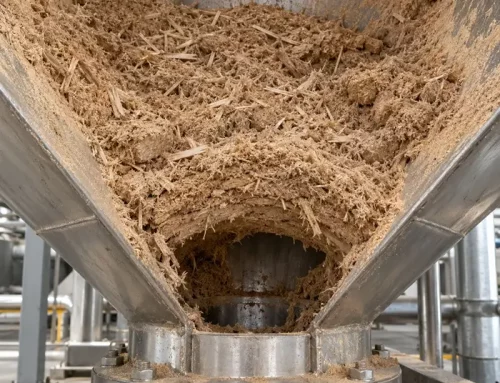
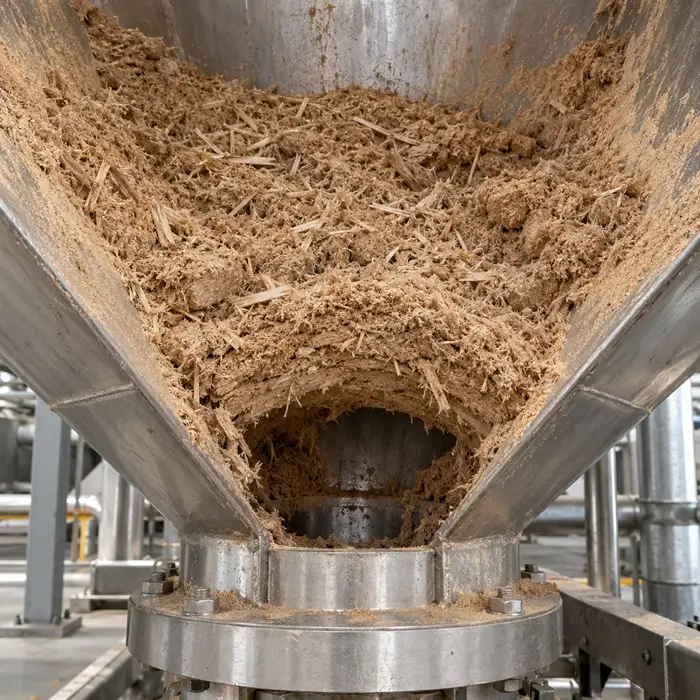
Cohesion introduces a different failure mode: intermittent fill. A cohesive powder can arch or restrict flow above the screw inlet, producing cycles of partial filling and slug delivery instead of steady output. Shear cell testing provides the flow function coefficient, or ffc, which helps indicate how readily a consolidated powder will flow under stress.
Jenike classifications place very cohesive powders below ffc 2, while powders above ffc 4 are generally less difficult to handle. For screw feeding, however, ffc should be treated as a risk signal rather than a direct prediction of feeder performance. As ffc falls, the risk of unstable inlet flow increases. Whether agitation or another flow aid is required depends on the hopper outlet, stress state, feeder inlet geometry, and operating conditions.
Bulk Density Drift Within a Production Run
As the hopper empties, head pressure above the screw inlet decreases. Less pressure means less pre-compaction of incoming powder, lowering effective bulk density at the delivery point. The same screw speed delivers less mass per revolution late in a run than at the start; compressible powders amplify this drift.
In a volumetric feeder, this drift accumulates without direct mass correction. A loss-in-weight feeder corrects for this drift by adjusting the screw speed to maintain the mass setpoint. Low powder permeability can compound this: air trapped during compaction temporarily lowers apparent bulk density in the screw zone, adding delivery variability that resembles compressibility effects but requires different remediation.
Gravimetric control, however, does not remove the underlying change in powder behaviour. Large or rapid changes in screw fill can still cause speed variation, control instability, and operation outside the feeder’s preferred working range. Refill events can add another disturbance by changing hopper pressure, aeration state, and consolidation above the inlet.
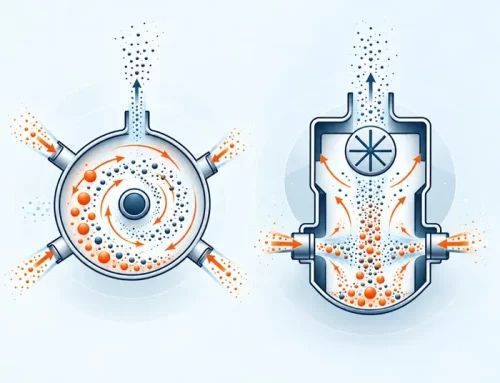
This is why similar dosing variation can arise from different mechanisms. Compressibility changes how strongly powder density responds to consolidation, while low permeability delays the release of trapped air and the recovery of a stable fill state. The resulting symptoms may look similar, but the corrective actions are different.
Characterization Measurements That Predict Performance Before Installation
The most useful characterization program begins with the type of feeder instability to be explained.
When mass output changes as the hopper empties, measure bulk density across more than one consolidation state. Carr’s Index and Hausner Ratio can provide an initial screening signal. Still, density measurements under defined stresses give a better indication of how large the operating range may become between a full and nearly empty hopper.
When delivery becomes intermittent, investigate whether the screw is being filled continuously. Shear cell testing can show whether cohesive strength is high enough to make arching or unstable inlet flow a credible mechanism. The result should then be interpreted together with hopper outlet dimensions and feeder inlet geometry.
When the screw appears full but axial conveying remains poor, wall friction deserves attention. Testing the powder against the actual barrel or liner material can reveal whether the powder is likely to slip relative to the surface or rotate with the screw instead of moving efficiently toward the discharge.
When dosing instability appears after refill, during rapid filling or after consolidation, permeability becomes important. A powder that releases air slowly may enter the screw in an aerated state and only reach a stable density after time under load. This can create temporary mass-flow variation even when the screw speed remains constant.
No single measurement predicts screw feeder dosing accuracy. The useful combination depends on the observed failure mode. Compressibility measurements address density sensitivity, shear testing addresses continuity of supply, wall friction addresses transport against the equipment surface, and permeability addresses the role of trapped air. Together, they help identify whether the likely problem lies in the density entering the screw, the continuity of filling, or the transport of powder once the channel is occupied.
The guide to selecting the right feeder for your powder provides more detail on matching feeder type to powder properties.
Conclusion
The same screw speed does not guarantee the same mass output because the screw does not meter mass directly. It meters a changing volume of powder whose density, continuity of filling, and movement through the channel depend on the powder’s response to stress.
Compressibility determines how strongly density changes with consolidation. Cohesion affects whether the inlet remains continuously supplied. Wall friction influences how efficiently filled screw flights move powder axially, while permeability determines how quickly trapped air can escape and a stable fill state can develop.
The practical question is therefore not simply whether a powder flows well. The key question is which property changes the state of the powder inside the feeder and under which operating conditions that change becomes large enough to affect dosing accuracy.
More detail on matching feeder type to powder properties is available in the guide to selecting the right feeder for your powder.