
Table of contents
Executive Summary
laser-assisted bioprinting powder principles show the benefits of particle thinking. Treat every printed droplet as a living particle. Then use the same physics that guide powders to design jetting, impact, packing, and maturation. This frame reduces trial and error and gives teams a shared language. It also improves transfer from the research bench to a controlled manufacturing line with traceable quality.
The Physics Frame
Jetting sits at the balance of inertia, viscosity, and surface tension. The Ohnesorge number gathers those effects into one guide for breakup behavior. The Weber number captures impact and spread on contact. These dimensionless groups remove unit noise and let you compare data across fluids, heads, and print scales. Keep Oh inside a moderate band and ligaments pinch off cleanly. Drift too low and satellites rise. Drift too high and jets refuse to form. For laser-assisted systems that target micrometer drops, a practical jettable window is often discussed around Oh ≈ 0.1–1.0 [1]. Impact outcomes then track the Weber number and the substrate’s surface energy. A small change in speed at fixed drop size can move spread from acceptable to over-spread. A small change in surface chemistry can shift adhesion from strong to weak. This is why you design with dimensionless groups first. The ratios remain meaningful when equipment, lots, or operators change.
Why Oh and We Matter
Oh controls whether the ligament forms, thins, and pinches on a stable timescale. We sets how far a drop spreads before recoil and setting. Together they map the operating window with more fidelity than any single raw number. Teams can read the same map and make consistent choices under time pressure.
Formulation Strategy
Formulation translates physics into behavior. A good bio-ink flows exactly when actuated, then holds shape after landing. Shear-thinning lowers apparent viscosity during the pulse so the jet forms without harsh shear in a nozzle. A small yield stress then arrests creep and keeps edges crisp at rest. Surface tension ties both parts together. Too high and the ligament snaps back into beads. Too low and drops over-spread and lose placement fidelity. Osmolality and pH influence surface tension and cell health, so small drifts over a long run can push the process off its window. Temperature matters for the same reason. Viscosity is temperature sensitive, and a gentle thermal drift at the donor film can look like a formulation error unless you are watching it.
Droplet Creation and Satellite Control
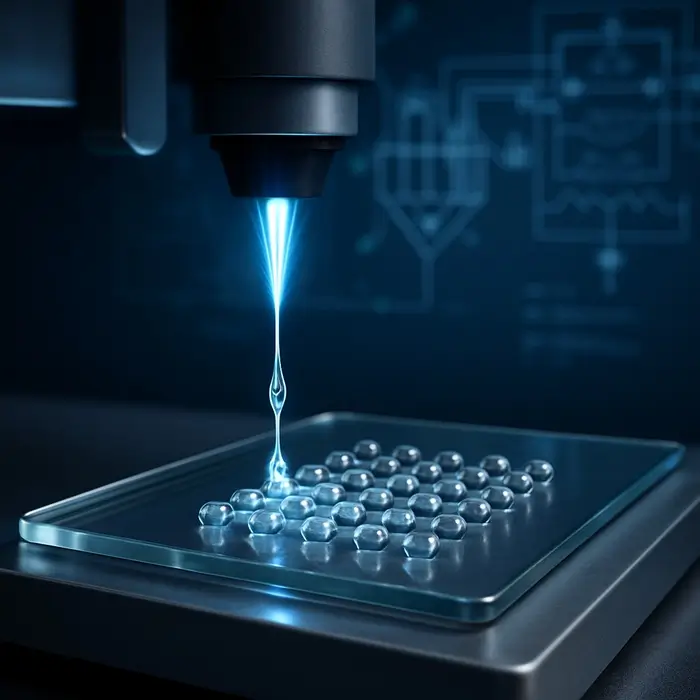
A short laser pulse deposits energy into a thin donor film. A micro-jet forms, thins, and pinches into a string of picoliter drops. High-speed imaging exposes the truth of that sequence. It shows whether breakup is regular or ragged. It also counts satellites before they seed defects inside thin layers. Corrective action lives in physics, not in hope. Adjust viscosity and surface tension to pull Oh back into band. Match pulse energy to film thickness so the jet forms without over-driving the ligament. Keep the donor film uniform across the field to avoid slow drift from one corner to another. Place one explicit rule in the operator view near the live satellite counter and make it non-negotiable: If satellite fraction exceeds 0.1% per 1,000 drops, increase σ by 5–10%, or reduce U by 0.5–1.0 m·s⁻¹, then recheck on imaging. That single if–then closes the loop in seconds and prevents poor layers from stacking into a bad batch.
Impact, Spread, and Setting
On impact, a drop spreads, recoils, and sets on a timescale defined by inertia, viscosity, and capillarity. On wettable surfaces in low-viscosity regimes, the maximum spread ratio often follows a quarter-power reference with the Weber number. Many studies report Dmax/D0∝We1/4D_/D_0 \propto \mathrm^ in that regime [2]. Treat this as a reference curve, not a law. Viscoelastic behavior lowers spread below the reference. Hydrophobic patches or micro-texture can also shift the curve. The only safe plan is to measure on your real substrate, at your real temperature, with your real formulation. Pick a target spread ratio for the tissue geometry. Back-calculate a speed that meets it. Tune surface treatment to tighten the distribution. Confirm with high-speed frames and with post-impact images at controlled delays, since late creep can undo a clean initial footprint.
Adhesion on Treated Substrates
Adhesion is set by both chemistry and physics. Protein coatings create binding sites and raise the work of adhesion through ligand–receptor interactions. Wettability shapes the contact line and the early force balance that defines whether a drop clings or slips. Alignment software places droplets precisely on pre-treated regions. It does not create the chemistry by itself. Validate coating density and uniformity with routine assays. Then observe cell morphology and focal adhesion markers over time. Close that loop to avoid prints that look perfect at T0 and fail function at day two.
Layer Formation and Early Fusion
Think of each pass as a controlled powder bed made of soft, living particles. Low polydispersity supports dense packing and reduces void fraction between neighbors. After landing, surface tension draws adjacent droplets together and promotes neck growth. Gelation or ionic crosslinking fixes the network at a chosen time, which sets the mechanical baseline for the next pass. Biology then takes over. Cells contract and lay down extracellular matrix, which remodels the shape under stress. The process is simpler if you tune the physical fusion stage first. Lock the window with surface tension, yield stress, and temperature. Then tune biological remodeling with cues and growth factors. Mixing both in one step slows learning and makes responses hard to interpret.
Modeling That Informs Choices
Models cut the search space when they respect data. Discrete element thinking treats droplets or micro-aggregates as soft, slightly adhesive particles. Simple elastic contact with a cohesion term reproduces early fusion and compaction. Fit those parameters to atomic force measurements and to fusion time series from time-lapse imaging. Couple the particle picture to fluid drag for flight and landing so the predicted impact angle and speed match reality. Use computational fluid dynamics near the jetting head to understand ligament growth, pinch-off timing, and the onset of satellite formation. After deposition, solve a diffusion model for oxygen inside thick stacks and printed volumes. Without perfusion, oxygen limits appear within a few hundred micrometers in many tissues. A practical planning number is about 100–200 μm for viable thickness in static conditions [3]. Use that range to set pass thickness and to decide when to insert perfusion paths or sacrificial channels. Models do not replace experiments. They focus the next three runs and reduce the chance you learn the same lesson twice.
Inline QC and Closed-Loop Control
Quality should move at print speed. The live signals that matter most are satellites, placement error, and voids. Satellites tell you whether jetting is inside the breakup window. Placement error tells you whether motion and optics remain true at the substrate, not only at the stage encoder. Voids tell you whether packing and fusion are creating dense layers across the field. Each signal must drive a fast action. Increase surface tension or lower speed when satellites rise. Recalibrate optics or stage when placement drifts. Adjust yield stress, pass overlap, or cure timing when voids appear. Record the change with the variables that matter. Promote the most sensitive ones to critical process parameters inside a simple quality by design file. That file becomes the memory of the line and keeps choices consistent between shifts.
System Blueprint
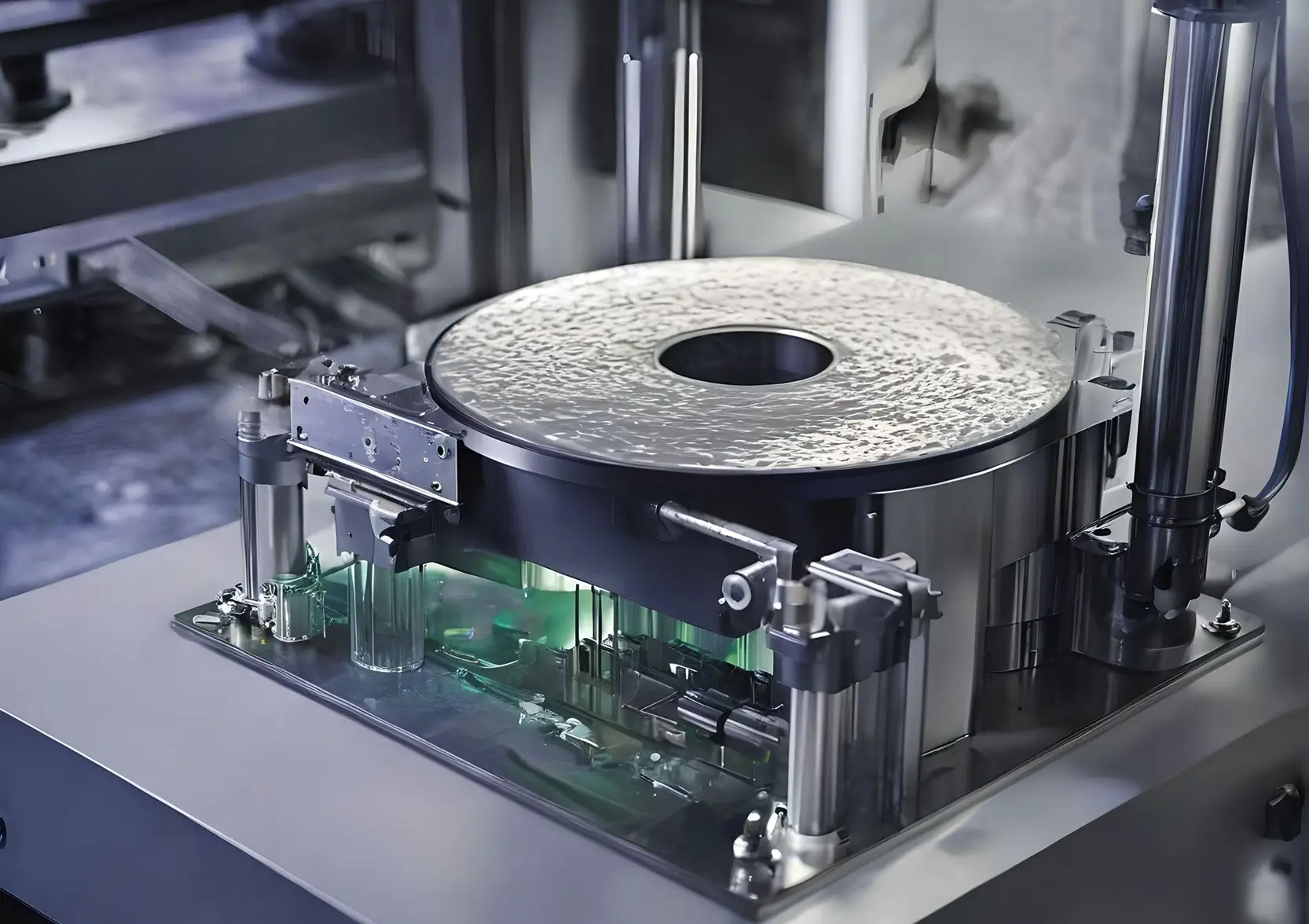
A reliable cell looks simple and behaves predictably. A reservoir feeds a thin donor film that sits under stable temperature control. Laser optics shape and deliver a pulse with known energy at the film. The jetting zone runs under high-speed imaging that can see satellites at the chosen frame rate. A pre-treated substrate rides on a motion stage with verified repeatability at the micrometer scale. An environmental shell holds temperature and cleanliness in a narrow band. A cure step fixes structure without damaging cells. A control stack watches physics in real time and applies reject rules that operators understand. The blocks only work as a system when each has a clear owner and a clear slice of physics and quality. That ownership speeds root cause analysis when runs drift.
Ownership and Physics
Give each block a measurable goal. The film owns thickness and temperature. The optics own pulse energy at the film. Imaging owns satellite fraction and drop size distribution. The stage owns placement at the substrate plane. The environment owns temperature and particles. Cure owns set without harm. Control owns alarms, stops, and the audit trail.
Scaling and Takt Time
Scale by lanes, not by stress. Raising speed and energy in one lane invites damage and variability. Parallel printheads keep local physics gentle and multiply area rate. Compute a sober takt time. Use net areal rate after rejects, not the glossy number. Include cure time and inspection time. Add a realistic buffer for rework because rework always appears in early lines. If takt still misses the mark, add lanes. Do not push a stable window into instability just to meet a calendar promise. Viability and function will not negotiate with schedule pressure.
Worked Example
Target a drop diameter near twenty micrometers at a jet speed near five meters per second. Use water-like density and a surface tension around forty five milli-newton per meter as a starting point. Compute the Weber number and expect moderate spread on a wettable surface. Choose an Ohnesorge number near one third and solve for viscosity. The answer sits near nine milli-pascal seconds at the print temperature. Prepare that fluid and confirm rheology. Run high-speed imaging to verify breakup and spacing. Measure the spread on your actual substrate. If spread runs wide, raise surface tension or reduce speed and confirm the new point on the reference curve. If spread runs tight and adhesion is weak, adjust the surface treatment and retest morphology and attachment at twenty four hours. Keep that loop tight. Let the numbers lead the edits, not opinion.
GMP Translation
GMP needs discipline and traceability more than exotic technology. Treat fluid changes like material changes. Record lot, age, and storage conditions. Use closed transfers and stable zones to reduce contamination risk and thermal drift. Calibrate sensors on a defined cycle and record the results. Validate three batches that meet viability, sterility, identity, and function with the same print recipe. Keep ongoing qualification focused on drift so corrective actions close within one print whenever possible. The best lines look boring from outside because nothing dramatic happens during a run. Boring is good when lives depend on the product.
Conclusion: Laser-Assisted Bioprinting Powder Principles
Think in powders from the first parameter to the last inspection. Stabilize droplet creation with an honest window instead of ad hoc tuning. Control impact and adhesion with measured surfaces rather than assumptions. Pack layers with smart polydispersity, then let biology mature the structure on a stable base. Use models to narrow the search and experiments to lock the truth. Scale with lanes and protect viability. Clear physics turns promising biology into a repeatable manufacturing process that teams can learn, teach, and improve with confidence thanks to laser-assisted bioprinting powder principles and guidelines.