
Table of contents

In pharma and biotech, smaller often means better. Submicron particles improve solubility, stability, and delivery options. However, making them isn’t straightforward. Many systems overheat the material or lose half of it to the exhaust.
By contrast, nano spray drying offers a cleaner route. It combines fine droplet control with gentle drying. As a result, you get powder you can actually use, even when the feed is delicate and expensive.
How Nano Spray Drying Works
A Nano Spray Dryer uses the following method: a vibrating mesh to generate droplets. Unlike traditional systems, there’s no high-pressure nozzle. A piezoelectric membrane pulses rapidly, pushing the liquid through microscopic holes. As a result, the droplets that form are typically between 2 and 5 microns.
From there, drying happens fast. As the solvent evaporates, those droplets shrink into particles around 200 to 500 nanometers. Importantly, they stay intact, even when the feed contains heat-sensitive actives.
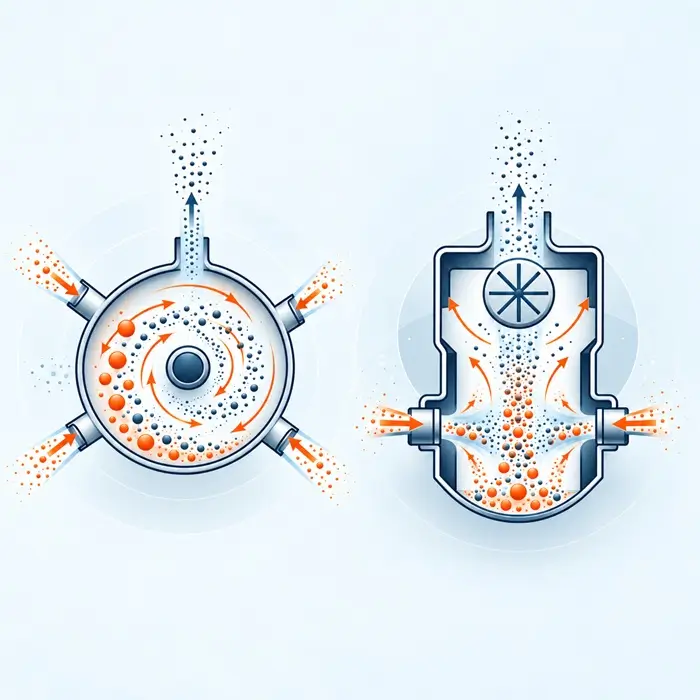
Meanwhile, collection happens through an electrostatic field. Rather than spinning particles into a cyclone, the system charges them and attracts them to a collector plate. That one change dramatically improves recovery. I’ve seen batches come in above 90 percent, even with low-density powders.
Where It Works Best
This isn’t a production method. Most systems handle just 100 to 200 milliliters per hour. But that’s fine. You’re not here for volume. You’re here for precision.
Use it when:
- You need consistent, breathable powders for inhalation
- You want to improve solubility for tricky APIs
- You’re encapsulating enzymes or biologics that fall apart under heat
- You’re screening carrier materials for controlled release
Nano spray drying works especially well when material is scarce. It recovers most of what you feed in, so you waste very little. That alone makes it useful in early formulation.
What You Control
This process is sensitive, but predictable. Every setting matters.
- Solids content: Keep it between 0.5 and 3 percent. Thicker solutions block the mesh.
- Mesh size: Finer meshes give smaller droplets but clog more easily. Balance output with reliability.
- Temperatures: Inlet settings between 80 and 100 °C work well. Keep outlet temps under 45 °C for proteins or live cultures.
- Gas flow: Affects evaporation speed and particle lift. Tweak as needed.
- Voltage: Electrostatic collectors usually run around 10 kV. More voltage doesn’t always mean better capture.
Always filter the feed solution. You’d be surprised how often mesh clogging comes down to one missed filtration.
Solvents and Particle Shape
Different solvents change how your particles behave.
For example, water-based feeds tend to dry into solid, spherical particles. In contrast, ethanol and acetone evaporate quickly and often form hollow or collapsed shells. Additionally, some organic solvents increase wall loss or reduce electrostatic charge, which affects recovery.
I’ve seen formulations look perfect on paper, only to fail because of a single solvent misstep. In one case, a small tweak in the solvent mix or drying temperature made all the difference.
Drying speed changes particle shape. Fast evaporation often leads to thin-walled or wrinkled structures. Slow drying tends to produce denser, rounder particles. I’ve also seen how charge matters. The more stable the particle charge, the better the collector grabs them.
Common Pitfalls
Mistakes in nano spray drying often come from small oversights. Filtration is one. Without it, the mesh clogs fast. You also can’t treat this like a scale-up tool. It’s made for development, not production. Solvent issues cause real trouble. I’ve seen batches collapse or burn because the solvent evaporated too quickly. Overfilled collectors are another risk. When full, they reduce recovery and increase degradation. Cleaning matters too. Leftover residue, especially from PEGs or proteins, contaminates the next batch. And without a proper log, you won’t know what changed. Each run gives data.
Scaling Up (Sort Of)
Nano spray drying doesn’t scale directly. Mesh atomizers and electrostatic plates don’t exist in large-scale dryers. Still, that’s not the goal. Instead, this is a development tool. Use it to validate particle size, drying behavior, and release properties. Once that’s locked in, move to larger equipment with similar drying logic. In that sense, nano spray drying helps you build the process. Ultimately, it gets you the data you need to take the next step.
Conclusion
This method doesn’t do everything. However, when you need precision, recovery, and thermal protection, it does more than most.
In fact, it works where other methods fail. More importantly, it helps you move forward without burning material or introducing doubt. And when particle size matters, it lets you dial in exactly what you need.
If you work in formulation, then it’s a tool worth knowing well.
FAQ Nano Spray Drying
Downloadable PDF
This workfloor-ready guide offers practical instructions for producing submicron powders, It includes:
-
A quick-start checklist for feed preparation and mesh setup
-
Drying parameter ranges for APIs, proteins, and polymers
-
Solvent effects on particle shape and collection behavior
-
Troubleshooting advice for common issues like clogging, wall loss, and low yield
-
A cleaning and maintenance log to support repeatability
Use this protocol to optimize yield, protect heat-sensitive materials, and improve consistency in early-stage formulation work.
Download the workfloor-ready PDF guide for producing submicron powders using nano spray drying