
Table of contents

Infant formula powders sit at the awkward end of food powders. Formulation, processing, and preservation pull in different directions. The powder has to behave like human breast milk as much as possible, at least on the parts that matter. Hitting numbers on a label is only the starting point. People working on these products try to keep fragile nutrients intact, keep them absorbable, and stop the powder from drifting in behaviour during manufacture, storage, and preparation in the kitchen.
Nutrient composition in infant formula powders
On paper, infant formula powders are simple. Protein, fat, carbohydrate, vitamins, and minerals, all within narrow limits, as set out in the Codex Standard for Infant Formula (CXS 72-1981). In practice, every group has unique challenges.
Proteins carry much of the nutritional load. They are chosen for amino acid patterns and for how an infant’s gut deals with them. Most formulas use whey and casein in a ratio that roughly follows human milk. That ratio is not just a number. It changes how the food clots in the stomach, how fast it moves on, and what actually ends up absorbed.
The lipid fraction brings essential fatty acids and helps fat-soluble vitamins get into the body. These fats are touchy. They oxidise, develop off-flavours, and crack the emulsion if you mistreat them. So they need protection during concentration, spray drying, filling, and storage. Lecithin and milk proteins usually stabilise the fat droplets and keep them suspended inside the matrix. That emulsification step is where a lot of batches go wrong. Surfactant type, protein level, viscosity, and shear decide whether you get a tight emulsion or free oil and rancid notes later.
Carbohydrates, often lactose with some glucose syrup solids or maltodextrins, supply energy and set the sweetness and mouthfeel. Lactose follows human milk, so it is the default when possible. Alternative carbohydrates come in for lactose intolerance or medical formulas. Swap one carbohydrate for another, and solubility, osmolarity, sweetness, and sometimes stool pattern shift as well.
Then come vitamins and minerals. They look harmless on the spec sheet. In the real product, many are unstable. Heat, oxygen, light, and interactions with proteins or fat slowly erode their content. The formulator has to choose the right chemical form, add a safety margin, and still have enough left after spray drying and months in a warehouse to match the claim on the tin.
Spray drying and agglomeration in infant formula powders
Spray drying is where the carefully built liquid becomes powder. The liquid feed is pumped to the atomiser, broken into droplets, and mixed with hot air. Water leaves quickly. Particles form in seconds, sometimes less.
That short time is enough to damage proteins, vitamins, and probiotics if conditions drift. Too high inlet temperature, long residence time, or poor control in the dryer gives denaturation, off-flavours, or poor dispersibility. Operators watch inlet and outlet temperatures, feed rate, and airflow to keep a narrow window. The simple wish is to remove enough water for safe storage while avoiding a cooked flavour and dead sensitive ingredients.
After base powder production, many plants run an agglomeration step. This changes how infant formula powders flow, how dusty they are, and how fast they wet when the parent prepares a bottle at home, which links directly to the WHO guidance on safe preparation, storage and handling of powdered infant formula.. It is one of the steps that caregivers notice most, even if they do not know the name for it.
Agglomeration uses steam, liquid binders, or surface-active agents to form bridges between particles. Process settings control granule size, porosity, and strength. High shear equipment can create clean, free-flowing granules that behave well on filling lines. That same shear and friction can generate heat and mechanical stress. Push it too far, and vitamin levels drop, or probiotic counts fall below specification. So the process is usually run at the edge of what is needed for handling, not at the edge of what the equipment can do.
Emulsion stability and microencapsulation
Milk-based infant formula powders rely on oil-in-water emulsions. These emulsions must survive concentration, spray drying, and storage without splitting.
Fat droplets always try to find each other again. Emulsifiers prevent this by forming an interfacial film. Lecithins and milk proteins are used most often. Their structure lets them sit at the oil-water boundary and stabilise droplets. When the system is set up well, the droplet size distribution is narrow and creaming or coalescence is limited during the product’s life.
If the emulsion fails, the can tells you. Oiling off, visible fat rings, changes in mouthfeel, and sometimes a paint-like surface on the reconstituted feed. Behind that, there is usually a loss of essential fatty acids and a product that no longer behaves as intended.
Microencapsulation gives extra protection for specific nutrients. Vitamins, minerals, and probiotics can be wrapped in shells made from starches, proteins, or lipids. The coating slows contact with oxygen and moisture and can reduce thermal stress. Some systems are designed to open later in the gut, so the active compound sees as little damage as possible before reaching the site of absorption.
Chemical interactions and powder characteristics
Once dried, infant formula powders behave more like a network of interfaces than a simple mixture.
Whey and casein can form aggregates or gel-like structures. That changes viscosity and the way the reconstituted feed feels in the mouth. Their interactions with sugars influence Maillard reactions, sugar crystallisation, and glass transition behaviour. Each of those feeds into colour, flavour, stickiness, and shelf stability.
Inside a single particle, the balance between amorphous and crystalline material matters. Amorphous regions tend to absorb moisture and can become sticky, which leads to caking and wall buildup in silos or filling equipment. Highly crystalline powders often flow more easily but may dissolve more slowly in the bottle. Formulators adjust solids composition and drying conditions to land in an acceptable middle zone, not at either extreme.
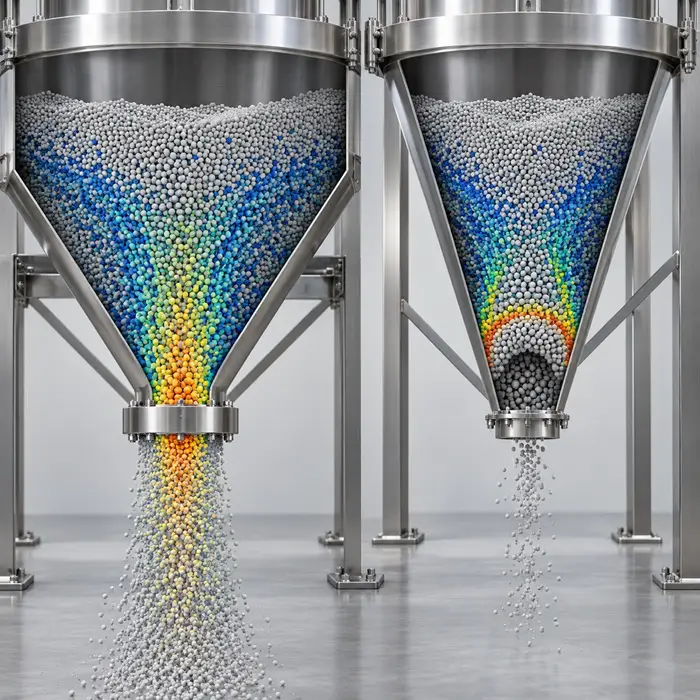
Powders with high fat content often flow badly if nothing else is done. Hydrophobic surfaces encourage clumping and smearing on metal walls. Flow aids and surfactants change surface energy and sometimes surface charge. With the right combination, particles move past each other instead of locking together. The effect shows up downstream as more stable flow into scoops, dosing systems, and sachet fillers.
Comparing complex and simple food powders
Food powders occupy a wide range in terms of how much control they demand. Infant formula powders are at the demanding end. They contain many components that react to heat, moisture, oxygen, light, and pH in their own ways and at different speeds. Those reactions can work together or interfere with each other.
A refined salt or a single modified starch behaves very differently. The chemistry is simpler. There are fewer routes for unexpected changes, and the process windows are wider. These materials still need proper equipment and storage, but they rarely require the same level of formulation tweaking or long-term stability testing.
In infant formula, almost every change touches something else. Adjusting a carbohydrate source reshapes osmolarity, browning behaviour, and glass transition temperature. Changing a fat blend alters oxidative stability, emulsion behaviour, and sometimes how well the powder wets. This is why people working in this field talk about recipe, process, and packaging as one coupled system rather than three separate tasks.
Nanotechnology and future directions
Nanostructured delivery systems are getting more attention in nutrition science. Nanoemulsions and particulate carriers can improve solubility or stability for difficult compounds in adult products. On a whiteboard, these same tools look attractive for infant formula powders as well.
In real life, infant nutrition sits under a stricter spotlight. Analyses of some baby products have reported engineered nanoparticles, including nano hydroxyapatite, nano titanium dioxide, and nano silicon dioxide. Certain shapes, such as needle like nano hydroxyapatite, have raised specific toxicological concerns.
Food authorities have started to review these findings. Assessments from bodies like Food Standards Australia New Zealand currently do not show a clear, measurable risk for the materials and exposure levels they examined, and they note that nano sized structures also appear naturally in foods and in the environment. At the same time, major regions such as the European Union and the United States still regulate infant formula mainly through broad safety and composition rules instead of very detailed nano specific chapters.
Any deliberate move towards nano enabled structures in infant formula powders will need more than a promise on a slide. It will need realistic exposure estimates, long term safety work, and open reporting of both benefits and risks. If nanotechnology finds a stable place in this field, it will likely be in a few clearly defined applications where the nutritional gain is large and the safety case has been made in detail, not as a generic selling point.