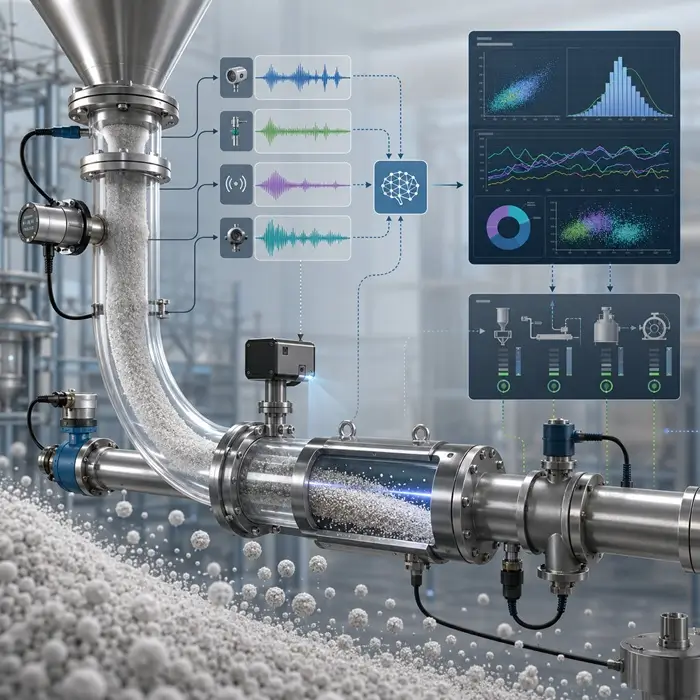
Material Handling and Storage Systems

Material handling and storage systems ensure efficient transport, storage, and dispensing of powders across industries. From silos and hoppers to big bags and conveyors, these systems optimize flow, reduce waste, and enhance operational safety. Explore the tools and techniques that keep powder processes running smoothly and reliably.

Featured Material Handling and Storage Systems articles

  • Sieve blinding in powder screening showing near-size wedging, fine-particle coating, agglomeration, and bed overload on a vibrating sieve.

    Sieve Blinding: Why Powder Screens Fail Before the Particle Size Spec Does and How to Solve it

    Sieve blinding does more than reduce screening capacity. It changes the material stream. Once particles block, coat, or overload the mesh, the screen no longer applies the intended cut point. That can shift the coarse and fine balance entering the next process step, even when the incoming powder still appears to meet [...]

  • Operator inspecting a stainless-steel process line to minimize changeover losses in continuous powder lines.

    Changeover Losses in Continuous Powder Lines: 5 Fast Wins to Boost Efficiency

    Changeovers can quietly waste hours and tons of product in continuous powder lines. The cause is rarely a single fault. Most losses stem from small oversights that add up—sticky residues, trapped air, timing mistakes, or slow cleanups. Focusing on five targeted actions can reclaim yield, reduce downtime, and improve consistency without incurring new [...]

  • Macro view of laser-assisted bioprinting: a clean ligament ejects a micrometer droplet onto a glass substrate patterned with droplets.

    Case Study: Powder Technology Principles in Laser-Assisted Bioprinting

    Table of contents Executive Summary laser-assisted bioprinting powder principles show the benefits of particle thinking. Treat every printed droplet as a living particle. Then use the same physics that guide powders to design jetting, impact, packing, and maturation. This frame reduces trial and error and gives teams a shared [...]

  • Powder Technology Guide

    The Ultimate Guide to Powder Technology

    Powder technology is the backbone of precision manufacturing and process optimization. Industries that master it, through deep control of particle size, flowability, and morphology, gain critical advantages in processes like mixing, granulation, milling, and blending. Whether developing pharmaceuticals, producing food powders, printing metal parts, or enhancing materials, success hinges on understanding how powders [...]

  • Advanced Powder Characterization

    Advanced Powder Characterization Techniques

    In this article, we will take a glance at the Advanced Powder Characterization techniques, that are currently available. Characterizing powders is a deceptively complex challenge. At first glance, it might seem that measuring particle size, bulk density, or flowability should tell us all we need to know. But anyone working with powders knows better. [...]

newsletter icon

News And Articles In Your Inbox

Sign up and receive PowderTechnology.info news, articles, and content from our partners in a quick and easy monthly newsletter.

You have been successfully subscribed.
There was an error trying to subscribe. Please try again later.
Material Handling and Storage Systems - Silo Storage

Material Handling and Storage Systems: Silo Storage

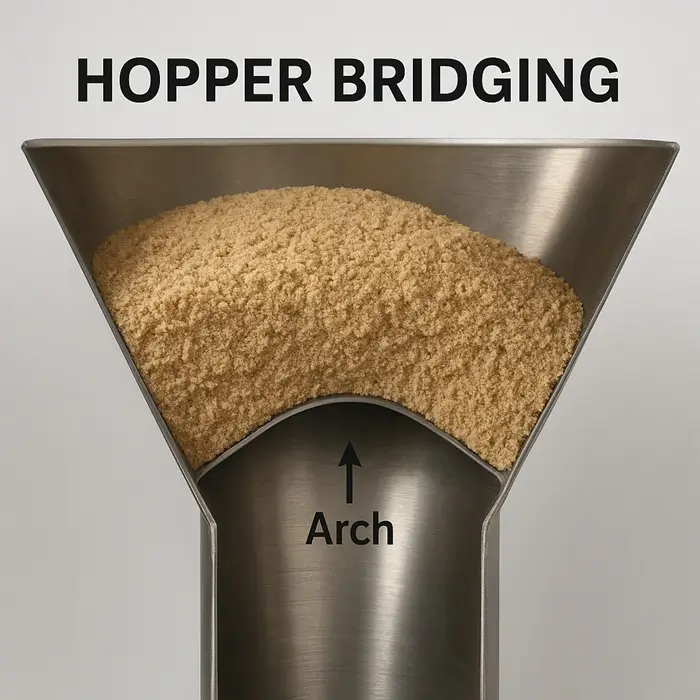
Silo storage is a cornerstone of efficient powder handling, providing safe and reliable containment for bulk materials. Proper silo design ensures optimal flow, prevents clogging, and minimizes issues like arching or ratholing. This section explores the techniques and innovations that make silo storage a key component in maintaining smooth operations across industries.

Featured Silo Storage  Articles

More Silo Storage Articles

More Silo Storage Articles

Material Handling and Storage Systems: Hoppers

Granulation is a vital process in powder technology, transforming fine powders into larger, more cohesive granules. This improves flowability, reduces dustiness, and enhances handling properties. Techniques such as wet granulation, fluidized bed granulation, and melt granulation are tailored to specific material requirements and applications. Granules created through this process find extensive use in pharmaceuticals, fertilizers, and food industries, where uniform size, density, and performance are critical. Proper control of parameters ensures consistent quality and optimizes downstream processes.

Material Handling and Storage Systems - Hoppers

Featured Hopper articles

  • Acoustic emission for flow blockage prediction sensor mounted near the lower cone outlet of a powder hopper

    Acoustic Emission for Flow Blockage Prediction

    Acoustic emission for flow blockage prediction captures high-frequency stress waves generated by particle-wall friction, particle impacts, and changing contact networks inside flowing solids. Used properly, it can detect degrading flow conditions before a full blockage develops. Used badly, it becomes another noisy alarm channel that operators learn to ignore. The difference comes down [...]

  • Powder flowability technical illustration comparing normal hopper discharge with arching and pulsing caused by poor venting and unstable flow.

    Powder Flowability: Factors and Measurement Techniques

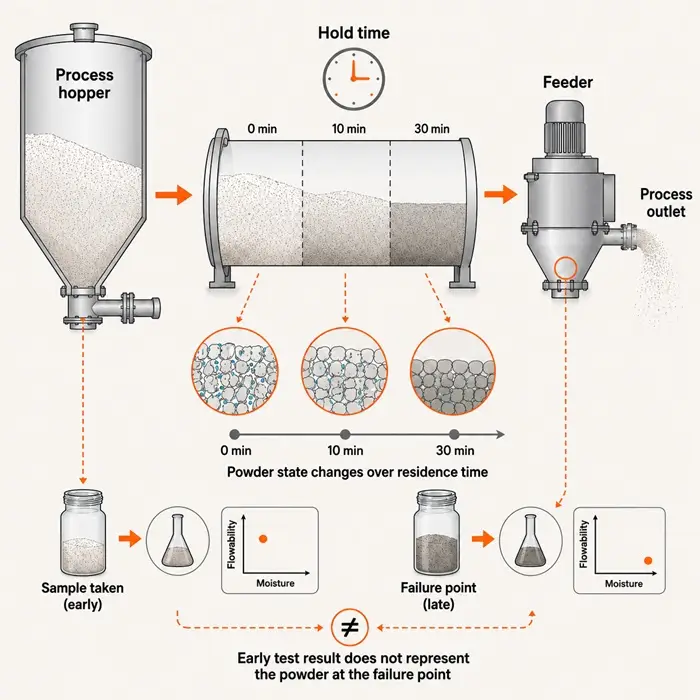
    Powder flowability is not one fixed property. A powder can look free-flowing in a simple test and still fail in a hopper, feeder, or transfer line. The right test depends on the stress state, air conditions, wall interaction, and failure mode that matter in the real process. Article updated [...]

  • FIBC discharge problems technical illustration showing how the liner-spout interface can cause unstable discharge, dust release, and residual heel in a bulk bag emptying station.

    Why FIBC Discharge Problems Often Start at the Liner-Spout Interface

    FIBC discharge problems are often blamed on the powder being discharged too quickly. In many cases, the real issue sits lower down, at the outlet interface between the liner, discharge spout, receiving hopper, vent path, and bag support. That local geometry can decide whether a big bag empties cleanly, surges, releases dust, or [...]

Material Handling and Storage Systems - Conveying Systems

Material Handling and Storage Systems: Conveying Systems

Conveying systems are essential for the efficient movement of powders and bulk materials within industrial processes. Whether using pneumatic, mechanical, or specialized conveyors, these systems ensure the safe and reliable transfer of materials while minimizing loss and contamination. Explore the innovations and techniques that optimize powder flow, enhance productivity, and meet the diverse needs of modern industries.

Featured Conveying Systems Articles

  • Powder segregation diagnosis during hopper filling showing coarse and fine fractions separating in an industrial powder transfer process

    Powder Segregation Diagnosis During Mixing, Conveying, and Filling

    Powder segregation diagnosis starts by locating where the blend loses uniformity. Some blends leave the mixer in spec and drift only during transfer, filling, or discharge. In practice, the main mechanisms are sifting, fluidization, trajectory segregation, and dusting. Each one is triggered by a different combination of particle properties, airflow, and equipment geometry. [...]

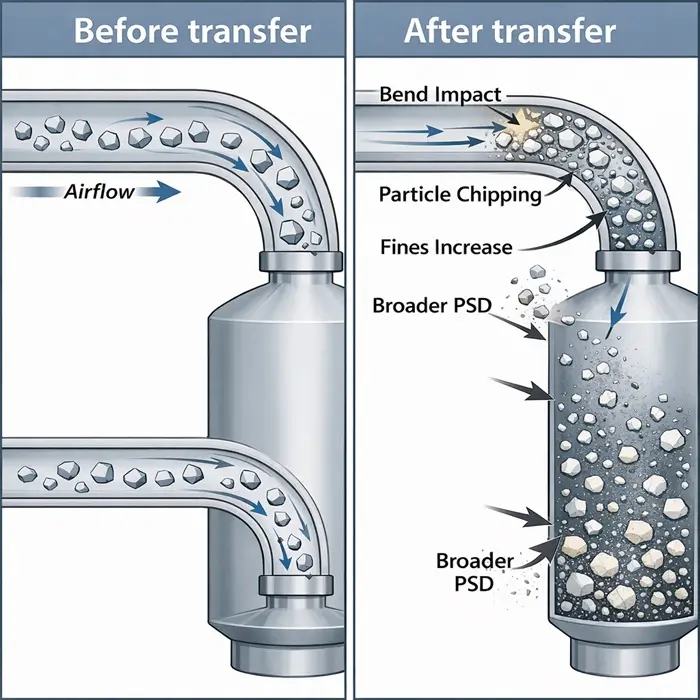
  • Pneumatic conveying attrition technical illustration showing how particles become chipped and generate fines after passing through bends in a pneumatic conveying line.

    Pneumatic Conveying Attrition: Transfer Quietly Changes Powder

    Pneumatic conveying attrition can change a powder even when the transfer looks successful. A line may run without blockage, and the material may still arrive with a broader PSD, more fines, and altered handling behavior. Therefore, if downstream dustiness, feeding, or blend performance shifts after transfer, the conveying line itself should be treated [...]

  • Deaeration lag in powders, hopper cutaway showing aerated bed with trapped air bubbles versus compacted bed, causing pause and surge discharge rate

    Deaeration lag, why “easy flowing” powders still surge

    Deaeration lag in powders creates a timing mismatch between how fast your process cycles and how fast trapped air can escape under hopper stress. That mismatch drives pause and surge discharge, density swings, and feeder instability. Fix the air pathway first. Reduce air entrainment during fill, verify vent capacity under real dust load, [...]

More Conveying System Articles

Big Bags (FIBCs)

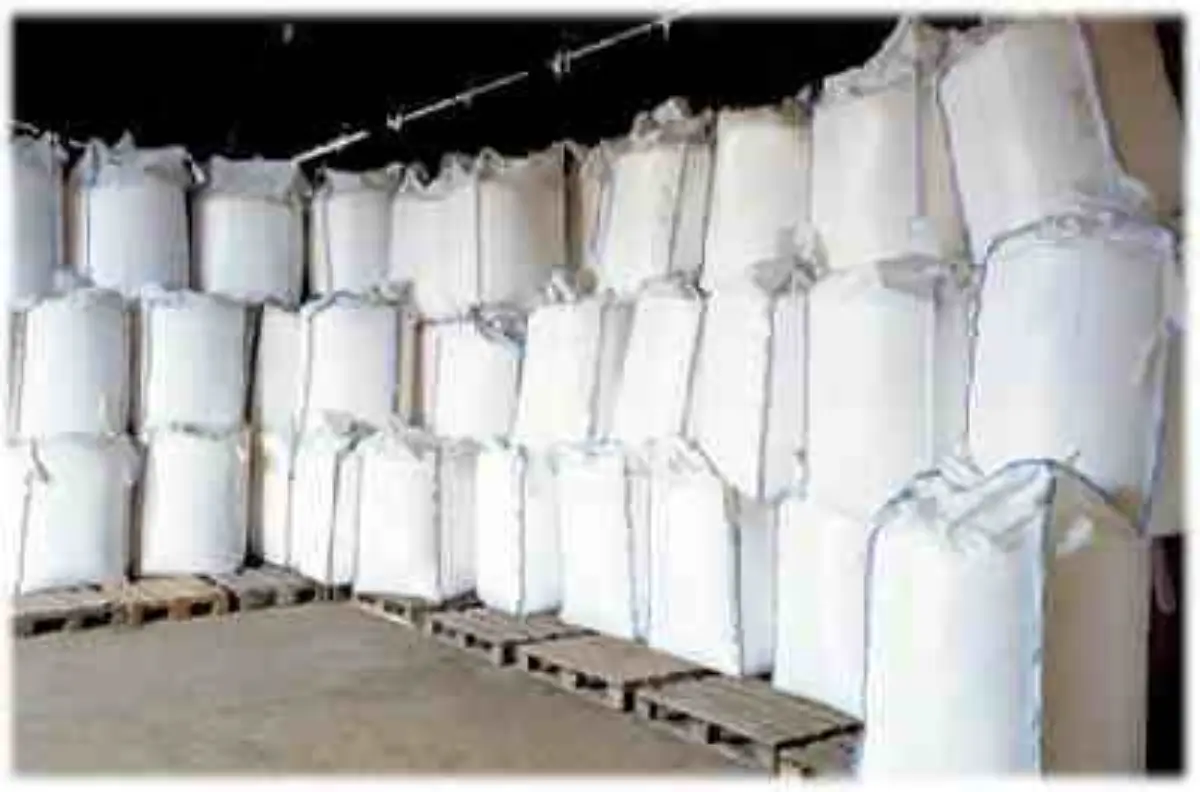
Big Bags, also known as Flexible Intermediate Bulk Containers (FIBCs), are a versatile and efficient solution for storing and transporting bulk powders and materials. Designed for durability and ease of handling, FIBCs are widely used in industries such as construction, agriculture, and pharmaceuticals. This section explores innovative loading, unloading, and dispensing techniques that ensure safety, minimize material loss, and enhance operational efficiency.

Material Handling and Storage Systems - Big Bags (FIBCs)

More Big Bags (FIBCs) Articles

Featured Big Bags (FIBCs) articles

  • FIBC discharge problems technical illustration showing how the liner-spout interface can cause unstable discharge, dust release, and residual heel in a bulk bag emptying station.

    Why FIBC Discharge Problems Often Start at the Liner-Spout Interface

    FIBC discharge problems are often blamed on the powder being discharged too quickly. In many cases, the real issue sits lower down, at the outlet interface between the liner, discharge spout, receiving hopper, vent path, and bag support. That local geometry can decide whether a big bag empties cleanly, surges, releases dust, or [...]

  • Engineer in a powder processing plant reviewing a tablet that visualizes control banding for powders near a ventilated big bag discharge station.

    Control banding for powders: making incomplete data actionable

    Control banding for powders turns incomplete hazard data into a clear exposure control strategy. It links powder properties, task exposure and engineering controls so plants can make consistent, defensible decisions instead of debating “safe enough” for every new material. Why control banding for powders matters now Most [...]

  • Powder discharging from a hopper, showing uneven flow due to prior handling and compaction

    Powder Memory: How Processing History Affects Behavior

    Powder memory explains why a powder’s behavior can change over time. Past handling, storage, or movement alters how powders flow, blend, or compact. By recognizing these changes, you can avoid many common process problems. Most powder issues do not come from size or shape alone. In fact, behavior often [...]

More Big Bags (FIBCs) Articles

Editor’s Picks