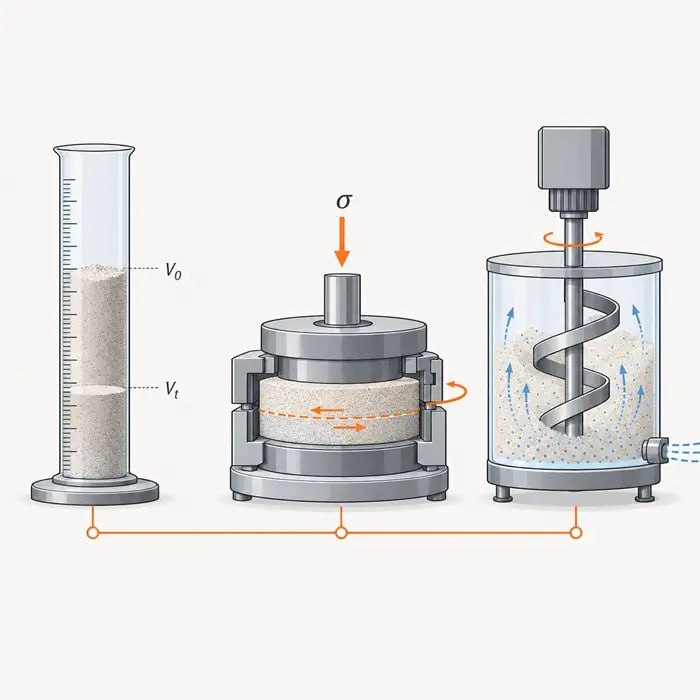


Many hopper and feeder problems look like cohesion. Operators see pulsing discharge, torque oscillations, or a hopper that suddenly “lets go” after a quiet pause. The instinct is to blame stickiness, fines, or outlet size. Sometimes that is correct. Still, a large share of these events is driven by air, not strength.
The useful concept is the deaeration lag in powders. It is the time delay between air being introduced into a powder bed and that air escaping again under the real stresses inside your hopper. When the process cycle is faster than the powder can deaerate, flow becomes discontinuous even if the powder feels free-flowing in a scoop.
The mechanism is a slow air problem that looks like a fast solids problem
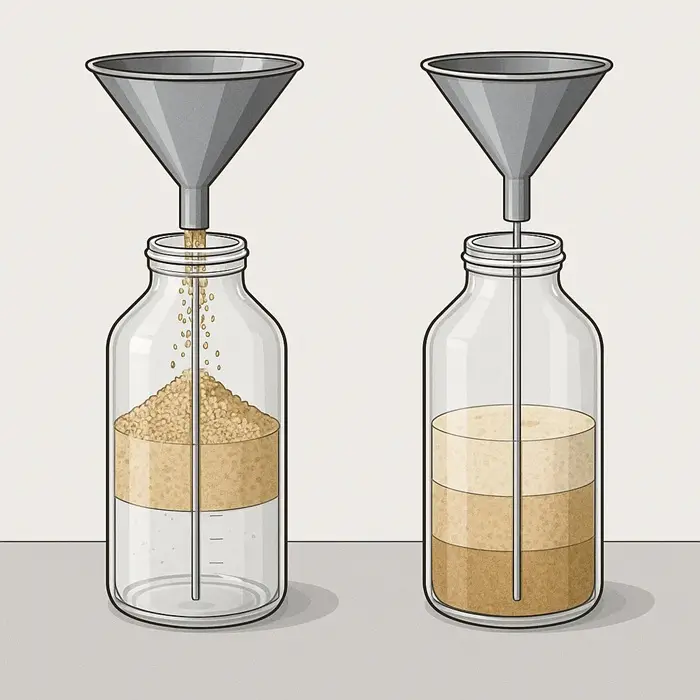
Powders pick up air during filling, transfer, and pneumatic conveying. Even gravity fill can inject air through entrainment at the falling stream, impacts in the cone, and leakage at flanges. If the bed retains air, the effective stress is lower than you think. The powder behaves lighter, more dilated, and easier to shear, until it does not.
Then a threshold is crossed. Air finds a preferential escape path, or the bed compacts locally near the outlet. The structure collapses, the bulk density jumps, and the discharge rate spikes. After that surge, the bed dilates again as fresh aerated material feeds the zone above the outlet. The result is a repeatable sawtooth pattern: pause, surge, pause.
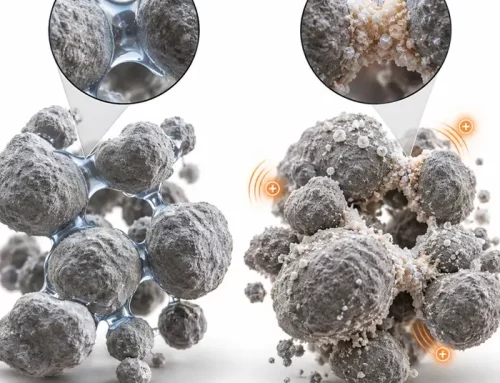
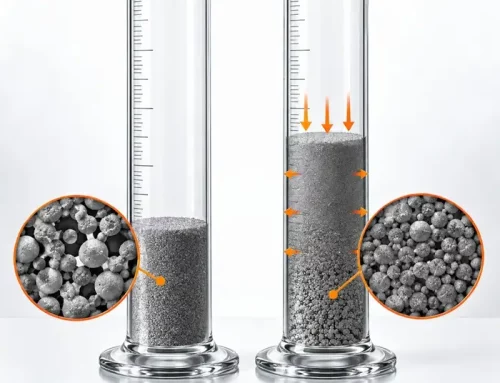
Two conditions amplify this—first, low permeability under load. Many fine or broad PSD powders vent well at low stress, then choke as stress rises and pores close—second, high compressibility. A compressible bed can change voidage quickly, so small pressure changes translate into large changes in local aeration state. Together, these create the classic symptom set: ratholing that appears and disappears, feeder flooding followed by starvation, and discharge that pulses even though nothing “bridges” in the obvious sense.
Read the Whitepaper by Jenike & Johnson Incorporated: Fine Powder Flow Phenomena in Bins, Hoppers, and Processing Vessels
What to measure
You do not need a perfect model. You need the right indicators.
-
Permeability versus stress. If permeability collapses as consolidation increases, the powder is prone to deaeration lag. Look for a steep drop across the stress range that matches your hopper head.
-
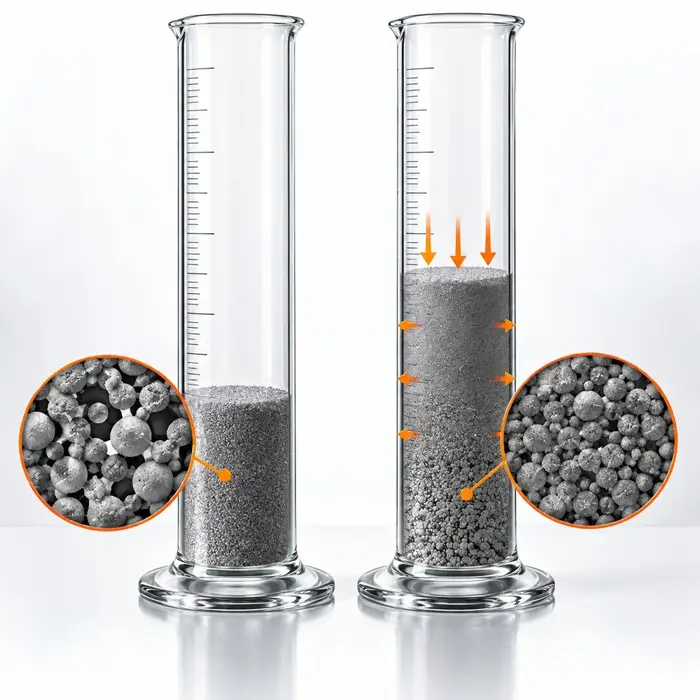
Compressibility curve. A steep bulk density increase with modest stress tells you the bed will shift states easily. That makes surging more likely, because the bed can switch from dilated to compacted quickly.
-
Aeration response in a dynamic flow test. An aeration sweep often shows a sharp drop in flow energy at mild aeration, followed by unstable behavior as the powder approaches a fluidized regime. The shape of that curve matters more than a single number.
-
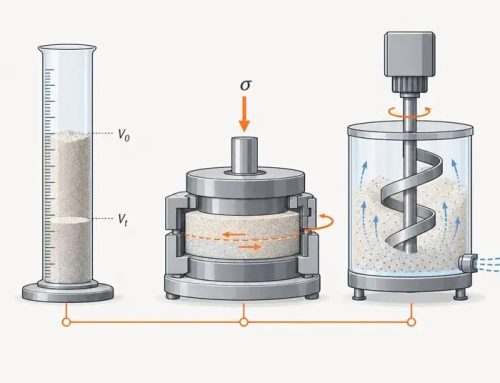
A simple plant check. Take a representative sample, deliberately aerate it by pouring it through a sieve or by shaking in a container, then measure the bulk density immediately and again after set times. If density keeps rising over minutes, your deaeration time constant is long enough to matter.
-
Vent path reality. A clean filter spec sheet is not a vent path. Check real differential pressure during fill and early discharge. If the vent is saturated, blinded, undersized, or throttled by ducting, the bed will trap air regardless of powder properties.
Decision rules and fixes that work in the field
Start with the air sources, because they are fast to validate.
-
Reduce air injection during fill. Lower drop height, slow fill rate, add a stilling well, and seal leak points that act as unintended air inlets.
-
Improve venting capacity. Size vents for peak fill, not average fill. Remove restrictive ducting, and verify filter media, cleaning, and blinding behavior under your real dust loading.
-
Add a deaeration zone. A short vertical section above the hopper can help air escape before the powder reaches the outlet. In some cases, a dedicated deaeration insert or baffle changes the failure mode completely.
-
Tune the feeder strategy. If the powder is aerated, feeders can flood. If it collapses, feeders can starve. Tighten level control, avoid aggressive speed changes, and consider control logic that accounts for density swings rather than assuming constant bulk density.
-
Only then revisit geometry. Outlet sizing and hopper angles still matter. Just do not treat them as the first lever when the signature is cyclic and air driven.
Quick diagnostic checklist for surging
If discharge pulses, check these in order.
-
Does the problem worsen right after filling or after pneumatic transfer?
-
Do you see density drift in the first minutes of discharge?
-
Is vent differential pressure high during fill or early discharge?
-
Does a short pause restore flow, then fail again?
-
Do tests show permeability collapse with stress?
Three yes answers is usually enough to treat air retention as the primary mechanism.