

A powder system can run smoothly for hours, stop for lunch, then restart with bridging, pulsing, or erratic feeder output. That pattern often gets blamed on inconsistent material. In many cases, the real trigger is the shutdown itself.
Powders do not stay neutral at rest. While the line is stopped, the bed continues to evolve under stress. Air escapes. Particle contacts settle. Cohesive strength can rise. In moisture-sensitive systems, short exposure time can also shift surface behavior. The restart then begins from a different internal state than the one that existed during flow.
That is why powder flow after a short shutdown deserves its own diagnosis. It is not the same problem as poor steady-state discharge.
Why the powder changes during a short stop
When powder is flowing, internal structures are constantly being broken and rebuilt. The bed remains disturbed. Stress redistributes continuously. Air can move through the bulk more easily.
Once the flow stops, that dynamic state disappears. The bed starts to settle under its own load. Fine particles can fill local voids. Trapped air can bleed out. Contact points between particles become more stable. In cohesive powders, this can increase bulk strength within minutes.
In practice, three mechanisms usually matter most:
1. Time consolidation
The powder strengthens while sitting under stress. This is often the main driver in cohesive solids stored above an outlet or feeder inlet.
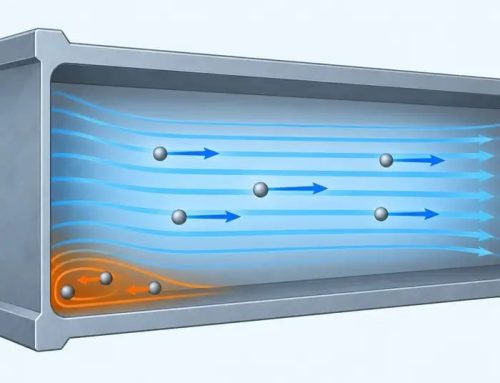
2. Deaeration or permeability loss
The bulk loses internal air support. The bed becomes denser and less mobile, especially near restricted flow zones.
3. Moisture-related strengthening
If the material is hygroscopic or surface-sensitive, even a short stop can increase interparticle attraction.
Not every powder shows all three effects. However, one of them is usually dominant.
Why restart is harder than steady discharge
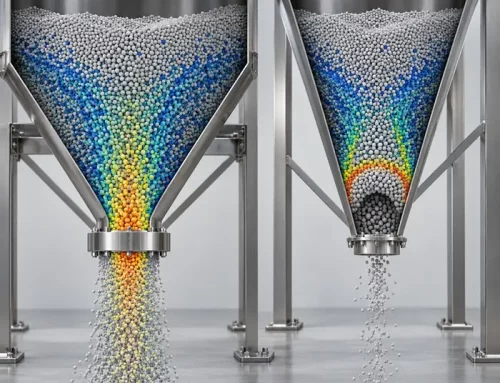
Steady discharge and restart are different mechanical states. During steady flow, the material near the outlet is already mobilized. During the restart, that same zone may have compacted and strengthened.
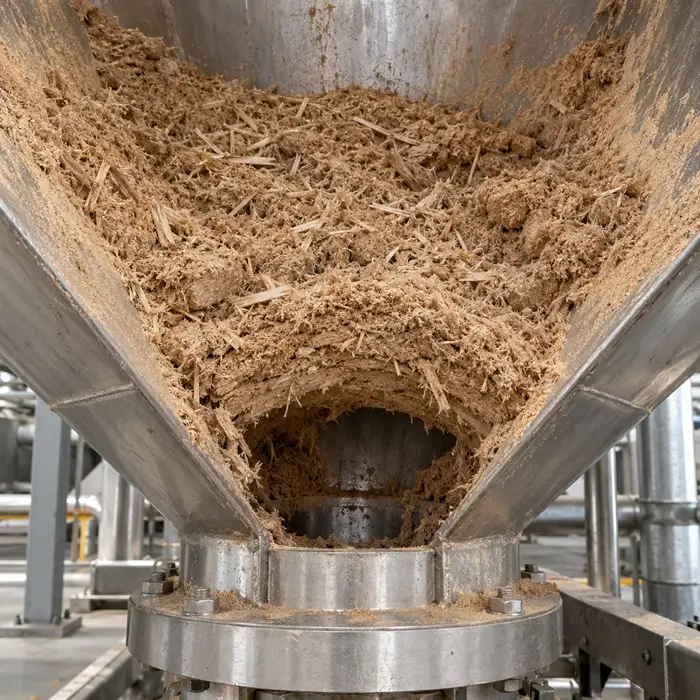
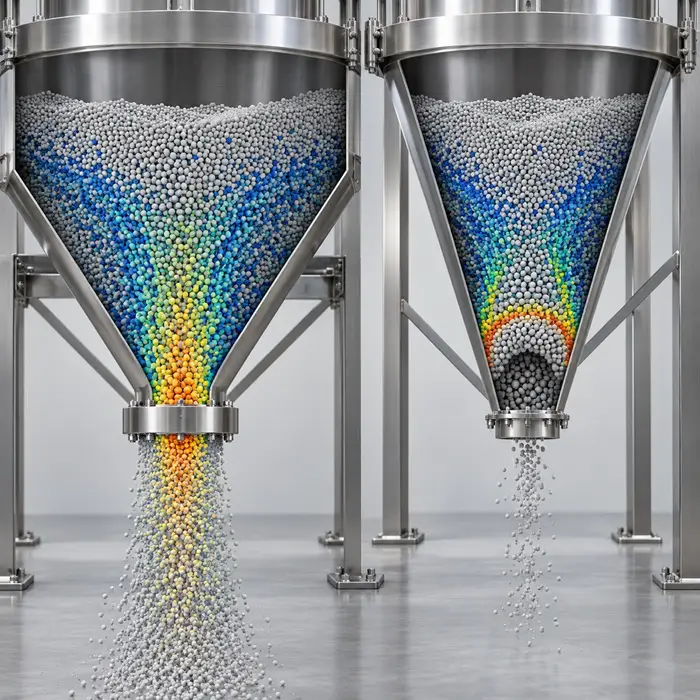
This matters most where the stress field is already unfavorable. Hopper outlets, feeder interfaces, transition chutes, and small day bins are common trouble points. If the resting bed gains enough strength, the outlet may no longer generate reliable mass movement at restart.
The result can take several forms:
-
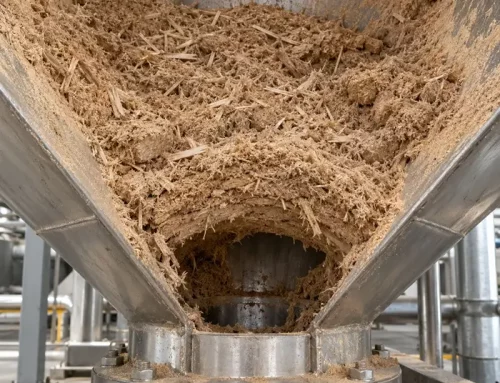
a stable arch above the outlet
-
a rathole that forms and holds
-
surging discharge
-
delayed feeder pickup
-
a sudden spike in restart torque
A line that runs well in motion can still fail at restart because the design margin is too small for the resting state of the powder.
A realistic plant example
Take a fine additive premix feeding into a continuous process. During normal operation, the hopper discharges acceptably, and the screw feeder runs at a stable load. Then the line stops for 30 minutes.
At restart, the feeder current jumps. Output becomes erratic. Operators tap the hopper or jog the screw. Flow returns, but only after a brief struggle.
That pattern points to local strengthening above the feeder inlet during rest. The powder was flowable enough in motion, but not stable enough after sitting under load. The stop exposed a weak point that was already present in the design or operating window.
How to tell which mechanism is driving the problem
This is where the diagnosis needs to sharpen. The symptoms may look similar, but the dominant mechanism can differ.
Signs that time consolidation is dominant
Restart gets worse with longer dwell time. Agitation or partial bed disturbance improves flow. The issue appears mainly after stops, not during continuous running.
Signs that deaeration or permeability effects matter
The powder behaves well when freshly filled or recently disturbed, then becomes sluggish after sitting. Restart may show compaction, surging, or unstable flow channels.
Signs that moisture effects are involved
The problem becomes worse during humid days, after exposure to ambient air, or in materials known to pick up moisture quickly.
Signs that feeder loading is the real pinch point
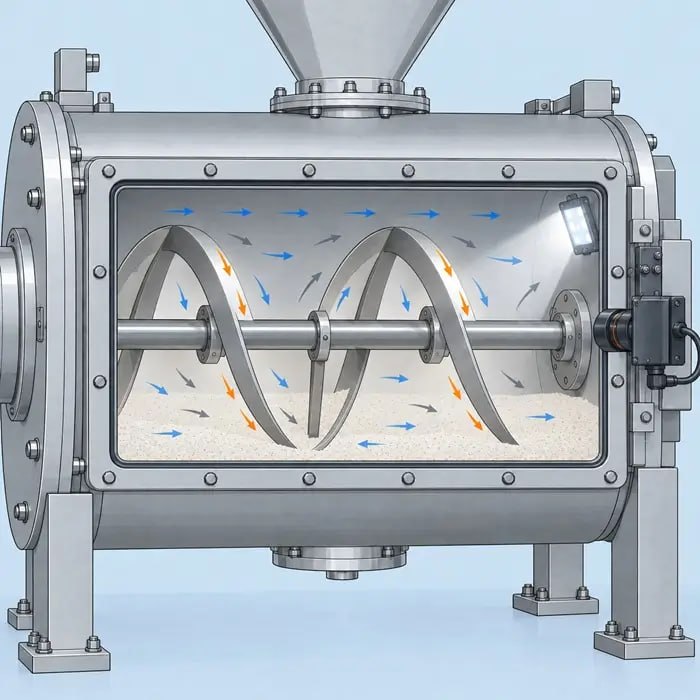
Motor load rises sharply at restart. The hopper may not fully bridge, but the feeder struggles to re-establish a stable drawdown.
This distinction matters because each mechanism points to a different corrective path.
What to measure when powder flow after a short shutdown keeps happening
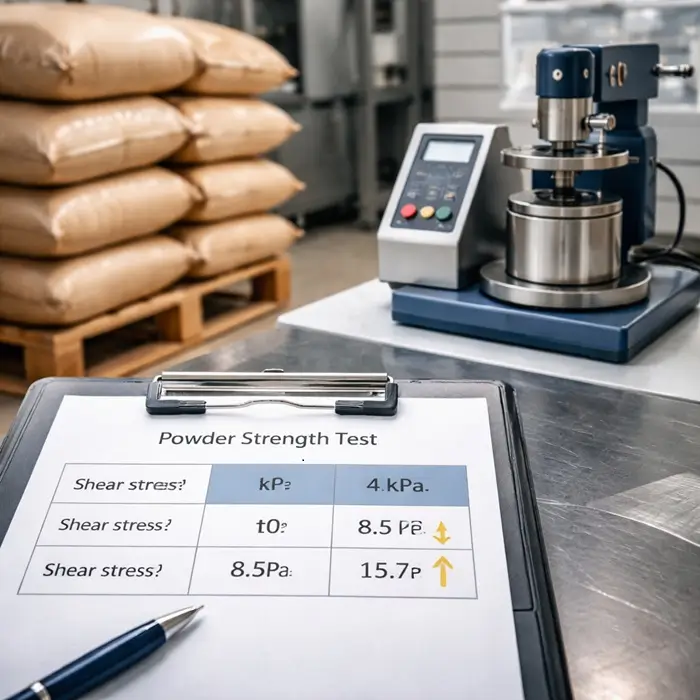
When powder flow after a short shutdown becomes a recurring issue, standard flowability language is not enough. You need to know how the material behaves after rest under stress.
The most useful measurements usually include:
-
shear behavior with time consolidation
-
wall friction against the actual contact surface
-
bulk density change under load
-
permeability or air sensitivity where relevant
-
moisture uptake behavior for hygroscopic systems
The key is not just asking whether the powder flows. The key is asking whether it strengthens fast enough during a short stop to cross a failure threshold at restart.
That is why a proper lab study can save time. It links a visible plant symptom to a measurable mechanism and then to a design or operating decision.
Check out ASTM D6773-02 – Standard Shear Test Method for Bulk Solids Using the Schulze Ring Shear Tester
What to do in practice
Start with the simplest engineering question: Does the outlet and feeder geometry still have enough margin after the powder has rested?
If the answer is no, the line may run fine in motion but remain fragile at every stop.
Practical fixes usually fall into four groups.
1. Reduce dwell stress in critical zones
Avoid leaving a full head of powder above a sensitive outlet during planned stops where possible.
2. Increase geometric margin
Review outlet size, hopper angle, inlet transition shape, and feeder interface. A design that barely works in motion is often not good enough.
3. Improve restart procedure
Restart logic matters. Controlled sequencing can reduce local shock loading and help the bed re-mobilize more reliably.
4. Reassess the powder state itself
Check fines content, moisture condition, and any recent upstream change that affects deaeration or cohesion.
The point is direct. A short stop is not operational dead time. It is a period in which the material can move outside its previous handling window.
In Closing
When a powder system fails after a short stop, the root cause is often hidden in the resting state of the bed. The equipment did not suddenly become worse. The powder state changed under load. Once you diagnose restart as a separate solids-handling condition, the problem becomes easier to isolate and far easier to fix.