

A powder can meet the specification and still fail in production. A batch may pass particle size, moisture, bulk density, or incoming flow checks, then bridge in a hopper, flood from a feeder, cake in storage, segregate during transfer, or form lumps during liquid addition.
That does not automatically mean the specification is wrong. It often means that the process has pushed the material beyond the condition in which the specification still predicts performance. That condition range is the powder operating window. The concept shifts troubleshooting from general material approval to process-relevant diagnosis. The task is to identify which process condition moved the powder from acceptable behavior into failure, then select a test that reproduces that condition.
Diagnostic Map: Symptom, Boundary, Test
Use the operating window as a troubleshooting map before selecting tests.
| Process symptom | Crossed boundary | Named test or measurement | Practical interpretation |
|---|---|---|---|
| Hopper bridging after storage | Consolidation stress and storage time | Jenike shear cell, ring shear tester, time consolidation shear test, flow function, unconfined yield strength | Compare cohesive strength after storage with the stress available at the hopper outlet. Calculate the critical arching dimension. |
| Ratholing or poor restart after standing | Wall friction, consolidation, outlet geometry | Wall friction test with real wall coupon, shear cell test, hopper design calculation | Compare wall friction angle and flow function with hopper angle, outlet size, and mass flow requirement. |
| Feeder pulsing, flushing, or flooding | Aeration, deaeration, permeability | Permeability test, deaeration test, aerated bulk density, tapped bulk density, discharge observation | Check whether the powder retains or releases air outside the range the feeder can tolerate. |
| Caking in bags, silos, or big bags | Humidity, temperature, contact pressure, time | Water activity, dynamic vapor sorption, humidity conditioning, caking strength, conditioned flow test | Define the humidity, temperature, pressure, and storage time where loose powder turns into a stronger cake. |
| Poor wetting or lump formation | Surface condition, agglomerates, liquid addition rate, shear | Contact angle on suitable compacted samples, capillary uptake, dispersion test, wetting observation, mixing sequence review | Compare the lab wetting condition with the actual liquid addition, powder movement, and shear state in the process. |
| Segregation after transfer or filling | Particle size, density, shape, air entrainment, drop height | Segregation test, before and after PSD, assay or composition mapping, fill height comparison | Identify whether local composition changes after handling, even when the batch average remains within specification. |
| Flow or caking shift after warm filling, cooling, or seasonal change | Temperature, phase behavior, humidity, electrostatics, time | Temperature conditioned flow test, water activity, thermal analysis, humidity exposure, electrostatic observation | Test the powder under the same thermal and humidity history that exists before the failure appears. |
This diagnostic map is also the internal linking structure for the page. Consolidation connects to flowability testing and hopper discharge. Aeration connects to permeability and feeder instability. Humidity connects to caking and moisture control. Wetting connects to powder wettability. Segregation connects to particle size, density, transfer, and filling. Temperature connects to storage stability, caking, electrostatics, and process environment.
Specification Describes a Point, the Process Creates a Range
Most powder specifications describe the material under defined test conditions. That is necessary for supplier agreements, batch comparison, and quality control. Production, however, rarely handles powder as a fixed laboratory sample.
During operation, the material may be stored under load, transferred through chutes, filled into bags, aerated during conveying, deaerated in a hopper, warmed by equipment, exposed to humid air, sheared in a mixer, or compacted by its own head pressure. Each step tests a different part of the powder’s behavior.
A standard specification may confirm that the material met the agreed limit. It may still leave one important question unanswered: how close is the powder to a practical failure boundary?
For example, a powder may flow freely when tested immediately after filling but bridge after 24 hours in a hopper. In that case, the relevant data may come from a shear cell or ring shear test after time consolidation, not from angle of repose or loose bulk density. The result should produce flow function and cohesive strength data that support hopper outlet assessment, arching risk evaluation, and restart decisions.
The specification gives control and repeatability. The operating window adds the process context needed to understand when that same material stops behaving reliably.
Consolidation and Hopper Discharge
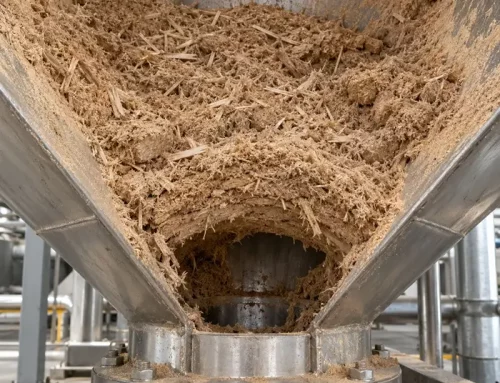
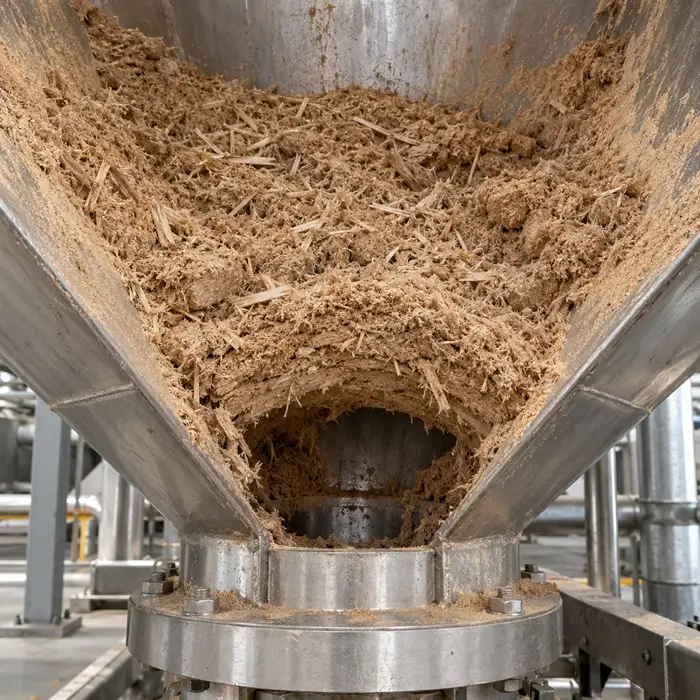
Storage and hopper discharge problems often sit at the consolidation boundary. A powder can look free flowing when loose, yet gain enough strength under load to bridge, rathole, or restart poorly after standing.
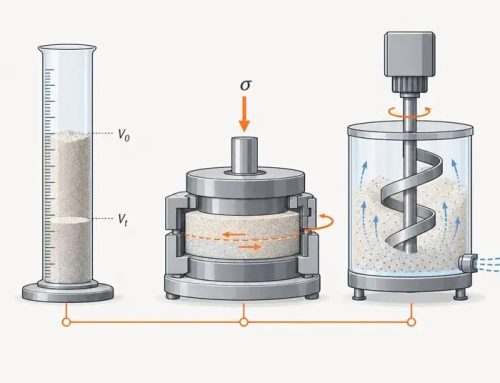
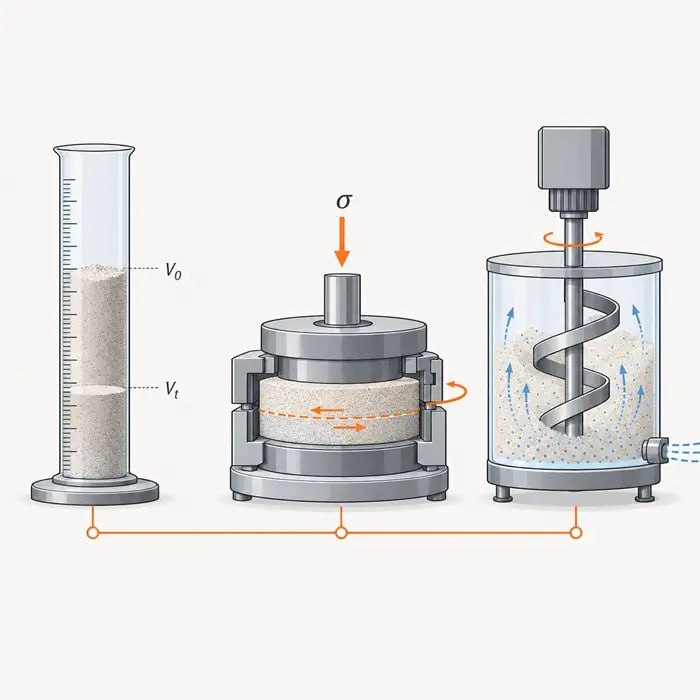
This is where named flow tests matter. A Jenike shear cell or ring shear tester can measure flow function, unconfined yield strength, bulk density, internal friction, and wall friction under defined consolidation stresses. For storage-related failure, the test should include the consolidation stress and rest time that resemble the silo, hopper, bin, or big bag condition.
ASTM D6128 is a relevant external reference here because it covers shear testing of bulk solids with the Jenike shear cell, including cohesive strength during continuous flow and after storage at rest.
The practical plant question is concrete:
Does the powder still discharge after the same stress and storage time it sees before failure?
If the answer is no, the operating window is probably defined by consolidation rather than by loose powder behavior. That should point the investigation toward hopper outlet size, wall angle, wall friction, mass flow requirement, storage time, or a material specification that controls time-consolidated strength.
For related reading, see why free-flowing powders still arch in hoppers and diagnosing and solving powder arching and blockage in hoppers.
Aeration, Permeability, and Feeder Instability
Feeder drift, flushing, flooding, and pulsing often come from the air boundary. Some powders retain air after pneumatic transfer, high-speed filling, or rapid discharge. Others deaerate quickly and compact near the feeder inlet. Both states can destabilize dosing.
Permeability testing is useful when powder performance depends on air exchange through the bed. Deaeration testing, aerated bulk density, tapped bulk density, and discharge observations can show whether air retention contributes to the failure.
A practical feeder investigation should compare three states:
1. Loose powder after filling
2. Aerated powder after transfer
3. Deaerated powder after standing or vibration
If feed rate changes sharply between those states, the operating window includes air condition, not only particle size or moisture. In that case, the answer may involve settling time, venting, slower filling, feeder inlet design, deaeration, or a feeder setup that tolerates the aerated state.
Moisture, Water Activity, and Caking
Moisture problems often look simple, but rarely are. A powder may stay within total moisture specification and still cake, stick, or lose flow if water is active at particle contacts or if the process environment drives local uptake.
The operating window should therefore separate total moisture content from behavior under exposure. Water activity, dew point, humidity conditioning, dynamic vapor sorption, caking strength, and conditioned flow testing can all be relevant, depending on the failure mode.
For storage caking, the test condition should include time, humidity, temperature, and pressure. A moisture result before storage may miss the important condition. The practical question is whether the powder forms stronger contacts after realistic exposure.
A useful comparison is:
1. Fresh powder at incoming condition
2. Powder after controlled humidity exposure
3. Powder after humidity exposure plus consolidation
4. Powder after temperature cycling, where relevant
If caking appears only when humidity and pressure combine, then neither moisture content nor flowability alone defines the risk. The operating window lies in the combined condition.
For more context, see powder stickiness and caking in food production.
Wetting, Lump Formation, and Agglomerate Survival
Poor wetting, floating powder, and lump formation often appear when laboratory mixing does not match production mixing. A powder may disperse cleanly under small scale conditions, then form lumps when liquid addition rate, droplet distribution, shear field, powder bed depth, or surface exposure changes.
The relevant measurements depend on the material. Contact angle can help when a compacted tablet or pellet can represent the surface without distorting the structure. Capillary uptake, dispersion observations, particle size after wetting, and controlled mixing trials may be more useful when porosity, agglomerates, or binder distribution control the failure.
The operating window in this case includes both material behavior and process sequence. Liquid addition rate, droplet size, mixing intensity, powder movement, order of addition, and penetration time all matter.
A practical case is a mineral, ceramic, or additive powder that wets during bench testing but forms lumps in a production mixer. The powder may not be incompatible with the liquid. The process may be adding liquid faster than the powder bed can distribute it, absorb it, or expose fresh surface.
For related context, see powder wettability, powder wettability in the food and feed industries, and dispersion in powder processing and laboratory testing.
Segregation After Transfer or Filling
Segregation creates a different kind of operating window because the batch average can remain correct while the local composition changes. This is especially important for blends with broad particle size distributions, density differences, shape differences, or minor active components.
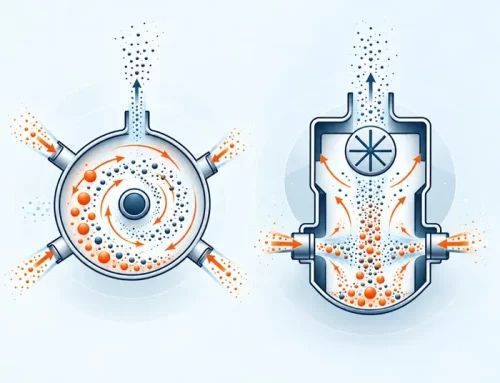
A segregation diagnosis should compare material before and after the handling step that causes the issue. Useful methods include before and after particle size testing, assay mapping, composition checks at different fill heights, and controlled segregation tests. Sifting and fluidization segregation are different mechanisms, so the test method should match the suspected plant behavior.
ASTM D6940 is relevant for sifting segregation tendencies, while ASTM D6941 is relevant for fluidization segregation tendencies.
A practical case is a dry blend that is uniform after mixing but fails assay checks after transfer into a hopper, container, or big bag. The powder did not fail at the mixer. It failed at the transfer boundary. The correct investigation compares the blend before transfer, after transfer, and at different discharge points.
This is also where dust belongs as a cross cutting symptom. Dust release during filling may follow fines content, drop height, air velocity, attrition, or local segregation of fines. Treat it as a handling and segregation signal unless the process clearly points to a separate dustiness mechanism.
For related reading, see powder segregation diagnosis during mixing, conveying, and filling, segregation mechanisms and prevention, and powder dustiness is a release problem, not a fines number.
Temperature and Time Dependent Behavior
Temperature and time often define the boundary when a powder fails after a seasonal change, warm filling step, cooling step, or long dwell period. The powder may pass room temperature testing, then cake, stick, charge, soften, or lose flow under the actual process history.
A practical example is a fat-containing food powder filled into warm bags and then moved into cooler storage. During cooling, fat phase behavior and moisture redistribution can change the contact strength between particles. The incoming moisture result may still look acceptable, but the product may cake after a defined storage time because temperature, humidity, pressure, and time act together.
Another case appears in dry winter operations. A powder that normally feeds well may begin clinging, dusting, or segregating when low humidity increases electrostatic effects. In that case, the operating window includes ambient humidity and charge behavior, not only the powder’s standard flow result.
The diagnostic question is direct:
Does the powder fail only after a specific thermal, humidity, or dwell history?
If so, test the material under that history. Temperature-conditioned flow testing, water activity, humidity exposure, caking strength, electrostatic observation, thermal analysis, and before and after particle size or morphology checks may all contribute. The right test is the one that reproduces the state present just before failure.
What to test next: Closing the Diagnostic Loop
A powder operating window turns powder testing into process evidence. The practical shift is simple: define where the powder stops behaving reliably, then test close to that boundary.
A hopper problem may require shear cell data and hopper design checks. A feeder problem may require permeability or deaeration measurements. A caking problem may require humidity conditioning, water activity data, temperature history, and storage pressure. A segregation problem may require before-and-after testing across the actual handling route.
The useful diagnosis links three points: the process symptom, the boundary the process crossed, and the test condition that reproduces that boundary. Once those points are clear, testing becomes more than a material description. It becomes a way to decide what must change in the powder, the process, or the equipment.