

A feeder problem usually announces itself at the worst possible point. The screw pulses, discharge surges, fill weights drift, dust appears, or the downstream process starts reacting to inconsistent supply.
By then, the important change may already have happened inside the hopper.
A hopper is not a neutral waiting room for powder. As material fills, settles, releases air, consolidates, and empties, the powder near the outlet keeps changing. Full, half-full, and low-level operation can present the feeder with different bulk densities, air contents, permeabilities, and flow resistance.
That is why hopper fill level belongs in the diagnosis when discharge behavior changes during the same production run.
Fill Level Changes the Powder Before It Reaches the Feeder
Fill level matters most with fine, cohesive, compressible, poorly permeable, or recently conveyed powders. Coarse, free-draining materials with stable bulk density usually tolerate changing fill levels without much drama. Fine powders with retained air behave differently. They can make a stable feeder look unstable because the powder reaching it is no longer in the same condition.
A full hopper puts weight on the powder below. Some of that load is carried by the walls through friction. Some remains in the bed and changes how tightly the particles pack together.
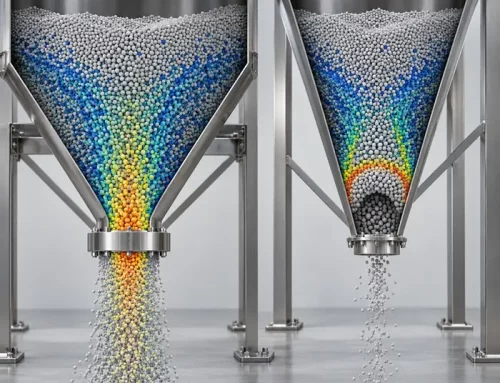
Near the outlet, that matters. Higher fill levels may densify the lower bed, reduce air pathways, and increase resistance to flow. A hopper that discharges freely straight after filling may behave differently after standing for ten minutes.
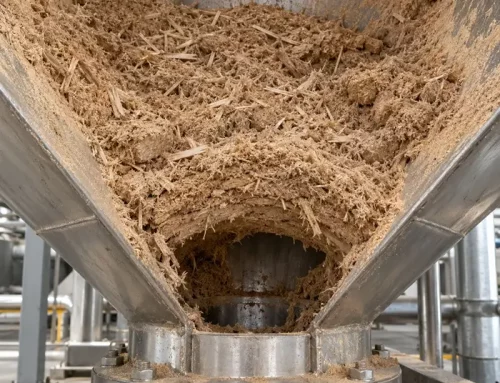
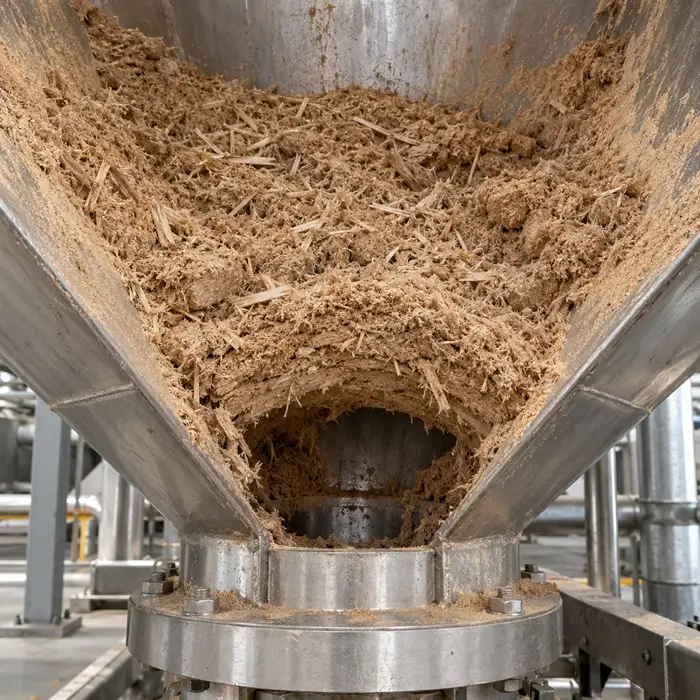
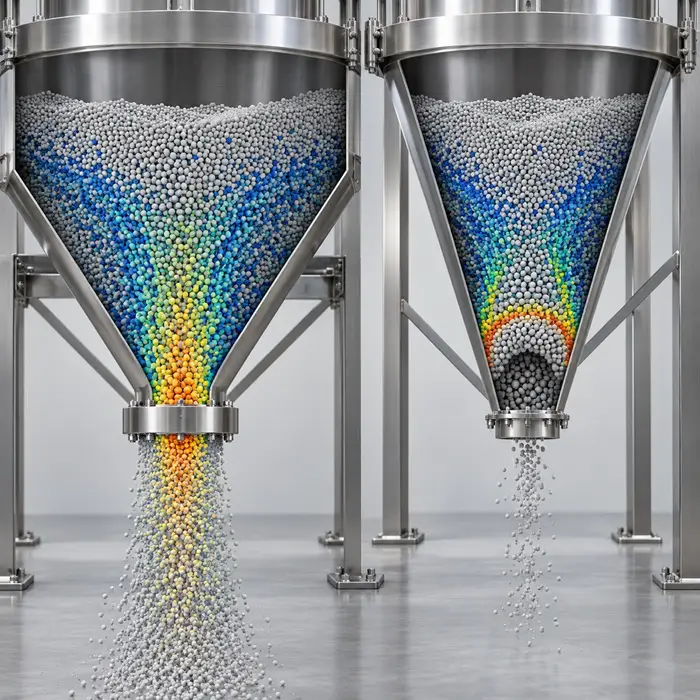
Low fill levels create a different risk. Once the material level drops close to the lower hopper section, there is less head of powder above the outlet. Small changes in density, air release, ratholing, or partial arching then have more influence on feeder output.
Use fixed observation points during plant checks: 80%, 50%, 25%, and just above the minimum operating level. These values are not design limits. They give operators repeatable conditions, which is far better than diagnosing from loose descriptions like “nearly full” or “almost empty.”
Retained Air Is Often the Missing Timing Factor
The strongest clue is often time.
After pneumatic conveying, vacuum transfer, dumping, or rapid filling, air can remain trapped between particles. The top of the bed may look settled, while the powder near the outlet is still aerated enough to flow as a lighter, more mobile material.
That temporary condition can produce flushing, oversupply, dust release, feeder pulsing, or variable fill weights. A few minutes later, the same powder may discharge more slowly because air has escaped and the bed has compacted.
This is why retained air is so easily mistaken for a feeder fault. The feeder may be responding normally to a powder state that is changing underneath it.
A typical case is a screw feeder below a hopper filled by pneumatic transfer. In the first few minutes after filling, the powder enters the screw at a lower bulk density and may move too freely. Output looks high, irregular, or difficult to control. After ten to twenty minutes, the powder has deaerated. Bulk density increases, flow resistance changes, and the same screw speed delivers a different mass flow. A feeder correction made during the aerated phase can therefore create a new error after the powder settles.
For related background, see Fine Powder Fluidization in Pneumatic Conveying and Permeability Collapse in Hopper Discharge.
What to Check Before Changing the Feeder
Start with the operating sequence, not the instrument list. Note the fill level, time since filling, visible aeration, discharge pattern, feeder output, and bulk density. Then repeat the observation after a defined hold period. The comparison is what counts.
During troubleshooting, compare the behavior immediately after filling and again after 5, 10, and 20 minutes. Changes in bulk density, feeder output, discharge pattern, or dust release across that window show that time since filling belongs in the diagnosis. A bulk density shift above about 5% between the immediate and settled state is already worth attention.
Permeability is the key measurement when the behavior follows a timing pattern. A powder that fails to release air within the normal process cycle will not present a stable feed condition after each refill. It will pass through an aerated phase, a settling phase, and a denser settled phase, while the feeder is expected to behave as if nothing changed.
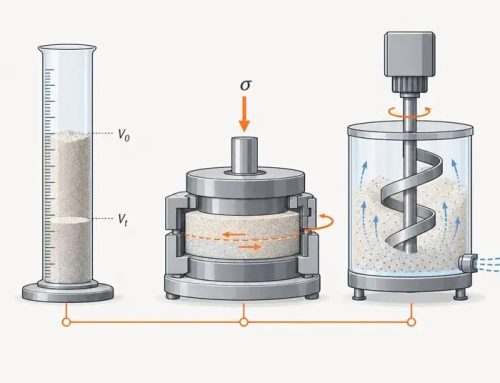
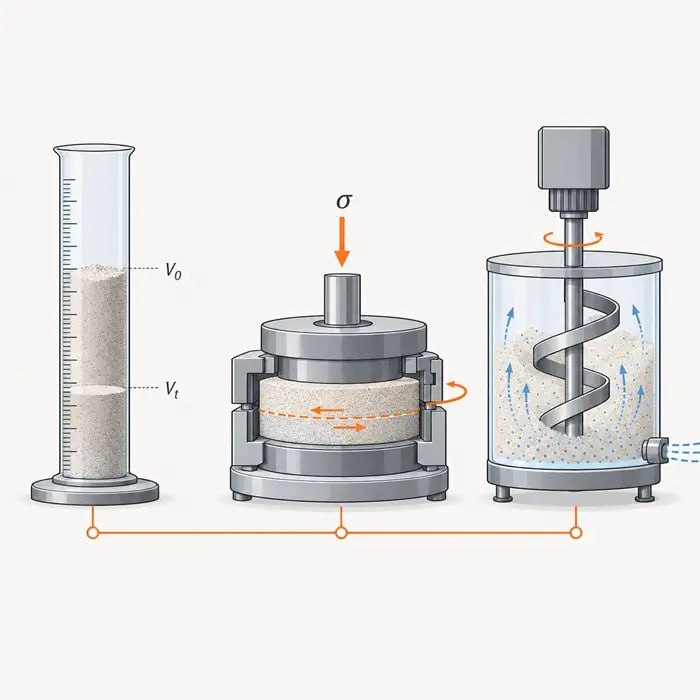
Aerated and settled bulk density measurements show how large that shift is. USP <616> is a useful external reference for bulk and tapped density practice: USP <616> Bulk Density and Tapped Density of Powders. Shear and wall friction data help identify whether consolidation or hopper geometry adds resistance. ASTM D6128 is relevant for Jenike shear testing of bulk solids: ASTM D6128.
Testing should follow the symptom. A feeder should not be treated as the only adjustable component when the hopper is delivering different powder states during the same operating cycle.
The Practical Decision
Fill level and time since filling belong in any serious discharge investigation. Together, they define the powder condition arriving at the outlet.
When a hopper behaves differently when full, half-full, and close to empty, the process is already giving useful information. Capture that pattern before changing feeder speed, hopper hardware, formulation, or control settings.
A feeder correction made without fill-level and deaeration data is being made against a moving target.
For a related feeder-specific case, see Loss in Weight Feeder Drift After Refill.