
Table of contents

A powder can pass incoming flow checks, fill cleanly, and still block a hopper in production. That contradiction causes expensive confusion during scale-up and troubleshooting. Operators may see a material that pours easily during handling, then arches after storage, after a weekend shutdown, or under the head pressure of a full vessel. The powder did not suddenly become different. The stress state did.
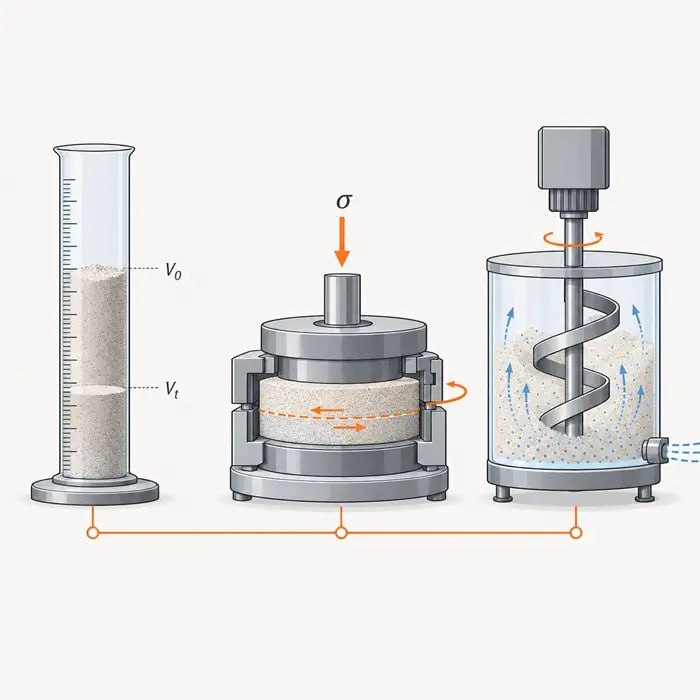
In powder technology, the term “free-flowing” is often based on simplified tests such as angle of repose, Hall or Carney flow, or compressibility-based indices. These methods can be useful for quick comparison, but they assess powder behavior under low-consolidation, dynamic conditions. A hopper outlet presents a different problem. Powder near the outlet carries load from the material above it, remains under sustained consolidation, and fails only if the stresses at the outlet can overcome the strength the powder has developed in that state.
That disconnect has shaped hopper design for decades. Formal powder mechanics and shear-based design methods gave engineers a way to evaluate powder strength under relevant stresses rather than relying on loose descriptors such as “good flow.” For background that supports this design logic, you can point readers to Dietmar Schulze’s overview of storage of powders and bulk solids in silos and to this summary of hpper design principles. For process, plant, and design engineers, the distinction still matters. A powder that behaves well in an R&D room or QC lab may still arch, rathole, or discharge erratically in a full-scale hopper.
Why Simple Free-Flow Tests Fail to Predict Hopper Blockage
Standard free-flow tests and hopper discharge conditions do not examine the same powder state.
Flow funnels and angle of repose tests assess a powder while it is loose, aerated, and moving. In those conditions, particles rearrange readily and the stresses are low. The result may tell you something useful about relative flow behavior during pouring or filling, but it does not quantify the strength the powder develops under sustained consolidation.
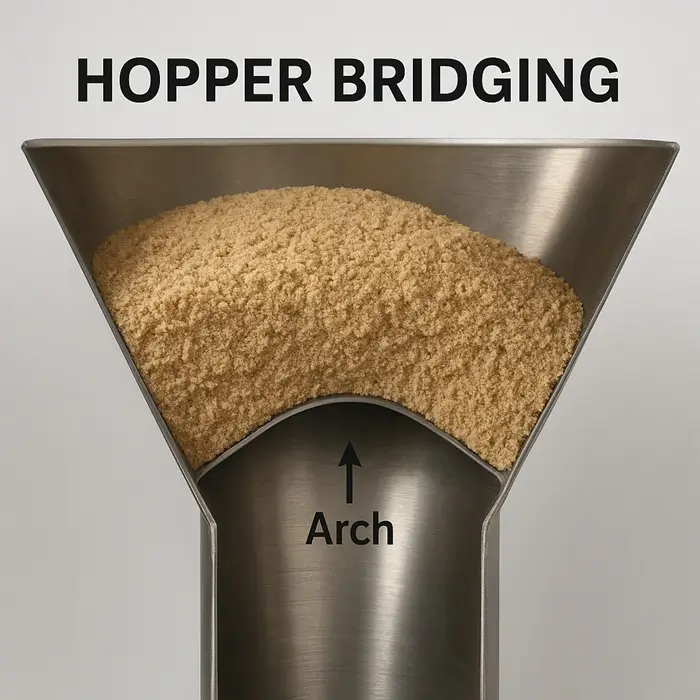
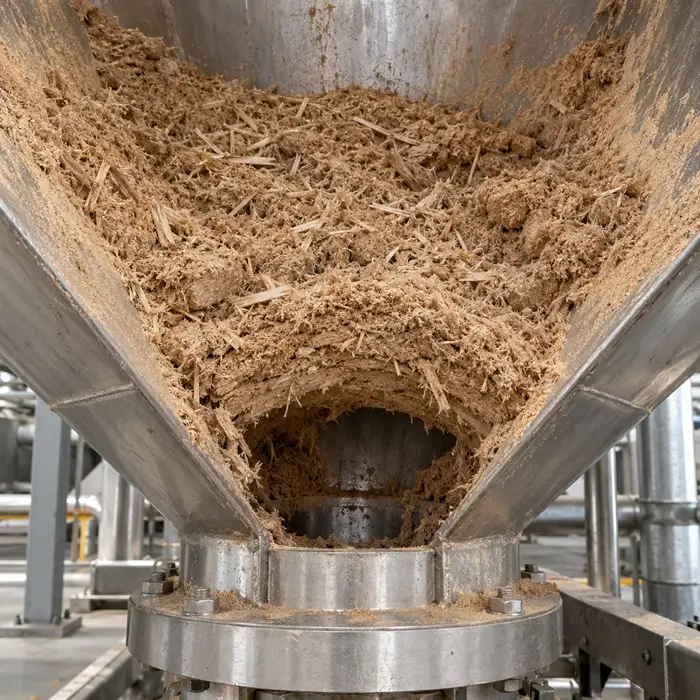
A hopper blockage is different. It is a static failure of a consolidated bulk solid. Powder at the outlet sits under the compressive load of the material above it. As stress rises, particles move closer together, the contact area increases, and interparticle forces become more effective. A powder that appears easy to handle in a low-stress test may therefore develop enough strength under load to support a stable arch across the outlet.
This is why “free-flowing” can be a misleading label in storage and discharge applications. It may describe one operating condition well, while missing the condition that actually governs hopper failure.
The Core Mechanism, How Consolidation Creates Cohesive Strength
Arching is a stability problem caused by strength development under consolidation.
As powder consolidates, bulk density rises, and the void space between particles decreases. That change strengthens interparticle contacts. For fine powders, especially below about 100 microns, van der Waals forces can become significant relative to particle weight. Moisture may create liquid bridges. Rough or irregular particle surfaces may increase mechanical interlocking. Electrostatic effects can also contribute in some systems, particularly when the material is dry and highly insulating.
Time can make the problem worse. Under static load, particles continue to rearrange into more stable configurations. Contact points increase, local bonding strengthens, and the bulk solid may gain additional strength over hours or days. That is why a hopper may discharge normally after filling, then arch after standing at rest. If you want a supporting internal read that frames these failures as structural rather than generic “bad flowability,” link the phrase contact networks in bulk powder behavior.
The relevant strength measure here is unconfined yield strength. Once the consolidated powder mass develops enough strength, it can support itself across the outlet. At that point, the issue is no longer whether the powder can flow in principle. The issue is whether the stresses at the hopper outlet are sufficient to break the structure that has formed.
The Shear Cell and Flow Function
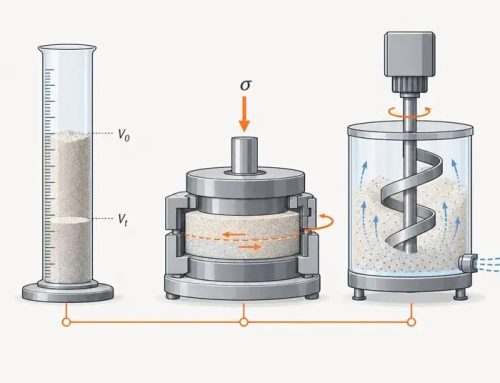
To predict arching reliably, the powder must be tested under stress conditions that resemble the real process. That is the role of the shear cell test.
Jenike, Peschl, and ring shear methods all work from the same basic principle. The powder sample is consolidated under a known normal stress, then sheared until it fails. Repeating that sequence over a range of stress levels produces a Flow Function, which relates unconfined yield strength to major consolidating stress.
This matters because it shows how the powder gains strength as consolidation increases. A single low-stress flow metric cannot capture that behavior. The Flow Function can.
From that curve, engineers can derive the critical arching diameter, often written as Dc. This is the minimum outlet size required to prevent a stable arch from forming under the relevant stress conditions. If the outlet is smaller than this value, the risk is not theoretical. The geometry and the powder strength are already misaligned.
Good testing practice also means matching the test conditions to the process. If the hopper operates after storage, then time consolidation should be included. If humidity changes during storage or transfer, the test plan should reflect that. If the powder is sensitive to handling history, compaction, or deaeration, those factors should be considered before concluding the data.
Comparing Test Results to Hopper Geometry
The diagnostic decision point is straightforward. Compare the actual hopper outlet size to the critical arching diameter derived from the Flow Function.
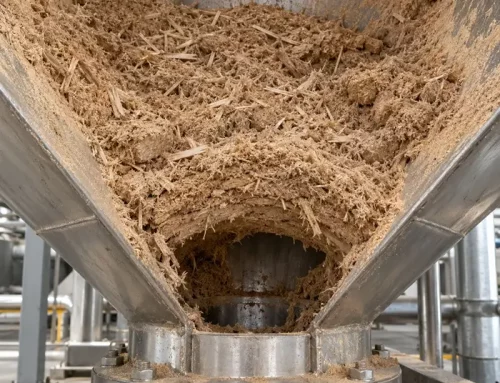
If the outlet is smaller than Dc, stable arch formation is probable. In that case, blockage is predictable even if the powder still looks free-flowing in routine tests. If the outlet is larger than Dc, outlet arching becomes less likely, and the investigation should shift toward other causes such as wall friction, flow pattern, segregation, variable moisture, or inconsistent feeding into the hopper.
This comparison is where many troubleshooting efforts become clearer. Engineers often spend time debating whether the powder is “really cohesive” when the more useful question is whether its measured strength under real consolidation exceeds what the outlet geometry can tolerate.
The stress dependence also matters. Some powders look easy to handle at low stress and become distinctly cohesive at the higher stresses present in a silo or process hopper. That shift is visible on the Flow Function. It is invisible in most quick free-flow checks.
Time consolidation can make the same point more sharply. A powder may discharge without issue when freshly filled, then form a blockage after sitting over a weekend. If the test program includes time under stress, that behavior often stops looking mysterious.
Flow Pattern Matters Too
Outlet size is not the only variable. Wall friction and hopper geometry also affect whether the powder moves in mass flow or funnel flow, which in turn changes the stress history near the outlet.
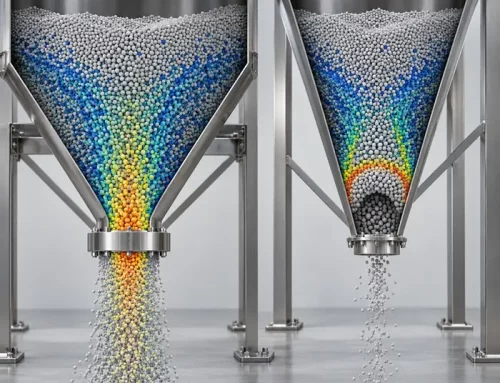
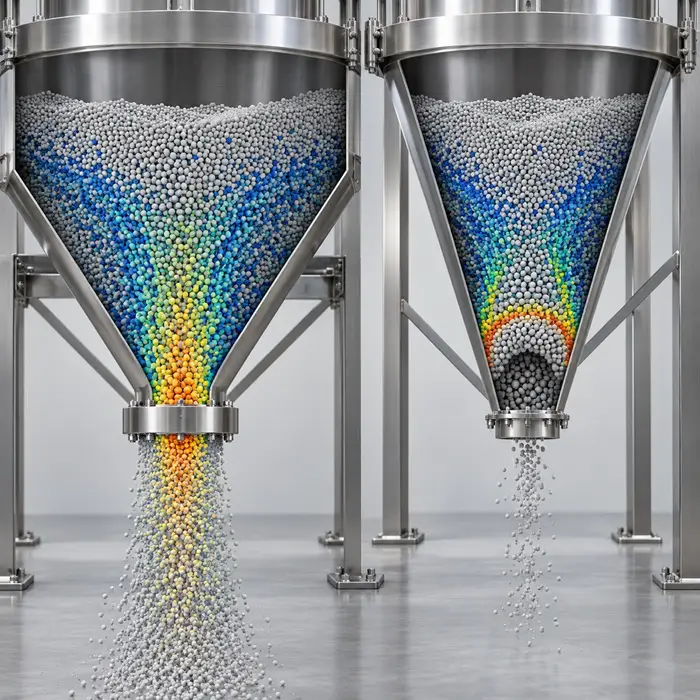
In mass flow, the entire contents move together, and the residence time is more uniform. In funnel flow, a flow channel develops while material near the walls remains stagnant. That stagnant material can consolidate longer, strengthen further, and eventually contribute to erratic discharge, caking, ratholing, or sudden collapse.
This is why wall friction testing matters alongside the Flow Function. A hopper can have an outlet that looks acceptable on paper, yet still behave poorly if the wall angle and surface finish promote funnel flow. In practice, arching and ratholing are often discussed together because both result from a mismatch between powder properties and hopper design, though the mechanisms are not identical.
If the blockage occurs directly at the outlet, arching is the primary suspect. If the hopper empties through a narrow central channel while material remains stagnant around it, ratholing becomes more likely. The distinction matters because the corrective action may differ.
Strategic Solutions, Formulation and Mechanical Interventions
Once the mechanism is confirmed, the solution should follow the diagnosis. There are two main paths. Modify the powder, or modify the equipment and process.
Powder and process changes
Flow aids such as silica or other glidants can reduce cohesive interactions, but only if they are dispersed properly. Poor dispersion can create inconsistency and, in some systems, make behavior less predictable rather than more stable.
Particle size distribution can also be adjusted. Granulation, controlled agglomeration, or changes in milling conditions may move the material away from the most cohesion-prone range. Moisture control is equally important. Small shifts in humidity can change liquid bridging, electrostatic behavior, and wall interaction enough to alter discharge performance.
If the powder flows after filling but blocks after storage, time consolidation should move up the troubleshooting list immediately. In that situation, changing the outlet hardware before testing the material at rest may waste time.
Equipment changes
If the actual outlet is below Dc, the most reliable fix is often the simplest one. Increase the outlet size. That addresses the arching condition directly.
When outlet enlargement is not practical, the hopper design itself may need to change. Steeper walls, smoother wall surfaces, or a redesign that promotes mass flow can reduce stagnant zones and lower the chance of strength build-up in critical regions. If you want to support that part internally, link wall friction drift in hoppers where you discuss wall condition, humidity, liners, and surface change over time.
Mechanical flow aids can help, but they should not be treated as a substitute for correct geometry. Vibration, for example, can either help or hurt. Short, high-intensity pulses may break an incipient arch. Continuous or poorly tuned vibration can settle the powder further and increase consolidation. Pneumatic dischargers, air cannons, agitators, or flexible-wall designs may also be effective, depending on the powder and vessel design, but they work best when applied to a clearly identified failure mechanism.
In other words, once shear testing shows that the outlet is undersized for the consolidated strength of the powder, stop expecting a low-level bolt-on fix to solve a geometry problem permanently.
In Conclusion
The gap between “free-flowing” labels and real hopper blockage is a classic powder engineering problem. It usually starts when low-stress test results are asked to answer a high-stress design question.
A powder may behave well in a funnel, during transfer, or during loose handling, and still develop enough cohesive strength under consolidation to form a stable arch. That is why hopper troubleshooting needs more than a quick flowability number. It needs a stress-relevant view of powder strength.
A shear cell test, interpreted through the Flow Function and compared directly to hopper geometry, provides that view. Once that comparison is made, the decision path becomes much clearer. If the critical arching diameter exceeds the outlet, the blockage has an engineering basis. At that point, the solution is no longer guesswork. It is a matter of matching powder behavior, flow pattern, and equipment geometry to the actual conditions in the process.