
🔑 Key Takeaway
Powder spreading in laser powder bed fusion is governed by a powder-recoater interaction, not a fixed material property. Streaking, short-feeding, and layer non-uniformity can each originate from different combinations of powder cohesion, particle size distribution, and shape, or from recoater blade wear and spreading speed. The same surface defect can have a feedstock cause or a hardware cause, so distinguishing them requires isolating variables rather than reading the layer surface alone. Flowability and shape characterization narrow the diagnosis, but the recoater gap and blade condition still need direct inspection to close the loop.
Table of contents
A recoater blade or roller performs one mechanical action: it drags a thin volume of powder across the build plate and levels it to a fixed gap height. Whether that pass produces a uniform layer or leaves a streak, a bare patch, or a thickness gradient is the outcome of a powder-recoater interaction, not a fixed property of the powder alone or the machine alone. The same powder lot can spread cleanly on a well-maintained recoater and streak badly on a machine running a worn blade or a faster pass speed.
Reading a layer defect correctly means separating what the powder contributed to that interaction, its cohesion, particle size distribution, and particle shape, from what the recoater contributed: blade condition, gap setting, and translation speed. The two sets of variables often produce visually similar symptoms on the powder bed, which is why streaking, short-feeding, and non-uniform layers get misdiagnosed as often as they get solved. This article works through the mechanisms behind each defect type and how to tell whether a given failure traces back to the feedstock, the hardware, or a specific combination of both.
How the Recoater Meets the Powder Bed
As a recoater blade or roller advances, it pushes a small reservoir of powder ahead of its leading edge and shears a portion of that reservoir through the gap set above the previous layer. Particles in that shear zone have to reorganize, roll, and slide past their neighbors to pass through the gap rather than remaining trapped in the moving pile. That reorganization is a bulk flow event, not a static leveling operation. Many of the same material attributes that influence hopper or feeder behavior also influence the powder’s ability to reorganize under the recoater, although the stress and deformation regime is different.
These material attributes are commonly characterized within reference frameworks such as ASTM F3049, which identifies properties including particle size, shape, and flow behavior as relevant to additive manufacturing feedstock.
Gap Height, D90, and the Jamming Threshold
As the coarse tail of the particle size distribution becomes large relative to the effective recoating gap or nominal layer thickness, the probability of particle-blade interference and jamming increases. Research modeling powder bed topography has shown that particles approaching the effective gap size can locally disturb the bed, become filtered from the flowing stream, or drag a track behind them as the blade continues forward (Additive Manufacturing, ScienceDirect). This is why a powder lot with an unremarkable D50 can still spread poorly at a thin layer setting if its D90 or oversize tail is large relative to the recoating gap, and why increasing the layer thickness can sometimes resolve a jamming-driven defect without any change to the powder itself. Reading D10, D50, and D90 in process context rather than as a single average is the starting point for catching this before it shows up on the bed.
Cohesion, Particle Size Distribution, and Shape as Separate Spreadability Controls
Cohesion, particle size distribution, and particle shape each influence spreading through a different physical pathway, and a powder can be compromised on one axis while performing normally on the others. Treating spreadability as a single pass or fail result obscures which of these is actually driving a given defect, which matters because the corrective action, adjusting layer thickness, reclassifying the powder, or blending in fresh material, differs for each.
Cohesion and Fines Content
Cohesive interparticle forces increase as the fraction of fine particles rises, because a higher proportion of small particles increases the number of contact points per unit volume and increases the relative contribution of surface forces compared to particle weight.
Particle-scale modeling of spreading behavior has shown, in the system studied, that increasing the fraction of fines below roughly 10 micrometers increased agglomeration and reduced flowability, with the effect extending to poor spreadability and, at high cohesion, blade-particle interactions where the blade pushes a pile ahead of it without depositing a continuous layer (Additive Manufacturing, ScienceDirect).
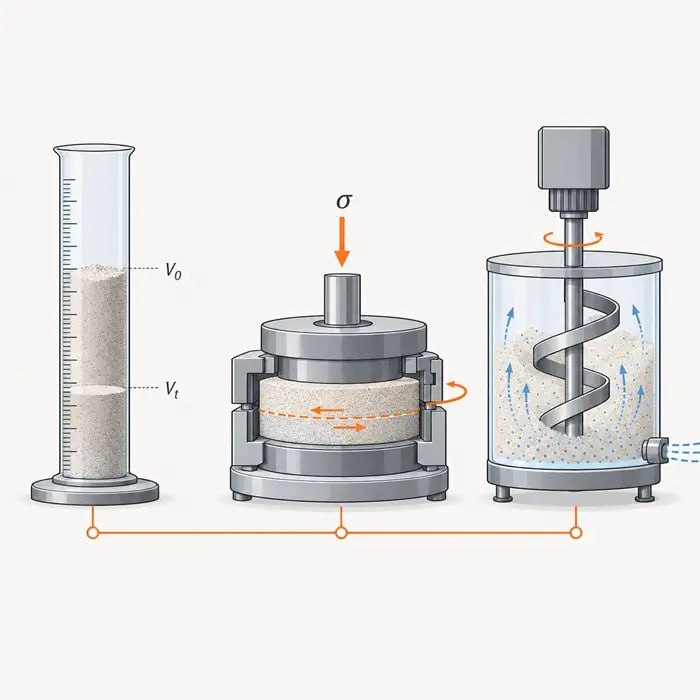
Fines content is a useful diagnostic starting point precisely because a small mass fraction of fine particles can shift bulk cohesion disproportionately, and shear cell testing gives a more direct read on that cohesion than a bulk density or angle of repose check.
Particle Size Distribution Width
A wider particle size distribution generally allows finer particles to occupy the void spaces between coarser ones, which can raise packing density and produce a smoother bed surface at a given layer thickness. That same width creates more opportunity for size segregation during the repeated shearing and vibration a recoater pass applies, since finer and coarser particles do not always move together under shear. The practical implication is that a powder chosen for its bed density based on a static packing test may still segregate under dynamic recoating, so segregation diagnosis during handling and repeated-pass evaluation are a necessary complement to a one-time PSD or packing measurement, not a substitute for it.
Particle Shape and Surface Roughness
Particle shape governs how readily particles roll and reorganize under the blade. More irregular or rougher particles increase the number and strength of interlocking contacts, which can promote local force-arch formation ahead of the blade and increase resistance against the recoater edge itself. The same particle-scale modeling work that examined fines content found that powder morphology affects flowability and spreading behavior as a variable distinct from particle size, meaning two powders with matched PSDs can still spread differently if their shape and surface texture differ. How particle shape influences flow compared to size effects is worth checking separately rather than assuming a PSD specification alone controls spreadability.
Mapping Layer Defects Back to Mechanism
Streaking, short-feeding, and layer non-uniformity look distinct on the bed surface, but each can originate from more than one mechanism, and the powder is not always the responsible variable. Separating a feedstock-driven cause from a hardware-driven cause changes what gets adjusted: a powder lot gets reclassified or blended, while a recoater gets serviced or its speed reset. Confusing the two usually means fixing the wrong thing first.
Streaking: Particle Jamming Versus Blade Wear
A streak running parallel to the recoater travel direction can come from a jammed oversize particle or agglomerate caught at the gap, or from a nick, chip, or worn section on the blade edge dragging a track through every subsequent layer regardless of what the powder is doing. Comparative work on recoater design found that sharp edges on hard recoater blades can jam particles and produce streaking with a segregation pattern along the recoating direction, while soft recoater blades wear faster over a build and introduce their own inconsistencies as that wear progresses (Powder Technology, ScienceDirect). A streak that stays at the same lateral position build after build, independent of powder lot changes, points toward blade damage. A streak that shifts position or intensity when the powder lot or its oversize tail changes points back to the feedstock, and revisiting the coarse end of the particle size distribution is the more useful next step than replacing the blade.
Short-Feeding: Insufficient Delivery Versus Poor Flow
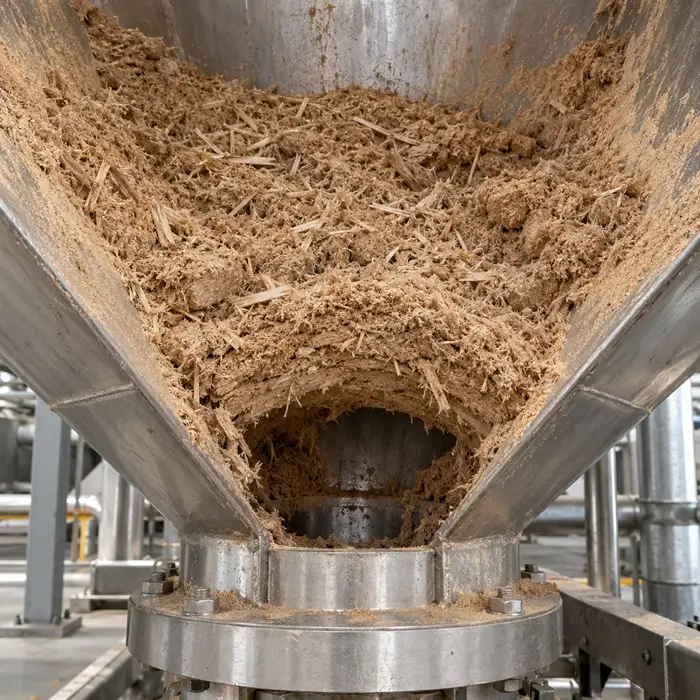
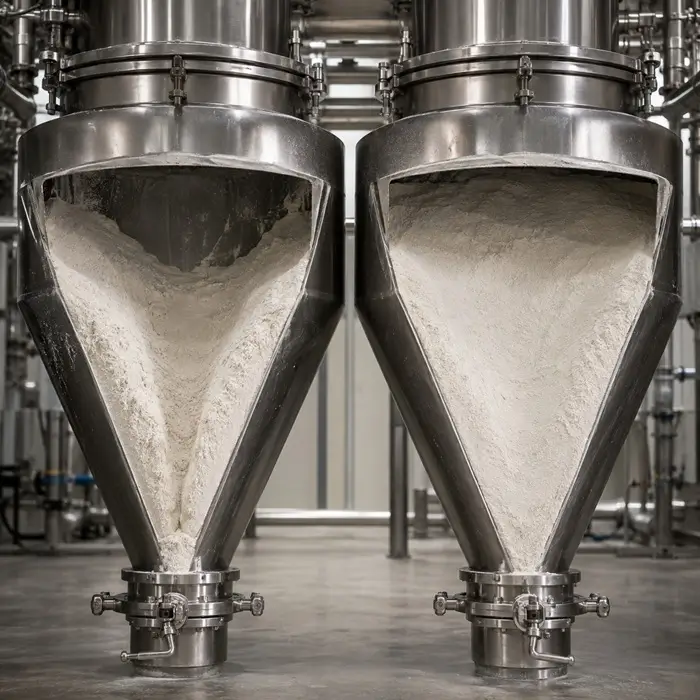
Short-feeding, where the recoater leaves an area of the bed with too little powder rather than the wrong powder, usually starts upstream of the blade rather than at it. One pathway is a dosing or hopper problem: the metered volume delivered to the recoater reservoir is genuinely too small for the area it needs to cover, which is a machine calibration issue rather than a powder property. The second pathway is cohesion-driven: the dosed volume is adequate, but the powder bridges or arches in the reservoir, or piles ahead of the blade instead of shearing through the gap at a consistent rate, leaving a starved region behind. Fill level effects on discharge and where flow becomes flooding are both relevant reference points here, since a powder that flows adequately at one fill level or dosing rate can starve at another without any change to the material itself.
Layer Non-Uniformity: Segregation and Packing Variation
Non-uniformity that shows up as a gradual density or thickness gradient across the bed, rather than a sharp streak, is consistent with segregation or packing variation and should be investigated against those mechanisms before being attributed to a single blockage event. Recoater geometry and travel speed influence granular convection ahead of the blade, and that convection pattern can drive size segregation within the moving pile even when the feed powder’s bulk PSD is well within specification (Powder Technology, ScienceDirect). Because the segregation is generated by the spreading pass itself rather than being present in the feed hopper, a sample pulled from the powder supply before recoating will not show it, and detecting it requires evaluating the bed after spreading rather than the feedstock before it.
Isolating Blade Wear and Spreading Speed From Powder-Driven Causes
Blade condition and spreading speed are recoater variables, and both can produce defect signatures that resemble a powder-driven problem if they are not tested separately. A practical isolation approach holds the powder lot constant and varies one hardware variable at a time: run the same feedstock at two spreading speeds, or the same feedstock before and after a blade change, and compare the resulting layer. If the defect appears or disappears with the hardware change while the powder remains constant, the recoater variable is implicated. Repeating the comparison across powder lots then helps establish whether the sensitivity lies primarily with the machine condition, the feedstock, or their interaction.
This kind of controlled, instrumented comparison is closer to what dedicated powder spreading research testbeds are built for than to what most production floors can run between builds. NIST’s additive manufacturing powder metrology research includes instrumented spreading studies that separate flowability, particle size, and layer density effects from recoater hardware effects under controlled conditions, which is a useful reference point for what a genuine isolation test looks like even where a facility cannot replicate the same level of instrumentation. On a production line, the more accessible version is disciplined recordkeeping: logging blade service dates, spreading speed, and powder lot together against layer quality so a hardware pattern is not misread as a feedstock pattern, or the reverse.
Test Selection for Diagnosis
No single test predicts spreadability outright, so diagnosis works best as a small panel matched to the suspected mechanism rather than one measurement treated as a verdict. Shear cell testing gives a direct read on cohesive strength and is the more informative check when a jammed pile or a starved region points toward a cohesion-driven cause. Dynamic and aerated flow energy testing is relevant when the suspected mechanism involves how the powder behaves while being actively disturbed by the blade, rather than at rest, which static tests do not capture. Hausner ratio and Carr index values can flag a powder worth investigating further but should not be read as a spreadability pass or fail, and the same caution applies to angle of repose, which reflects a different flow regime than a thin sheared layer under a blade. For powders that accumulate reuse cycles, tracking how virgin-to-reused blend ratios shift particle size and shape over time is worth pairing with the same panel, since a blend that spread acceptably new can drift toward a jamming or cohesion problem after several reuse cycles even without a formal specification breach.
Process Decisions
Once a defect has been placed against a mechanism, the response follows from where the fault sits rather than from a generic troubleshooting sequence. A jamming-driven streak tied to the coarse tail of the distribution is addressed by reclassifying or resieving the powder, or by increasing layer thickness where the part geometry allows it, not by replacing the blade. A blade-wear streak that persists across powder lots is addressed by recoater maintenance on a service schedule, not by reformulating the feedstock. A cohesion-driven short-feed is addressed by checking fines content and reservoir dosing together, since raising the dose volume without addressing cohesion just moves the same bridging problem to a larger pile. Segregation-driven non-uniformity is the hardest of the three to fix by adjusting the powder alone, since it is generated by the spreading pass itself, and it often responds better to a change in recoater speed or geometry than to a tighter powder specification.