Flowability

Flowability refers to the ability of powders and bulk solids to move freely under various conditions, impacting material handling, processing efficiency, and product quality. In industries like pharmaceuticals, food, and chemicals, understanding and optimizing flowability is essential to prevent blockages, ensure uniformity, and maintain consistent production rates.

On this page, learn about the factors affecting flowability, methods to measure and improve it, and its critical role in achieving efficient and reliable industrial operations.

Featured Flowability articles

  • Powder permeability dosing instability in a hopper feeding a loss in weight feeder.

    Powder Permeability, The Hidden Cause of Dosing Instability

    Powder permeability dosing instability often starts with trapped air. Low permeability traps air, shifts bulk density, and makes feeders surge and drift. Measure permeability, then improve venting and refill behavior before tuning the feeder. Powder permeability dosing instability rarely looks like a gas problem. It looks mechanical. The [...]

  • Winter powder quality control sampling graphite to prevent flow issues during the Christmas rush

    Graphite Under the Tree

    In the Holiday rush, winter humidity shifts and faster throughput can break powder flow, so trend PSD, moisture, density, and flow to prevent clogs and quality drift. A winter powder quality control plan is key. Table of contents Winter powder quality control for the Christmas [...]

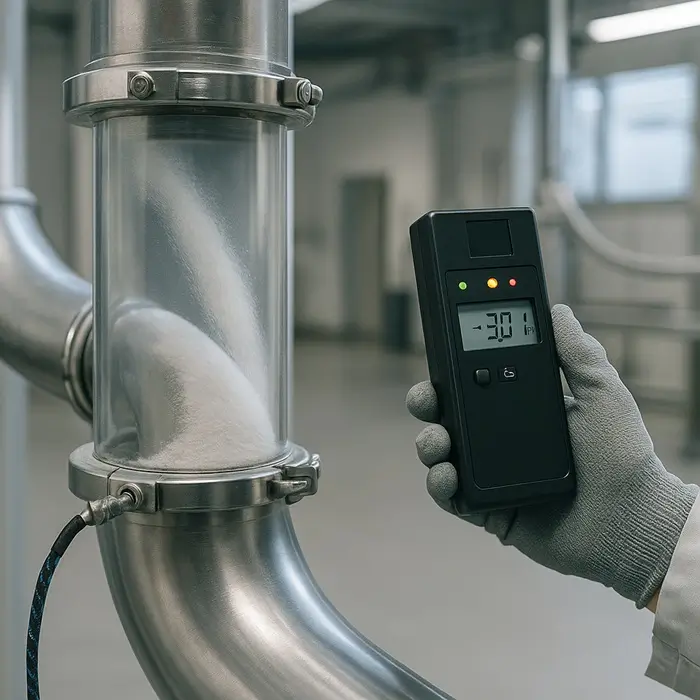
  • Triboelectric charging in powders at a pneumatic conveying transfer point, showing fine powder flow near grounded stainless steel piping and an electrostatic field sensor.

    Triboelectric Charging in Powders: The science, failure modes, and industrial controls

    Triboelectric charging forms when powders contact and separate, creating a shifting charge distribution. It can drive wall coating, segregation, coating drift, and ESD risk. Control it with hotspot measurements, humidity control, dissipative surfaces, ionisation, and KPI checks. Table of contents Why triboelectric charging in powders [...]

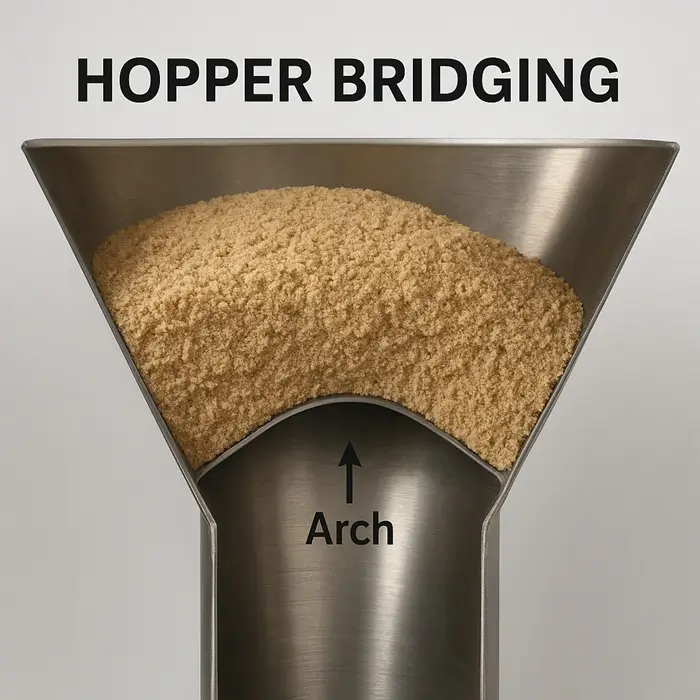
  • Hopper bridging arch forming across the outlet of a conical powder hopper

    Hopper Bridging: Why One Hopper Always Bridges First

    Hopper bridging is rarely random. It points to a mismatch between powder behavior, stress fields, and hopper geometry. When you read that signal correctly, you can fix causes instead of fighting symptoms. Every plant has a troublesome hopper somewhere in the process. The same alarm appears, usually at [...]

  • Hand scooping infant formula powders into a baby bottle on a wooden board.

    The complexities of infant formula powders

    Infant formula powders are far more demanding than simple food powders. Safe infant formula powders depend on tight control of formulation, spray drying, agglomeration, emulsion stability, and packaging, so fragile nutrients stay stable and absorbable from production line to feeding bottle. Table of contents Infant [...]

newsletter icon

News And Articles In Your Inbox

Sign up and receive PowderTechnology.info news, articles, and content from our partners in a quick and easy monthly newsletter.
You have been successfully subscribed.
There was an error trying to subscribe. Please try again later.

More Flowability Articles

Editor’s Picks