
Publications

Browse PTI technical publications

Find content by subject, editorial format, or publication date

Find technical publications by the powder behaviour, material property, process, or measurement you are working with. You can also browse the latest releases, choose an editorial format, or open the complete publication catalogue.


Browse publications by technical subject

Browse by Subject

Find publications by powder behaviour, material property, process, or measurement topic.

Latest PTI publications

Latest Publications

See the newest PTI publications first, regardless of technical subject or editorial format.

Browse publications by editorial format

Browse by Format

Choose Feature Articles, Insights, or Know How according to the depth and type of content you need.

Browse all PTI publications

All Publications

Open the complete PTI publication catalogue, newest first, and continue loading older content as needed.

Latest from PTI

Recently published

The four newest PTI publications appear here automatically, regardless of subject or editorial format.
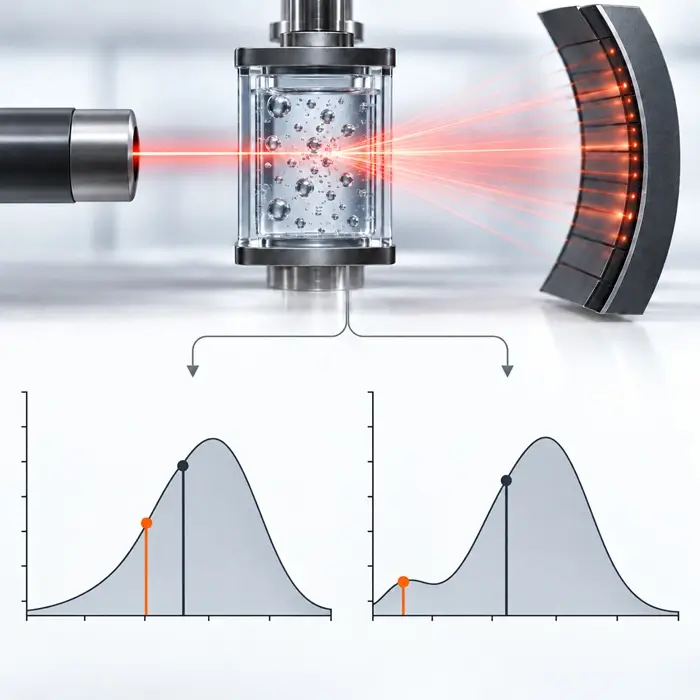
  • Laser diffraction illustration showing identical scattering data producing different particle size distributions, with a greater shift in D10 than D50 after changing optical settings.
    16 October 2026

    Refractive Index in Laser Diffraction: D10 vs D50

    Laser diffraction calculates particle size from measured scattering using an optical model [...]

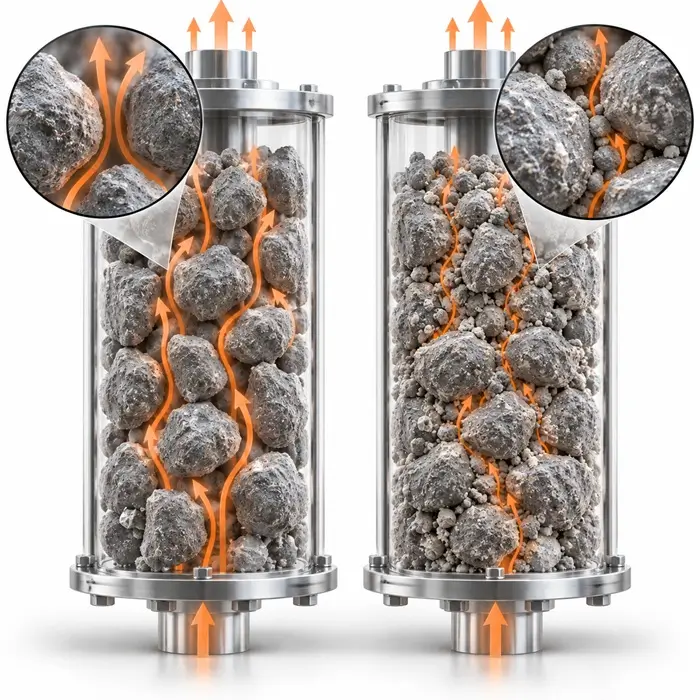
  • Comparison of powder beds before and after milling, showing how fines narrow pore throats and restrict airflow through connected voids.
    15 October 2026

    Why Can Permeability Fall After Milling?

    Milling can reduce powder-bed permeability even when the material meets its [...]

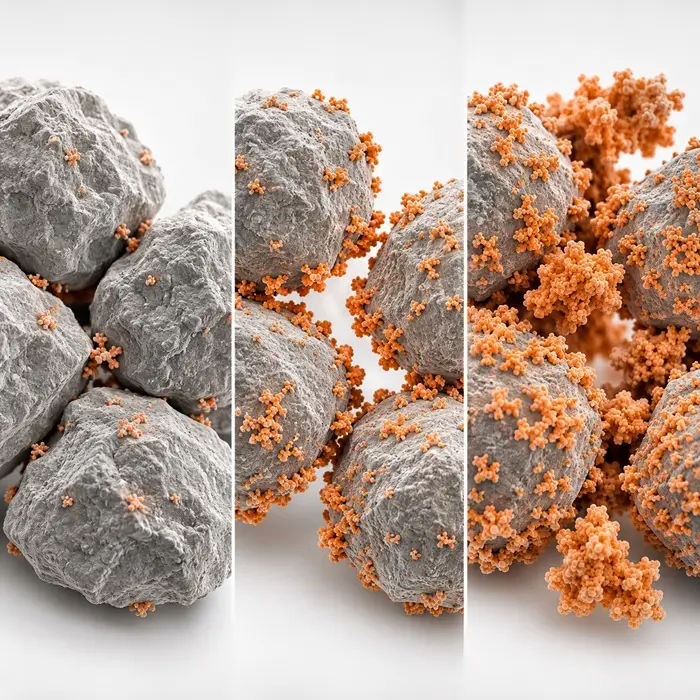
  • Microscopic comparison of powder particles showing low silica coverage, effective surface coverage, and excessive silica agglomeration that can worsen powder flow.
    14 October 2026

    Why Does Too Much Silica Make Powder Flow Worse?

    Fumed (colloidal) silica improves powder flow by separating host particles and reducing [...]

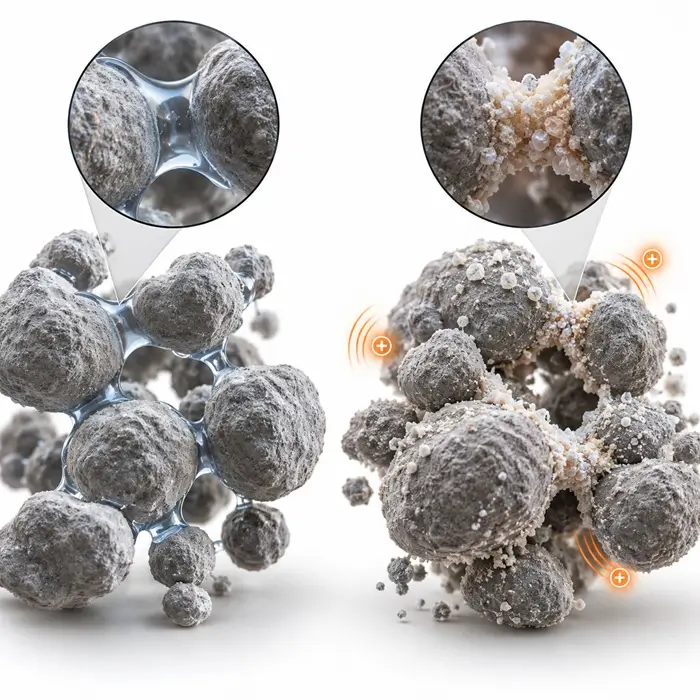
  • Scientific comparison of powder particles before and after drying, showing liquid bridges, solid bridges, electrostatic charge retention, and fines.
    13 October 2026

    Why Does Powder Become More Cohesive After Drying?

    Drying does not always improve powder flow. Dissolved material can form solid [...]

Browse by Subject

Find PTI content by technical subject

Choose the powder behaviour, material property, process, or measurement behind the question. Each subject opens the corresponding PTI publication category, bringing related technical publications together in one place. Industries are intentionally omitted because PTI already provides dedicated industry pages.

Browse by format

Choose the depth and type of content

Feature Articles, Insights, and Know How are editorial formats within PTI publications. They are not separate technical destinations.
Feature Articles

Long-form technical analysis built around a defined engineering question, comparison, mechanism, process, or application.

Technical Briefs

Concise, practical explanations of focused powder and particle technology questions, mechanisms, measurement issues, and process challenges.

Insights

Focused interpretation of a study, method comparison, process result, standard, or emerging technical development.

Know How

Practical technical guides that go deeper into measurement, interpretation, equipment, and powder-behavior decisions.

Feature Articles

Long-form technical analysis

Recent Feature Articles examine a defined engineering question in greater depth, connecting mechanisms, measurements, process context, and interpretation where the subject requires it.

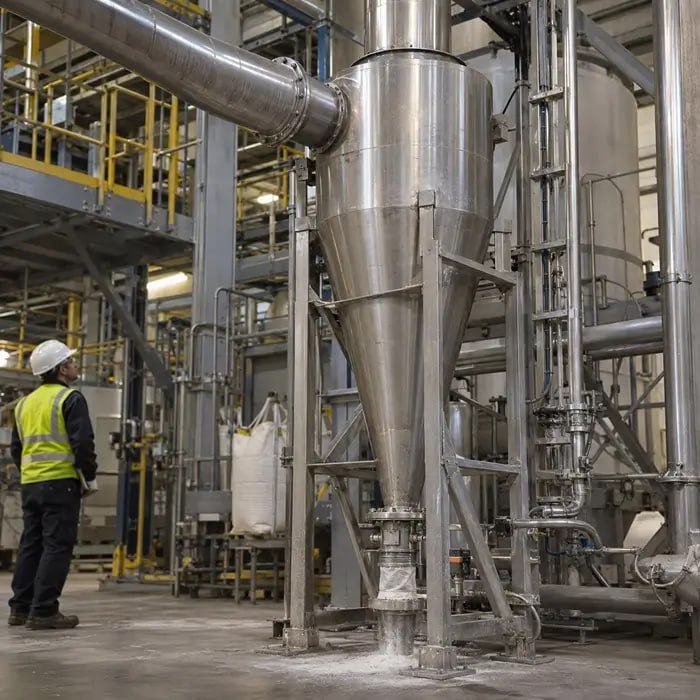
  • Industrial cyclone separator used for cyclone cut size classification of powder fines
    10 October 2026

    Cyclone Separation of Fine Powders: Cut Size, Efficiency Curves, and Agglomeration

    The classical cyclone cut size model assumes discrete, non-agglomerating particles. Cohesive or moisture-sensitive fines can travel through a cyclone as agglomerates instead, which changes what a PSD result actually tells you about classifier performance.

    Feature Article

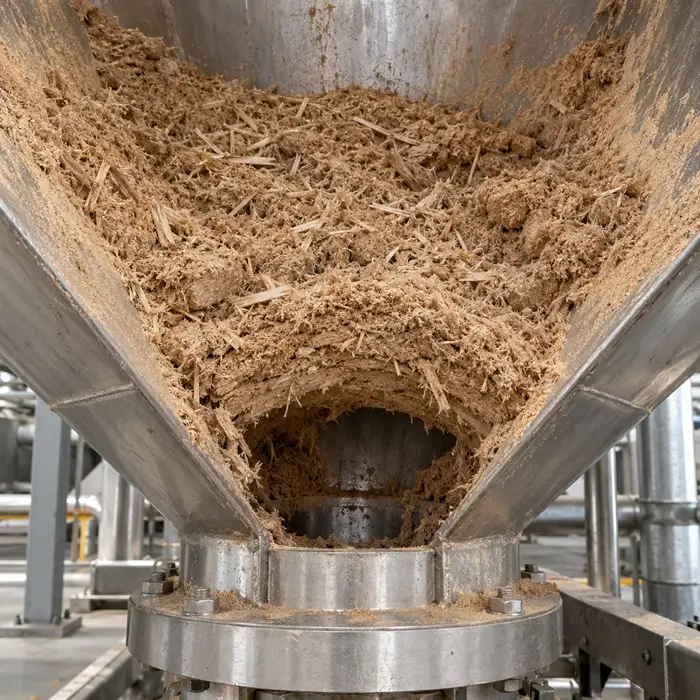
  • Wood powder bridging above the outlet of a stainless-steel hopper
    3 October 2026

    Wood Powder Feeding Problems: Separating Moisture Effects From Particle Interlocking

    Wood powder can bridge because fibrous particles mechanically interlock, because moisture increases [...]

    Feature Article

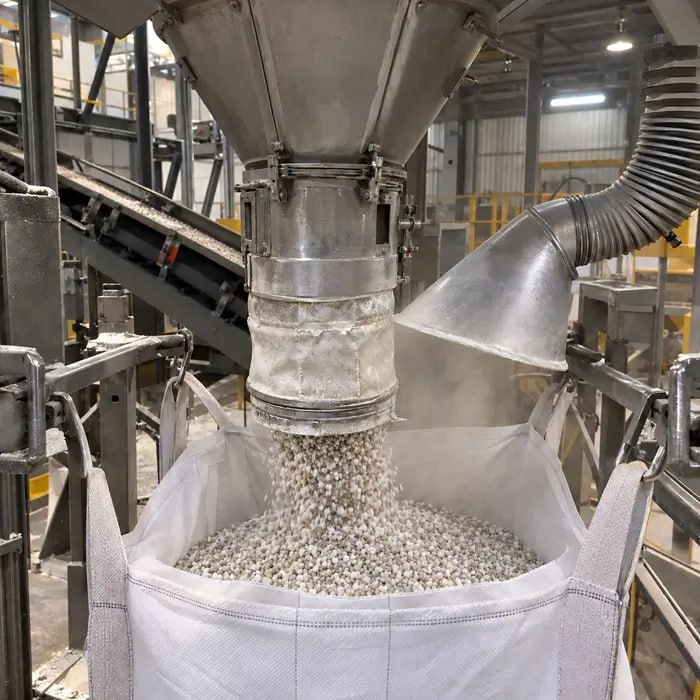
  • Fertilizer powder and granule handling at a bagging line showing dust extraction at the fill spout
    26 September 2026

    Fertilizer Powder and Granule Handling: Segregation, Caking, and Dust Control

    Bulk-blended fertilizer fails in three recurring ways: segregation between straight materials of different size and density, hygroscopic caking in urea and ammonium nitrate under humidity cycling, and dust release during bagging. Each failure mode maps to a specific diagnostic test rather than a single generic powder check.

    Feature Article

  • Closed vacuum conveying system transferring fine powder through a stainless-steel line into a filter receiver with secondary filtration and vacuum generation.
    19 September 2026

    Vacuum Conveying for Fine and Hazardous Powders: Containment, Velocity, and Filter Design

    Vacuum conveying contains by default: any breach draws air inward rather than pushing powder out. That containment advantage comes with a fixed pressure budget, and filter design competes directly with conveying velocity for every millibar of available driving force.

    Feature Article

Technical Briefs

Concise answers to focused technical questions

Recent Technical Briefs provide concise, practical explanations of focused powder and particle technology questions, covering specific mechanisms, measurement issues, processing challenges, and interpretation problems.

  • Laser diffraction illustration showing identical scattering data producing different particle size distributions, with a greater shift in D10 than D50 after changing optical settings.
    16 October 2026

    Refractive Index in Laser Diffraction: D10 vs D50

    Laser diffraction calculates particle size from measured scattering using an optical model [...]

  • Comparison of powder beds before and after milling, showing how fines narrow pore throats and restrict airflow through connected voids.
    15 October 2026

    Why Can Permeability Fall After Milling?

    Milling can reduce powder-bed permeability even when the material meets its [...]

  • Microscopic comparison of powder particles showing low silica coverage, effective surface coverage, and excessive silica agglomeration that can worsen powder flow.
    14 October 2026

    Why Does Too Much Silica Make Powder Flow Worse?

    Fumed (colloidal) silica improves powder flow by separating host particles and reducing [...]

  • Scientific comparison of powder particles before and after drying, showing liquid bridges, solid bridges, electrostatic charge retention, and fines.
    13 October 2026

    Why Does Powder Become More Cohesive After Drying?

    Drying does not always improve powder flow. Dissolved material can form solid [...]

Insights

Focused technical interpretation

Recent Insights examine a study, method, process result, standard, or emerging technical development in a tighter editorial format.

  • Diagram comparing Hausner ratio, shear cell, and dynamic flow energy methods used in PBF powder flowability testing
    10 October 2026

    PBF Powder Flowability Testing: Why Different Methods Disagree and What the Results Mean

    Hausner ratio, shear cell, and dynamic flow energy results on the same PBF powder lot rarely agree exactly. That disagreement is a decision input, not proof that a method or lab got it wrong.

    Insights

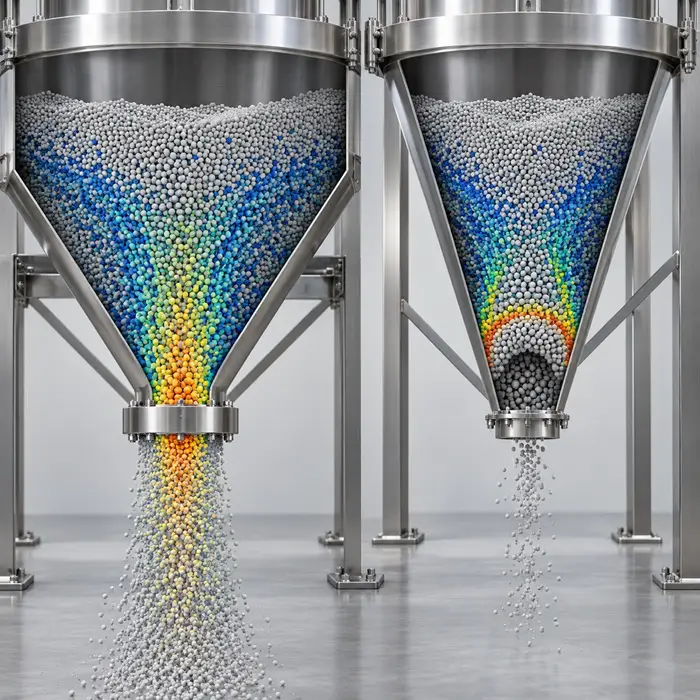
  • DEM comparison of powder flow in two hopper geometries, showing smooth discharge and arching
    3 October 2026

    DEM Calibration: Why a Model That Reproduces One Bulk Test Can Still Fail in a Different Hopper Geometry

    DEM input parameters are fitted to match a bulk observable, not derived from first principles. A parameter set calibrated against an angle of repose test constrains one point in a multi-dimensional parameter space. When the hopper geometry changes, the stress state changes, and unconstrained parameters become the dominant source of prediction error.

    Insights

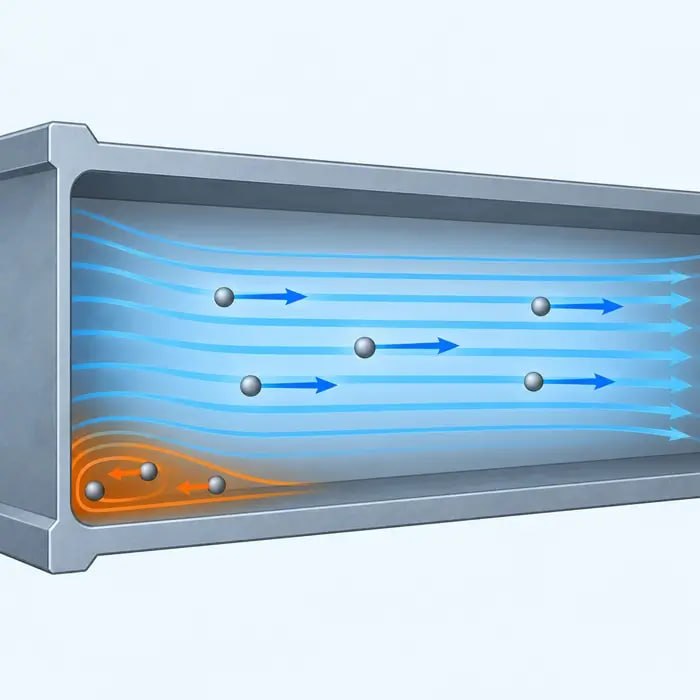
  • Diagram showing particle back-flow in pneumatic conveying at a low-drag duct corner
    26 September 2026

    Triboelectric Particle Back-Flow in Pneumatic Conveying: Why Charged Particles Migrate Upstream at Duct Corners

    CFD-DEM simulations show triboelectrically charged particles can reverse direction in low-drag duct corner zones during pneumatic conveying, with the delay between feed pulses driving the effect more than pulse length.

    Insights

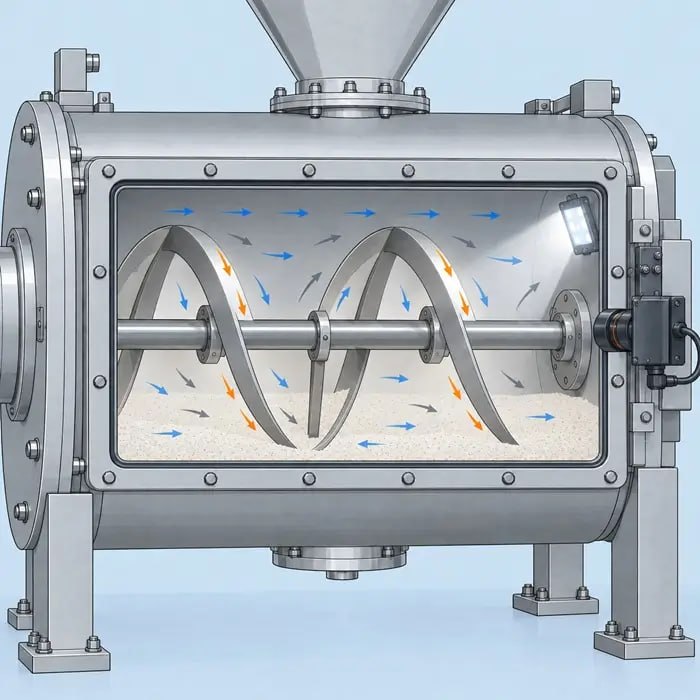
  • LED-based particle image velocimetry velocity field mapping powder flow inside a blender
    19 September 2026

    Real-Time Powder Flow Imaging: What LED-Based Particle Image Velocimetry Adds Beyond Static Flowability Tests

    LED-based particle image velocimetry (PIV) images the velocity field inside a moving powder bed during blending, adding spatial resolution that static angle of repose, Hausner ratio, and shear cell tests cannot provide. Here is what that resolution can and cannot support for a process decision.

    Insights

Know How

Practical technical guidance

Recent Know How publications focus on practical measurement, method selection, interpretation, equipment, and technically useful working guidance.

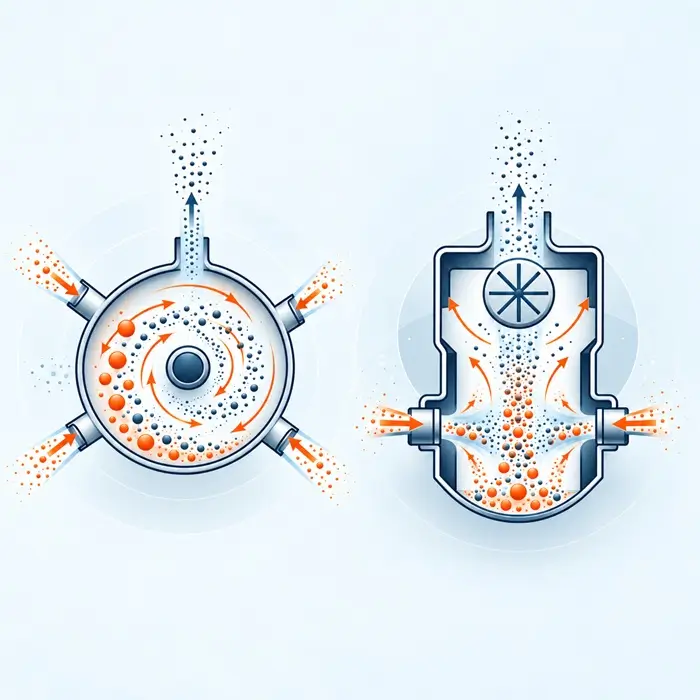
  • Illustration comparing spiral jet milling with fluidized-bed opposed jet milling and particle classification.
    3 October 2026

    Micronization by Jet Milling: How Classification, Milling Intensity, and Time Change Surface Properties

    Jet milling micronization reduces particle size through particle-particle impact controlled by classifier wheel speed and feed rate. Pushing the cut point lower can raise amorphous surface content and hygroscopicity in ways a passing PSD result will not reveal. This guide covers the mechanism and the tests that actually diagnose a changed lot.

    Know How

  • Jenike shear cell vs ring shear tester comparison diagram for hopper design decisions
    5 September 2026

    Jenike Shear Cell vs Ring Shear Tester: Matching the Method to the Hopper or Silo Decision

    Jenike shear cells and ring shear testers measure the same yield locus through different mechanics. Here is how their sample, stress range, and time differences map onto the mass-flow versus funnel-flow hopper design decision, plus a checklist for choosing between them.

    Know How

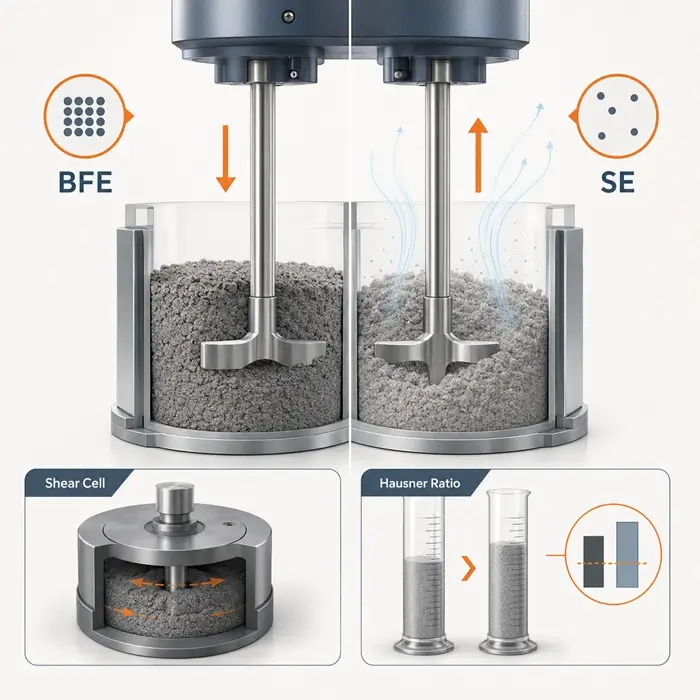
  • Technical illustration of dynamic powder testing, showing a rotating blade moving through a powder bed to compare confined flow energy, low-confinement specific energy, and aeration-sensitive behavior.
    1 August 2026

    Dynamic and Aerated Powder Testing: What Flow Energy Adds Beyond the Shear Cell and Hausner Ratio

    Dynamic and aerated powder testing measures basic flow energy and specific energy to fill the gap between shear cell consolidation data and Hausner ratio screening, particularly for fluidized processing and rapid-refill feeding.

    Know How

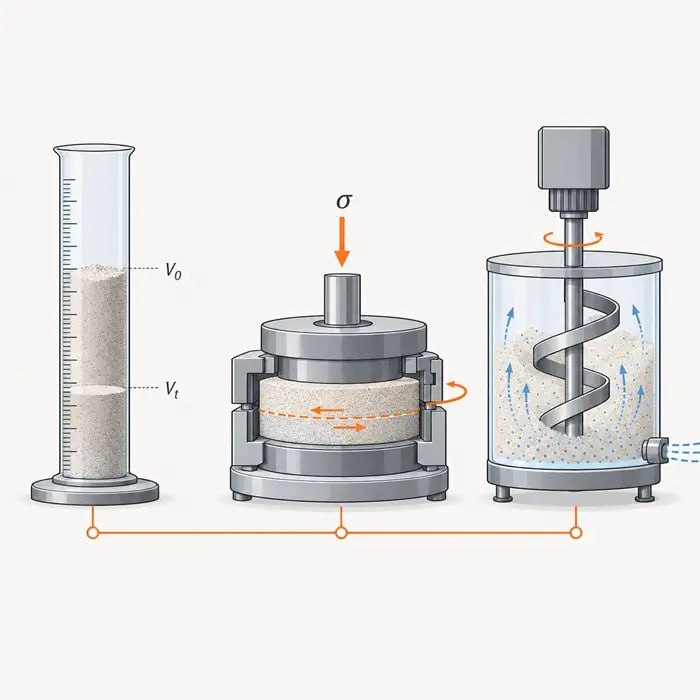
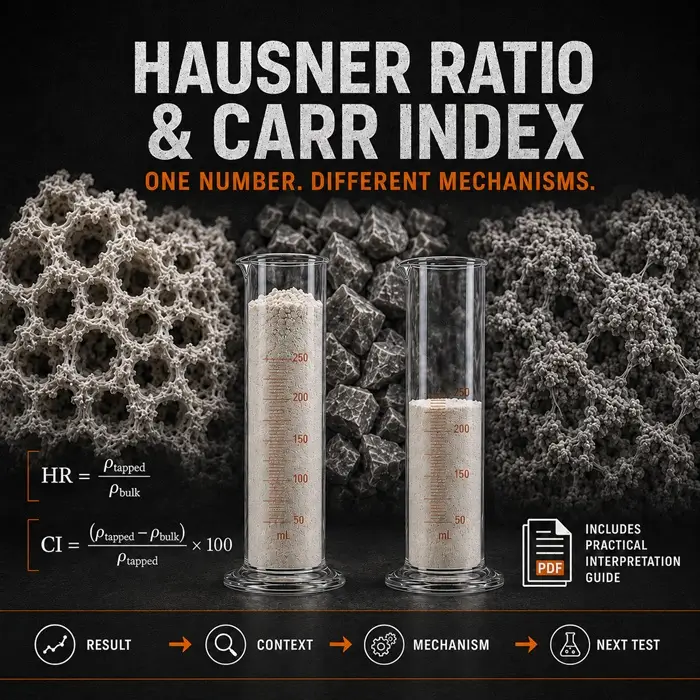
  • Technical hero image for a PowderTechnology.info Monthly Know-How on Hausner Ratio and Carr Index, showing two graduated cylinders with loose and tapped powder, three different powder mechanism backgrounds, the Hausner Ratio and Carr Index formulas, a workflow from result to next test, and a reference to an included practical interpretation guide.
    4 July 2026

    Hausner Ratio and Carr Index: What the Numbers Tell You and Where They Break Down

    Both the Hausner Ratio and Carr Index reduce bulk and tapped density to a single number. The mechanism behind that number, whether aeration, particle shape, or surface cohesion, determines whether it supports a process decision or actively misleads one.

    Know How

All Publications

The complete PTI publication catalogue

Browse all published PTI content, newest first. Use the subject index above when you know the technical topic, or the structured PTI hubs when you want a guided route through a problem, property, measurement, process area, or industry.
  • Laser diffraction illustration showing identical scattering data producing different particle size distributions, with a greater shift in D10 than D50 after changing optical settings.
    16 October 2026

    Refractive Index in Laser Diffraction: D10 vs D50

    Laser diffraction calculates particle size from measured scattering using an optical model [...]

  • Comparison of powder beds before and after milling, showing how fines narrow pore throats and restrict airflow through connected voids.
    15 October 2026

    Why Can Permeability Fall After Milling?

    Milling can reduce powder-bed permeability even when the material meets its [...]

  • Microscopic comparison of powder particles showing low silica coverage, effective surface coverage, and excessive silica agglomeration that can worsen powder flow.
    14 October 2026

    Why Does Too Much Silica Make Powder Flow Worse?

    Fumed (colloidal) silica improves powder flow by separating host particles and reducing [...]

  • Scientific comparison of powder particles before and after drying, showing liquid bridges, solid bridges, electrostatic charge retention, and fines.
    13 October 2026

    Why Does Powder Become More Cohesive After Drying?

    Drying does not always improve powder flow. Dissolved material can form solid [...]

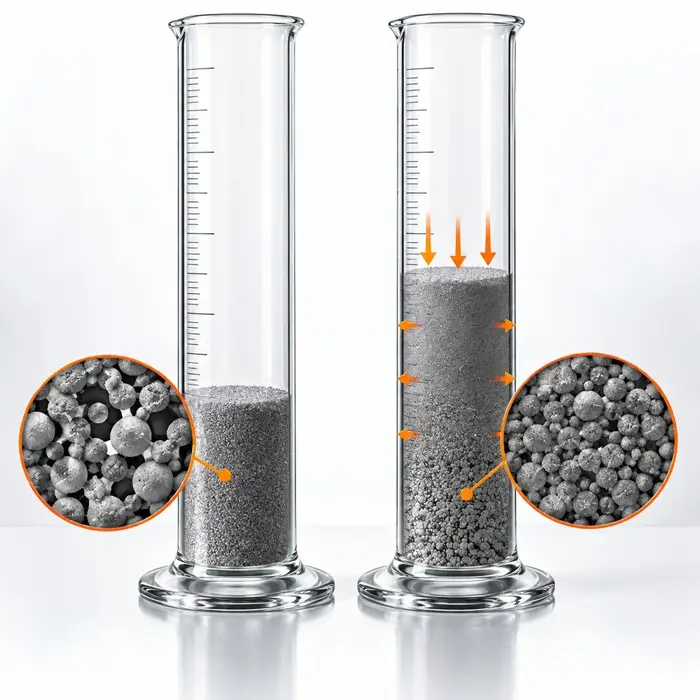
  • Technical illustration comparing two powder fill masses in identical graduated cylinders, showing differences in bed depth, particle packing, and stress transmission.
    12 October 2026

    Why Does Tapped Density Change With Fill Mass?

    Increasing fill mass can raise or lower measured tapped density, depending on [...]

  • Industrial cyclone separator used for cyclone cut size classification of powder fines
    10 October 2026

    Cyclone Separation of Fine Powders: Cut Size, Efficiency Curves, and Agglomeration

    The classical cyclone cut size model assumes discrete, non-agglomerating particles. Cohesive or moisture-sensitive fines can travel through a cyclone as agglomerates instead, which changes what a PSD result actually tells you about classifier performance.

    Feature Article

  • Diagram comparing Hausner ratio, shear cell, and dynamic flow energy methods used in PBF powder flowability testing
    10 October 2026

    PBF Powder Flowability Testing: Why Different Methods Disagree and What the Results Mean

    Hausner ratio, shear cell, and dynamic flow energy results on the same PBF powder lot rarely agree exactly. That disagreement is a decision input, not proof that a method or lab got it wrong.

    Insights

  • Wood powder bridging above the outlet of a stainless-steel hopper
    3 October 2026

    Wood Powder Feeding Problems: Separating Moisture Effects From Particle Interlocking

    Wood powder can bridge because fibrous particles mechanically interlock, because moisture increases [...]

    Feature Article

  • Illustration comparing spiral jet milling with fluidized-bed opposed jet milling and particle classification.
    3 October 2026

    Micronization by Jet Milling: How Classification, Milling Intensity, and Time Change Surface Properties

    Jet milling micronization reduces particle size through particle-particle impact controlled by classifier wheel speed and feed rate. Pushing the cut point lower can raise amorphous surface content and hygroscopicity in ways a passing PSD result will not reveal. This guide covers the mechanism and the tests that actually diagnose a changed lot.

    Know How

  • DEM comparison of powder flow in two hopper geometries, showing smooth discharge and arching
    3 October 2026

    DEM Calibration: Why a Model That Reproduces One Bulk Test Can Still Fail in a Different Hopper Geometry

    DEM input parameters are fitted to match a bulk observable, not derived from first principles. A parameter set calibrated against an angle of repose test constrains one point in a multi-dimensional parameter space. When the hopper geometry changes, the stress state changes, and unconstrained parameters become the dominant source of prediction error.

    Insights

  • Diagram showing particle back-flow in pneumatic conveying at a low-drag duct corner
    26 September 2026

    Triboelectric Particle Back-Flow in Pneumatic Conveying: Why Charged Particles Migrate Upstream at Duct Corners

    CFD-DEM simulations show triboelectrically charged particles can reverse direction in low-drag duct corner zones during pneumatic conveying, with the delay between feed pulses driving the effect more than pulse length.

    Insights

  • Fertilizer powder and granule handling at a bagging line showing dust extraction at the fill spout
    26 September 2026

    Fertilizer Powder and Granule Handling: Segregation, Caking, and Dust Control

    Bulk-blended fertilizer fails in three recurring ways: segregation between straight materials of different size and density, hygroscopic caking in urea and ammonium nitrate under humidity cycling, and dust release during bagging. Each failure mode maps to a specific diagnostic test rather than a single generic powder check.

    Feature Article

Testing support

Need the measurement, not just the article?

If the publications help narrow the technical question but the decision still depends on measured powder behavior, Delft Solids Solutions can help define an appropriate test plan and interpret the result. Explore Delft Solids Solutions testing support →

Delft Solids Solutions logo