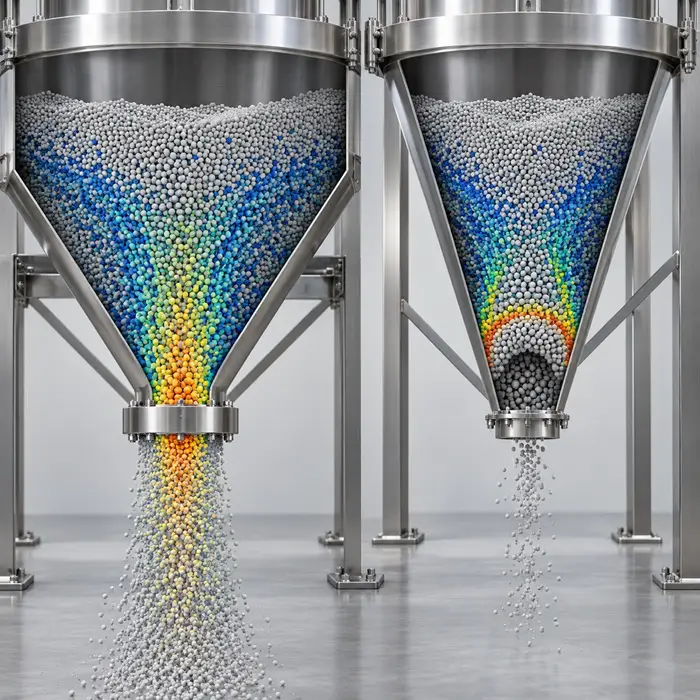
Calibration in DEM covers a specific process: adjusting input parameters until the simulation reproduces a measured bulk observable. It does not mean that particle-scale measurements have uniquely determined all relevant parameters. Calibration tunes the model to reproduce one or more selected outputs. That distinction matters when engineers apply the same parameter set to a geometry or load condition outside the calibration or validation range.
Calibration Means Fitting, Not Measuring
Some DEM input parameters, including restitution and friction coefficients, can be measured directly under defined test conditions. However, values from particle- or contact-scale measurements do not necessarily reproduce bulk powder behavior when modelers use simplified particle shapes and contact models.
Real process powders are irregularly shaped, polydisperse, and affected by surface condition, moisture, handling, and storage history. Their contact mechanics do not map cleanly onto the idealized contacts used in many DEM models. Modelers therefore often treat rolling friction, cohesion parameters, and similar inputs as effective parameters that compensate for behavior the model does not explicitly represent.
Inverse calibration addresses this gap: run simulations across varied parameter combinations, compare each result with a measured bulk observable, and identify parameter sets that reproduce the target within an acceptable range. Common calibration targets include the angle of repose, poured or tapped bulk density, and mass flow rate through a fixed orifice at a defined fill condition. A single scalar calibration target cannot uniquely determine several simultaneously calibrated contact parameters.
One Observable, Many Valid Parameter Sets
Research published in Powder Technology has shown that multiple contact-parameter combinations can reproduce a single macroscopic reference value. The calibrated parameter set is therefore one of several feasible solutions rather than a unique determination of the underlying material properties.
This is an identifiability problem: the measured bulk response does not contain enough independent information to determine every relevant model parameter uniquely.
Rolling friction is a particularly clear example. Spherical particles in DEM rotate more freely than many real irregular particles. Modelers therefore often introduce rolling resistance to reproduce some of the rotational resistance associated with unresolved particle shape. As Wensrich and Katterfeld demonstrated in Powder Technology, this equivalence is not exact. When modelers use rolling friction as a surrogate for unresolved particle shape, they should not interpret its calibrated value as an independently measured material constant.
Why Multiple Targets Matter
A concrete calibration study shows why a single observable is not enough. In a 2021 study in KONA Powder and Particle Journal, researchers varied DEM parameters against three measured bulk responses: angle of repose, bulk density, and mass flow rate. Wide ranges of parameter combinations reproduced each reference response on its own. Only superimposing the three response contours narrowed the admissible parameter space toward a near-unique solution. Matching one bulk result therefore did not establish that the same parameter combination would reproduce the other measured behaviors.
Parameter sensitivity also depends on the modeled response and the conditions under which the particles move. Parameters that have little influence in one calibration test can matter more under a different stress state, confinement level, or flow regime. Calibration targets should therefore represent the behavior the final model is expected to predict.
How Geometry Change Exposes the Unconstrained Parameters
When engineers transfer a calibrated parameter set to a new hopper geometry, several aspects of the stress and flow field can change simultaneously. Changing fill depth can alter consolidation stresses within the material. Changing the hopper angle modifies the balance between normal and shear stresses at the wall. Narrowing the outlet changes the conditions governing arch formation and discharge.
These changes can also alter which DEM parameters control the predicted response, and by how much. Wall friction angle and hopper half-angle together influence whether mass flow or funnel flow develops, while a heap-based calibration may provide little information about wall-dominated flow under confinement.
Rolling friction and cohesion can influence confined hopper flow differently when calibration constrains them mainly under low-confinement conditions. A model that correctly reproduces heap shape may predict the wrong critical outlet dimension, overestimate or underestimate discharge rate, or miss a change in flow pattern. For the physical reason why apparently free-flowing powders can still fail once confinement and outlet geometry become important, see why free-flowing powders still arch in hoppers.
Numerical Simplifications Add Another Transfer Risk
Industrial DEM models often use enlarged particles to reduce computational cost. This changes the ratio between particle size and local geometric features, which becomes particularly important near narrow outlets and other constrictions. A particle scale that reproduces a bulk calibration test can therefore be too coarse to resolve hopper discharge or arching behavior.
Coetzee’s particle-upscaling study demonstrates the problem directly. Scaled particles reproduced the dynamic angle of repose with scale factors up to 4 when the drum-to-particle diameter ratio remained at least 25. For hopper discharge, accurate prediction of discharge rate required a scale factor below about 1.3, while the velocity field tolerated a scale factor of about 2.5. The model reproduced the calibration observable, but the application required much finer numerical resolution.
Modelers also reduce particle stiffness to increase the DEM time step. For dry, relatively coarse particles dominated by contact forces, stiffness reduction is often acceptable. For cohesive powders or systems where other attractive forces matter, however, changing stiffness can alter the predicted behavior unless the model scales those interactions consistently. Washino, Chan, and Tanaka demonstrated this effect and proposed reduced-particle-stiffness scaling for DEM models that include attractive forces.
Scoping DEM Output: Practical Checks Before Quoting a Prediction
Calibrated DEM is often most defensible for controlled comparison: does design A perform differently from design B when the comparison uses the same material model and operating conditions?
Using DEM as an absolute predictor of flow rate, critical arch span, or rathole stability requires stronger evidence that the model remains valid under the simulated conditions. That evidence can come from validation against the application itself or from experiments that reproduce sufficiently similar geometry, confinement, stress levels, and flow behavior.
Before accepting a DEM result as an engineering prediction, check what calibration and validation actually covered. Does the test represent the confinement level, stress state, and flow mode of the application? Did the calibration constrain rolling friction, cohesion, wall interaction, and other influential parameters under representative conditions, or mainly against a low-stress bulk observable?
Where shear cell testing or wall-friction measurements are available, incorporating additional independent calibration or validation targets can constrain more of the model and reduce parameter non-uniqueness. If representative validation is absent, report the result as a comparative or directional indicator rather than presenting the simulated value as an established engineering prediction. A contract research lab such as Delft Solids Solutions can provide testing and characterization.