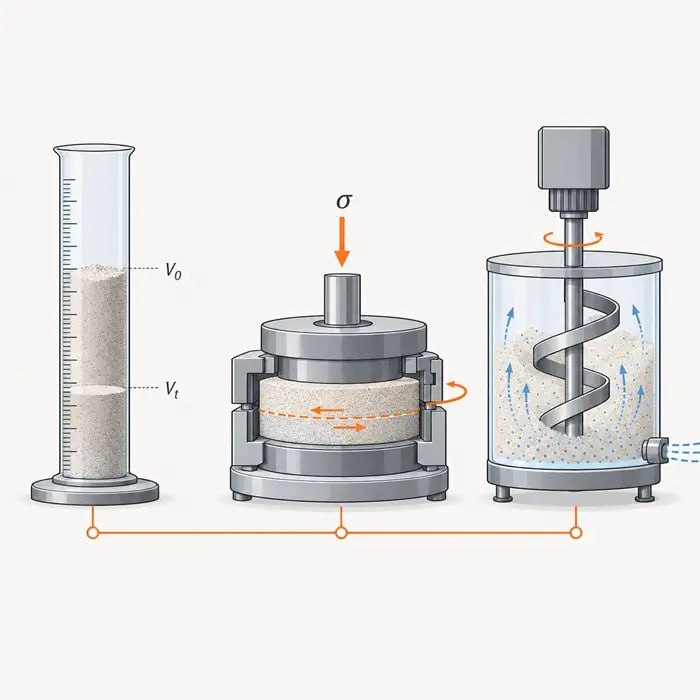

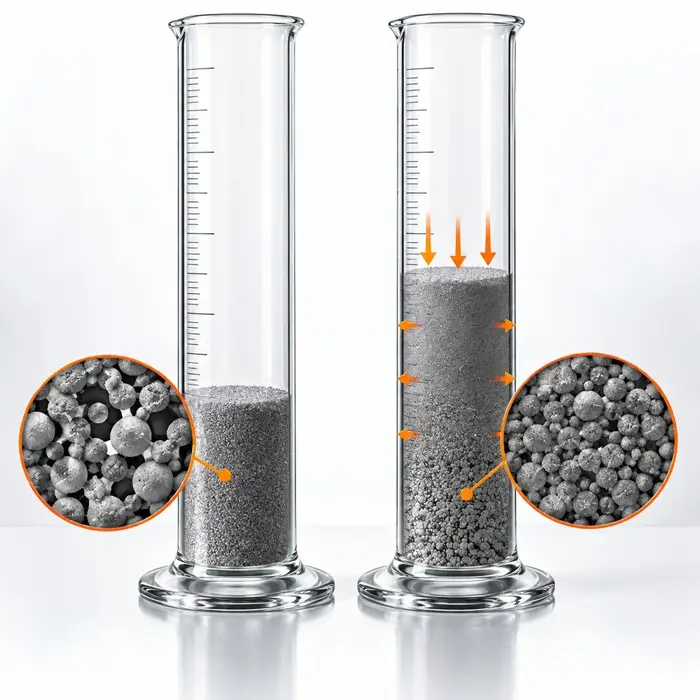
Two laboratories test the same powder using the same tapper and settings. One uses 50 g, the other 100 g. Both reach stable final volumes, yet their tapped densities differ. Changing sample mass changes the mechanical conditions inside the cylinder. Bed depth, stress distribution, and the initial packing state influence the result.
Bed Depth Changes the Stress Distribution
Particles near the bottom of a powder bed support part of the weight above them. Increasing fill mass increases bed depth and changes consolidation stress. Greater consolidation stress collapses loose particle structures and drives rearrangement into denser packing. Cohesive powders are particularly sensitive because their particle bridges and voids collapse progressively under loading.
However, stress does not increase indefinitely with depth. The Janssen effect describes how wall friction carries part of the powder’s weight onto the cylinder walls, limiting vertical stress at greater depths. This stress approaches saturation depending on cylinder diameter, wall friction, and the ratio of lateral to vertical stress.
Doubling sample mass therefore changes the bed’s stress history, rather than simply doubling the load reaching the bottom.
The Initial Filling State Matters
Powder preparation influences packing before tapping begins. Pouring from a fixed position reduces particle free-fall distance as the bed rises, changing deposition conditions. Filling rate, segregation, and entrained air introduce further differences. USP <616> specifies gentle sieving through apertures of at least 1.0 mm, when necessary, to break storage agglomerates without altering the material. These choices set the starting structure that tapping then consolidates.
Vessel Geometry and Measurement Resolution
Cylinder diameter influences wall friction relative to powder volume. Narrow cylinders have a greater wall-area-to-volume ratio, increasing the relative importance of particle-wall interactions and changing consolidation conditions.
Measurement resolution introduces another effect. A 250-mL cylinder readable to 2 mL has a graduation interval equivalent to 0.8% of a 250-mL fill but 1.3% of a 150-mL fill. The same applies to the USP tapping endpoint: a 2 mL criterion is a stricter relative limit for larger fills than for smaller ones.
Does Every Tap Affect the Entire Bed Equally?
A tapping instrument moves the cylinder, but particles throughout the bed experience different local stresses and rearrangements.
USP <616> defines two graduated-cylinder tapping configurations:
– High drop: 14 ± 2 mm at 300 ± 15 taps/min.
– Low drop: 3.0 ± 0.2 mm at 250 ± 15 taps/min.
These configurations impose different mechanical conditions, with effects influenced by bed depth, particle contacts, and wall friction.
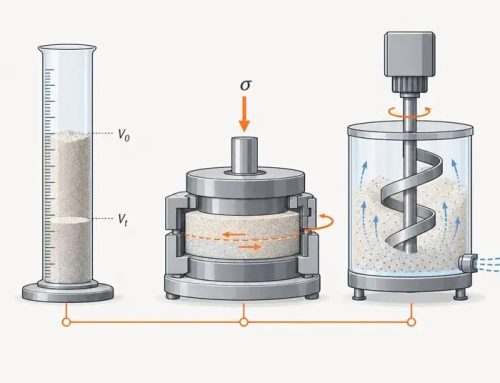
The method specifies volume readings after 10, 500, and 1,250 taps. For a 250-mL cylinder, further tapping is required if the difference between the 500- and 1,250-tap volumes exceeds 2 mL. Subsequent readings must meet the same criterion.
The endpoint confirms that consolidation has effectively stopped under that procedure. It does not make packing states equivalent across sample masses.
How to Keep Results Comparable
USP <616> specifies approximately 100 g in a 250-mL cylinder. If this produces an untapped apparent volume outside 150–250 mL, select a different mass within that volume range. For smaller samples, a 100-mL cylinder may be used with an untapped volume of 50–100 mL. Report modified conditions.
For consistent measurements:
– Standardize sample preparation and filling.
– Keep cylinder geometry and tapping settings consistent.
– Record sample mass, initial volume, and final volume.
– Apply the specified tapping endpoint.
– Repeat measurements to assess fill-mass sensitivity.
What About Hausner Ratio and Compressibility Index?
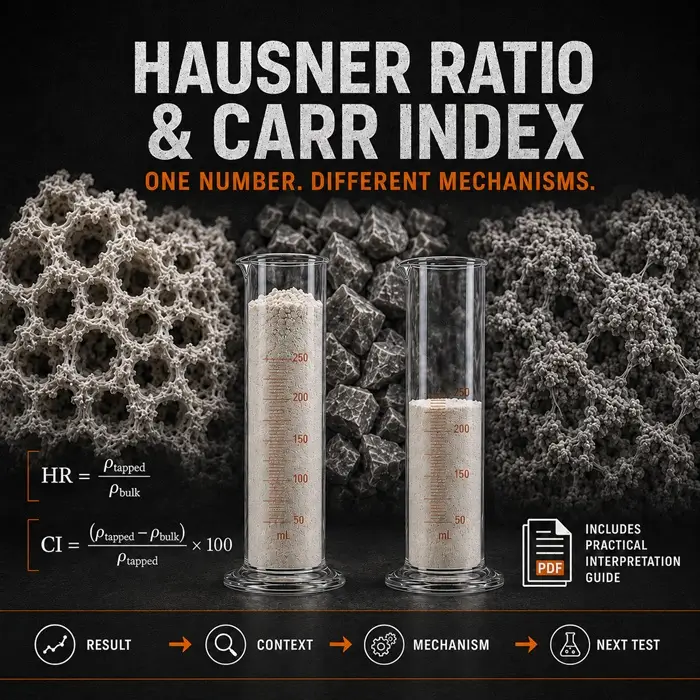
Hausner ratio and compressibility index (Carr index), described in USP <1174>, depend on both bulk and tapped density. Changing fill mass can alter both values. Their shifts sometimes compensate and sometimes reinforce each other, changing the calculated indices without any change in the powder itself.
Tapped density is a protocol-dependent bulk property, not an intrinsic material property.