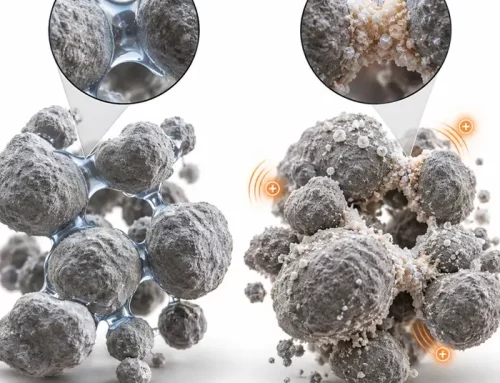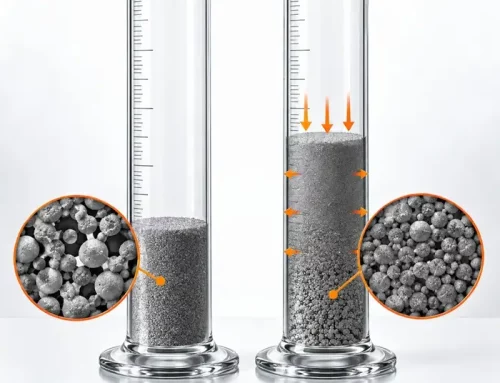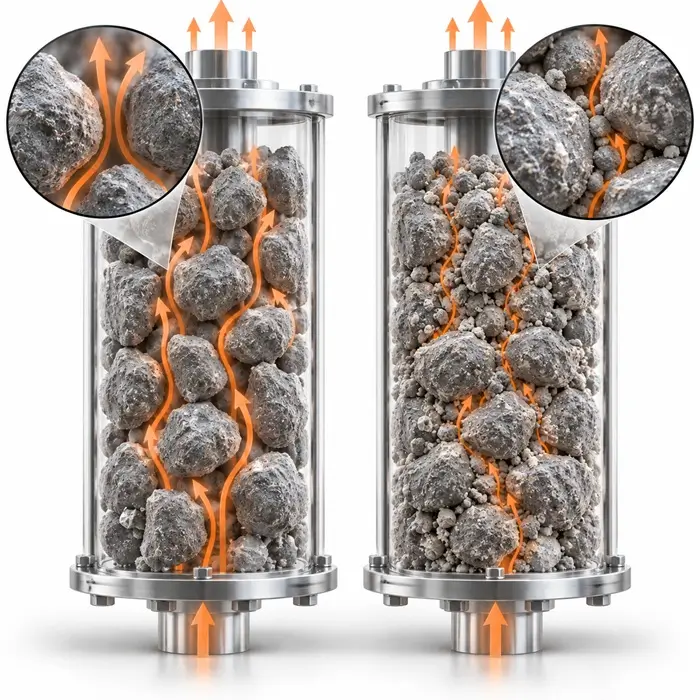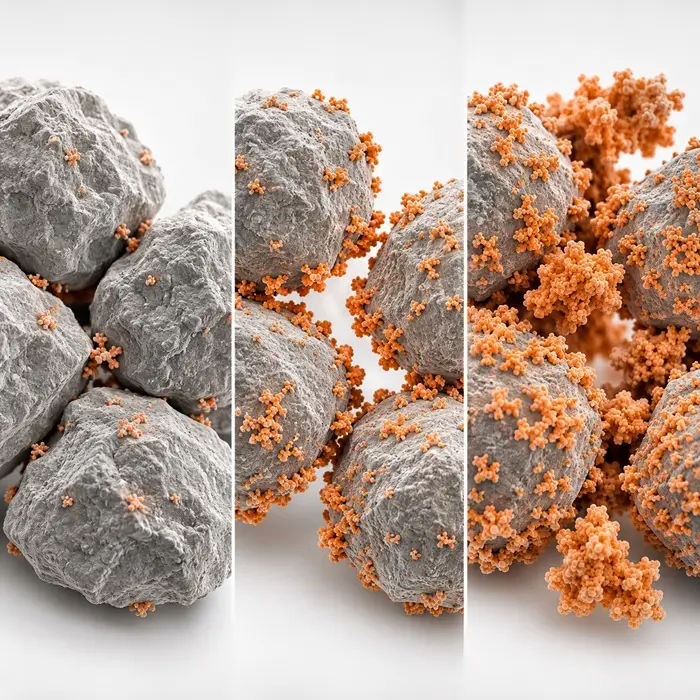

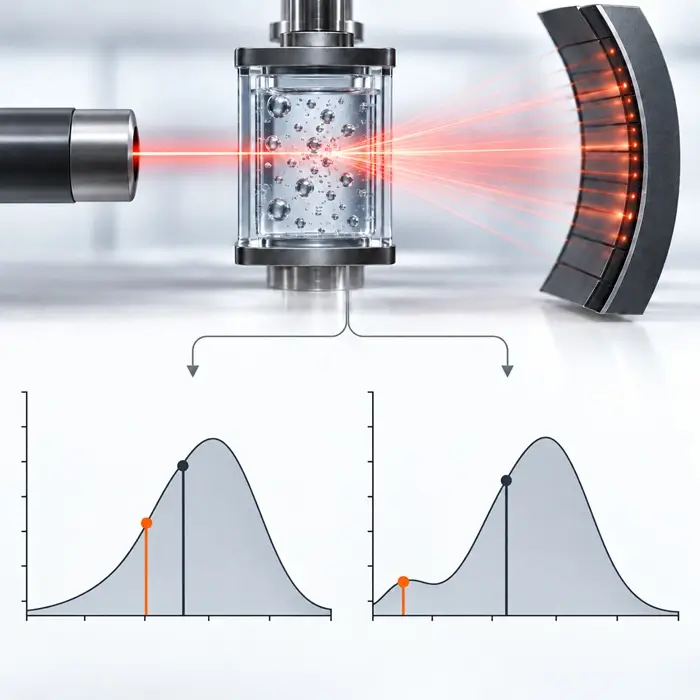
The same laser diffraction measurement is processed twice using different optical settings. D10 shifts far more than D50. The powder has not changed. The software has assigned the measured scattering to different particle sizes.
How Optical Properties Affect the Calculated Distribution
Laser diffraction measures scattered light at different angles. Mie theory predicts the scattering pattern using particle diameter, the particle’s real and imaginary refractive indices, and the refractive index of the dispersing medium (Ma, 2021).
The important optical contrast is the particle-to-medium refractive index ratio. When the indices are close, as can occur with organic or pharmaceutical particles dispersed in water, the scattering response becomes more sensitive to the assumed optical properties.
The imaginary component, often called the absorption index, describes light attenuation within the particle. Incorrect absorption values can distort the calculated distribution, particularly for irregular, translucent, or colored materials.
Why the Fine Fraction Moves First
Larger particles scatter strongly toward smaller angles, where diffraction often dominates. Scattering from smaller particles is more sensitive to optical properties as particle dimensions approach the wavelength of light. When the optical model cannot explain the measured high-angle signal, it can introduce a small artificial fine-particle population.
A recognizable symptom is a ghost fine peak: an unexpected fine mode or shoulder, typically in the submicron to low-micron range. Changing the optical constants can make this feature move or disappear without any change in the scattering measurement. Laser diffraction normally reports volume-based percentiles. Dv10 is the diameter below which 10% of the calculated particle volume falls; Dv50 is the median by volume.
Redistributing a small volume fraction at the fine end can shift Dv10 substantially while leaving Dv50 less affected. This is not universal. Sensitivity depends on particle size, distribution shape, absorption, and measurement conditions. Dv50 can also change substantially when a larger portion of the distribution is affected.
What Published Measurements Show
Rawle (2015) investigated the optical properties of silica test dust using laser diffraction. After identifying the material as quartz, Rawle fixed the real refractive index at 1.544. Holding the real index constant and varying only its imaginary component produced these results from the same wet scattering measurement:
| Absorption index | Dv10 (µm) | Dv50 (µm) |
|---|---|---|
| 0.001 | 1.708 | 4.098 |
| 0.01 | 1.530 | 3.879 |
| 0.1 | 0.998 | 3.155 |
Source: Rawle (2015), Table 1. The original study reports these parameters as x10 and x50.
Source: Rawle (2015), Table 1. The original study reports these parameters as x10 and x50.
Across these settings, Dv10 decreased by approximately 42%, compared with 23% for Dv50, relative to the 0.001 setting.
The study also identified an unexpected minimum near 1.2 µm in the wet particle size distribution when the material was analyzed using optical properties assigned to cristobalite rather than quartz.
Independent X-ray diffraction, density measurements, and optical testing helped establish appropriate constants.
Check the Model Before Rejecting the Batch
When Dv10 approaches a specification limit, separate optical-model uncertainty from measurement variation.
- Real refractive index: Verify particle and dispersant values at the measurement wavelength.
- Absorption index: Test a physically justified range, considering transparency, color, and particle shape.
- Sensitivity: Reprocess the same scattering data and compare Dv10, Dv50, Dv90, and the complete distribution.
- Fit quality: Examine detector residuals and investigate unexpected fine modes rather than selecting settings solely for the lowest residual.
- Measurement conditions: Verify obscuration, background, dispersion, and repeatability independently.
Decision rule: If the spread in Dv10 across plausible optical inputs exceeds the product’s Dv10 specification tolerance, a defensible pass/fail decision requires resolving the optical uncertainty first.
Record the selected optical constants in the measurement method and report them with the result, consistent with ISO 13320:2020.
A repeatable Dv50 does not validate Dv10. The calculated fine fraction must also withstand a justified optical-model sensitivity check.
Technical Basis / Sources
- Rawle, A. F. (2015). Best practice in laser diffraction: A robustness study of the optical properties of silica. Procedia Engineering, 102, 182–189.
- International Organization for Standardization (2020). ISO 13320:2020. Particle size analysis: Laser diffraction methods. Edition 2, reviewed and confirmed in 2025.
- Ma, M. (2021). Laser Diffraction for Particle Sizing: Theory Simply Explained in One Figure. Malvern Panalytical, January 28, 2021.