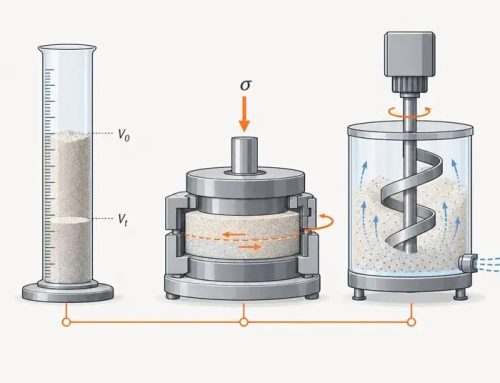

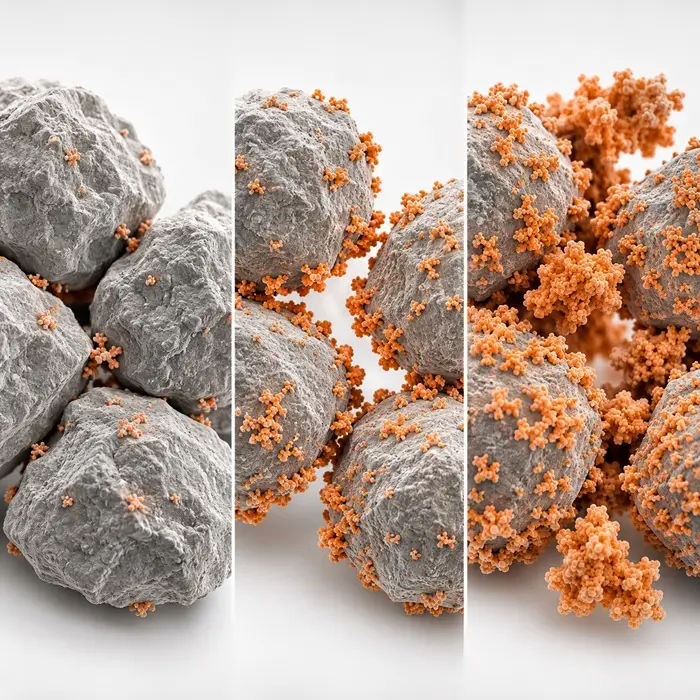
A small silica addition improves discharge, so the next trial uses more. The blend becomes cohesive again. The silica has not stopped working; the balance between surface coverage and free agglomerates has shifted.
Why Small Additions Improve Flow
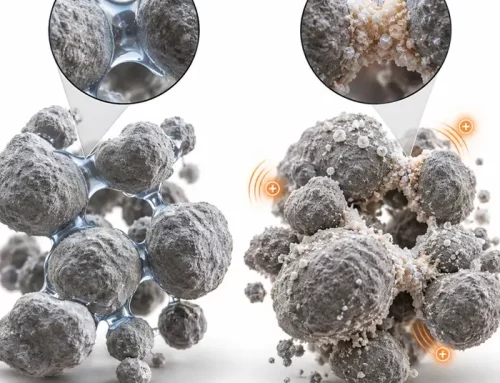
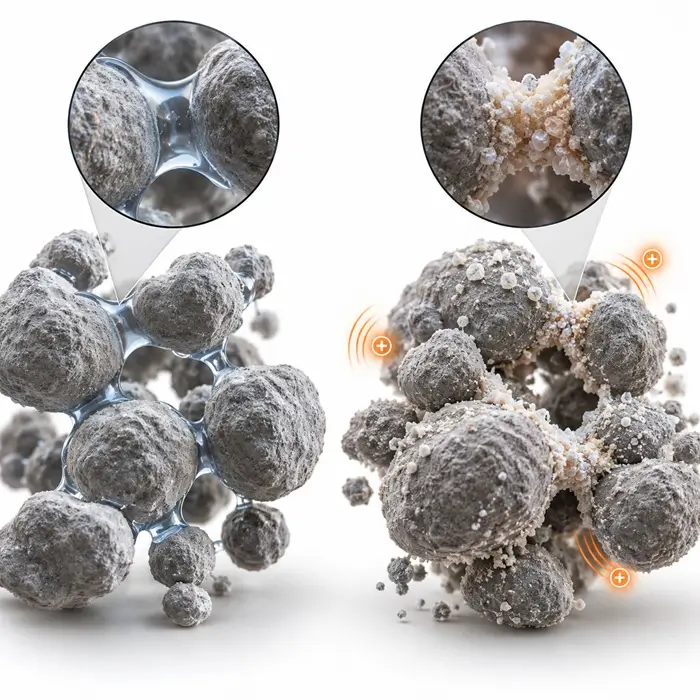
Fumed silica is widely used as a glidant in pharmaceutical formulations and as a free-flow agent in food and chemical powders. Its fine aggregates attach to larger host particles, changing their contact geometry. This increases the separation distance between host particles, sharply reducing van der Waals attraction, and limits mechanical interlocking at surface irregularities. Coverage at contact points matters more than a continuous coating. Smaller or rougher host particles generally require more silica because they present more surface area.
What Happens When Coverage Becomes Excessive?
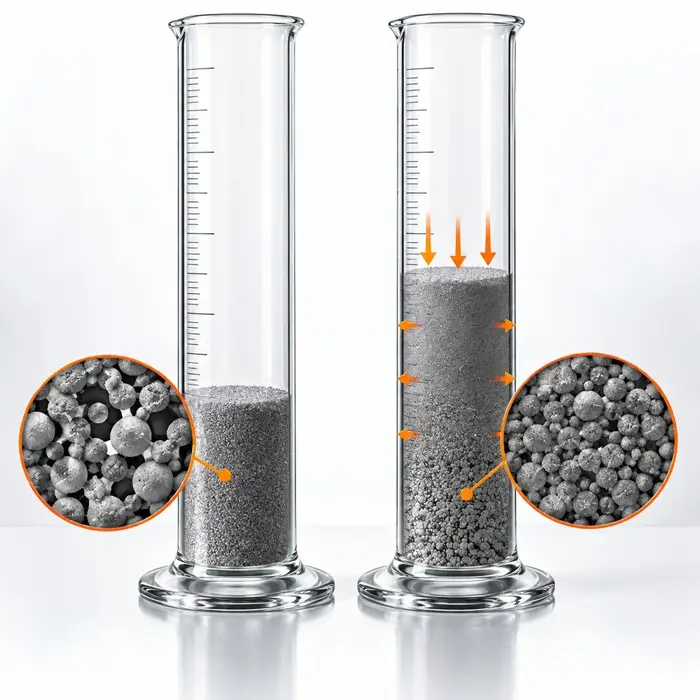
As silica concentration increases, flow initially improves, reaches an optimum or plateau, and may then deteriorate. First, excess silica remains as free aggregates rather than attaching to host surfaces. These aggregates can join into larger agglomerates, introducing a cohesive fine-particle population.
Second, increasing coverage changes the contacts between host particles. Instead of separated host surfaces, contacts increasingly occur between silica-covered regions. The blend can begin to exhibit the cohesive behavior of fine silica itself.
What Does the Experimental Evidence Show?
Blanco et al. (2021) investigated additions of colloidal silicon dioxide to poorly flowing lactose 200 M using image-based flow analysis. At approximately 33% relative humidity, flow improved with increasing silica concentration. The 0.15% w/w sample showed the most favorable flow pattern. Further additions reduced the improvement, and occasional agglomerates associated with excess silica appeared at 0.25% w/w.
The method detected changes using concentration increments of just 0.025 percentage points. Across most tested conditions, additions of 0.10–0.50% w/w were generally effective. These values apply to the lactose, silica grade, and processing conditions investigated, not to every formulation. The study also examined tablet die filling, where excess silica can interfere with magnesium stearate lubrication.
Silica Grade and Mixing Matter
Surface-treated hydrophobic silica can disperse more readily during mixing than hydrophilic grades. Hydrophilic silica also adsorbs moisture, making its performance sensitive to relative humidity. A 2005 doctoral study at the University of Tübingen found that hydrophobic grades improved flow under relatively gentle mixing conditions. Hydrophilic grades required greater mixing energy to achieve comparable surface coverage and distribution.
Yang et al. (2005) demonstrated the importance of dispersion when coating cohesive cornstarch with nanosized silica. More effective coating equipment produced more uniform surface coverage and better flow than simple blending at comparable additions.
Find the Useful Addition Range
Test the untreated powder alongside several low silica concentrations, keeping mixing conditions constant.
- Dose: Use smaller concentration increments around the apparent optimum.
- Dispersion: Examine silica distribution and agglomerates using scanning electron microscopy (SEM), with elemental analysis where appropriate.
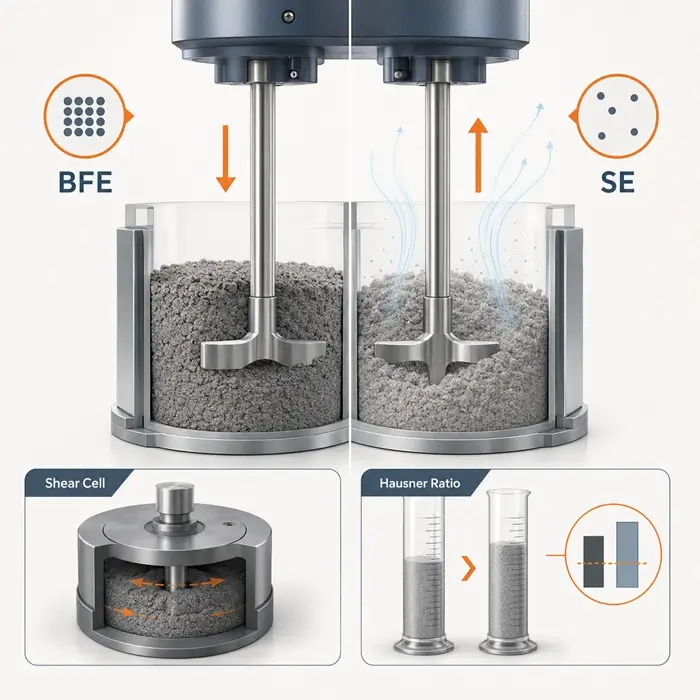
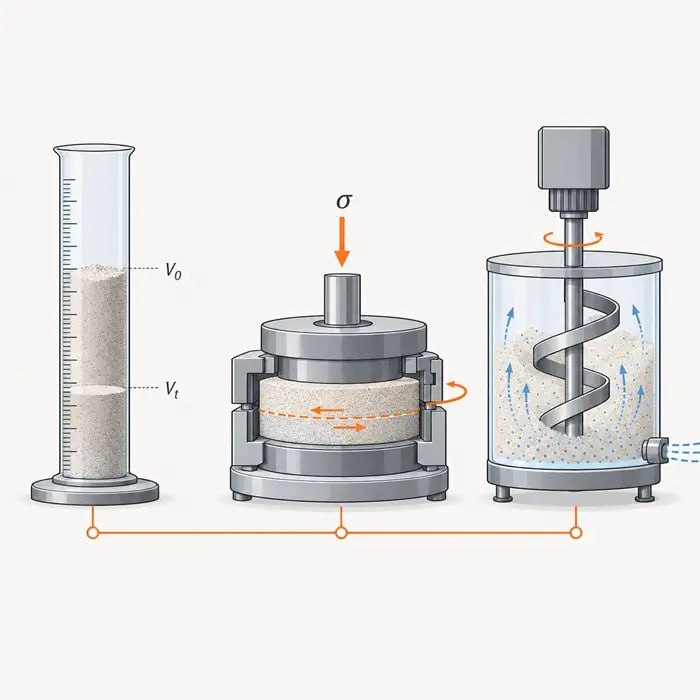
- Flow: Compare shear cell measurements at low normal stress. Dynamic or image-based methods may reveal small differences that conventional bulk tests miss.
- Process: Verify discharge, feeding, or die filling under controlled humidity.
If flow worsens as silica agglomerates appear, reduce the dose or improve dispersion before switching silica grade; if the optimum shifts with mixing intensity, surface coverage rather than nominal concentration is likely controlling the result.
The useful dose is the amount of well-dispersed silica needed to improve the process, not the maximum the blend will accept.
Technical Basis / Sources
- Blanco, D., Antikainen, O., Räikkönen, H., Yliruusi, J., and Juppo, A. M. (2021). Effect of colloidal silicon dioxide and moisture on powder flow properties: Predicting in-process performance using image-based analysis. International Journal of Pharmaceutics, 597, 120344.
- Yang, J., Sliva, A., Banerjee, A., Davé, R. N., and Pfeffer, R. (2005). Dry particle coating for improving the flowability of cohesive powders. Powder Technology, 158(1–3), 21–33.
- Jonat, S. (2005). The mechanism of hydrophilic and hydrophobic colloidal silicon dioxide types as glidants. Doctoral dissertation, University of Tübingen.