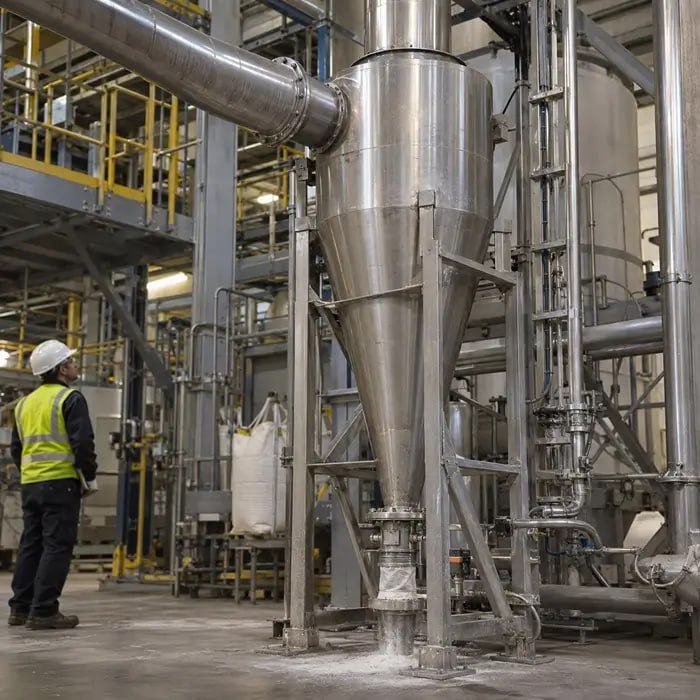

The milled powder meets its particle size specification, but something has changed downstream. A receiving vessel takes longer to deaerate, or material that previously discharged steadily now moves in irregular bursts. The mill may have produced exactly the required D50 while changing how air moves through the powder bed.
Fines Restrict the Paths Air Must Follow
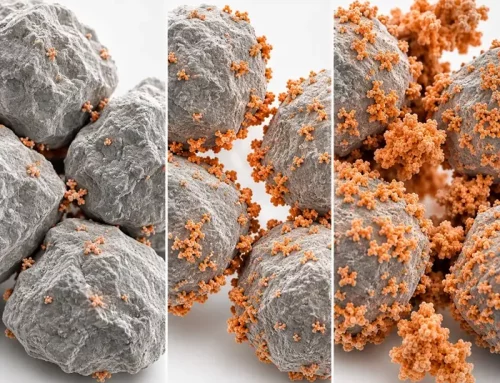
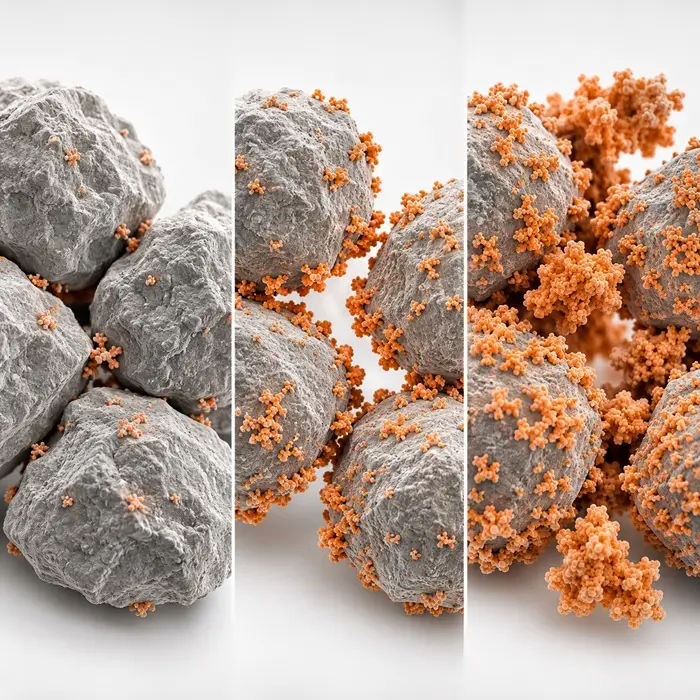
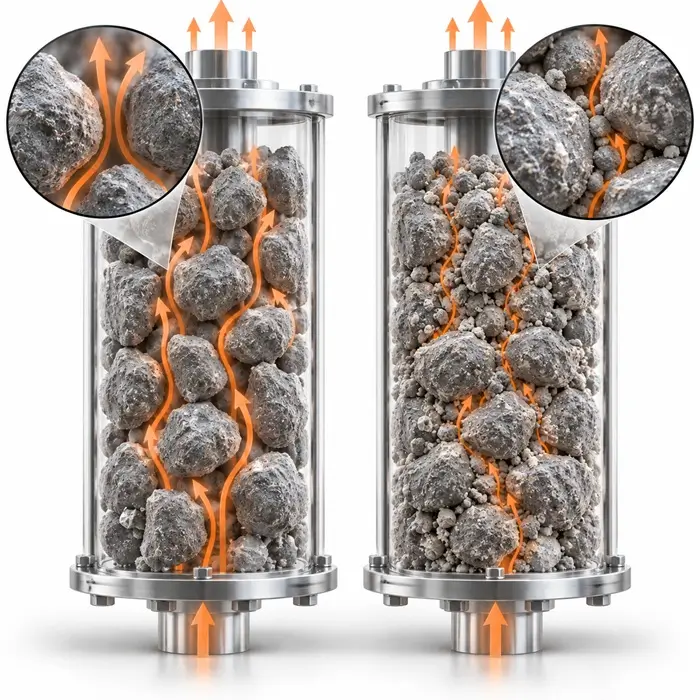
Air moves through the connected spaces between particles. Milling breaks larger particles and often produces fines that occupy voids between coarser grains, narrowing the passages through which air must travel. These narrow connections are called pore throats.
A powder bed can contain substantial empty space yet remain poorly permeable. The size and connectivity of those passages matter more than total void volume alone. Consider a simplified powder of 50 µm particles in which 10% of the mass is 5 µm fines. Assuming equal particle densities and spherical particles, the surface-area-weighted diameter (Sauter mean diameter, d32) becomes:
d32 = 1 / (0.9/50 + 0.1/5) ≈ 26.3 µm
Under constant-porosity Kozeny-Carman assumptions, permeability scales with the square of this diameter. The predicted permeability becomes:
k(after) / k(before) = (26.3/50)² ≈ 0.28
That is less than 30% of the original permeability from a 10% fines fraction by mass. This is a model illustration, not a universal prediction for milled powders.
Particle Size and Packing Work Together
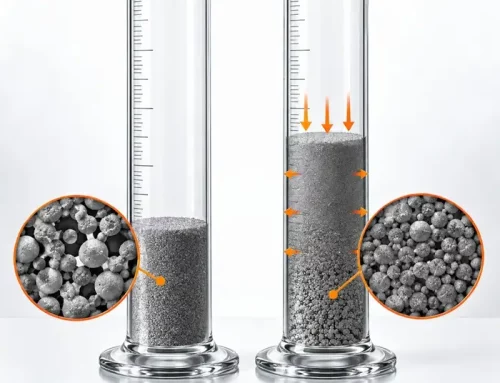
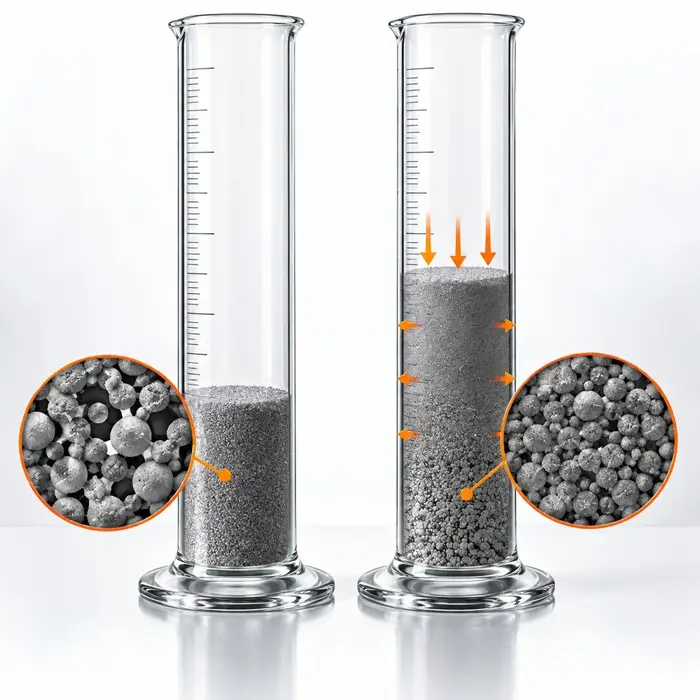
The Kozeny-Carman relationship captures two important influences: characteristic particle size and bed porosity. Packing can move in either direction after milling. Fines may fill spaces between coarser particles, producing a denser bed. But as particles become finer and more cohesive, interparticle forces can also support a looser structure with higher porosity.
Permeability remains sensitive to both effects. In the Kozeny-Carman model, reducing porosity from 0.50 to 0.45 lowers predicted permeability by approximately 40%, even when particle size remains unchanged. Conversely, increased porosity may partly offset the effect of smaller particles without restoring the original permeability. Real milled powders introduce further complications. Angular fragments, agglomeration, broad size distributions, and consolidation history all influence the connected pore network.
Why Discharge Behavior Changes
Fine powders often need air to move through the bed as particles rearrange during discharge. When powder dilates near a hopper outlet, additional void space must be supplied with air. Low permeability restricts that air movement, so an underpressure develops in the dilating zone and the resulting gas pressure gradient opposes particle discharge. This helps explain why fine-powder flow rates can fall below predictions based on gravity-driven discharge alone.
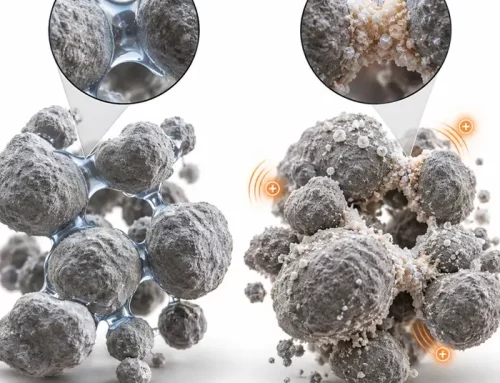
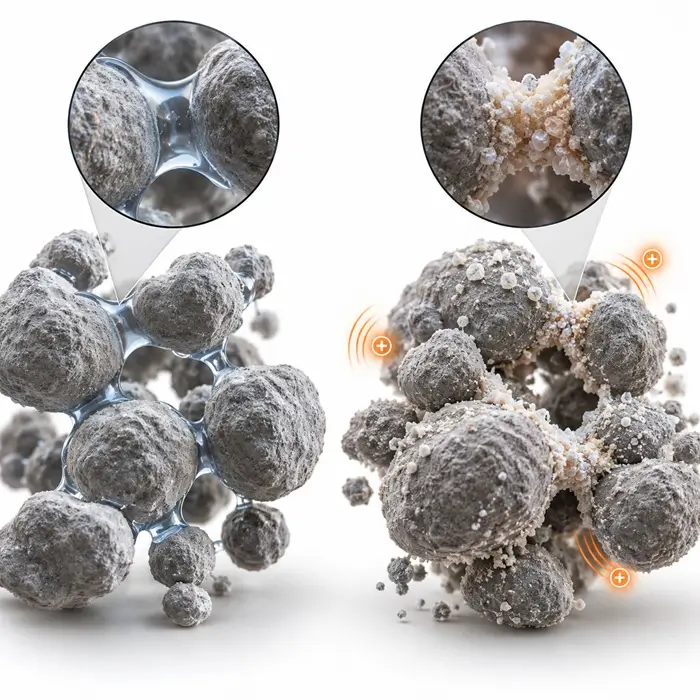
Cohesion introduces further instability. Channel formation, rathole collapse, and localized aeration can contribute to irregular discharge or sudden powder movement. In receiving vessels, restricted gas movement also slows deaeration and settling. The resulting behavior depends on both the powder and the equipment.
Check the Bed Before Changing the Mill
Start by comparing the complete particle size distributions before and after milling. Look beyond D50, particularly at the fine fraction and surface-area-weighted diameter.
Then measure powder-bed permeability under controlled conditions.
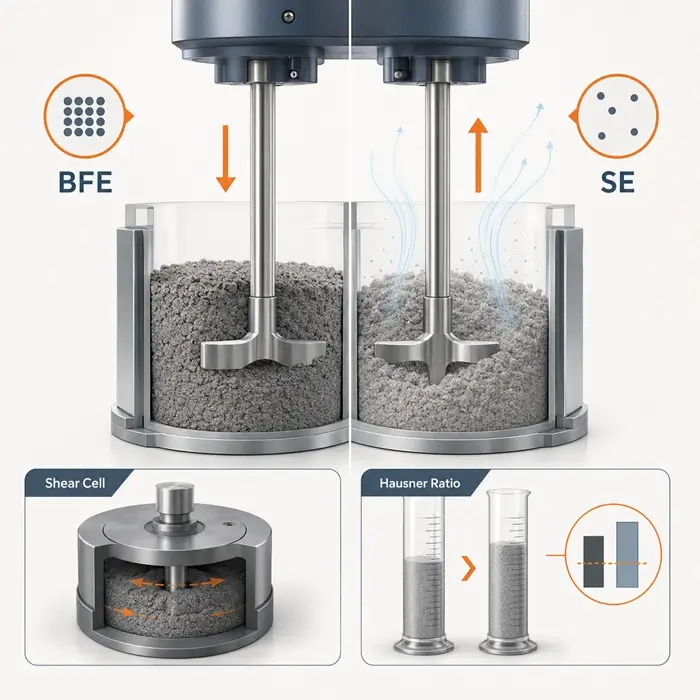
- Permeability: Measure pressure drop and gas permeability at defined gas velocities and consolidation stresses (for example, ASTM D8327-24 using the FT4 powder rheometer).
- Packing: Record bed height, bulk density, porosity, and sample preparation.
- Particle condition: Examine fines, agglomeration, and particle shape.
- Process behavior: Compare deaeration time, discharge rate, and pressure fluctuations.
Blaine air-permeability testing, used for cement fineness under ASTM C204, provides an indirect measure of specific surface area. It does not replace permeability testing under representative process stresses.
Pressure drop also depends on bed depth, gas velocity, and packing. A higher pressure drop alone does not prove that intrinsic bed permeability has fallen.
If permeability decreases alongside an increased fine fraction at matched packing conditions, review milling intensity or classification. If the difference emerges mainly under consolidation, investigate packing and handling conditions.
The target is a particle size distribution that meets product requirements without imposing unacceptable resistance to air movement.
Technical Basis / Sources
- ASTM D8327-24: Powder permeability as a function of consolidation.
- ASTM WK95507: Proposed revision of ASTM D8327-24.
- Crewdson, Ormond, and Nedderman (1977), Air-Impeded Discharge of Fine Particles from a Hopper.
- Ouwerkerk, Molenaar, and Frank (1992), Aerated Bunker Discharge of Fine Dilating Powders.
- ASTM C204-26: Fineness of hydraulic cement by air-permeability apparatus.