
🔑 Key Takeaway
LED-based PIV maps particle velocity at an optically visible boundary during blending, revealing low-velocity zones and local flow patterns that off-line tests cannot show. It complements, rather than replaces, Hausner ratio or shear-cell testing: PIV diagnoses motion in a specific mixer, while bulk tests characterize material behavior for screening and equipment design. Motion does not by itself establish blend uniformity.
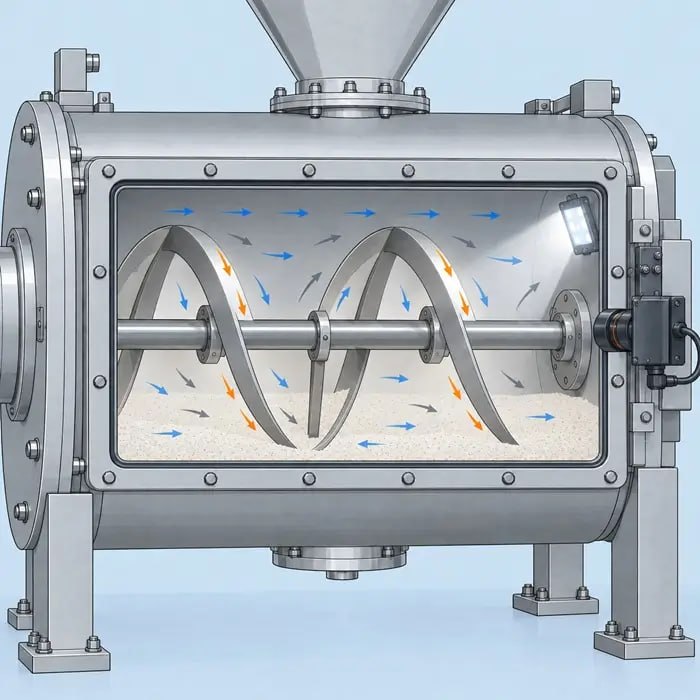
A lab blender reaches its blend-uniformity target, but the scaled-up production unit does not. The powder itself may not have changed; the problem may instead lie in how material circulates through the larger vessel, around the blades, or between different regions of the bed.
LED-illuminated particle image velocimetry (PIV) provides a way to investigate that motion. Instead of reducing behavior to a bulk metric, it images the speed and direction of particles across a visible section of the moving bed while the process runs. That raises the practical question: what does a velocity field add to a process decision, and where does it stop being useful?
What Static Flowability Metrics Actually Report
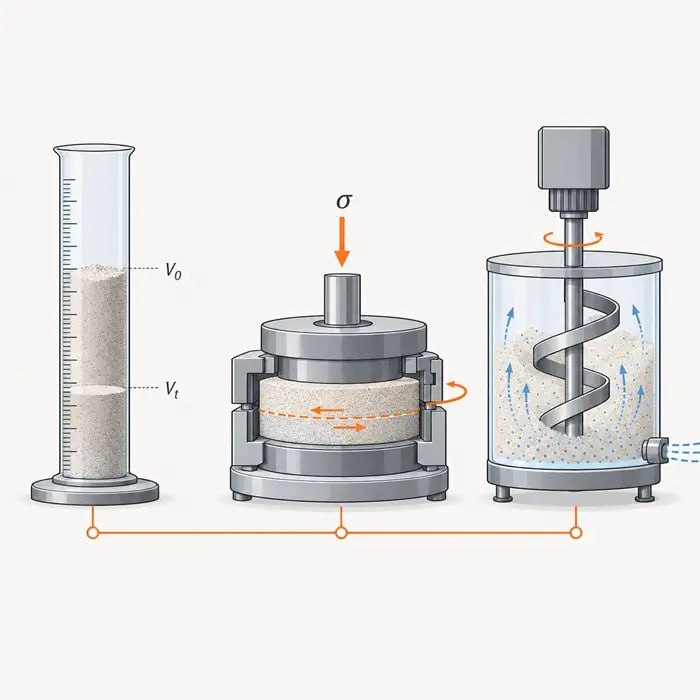
Angle of repose and the Hausner ratio provide relatively simple comparative measures for screening powders, formulations, or lots. Shear cell testing measures stress-dependent properties such as cohesive strength, wall friction, and the relationship between consolidation and unconfined yield strength, providing data that can support hopper and bin design. These methods answer valuable material-property questions, but they do not map local motion around a blade, shaft, wall, or poorly swept region inside an operating mixer.
What LED-Based PIV Adds During Blending
PIV determines particle motion from pairs of images captured a known time apart. The image is divided into small interrogation windows, and cross-correlation estimates how far the particle pattern in each window shifts between frames; dividing that displacement by the frame interval produces a local velocity vector. LED strobe illumination provides the short, repeatable light pulses needed for this frame-pair analysis without the safety and cost burden associated with a pulsed laser.
In a 2026 study in the European Journal of Pharmaceutical Sciences, Sang Min Lee, Ji Yeon Kim, and Du Hyung Choi optimized an LED-based PIV system for six pharmaceutical excipients: three grades of microcrystalline cellulose (MCC) and three lactose-based powders. The optimized analysis used a 32-pixel interrogation window, 16-pixel CLAHE contrast enhancement, and illumination of roughly 65,000 lx. Mean velocities ranged from 0.32 to 0.99 px/frame; because these are setup-specific image velocities rather than calibrated physical velocities, they should not be interpreted as transferable values in mm/s.
The more revealing result was that Avicel PH-102 and PH-112 both averaged 0.32 px/frame but differed by approximately 6- to 9-fold in blade-region vorticity and shear strain rate. Complementary measurements with an FT4 powder rheometer showed that cohesion and unconfined yield strength correlated inversely with PIV velocity (r = −0.97), while basic flowability energy did not predict blending performance. This shows both the agreement between PIV and established stress-dependent flow measurements and the additional process information contained in the spatial velocity field.
PIV nevertheless measures motion, not composition. Lee, Kim, and Choi identify direct process-performance measures such as blend uniformity as an important area for further validation, rather than treating velocity fields themselves as proof of mixedness.
Lee, Kim, and Choi describe the method as real-time because it captures powder motion during blending. The term refers to measurement of the operating process rather than requiring instantaneous on-screen display of the final velocity-vector field.
Where the Method Reaches Its Limits
Optical Access and Image Quality
Optical access is the first limitation. A camera can only resolve motion at a boundary it can observe, typically through a transparent wall or at an exposed free surface. In 2000, Lueptow, Akonur, and Shinbrot in Experiments in Fluids demonstrated granular PIV adjacent to a clear bounding wall, illustrating the inherent limitation of optical measurements in opaque granular systems: the interior of the powder bed remains hidden.
Reliable cross-correlation also depends on sufficient image texture and contrast. Poor illumination, reflections, poorly resolved particle surfaces, or powder accumulating on the viewing surface can weaken the correlation and reduce confidence in the resulting vectors. Lee, Kim, and Choi therefore optimized illumination, contrast enhancement, and interrogation-window size rather than treating imaging conditions as incidental.
Wall Measurements Are Not Bulk Measurements
Near-wall velocity is not automatically representative of motion deeper in the bed. Blade geometry can generate strongly three-dimensional flow, and the wall itself can influence the motion being measured. In 2007 experiments on wet masses during high-shear granulation, Darelius et al. in Chemical Engineering Science found that near-wall velocity depended strongly on wall friction. The system was not a dry powder bed, but the study demonstrates why boundary conditions must be considered when interpreting a wall-based velocity measurement.
Positron emission particle tracking (PEPT) illustrates the complementary advantage of a non-optical technique. In a 2009 pitched-blade stirred-tank study using water and solid-liquid suspensions, Pianko-Oprych, Nienow, and Barigou in Chemical Engineering Science directly compared PEPT and PIV. PEPT could recover three-dimensional velocity information in opaque regions where optical PIV became inaccessible. The comparison was not performed in a dry powder mixer, but it demonstrates the fundamental difference between optical boundary measurement and tracer tracking inside an opaque system.
Free-Surface Imaging Extends the Options
A transparent side wall is useful, but it is not the only possible geometry. In 2005, Conway, Lekhal, Khinast, and Glasser in Chemical Engineering Science used PIV to measure instantaneous, average, and fluctuating velocity fields both at the exposed top surface and near the wall of a four-bladed granular mixer.
Top-down imaging can therefore avoid the need for a side window where the powder surface remains visible, but the same fundamental limitation remains: PIV observes an accessible boundary rather than motion throughout the opaque interior.
From Velocity Field to Process Decision
A PIV velocity field can support decisions about blade configuration, fill level, rotational speed, scale-up, or suspected poorly swept regions. Derived quantities such as vorticity and shear strain rate can reveal differences in local deformation and circulation that an average particle velocity may hide. The measurement can also provide experimental data for validating discrete element or CFD models against actual particle motion.
That motion information should not be confused with mixedness. A low-velocity zone, weak exchange between regions, or strongly localized circulation can help explain why blending performs poorly, but PIV does not establish that the components have reached the required composition. Blend uniformity still requires a composition-sensitive measurement such as appropriately calibrated NIR spectroscopy or representative sampling followed by chemical analysis.
PIV also does not replace material-property measurements used for equipment design. Hopper and discharge decisions still depend on measurements such as shear cell data collected over representative stresses. PIV is most useful when the question is how powder moves within a particular mixer and whether that motion provides a plausible mechanism for the process problem being investigated.
Practical Interpretation Checklist
Confirm that the vessel provides optical access to the region of interest, either through a transparent wall or an exposed free surface. Without a clear view of the moving particles, PIV cannot generate a reliable velocity field.
Check image quality before interpreting the vectors. Poor contrast, reflections, particle buildup on a window, or insufficiently resolved surface texture can weaken the correlation and produce unreliable local velocities.
Do not assume that near-wall velocity represents interior flow. Wall friction, blade geometry, and three-dimensional circulation can all make the observed boundary motion different from the bulk.
Record blade speed, fill level, viewing position, and wall condition with the result. The measured velocity field belongs to that operating condition and can change when any of those variables changes.
Use PIV to identify or investigate mechanisms such as stagnant regions, recirculation, weak exchange between zones, or localized shear. Use separate composition-sensitive measurements when the decision depends on actual blend uniformity.
Keep shear cell testing and other appropriate bulk-property measurements as the basis for hopper, feeder, and discharge design. PIV describes in-process motion; it does not measure consolidation-dependent flow strength.