

Test methods hub
Choose the measurement that answers the question
Connect the uncertainty, test output, limitation, and process decision
A useful test does more than produce a number. Start with the material state and decision, identify which causes must be distinguished, and select the measurement whose output can resolve that uncertainty.




Measurement families
Choose the family before the technique
Each family page is a technique-selection and interpretation guide. It shows which tests belong in the family, what each technique actually measures, the sample state and preparation that matter, the outputs you can expect, the limitations that prevent overclaiming, and how to choose the route that fits the engineering or quality decision.
Showing all 11 families.
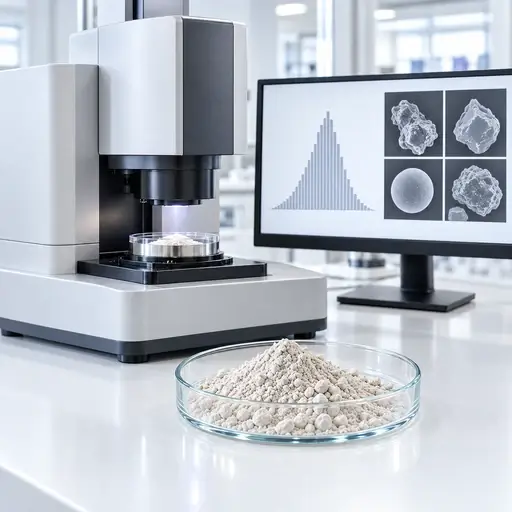
Particle Size and Morphology
Size distributions, fines and oversize, particle shape, agglomeration, morphology and population-resolved imaging. On this family page: Compare sieving, laser diffraction, sensing-zone, sedimentation and imaging routes by size range, dispersion state, measurement basis and required size or shape output.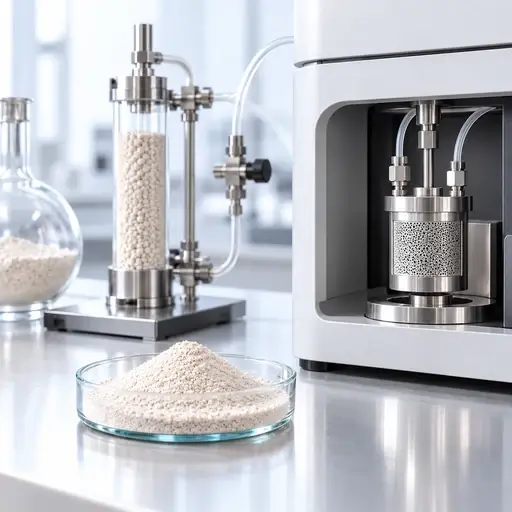
Density, Packing, Porosity and Surface Area
Bulk and particle density, packing state, compressibility, pore structure, accessible porosity and specific surface area. On this family page: Separate loose, tapped, skeletal and envelope density from packing history, then choose gas adsorption, porosimetry or related routes for accessible pore and surface structure.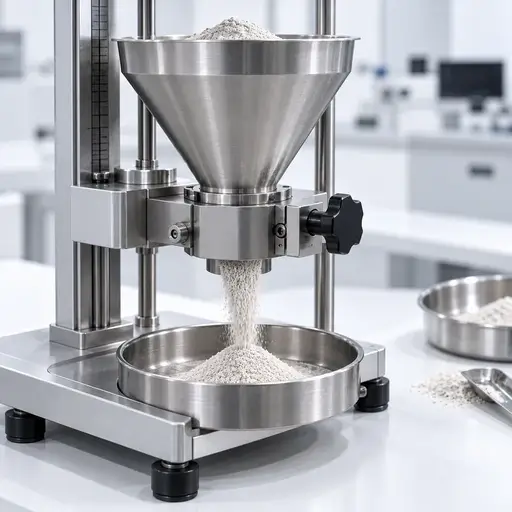
Powder Flow and Bulk Mechanics
Cohesive strength, shear behavior, wall friction, empirical flow response and dynamic resistance to movement. On this family page: Choose Jenike, ring shear, wall friction, orifice or dynamic rheometry by stress state and unit operation, then interpret flow function, friction and dynamic outputs without collapsing them into one flowability number.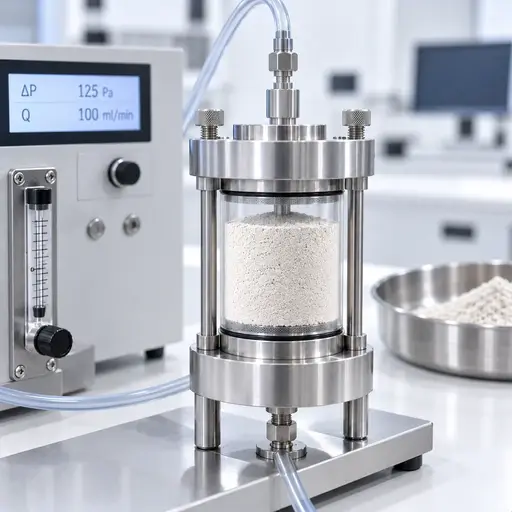
Permeability, Aeration and Deaeration
Gas transport through powder beds, pressure drop, aeration response, air retention, deaeration and fluidization tendency. On this family page: Select pressure-flow, aeration and deaeration measurements by bed state, consolidation level and process timescale so the test reproduces the gas-solid condition that matters.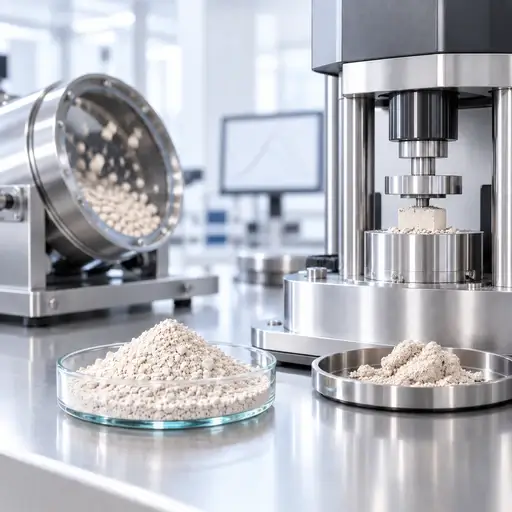
Mechanical Strength, Attrition and Caking
Particle and granule strength, friability, abrasion, impact breakage, handling damage, caking and storage-strength development. On this family page: Choose the stress mode, energy or cycle count that matches the failure, and separate immediate breakage from wear, consolidation and time-, humidity- or temperature-driven caking.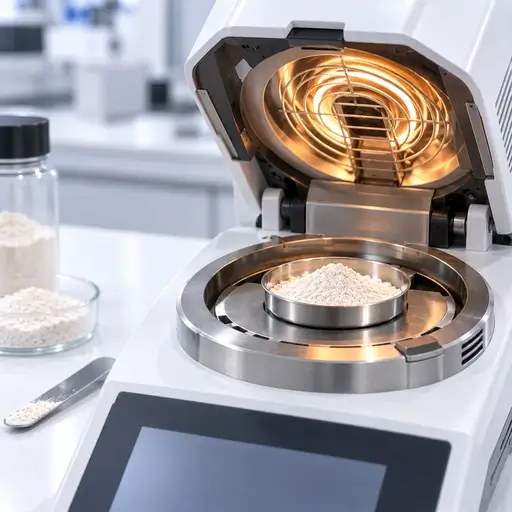
Moisture and Environmental Response
Water content, water activity, sorption and desorption, critical humidity and the effect of environmental history on powder behavior. On this family page: Separate water content from water availability and sorption response, then choose Karl Fischer, loss-on-drying, water-activity or DVS-type routes by the actual moisture question and conditioning history.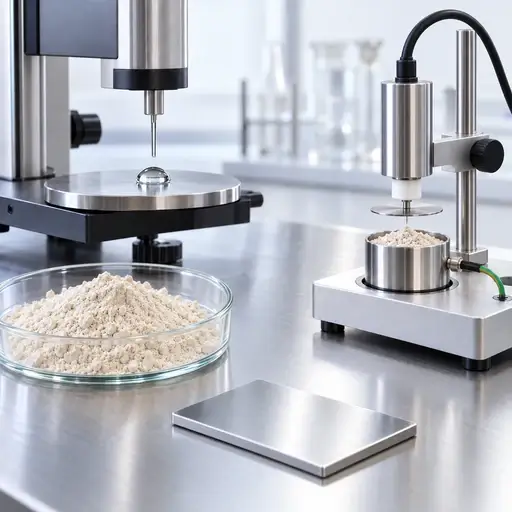
Surface, Wettability and Electrostatics
Surface interaction, wetting and penetration, interfacial behavior, charge generation, charge decay, potential and electrical resistance. On this family page: Choose wetting, contact-angle, capillary, surface-energy, zeta-potential, charge-generation, decay or resistivity routes by the actual interface, contact history and handling mechanism.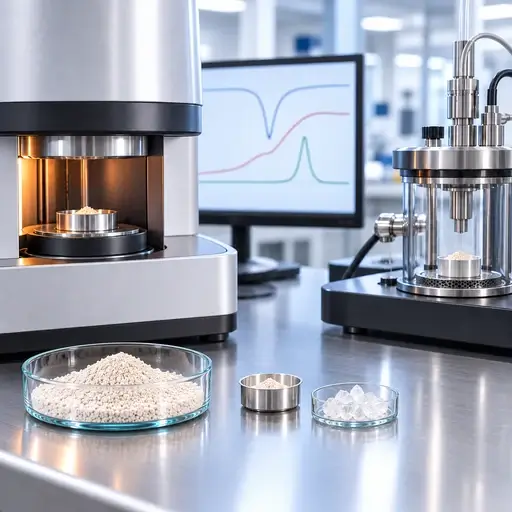
Thermal, Solid-state and Reactivity
Thermal transitions, mass changes, crystalline or amorphous state, phase changes, stability and reactive behavior. On this family page: Compare calorimetry, thermogravimetry, phase-state and controlled-reactivity routes by atmosphere, heating rate, sample mass, prior history and the stability or processing window that matters.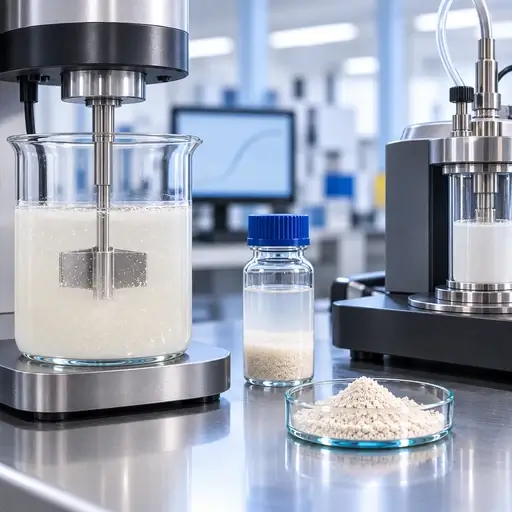
Liquid-phase and Dispersion Behavior
Wetting, dispersion, rheology, suspension stability, settling, redispersion and behavior after particles enter a liquid phase. On this family page: Compare dispersion, redispersion, rheology, viscosity and sedimentation routes by solids loading, liquid composition, shear and mixing history, temperature and measurement timescale.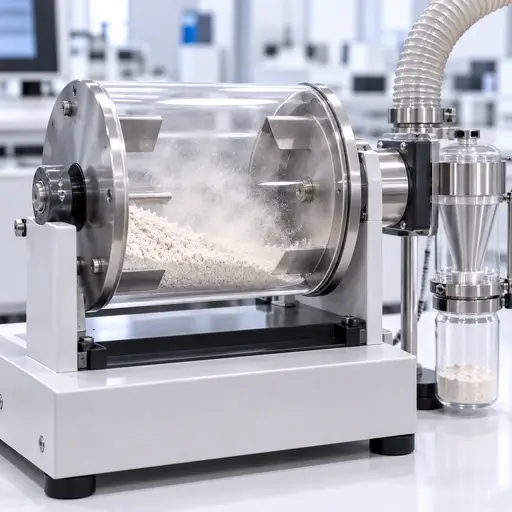
Dustiness and Airborne Release
Airborne particulate release under defined handling stress, including total and health-relevant particle-size fractions. On this family page: Select the dustiness stress and collection convention that represents the intended comparison, and keep dustiness distinct from workplace exposure, explosibility and attrition measurements.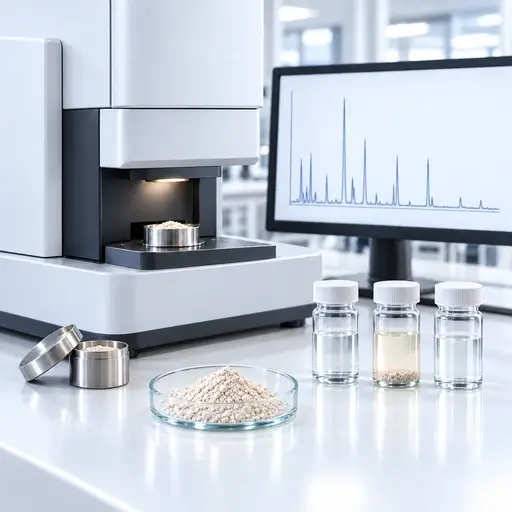
Composition, Contaminants and Leachability
Elemental or molecular composition, contaminants, residuals, extractables and fractions that can be released under defined leaching conditions. On this family page: Choose elemental, spectroscopic, chromatographic or extraction-based routes by the target analyte, detection limit and whether the decision concerns total, surface-localized, extractable or leachable material.No matching measurement family. Try a broader technical term.
Quick comparison
Match the uncertainty to the measurement family
Use the decision question and required output to narrow the family first. The family page then helps you choose the specific technique by material state, sample preparation, stress, timescale, resolution and the limits of the measurement basis.
| Decision question | Measurement family | Useful output | Critical limitation |
|---|---|---|---|
| Is particle size, a tail fraction, shape or agglomeration controlling the result? | Particle Size and Morphology | Size distribution, percentiles, fines/oversize, shape descriptors or morphology | Size and shape depend on measurement basis, dispersion state, sampling and detection limits. |
| Is packing, density, pore accessibility or internal surface controlling behavior? | Density, Packing, Porosity and Surface Area | Bulk/tapped/skeletal density, packing response, pore volume/size or specific surface area | Preparation history and the probe used determine which structure is actually accessible and measured. |
| Will the powder arch, rathole, slip or resist movement? | Powder Flow and Bulk Mechanics | Flow function, strength, friction or dynamic resistance | No single flow index represents every stress state, wall condition or unit operation. |
| Can gas move through the bed, or is retained air changing the process? | Permeability, Aeration and Deaeration | Pressure-flow response, permeability, aeration or deaeration behavior | Bed structure, consolidation and test timescale must represent the process state. |
| Will particles survive handling or storage without breaking, wearing or caking? | Mechanical Strength, Attrition and Caking | Breakage force, strength distribution, fines generation, attrition rate or cake strength | Stress mode, energy, cycles, consolidation, humidity, temperature and time can change the failure mechanism. |
| Is water content or environmental exposure changing powder behavior? | Moisture and Environmental Response | Water content, water activity, sorption response or critical-RH behavior | Water content, activity and sorption answer different questions and cannot be substituted casually. |
| Are wetting, surface interaction or electrical charge controlling the behavior? | Surface, Wettability and Electrostatics | Wetting/penetration, surface-energy, zeta-potential, charge, decay or resistivity outputs | Surface finish, liquid chemistry, humidity, contact history and grounding can dominate the result. |
| Is temperature, phase state or reactivity defining a stability or processing window? | Thermal, Solid-state and Reactivity | Transitions, mass change, crystallinity/polymorph state or reactivity onset | Heating rate, atmosphere, sample mass, prior history and confinement can shift observed transitions and onsets. |
| Does performance depend on what happens after the powder enters a liquid? | Liquid-phase and Dispersion Behavior | Dispersion state, viscosity, yield behavior, settling, stability or redispersibility | Solids loading, liquid composition, shear/mixing history and measurement timescale must match the intended state. |
| How readily does handling release airborne particulate? | Dustiness and Airborne Release | Method-specific total, inhalable, thoracic or respirable release | Dustiness depends on test stress and collection convention and is not the same as a workplace exposure measurement. |
| Is the question what the powder contains, what contaminant is present or what can leach out? | Composition, Contaminants and Leachability | Elemental/molecular composition, contaminant identity, residuals, extractables or leachable fraction | Sample preparation, detection limits and whether the method measures total, surface-localized or extractable material determine the meaning of the result. |
A family narrows the measurement route. Use the individual family page to choose the exact technique, sample preparation, conditioning and test conditions.
Connect the result
Move between properties, processes, and evidence
A measurement becomes useful only when its output is connected to material behavior and the process decision it is intended to support.

Need the measurement, not just the guidance? PowderTechnology.info works closely with Delft Solids Solutions, a contract research organization specializing in the physical behavior of powders and granules. DSS provides contract testing and characterization, with its laboratory working in accordance with ISO 17025. Contact Delft Solids Solutions.
