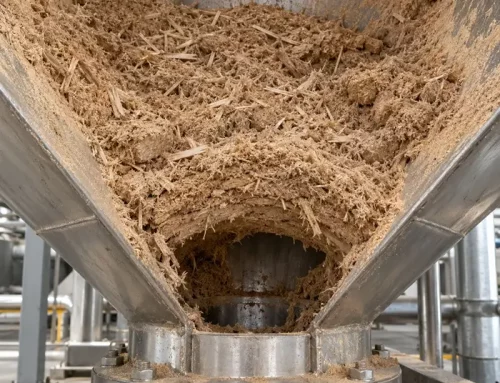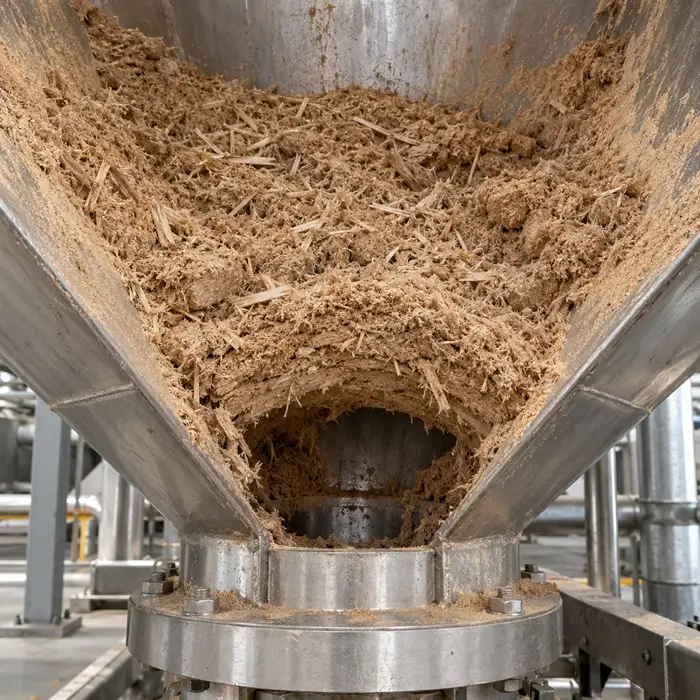

The powder was flowing properly before it entered the dryer. Now it sticks to the discharge chute, builds up on the hopper walls, or refuses to discharge consistently. In other cases, the material leaves the dryer without problems but forms lumps after a few days in storage.
The moisture content is lower, so why has handling become more difficult? Extending the drying cycle might make matters worse.
When Liquid Bridges Become Solid
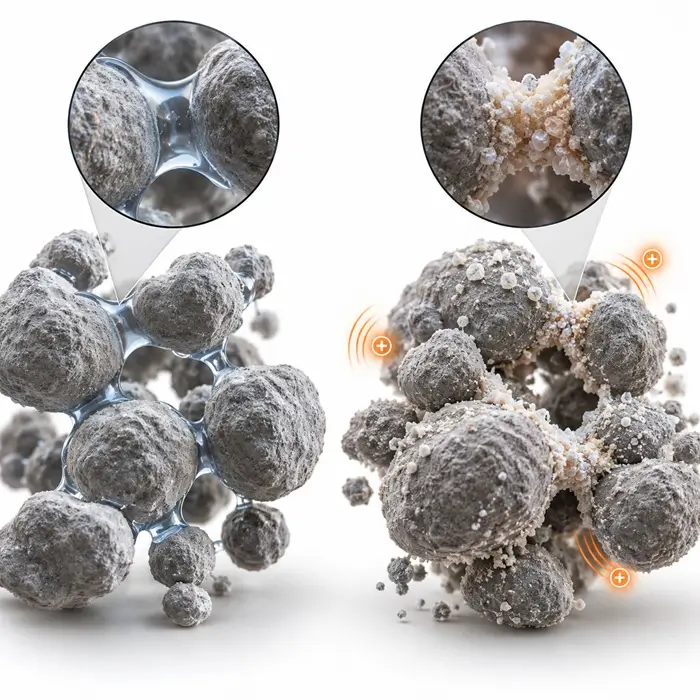
Moisture between particles creates capillary bridges. Removing the liquid should reduce that attraction, provided the liquid contains nothing that remains behind. In practice, process water often contains dissolved salts, sugars, or other soluble material. As the water evaporates, these substances become concentrated at particle contacts. They may crystallize or form amorphous deposits, leaving solid bridges where liquid bridges once existed.
These bonds remain after drying. In some materials, they strengthen during storage. Amorphous powders have another problem. Their tendency to stick depends partly on the relationship between product temperature and the glass transition temperature (Tg). Above Tg, the particle surface can soften and become sticky. Deposits may form inside the dryer or cyclone while the powder is still being processed. The same powder may leave the dryer without obvious problems and cake later. Moisture absorbed during storage lowers Tg, potentially making a previously stable material sticky.
A Drier Powder Can Hold More Electrical Charge
Watch what happens when the powder moves through a transfer line. Does it coat the walls? Does it cling to a sampling tool or behave differently after pneumatic conveying? Particle contacts during mixing, conveying, and discharge generate triboelectric charge. Adsorbed moisture often provides a pathway for charge dissipation. Removing that moisture increases surface electrical resistance in many materials, allowing charges to persist longer and increasing attraction between particles as well as to equipment walls.
Lumay et al. (2016) investigated this balance in lactose powders. Their best flowability occurred between 30% and 50% relative humidity. Below that range, electrostatic effects increased cohesion; above it, capillary forces became more important. Those percentages are not general operating limits. They show why reducing humidity is not automatically the right response. For combustible powders, increased charge retention can also create an electrostatic ignition hazard that belongs in the dust explosion risk assessment.
Check What Happened to the Fine Fraction
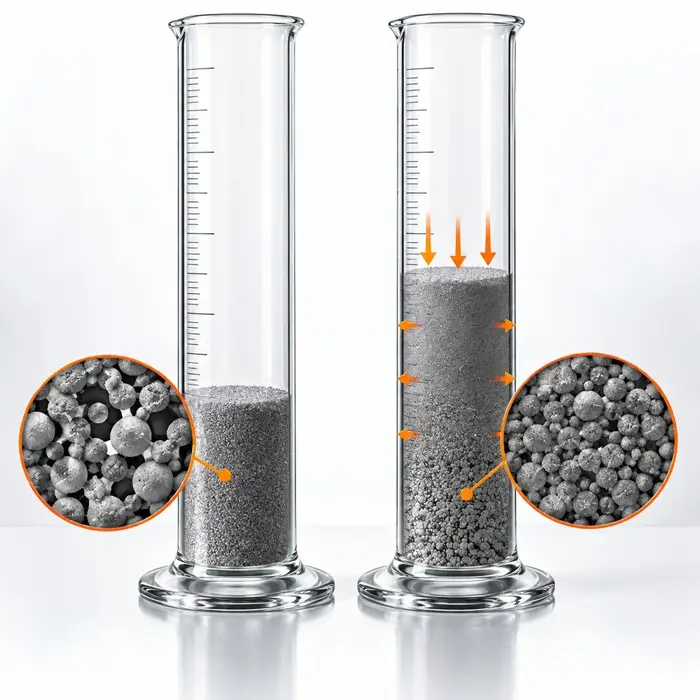
Fluidized-bed dryers, transfer systems, and mechanical handling impose stresses that break agglomerates or abrade particles. The resulting fines have little weight relative to the attractive forces acting between them. A modest increase in fines can change how a powder discharges, even when the median particle diameter barely moves. Compare the complete particle size distributions before and after processing. A D50 measurement alone may miss the change responsible for the handling problem.
Find the Cause Before Changing the Dryer
Start by establishing when the problem appears. Is the powder difficult to discharge immediately, only after transfer, or after several days in storage? Problems immediately after drying or transfer point toward charge or fines; problems developing during storage point toward solid bridges, moisture uptake, or glass-transition effects.
- Suspected electrostatics: Measure charge-to-mass ratio with a Faraday cup after a defined handling procedure. Charge decay measurements establish how long the charge persists.
- Suspected particle breakdown: Compare the fine fraction and particle morphology before and after drying.
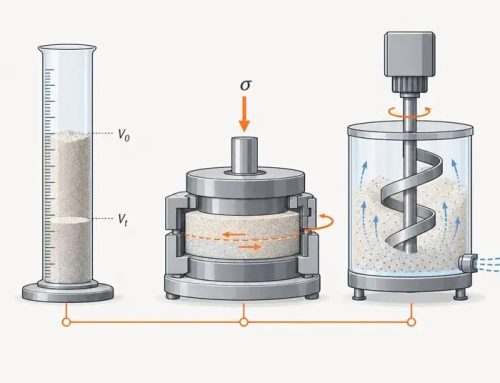
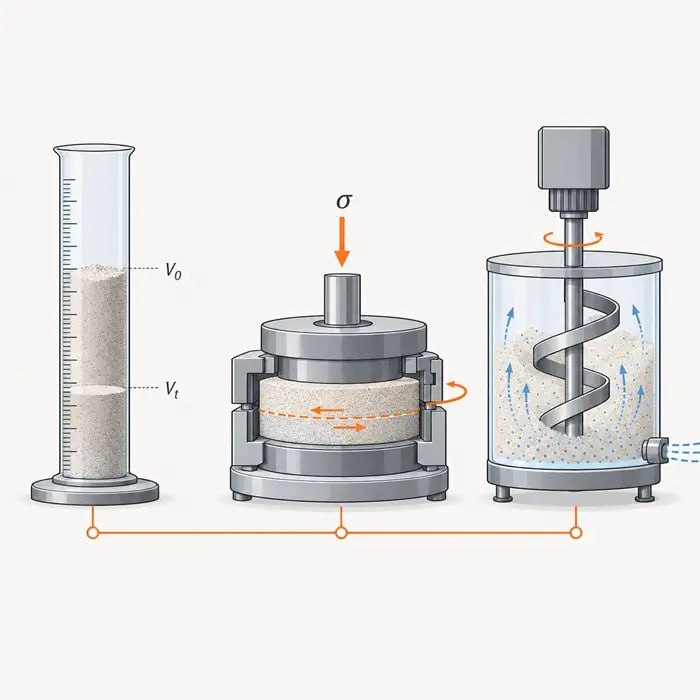
- Suspected solid bridges: Use shear cell measurements at matched consolidation stresses, including time consolidation. Increasing strength during storage is particularly relevant.
- Suspected moisture-related caking: Measure water activity and examine moisture sorption using dynamic vapor sorption (DVS) to assess storage behavior.
Wall friction testing provides additional information where deposits or poor discharge involve equipment surfaces. Higher wall adhesion with unchanged shear strength points toward electrostatics rather than increased bulk cohesion.
The results should guide the next step. Electrostatic problems may require grounding, ionization, or controlled humidity during transfer. Excessive fines point toward gentler handling or classification. Solid bridges and amorphous stickiness call for a closer look at drying temperature, drying profile, cooling, and storage conditions. If the measured powder properties have not changed, investigate the equipment and operating conditions before altering the formulation or drying process.
Technical Basis / Sources
- A Review of Bulk Powder Caking (2017), Powder Technology.
- Lumay et al. (2016), Effect of Relative Air Humidity on the Flowability of Lactose Powders.
- The Effects of Relative Humidity on the Flowability and Dispersion Performance of Lactose Mixtures (2017), Materials.
- Caking Phenomena in Amorphous Food Powders (1995), Trends in Food Science & Technology.