
Table of contents
How to Separate Mechanical Interlocking From Moisture-Driven Cohesion
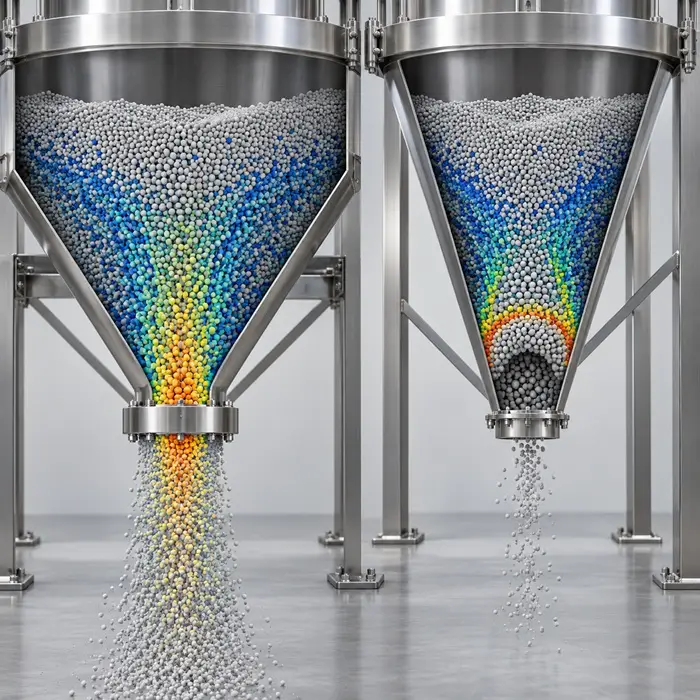
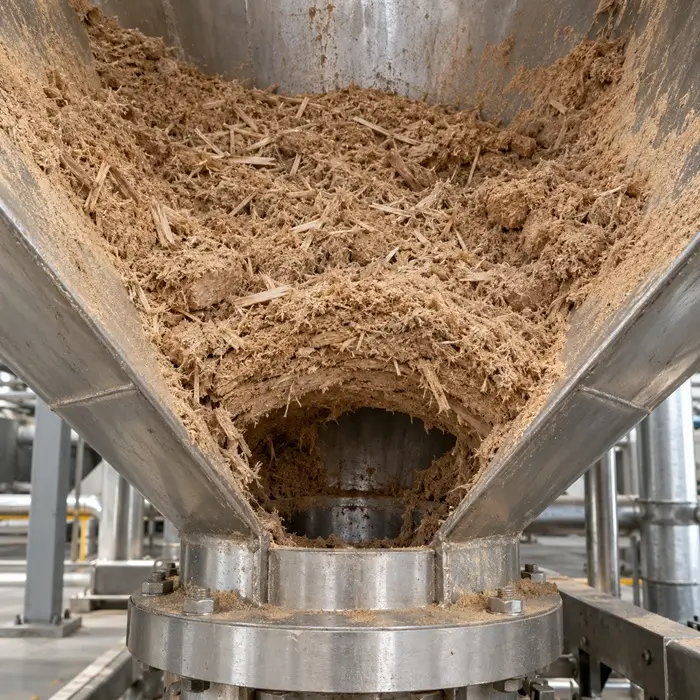
A wood powder may sit quietly in a hopper and then bridge as soon as the feeder starts. The same material can rathole, surge, or stop discharging altogether despite appearing dry and manageable during manual handling.
For pelletizing, torrefaction, gasification, and biorefinery processes, identifying the mechanism matters. Installing additional drying capacity makes little sense if fibrous particle geometry controls the failure. Changing the milling process may achieve little if humidity during storage is driving a large increase in powder strength.
The plant symptom alone does not distinguish the two.
Why Wood Powder Is Difficult to Feed
Milled wood differs fundamentally from many mineral and metal powders. Its particles are irregular, elongated, fibrous, and often broadly distributed in both size and shape. Long particles can hook around neighboring particles, while rough surfaces increase the opportunities for contact and interlocking.
A 2026 study by Khazem et al. compared spruce and poplar powders using rotating drum experiments and Discrete Element Method (DEM) simulations. Because the relevant interparticle parameters could not be measured directly for particles of this complexity, the researchers identified effective sliding friction, rolling friction, and cohesion energy density through inverse DEM calibration against the drum experiments [1].
The calibrated cohesion energy density was 130 kJ/m³ for spruce and 100 kJ/m³ for poplar. Image analysis also showed the rougher, more fibrous morphology of the spruce particles. The authors associated the poorer unconfined flow of spruce with the combined effects of cohesion, friction, agglomeration, and particle interlocking.
Moisture can intensify the handling problem. Water inside and between porous woody particles changes interparticle behavior through hydrogen bonding, capillary effects, liquid bridging, lubrication, and changes in the mechanical response of the biomass.
Lu et al. investigated milled loblolly pine across different moisture contents. Compressibility and shear resistance increased as moisture content rose, while hopper simulations predicted an approximately 50% reduction in effective discharge rate as moisture increased toward the experimentally measured fiber saturation point of 30% [3].
The result is a coupled problem: a powder may already have a geometry-driven tendency to interlock when dry, then become more difficult to move as it takes up moisture.
Use the Test That Matches the Failure
No single flow test reproduces every condition encountered during storage and feeding.
Rotating drum and shear testing are complementary. Biomass studies have shown that consolidated storage conditions and dynamic free-surface movement can produce different flowability trends [5]. The measurement therefore has to match the state in which the process fails.
Start With Controlled Moisture Conditions
The most useful first comparison is often the same powder tested at several controlled moisture states.
Test the as-received material, a dried sample, and samples conditioned at relative humidities representative of storage and processing. A rotating drum can show whether dynamic behavior changes, while DVS establishes how strongly the material takes up moisture across the same humidity range. Add shear testing if the material consolidates before the failure occurs.
Conditioned biomass can begin re-equilibrating as soon as it is exposed to different ambient humidity. Flow tests should therefore be performed under controlled environmental conditions where practical, or immediately after the conditioned sample is removed from its controlled environment.
Three response patterns then become useful diagnostically:
This comparison identifies the material response before the plant commits to an intervention.
What DVS Adds
Dynamic vapor sorption measures the mass gained or lost by a sample as relative humidity changes under controlled conditions. The resulting sorption isotherm shows equilibrium moisture content as a function of RH.
Species and treatment history matter. Zaihan et al. compared several wood materials after grinding them to pass an 850 µm sieve. At 90% RH and 25°C, Sitka spruce reached 20.1% moisture content, compared with 18.0% for radiata pine, 17.9% for sesenduk, and 16.2% for acacia [2].
Those values demonstrate why ambient RH alone cannot define the condition of a wood powder. Different materials exposed to the same humidity can equilibrate at different moisture contents.
DVS does not establish a universal critical RH for bridging. Connect the sorption curve to flow measurements on samples conditioned at selected points along that curve.
Add Shear Testing When Consolidation Matters
A rotating drum represents loose, dynamic flow. A hopper full of powder introduces consolidation.
Shear testing measures how strongly a powder resists yielding after being subjected to a defined consolidation stress. The resulting flow function coefficient, <strong>ffc</strong>, provides a useful engineering classification:
The coefficient is the ratio between major principal consolidation stress and unconfined yield strength. Higher values indicate easier flow, but ffc depends on consolidation stress and should not be treated as a universal material constant [6].
For a hopper that blocks after material has been stored for several hours, shear testing is therefore more relevant than relying on a rotating-drum result alone. Wall-friction testing should also be considered if the proposed solution involves changing hopper geometry or wall material.
Match the Intervention to the Result
If the dry material flows well and conditioning causes a large deterioration, moisture control deserves priority. Options include drying, enclosed storage, humidity control, shorter residence time, and protection from humid process air.
If the dry material remains difficult to handle, attention shifts toward particle structure and the equipment. Tighter milling control, removal of troublesome long fibers, changes to particle-size distribution, or a different milling route may reduce interlocking. A larger outlet, different hopper geometry, mechanical agitation, or a feeder designed for fibrous solids may instead allow the process to tolerate the material.
Where consolidation or wall friction controls the problem, hopper modifications should be based on shear and wall-friction measurements rather than a generic flowability index.
Drying Changes the Dust Hazard
A drying decision also changes the condition of a combustible dust.
Research on wood dust shows that particle size and moisture content materially affect whether an explosive atmosphere can develop [8]. Smaller wood-dust fractions can remain ignitable or explosible under conditions in which coarser or wetter material does not. ASTM E2019 also makes clear that minimum ignition energy values apply to the specific sample condition and test method rather than representing an intrinsic constant of the material [7].
If drying changes the moisture condition of a combustible wood powder, the dust-hazard assessment should therefore use material representative of the dried process state. A flow improvement should not be treated independently from the resulting combustible-dust characteristics.
Torrefaction Can Affect Both Contributions
Torrefaction matters here because it changes both the particles produced during milling and the material’s interaction with moisture.
Pachón-Morales et al. studied knife-milled spruce and poplar across six torrefaction intensities. More intense treatment produced finer, rounder, and more regular particles. Shear testing showed a gradual shift from cohesive behavior in untreated biomass toward nearly free-flowing behavior at the highest treatment intensities. The improvement was associated more strongly with reduced particle-shape irregularity and surface sharpness than with particle size alone [4].
Torrefaction also reduces the hygroscopicity of biomass. Thermal treatment alters hydrophilic functionality within the material and can substantially reduce equilibrium moisture uptake [9]. A process that already includes torrefaction may therefore reduce both moisture sensitivity and the tendency of the subsequently milled particles to interlock.
That benefit does not remove the safety question. Torrefied biomass is more brittle and can generate additional fines during handling and milling. Studies of torrefied biomass dust show that it remains explosible, with ignition and explosion behavior dependent on feedstock, particle size, moisture, and test condition [10]. Finer, drier torrefied dust should therefore receive its own representative dust-hazard assessment.
Flow Aids Buy Time, Not Understanding
Bridge breakers, agitators, vibration, and other flow-assistance devices can restore discharge when a permanent material or equipment change is not immediately practical. They remain mitigation measures because they do not remove the mechanism producing the bridge.
Vibration may repeatedly collapse an arch without preventing the next one from forming. Agitation can keep fibrous particles moving without changing their geometry. Mechanical assistance can stabilize production while the material and process conditions are characterized, but it should not replace the diagnosis.
Diagnose Before You Modify
Start by reproducing the material condition under which the failure occurs.
Compare the powder dry, as received, and after controlled humidity conditioning. Use dynamic testing to examine free-surface movement, DVS to quantify moisture uptake, and shear testing where consolidation matters. Add particle size and shape analysis when morphology is suspected.
That creates a direct route from <strong>symptom → material condition → flow response → intervention</strong>.
The evidence is cheaper than solving a moisture problem with new steelwork, or installing a dryer for a powder that still bridges when dry.
Explore the <a href=”/troubleshoot/”>Troubleshoot hub</a> for symptom-led powder-processing problems and the <a href=”/test-methods/”>Test Methods hub</a> for guidance on selecting characterization methods.
For a detailed comparison of individual flow tests, see <a href=”/selecting-the-right-powder-flow-test-method/”>Selecting and Comparing Powder Flow Test Methods (including PDF guides)</a>.
Testing Support
PowderTechnology.info works closely with Delft Solids Solutions (DSS), a contract research organization specializing in particle and powder characterization. DSS can combine dynamic vapor sorption, shear testing, and particle size and shape characterization to investigate how moisture condition, consolidation, and particle morphology contribute to a handling problem. Testing can be defined around the material and process conditions that actually produce the failure.
Frequently Asked Questions
References
[1] Khazem, R., Colin, J., Shi, H., Casalinho, J., Schott, D., & Puel, F. Characterization of wood powder properties: A DEM-based calibration with rotating drum experiments. Powder Technology, 473 (2026), 122157. DOI: 10.1016/j.powtec.2026.122157.
[2] Zaihan, J., Hill, C. A. S., Curling, S., Hashim, W. S., & Hamdan, H. Moisture adsorption isotherms of Acacia mangium and Endospermum malaccense using dynamic vapour sorption. Journal of Tropical Forest Science, 21(3) (2009), 277–285.
[3] Lu, Y., Jin, W., Klinger, J. L., & Dai, S. Effects of the Moisture Content on the Flow Behavior of Milled Woody Biomass. ACS Sustainable Chemistry & Engineering, 11(31) (2023), 11482–11489. DOI: 10.1021/acssuschemeng.3c01344.
[4] Pachón-Morales, J., Colin, J., Pierre, F., Puel, F., & Perré, P. Effect of torrefaction intensity on the flow properties of lignocellulosic biomass powders. Biomass and Bioenergy, 120 (2019), 301–312. DOI: 10.1016/j.biombioe.2018.11.017.
[5] Pachón-Morales, J., Colin, J., Casalinho, J., Perré, P., & Puel, F. Flowability characterization of torrefied biomass powders: Static and dynamic testing. Biomass and Bioenergy, 138 (2020), 105608. DOI: 10.1016/j.biombioe.2020.105608.
[6] Schulze, D. Powders and Bulk Solids: Behavior, Characterization, Storage and Flow. Springer, Berlin Heidelberg (2008). DOI: 10.1007/978-3-540-73768-1.
[7] ASTM International. ASTM E2019-03(2025), Standard Test Method for Minimum Ignition Energy of a Dust Cloud in Air. DOI: 10.1520/E2019-03R25.
[8] Santamaría-Herrera, A., Hoyuelos, F. J., & Casado-Marcos, C. Characterization of the explosiveness of wood dust. Process Safety and Environmental Protection, 169 (2023), 252–259. DOI: 10.1016/j.psep.2022.10.087.
[9] Chen, W.-H., Lin, B.-J., Lin, Y.-Y., Chu, Y.-S., Ubando, A. T., Show, P. L., Ong, H. C., Chang, J.-S., Ho, S.-H., Culaba, A. B., Pétrissans, A., & Pétrissans, M. Progress in biomass torrefaction: Principles, applications and challenges. Progress in Energy and Combustion Science, 82 (2021), 100887. DOI: 10.1016/j.pecs.2020.100887.
[10] Abelha, P., Cieplik, M., & Carbo, M. Explosivity Properties of Dusts from Torrefied Biomass Pellets. Chemical Engineering Transactions, 48 (2016), 403–408. DOI: 10.3303/CET1648068.