

Powder wettability often decides whether a powder-liquid process starts cleanly or begins with defects. A powder that floats during addition does not automatically need more mixing power. In many cases, the liquid has not yet reached the particle surfaces that matter.
Dispersion starts before the bulk liquid looks uniform. The liquid first has to spread across the particles, enter the spaces between them, and push air out of the powder structure. When that first contact is slow or incomplete, the process can begin with floating powder, sealed clumps, dry cores, or delayed dispersion.
These symptoms appear in many systems, from pigments and ceramic powders to proteins, additives, detergents, and battery slurry components. Enough shear may eventually force the material into suspension. However, the first seconds after addition often show why that extra force was needed.
Poor wetting does not always stop a process completely. It can make the process less predictable. One batch disperses within minutes, while another needs more time, more energy, or operator intervention. The powder may be the same, but the first contact with the liquid has changed.
Wetting Starts Before Dispersion
When powder enters a liquid, air does not disappear because the powder touches the surface. The liquid still has to replace the air around the particles and inside the powder bed.
If that exchange happens quickly, the powder wets, sinks, and disperses with fewer complications. If air remains trapped, the powder can behave like a loose powder-air structure. That structure can stay at the surface, break apart slowly, or form floating islands that resist incorporation.
This explains why a material may float even when the solid particles are denser than the liquid. The powder is not acting as one dense solid. It is acting as a structure that still contains air.
The same mechanism can produce clumps. The outer layer wets first and forms a dense or sticky shell. Inside that shell, dry powder remains shielded from the liquid. Once dry cores form, additional shear may break them apart, but the process has already become harder to control.
Why Some Powders Resist Wetting
Poor powder wettability can come from several material and process factors. Surface chemistry often sits at the center of the problem. Hydrophobic particles resist contact with water-based liquids. Surface coatings, fats, waxes, lubricants, or residues can reduce spreading even further.
Particle size also influences the first contact. Fine powders often trap air because they create small pores and cohesive powder beds. Still, particle size rarely explains wetting behavior on its own. A fine powder can wet well when its surface chemistry supports liquid spreading. A coarser agglomerate can resist wetting when air cannot escape from its internal structure.
An agglomerate structure adds another layer. A porous agglomerate may absorb liquid quickly when its pore network allows capillary penetration. Another agglomerate with a similar size may skin over at the surface and keep dry powder inside.
The liquid phase changes the outcome as well. Surface tension, viscosity, temperature, and dissolved additives all influence how easily liquid enters the powder bed. The same powder can therefore behave differently in two liquids, or under two process conditions.
For related background, read the PowderTechnology.info article on powder wettability in food and feed.
Poor Wetting Can Look Like Poor Mixing
Mixing and wetting are closely connected, but they do not describe the same limitation. Wetting controls first contact. Mixing controls distribution once the liquid can access the powder surface.
This difference is important in process troubleshooting. Stronger mixing can reduce visible lumps, yet it may also create foam, heat, particle damage, or unnecessary energy input. In some systems, high shear compensates for poor wetting without removing the cause.
A powder that forms fish eyes, floating islands, or dry-core clumps has already shown that the liquid did not enter the powder structure evenly. More mixing may still be part of the solution, but it is not always the starting point.
The better question is what the process allows the powder to do during addition. Does it spread and sink? Does it seal at the surface? Does it trap air before the liquid can penetrate? Those early details often explain the later dispersion problem.
What the First Seconds Reveal
The first seconds after powder addition often show more than the final mixed product. A powder that spreads and sinks cleanly has already passed the first barrier. A powder that floats, skins over, or forms clumps has not.
Floating powder usually points to trapped air or poor liquid penetration. A wet shell with a dry center points to sealing at the outside of the clump. Slow sinking may indicate that the liquid enters the powder bed, but not quickly enough for the selected addition rate.
This does not mean every wetting problem needs an elaborate test program. In many cases, the first improvement comes from watching the process under controlled conditions. The same powder mass, liquid volume, addition rate, temperature, and mixing intensity should be used each time. Otherwise, the result changes because the process changed, not necessarily because the powder changed.
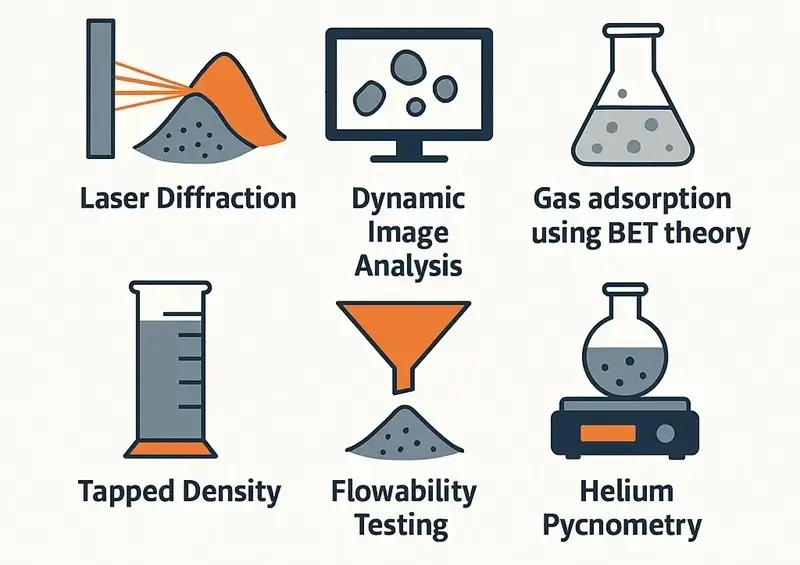
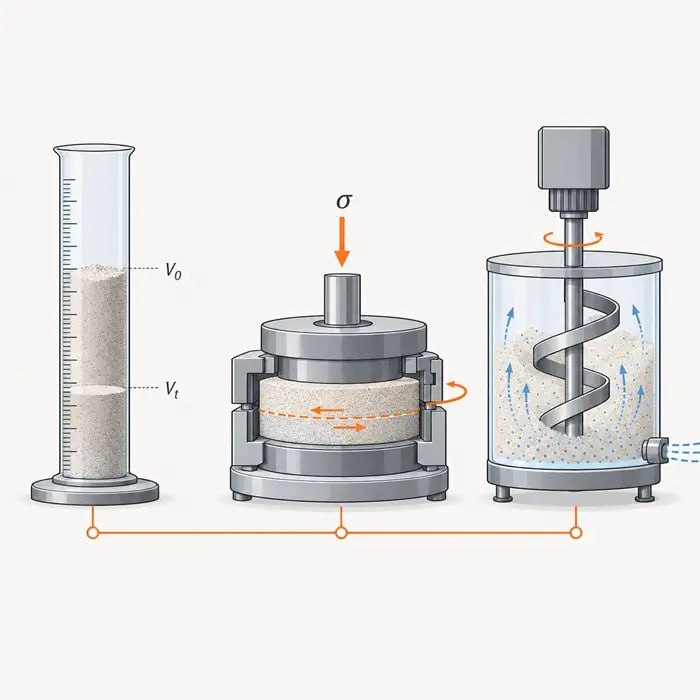
More formal measurements can still help when the cause remains unclear. Washburn-based capillary rise methods, contact angle data, dispersibility tests, and particle size checks can support the interpretation. They should not replace process understanding. They should confirm it.
For broader context on dispersion and powder testing, see Powder Dispersion and Data Interpretation and Powder Characterization Techniques.
From First Contact to Process Choice
Once the wetting limitation is understood, the process choice becomes more specific. A powder that mainly traps air may need slower addition, pre-wetting, vacuum deaeration, or a more open agglomerate structure. A hydrophobic surface may require a surfactant, a different liquid phase, or surface modification.
Addition order can also change the result. Some powders wet better when added gradually into a controlled vortex. Others perform better after dry blending with another component or pre-dispersion in a compatible liquid.
The central question is not how long the system should mix. It is whether the process gives the liquid a fair chance to enter the powder structure before clumps, floating layers, or dry cores form.
Controlled wetting gives dispersion a stable starting point. Poor wetting starts the process with trapped air, clumps, dry cores, and avoidable batch variation.