
🔑 Key Takeaway
SAE AIR7359 is an Aerospace Information Report that explains why certain metal powder feedstock characteristics are not controlled in AMS-AM specifications, citing reasons such as limited applicability across powders and processes and the immaturity of standardized inspection methods. It does not introduce new acceptance limits. In practice, a qualification program that chooses to control an excluded property should therefore build its own case: a documented method, demonstrated repeatability, and evidence that the property predicts a relevant process or part outcome.
Aerospace metal powder feedstock specifications do not try to control every property a lab can measure. SAE’s AMS framework for additive manufacturing separates alloy-specific powder requirements from requirements governing powder production and AM processing. AMS7002A, for example, defines process requirements for producing aerospace metal powder feedstock and is intended to be used alongside the applicable AMS powder specification. A newer SAE Aerospace Information Report, AIR7359, addresses a question qualification engineers ask often: why certain feedstock characteristics never made it into those requirements in the first place.
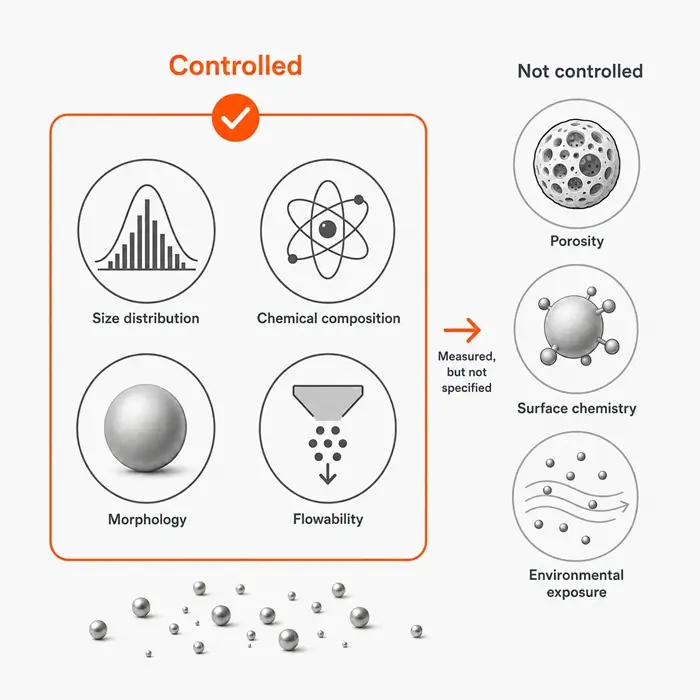
AIR7359 is described as a collection of explanatory notes rather than a new set of acceptance limits. Its stated purpose is to explain characteristics not controlled in AMS-AM powder feedstock specifications, and the rationale for leaving them out, citing reasons that include limited applicability across powder types and processes and the immaturity of standardized inspection techniques for a given property. For a program building or defending a metal powder feedstock qualification strategy, that distinction matters, because an excluded property is not automatically irrelevant.
An Information Report, Not a New Specification
Within SAE’s aerospace materials system, an Aerospace Information Report (AIR) carries different weight than an Aerospace Material Specification (AMS). An AMS document, such as the AMS7000-series powder feedstock specifications, states requirements a supplier’s material has to meet. An AIR is background and rationale: it explains why a family of specifications is structured a certain way, without itself imposing a pass or fail limit. AIR7359 fits this second category. Rather than repeating the same explanatory note inside every individual powder feedstock document, the report is meant to be referenced from multiple AMS-AM specifications so the reasoning behind exclusions stays consistent across the family.
The approach mirrors how metal powder feedstock quality is generally documented across an aerospace supply chain. A small set of controlled properties anchors the specification a supplier is measured against, while a wider set of characterization data supports interpretation of powder behavior without becoming a hard acceptance limit.
Why a Property Gets Left Out
Limited Applicability Across Powders and Processes
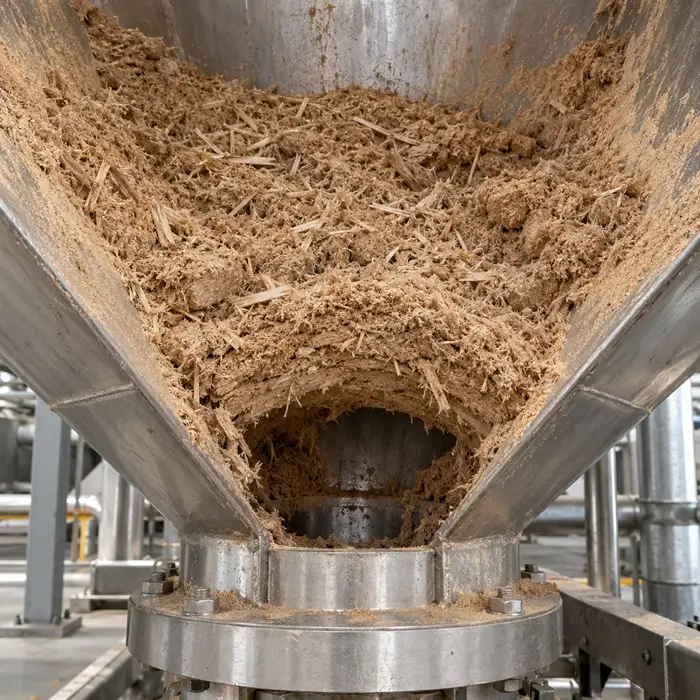
A property can behave differently depending on alloy system, particle size range, and the AM process the powder feeds. A morphology descriptor that helps predict spreading behavior in laser powder bed fusion does not necessarily predict flow through a hopper feeding directed energy deposition, and a moisture-sensitivity threshold established for one alloy chemistry does not automatically transfer to another. Writing a single numeric limit into a specification that spans multiple alloys and processes risks rejecting acceptable powder in one application while missing a real problem in another. AIR7359’s description of limited applicability points at this mismatch between a property’s diagnostic value in one context and the breadth of material and process combinations an AMS-AM specification is meant to cover.
Inspection Methods That Have Not Matured Into Standards
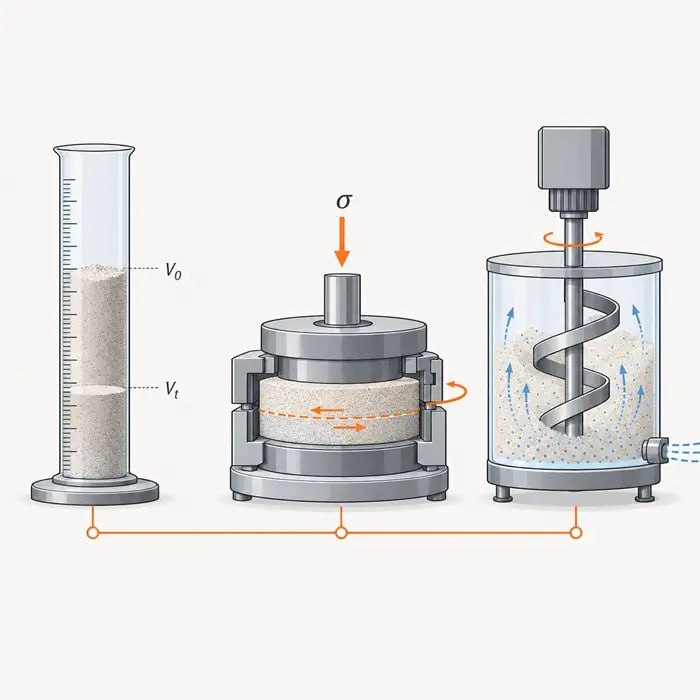
A specification limit is only as defensible as the method used to measure it. Several powder characteristics discussed in the additive manufacturing literature, including detailed particle morphology beyond basic sphericity, internal porosity within individual particles, and dynamic flow behavior under aeration, have measurement methods that are still converging on repeatable, cross-laboratory results. ASTM F3049, the guide most AM powder characterization programs draw on, was written explicitly as a starting point for future standard test methods rather than a finished set of them.
Separately, NIST’s published work on metal powder characterization highlights the need for standardized measurement methods capable of producing known and repeatable powder-property data.
Writing an acceptance limit around a method that has not cleared that bar creates disputes an AMS-AM specification is not built to settle, such as which laboratory’s result should be trusted and whether a supplier failure reflects the powder or the measurement.
What This Means for a Qualification Program
An excluded property is not resolved by AIR7359; it is handed back to whoever wants to control it. A qualification program that has observed a real link between a left-out characteristic, such as satellite content, internal porosity, or aerated flow behavior, and a specific process or part outcome can still add that property as a program-specific or purchase-order requirement. Doing so responsibly means recreating, at a smaller scale, the work an AMS-AM specification leaves to a mature standardized method once one exists.
That typically starts with documenting the exact test method and sample preparation used, since a property such as aerated flow energy can shift with how a sample is de-aerated and loaded before testing. It also means checking that the method repeats within and between operators before it is trusted to gate a lot, and being explicit about what the property is actually a proxy for rather than treating a passing result as proof the powder will process without incident. Programs such as aerospace PBF-LB qualification for virgin-to-reused powder blends already work through a version of this problem, since blend ratio limits are frequently set by internal program logic rather than a single harmonized AMS-AM value.
Before an excluded property becomes an internal acceptance criterion, four questions are worth answering in the qualification file. First, is there a documented, controlled test method behind the number, rather than an instrument’s default setting. Second, has repeatability and reproducibility been checked across the operators, instruments, or labs likely to run the test over the life of the program, an approach consistent with how shear cell testing programs typically validate a method before relying on it for lot release. Third, is there trial or field evidence that the property correlates with a specific process or part failure mode, rather than a general assumption that lower variability is always better. Fourth, is the numeric limit tied to that evidence, or copied from a different alloy, process, or supplier without confirming it applies here.