
Table of contents
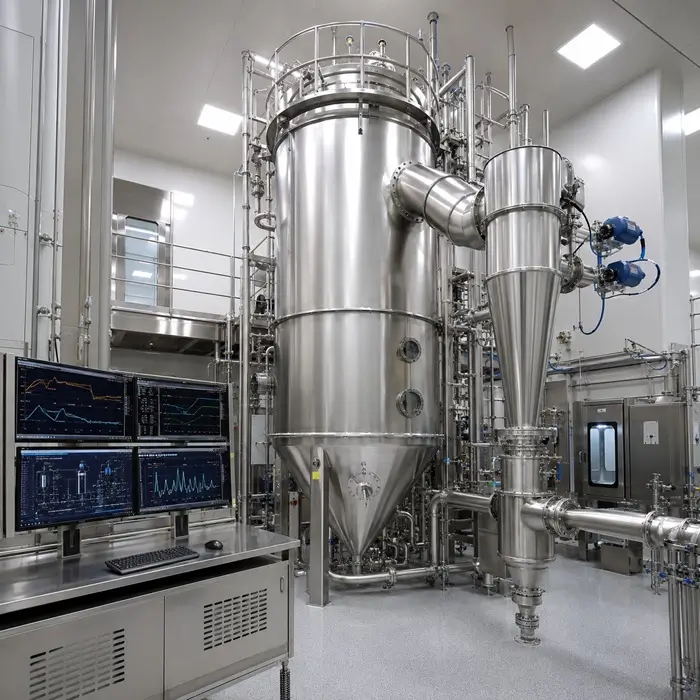
Spray drying is one of the most parameter-sensitive unit operations in pharmaceutical and food powder production. Small shifts in inlet temperature, atomization pressure, feed concentration, or ambient humidity propagate quickly into residual moisture, particle size, and morphology. Traditional PID control responds to these changes after the fact, and for operators managing narrow moisture specifications or heat-sensitive active ingredients, that lag has always been a liability.
The combination of process analytical technology and machine learning-based process models is now giving spray drying a more anticipatory control layer. How much that changes daily engineering reality versus how much remains vendor roadmap depends on where you look. This article separates what is industrially established from what is emerging, and identifies which powder quality parameters can be confirmed in-line versus which still require off-line methods before product can move.
Why Classical Spray Drying Control Has Always Been Reactive
In a conventional spray dryer, the outlet temperature thermocouple carries a disproportionate share of the process control burden. It is the primary feedback signal for residual moisture, and under stable conditions it works well enough. The relationship between outlet temperature and moisture content is predictable once calibrated, and PID control can hold temperature within a few degrees when nothing else is changing.
The limitation becomes visible when conditions shift. Ambient humidity changes between seasons, and sometimes between morning and afternoon in facilities without full inlet air dehumidification, directly affect the evaporative driving force. Atomization nozzle wear changes droplet size distributions gradually, and without a direct measurement, that change appears as unexplained moisture variability weeks after it begins.
What none of these classical loops can do is anticipate. PID control corrects deviations after they appear in the outlet temperature signal, by which point product that is off-specification may already be in the cyclone. The question modern real-time particle characterization and process monitoring approaches address is whether that lag can be shortened. Modern spray drying methods and their inherent limitations provide useful context on where the process operates at its boundaries.
What the FDA PAT Framework Actually Covers in a Spray Drying Context
The FDA PAT guidance, issued in 2004, describes a scientific, risk-based framework for pharmaceutical development, manufacturing, and quality assurance. Its core argument is that quality should be built into the product through process understanding rather than tested in at the end. For spray drying, that means identifying critical quality attributes of the output powder and the critical process parameters that control them, then monitoring both in real time.
For a typical spray-dried pharmaceutical powder, critical quality attributes include residual moisture, particle size distribution, bulk density, morphology, and, for amorphous solid dispersions, the degree of crystallinity. Critical process parameters include inlet temperature, outlet temperature, feed rate, atomization gas pressure or flow, and inlet humidity. No single sensor resolves the full quality picture, and that is where PAT and machine learning enter together.
The ICH Q10 Pharmaceutical Quality System guideline provides the broader quality management context in which PAT tools operate, emphasizing continual improvement through a defined state of control. The guideline supports real-time release testing as a long-term objective, but formal regulatory acceptance requires a validated design space and accepted submissions, not just sensor installation. The outlet temperature thermocouple and the inlet humidity sensor are already PAT tools by the framework’s definition: advanced PAT extends quality inference, it does not start it.
In-Line Measurement: What Is Confirmed, What Is Emerging, and What Remains Off-Line
Not all quality attributes in spray drying are equally accessible to in-line measurement. The current state of production-grade technology creates a clear hierarchy: residual moisture monitoring via NIR is mature, particle size trending via in-line laser diffraction is feasible with important interpretation caveats, and bulk density plus morphology remain off-line measurements.
| Powder quality attribute | Current in-line status | Practical production use | Still needs off-line confirmation? |
|---|---|---|---|
| Residual moisture | Mature via NIR when calibrated | Real-time monitoring, trend control, reduced sampling burden | Yes, for compendial or release confirmation |
| Particle size distribution | Feasible with caveats | Trend detection, nozzle wear monitoring, process drift detection | Yes, especially when release specs are based on off-line methods |
| Bulk density | Not production-ready in-line | Indirect process inference only | Yes |
| Morphology | Research or prototype stage | Off-line investigation of shape, collapse, dimpling, or agglomeration | Yes |
| Crystallinity | No release-grade production route during drying | Off-line confirmation for amorphous solid dispersions | Yes |
| Flowability | Not directly measurable from one process stream sensor | Requires interpretation from multiple powder properties | Yes |
Residual Moisture via NIR: The Strongest In-Line Case
Near-infrared spectroscopy is the most industrially mature in-line PAT tool for spray drying moisture monitoring. NIR probes positioned at the cyclone outlet or in a bypass sample loop provide continuous moisture readings without interrupting the process. Research on NIR characterization of spray-dried powders demonstrates that these methods can predict water content across a range of approximately 0.5 to 5% w/w when paired with appropriate chemometric calibration models.
A study on online NIR for secondary drying of a spray-dried solid dispersion intermediate demonstrated that in-process control testing could replace some off-line moisture checks and support a pathway toward real-time release. Calibration models must be built on representative samples, probe windows must stay clean in powder-laden streams, and models require revalidation when formulation or process conditions change.
For batch release, USP General Chapter 731 (Loss on Drying) or Karl Fischer titration remains the compendial reference method. In-line NIR reduces unplanned sampling frequency and narrows the window in which a moisture deviation can go undetected; it does not replace the release confirmation. The in-line signal also represents a bulk average and may not resolve localized moisture heterogeneity in specific size fractions.
Particle Size: In-Line Monitoring Is Possible, but Results Require a Bridging Study
A study specifically examining PAT applied to particle sizing in spray drying found that in-line laser diffraction can track size trends during a batch, but that median results are consistently higher than off-line results. Agglomerates in the product stream are measured as intact units in-line, whereas off-line dry dispersion methods break them apart. The guide to interpreting D10, D50, D90, and fines in process context covers the interpretive considerations when comparing methods, and the laser diffraction troubleshooting and pressure titration guide is relevant when designing a bridging study.
In-line particle size measurement is most useful as a trend indicator and early-warning signal for nozzle wear or feed concentration drift, not as a direct substitute for the off-line characterization against which the release specification is defined. A bridging study characterizing the relationship between in-line and off-line results for a specific formulation and dryer is required before the in-line result can carry any release-relevant function. Probe fouling and signal saturation at high solids loadings near the cyclone outlet make at-line configurations more reliable than true in-line placement in some GMP environments.
Bulk Density and Morphology: No Production-Ready In-Line Route Yet
Bulk density is not currently measurable in-line during spray drying production. It depends on particle shape, surface roughness, size distribution, and packing conditions imposed during measurement, none of which can be inferred from a single process stream sensor. As discussed in the context of bulk density as a powder quality indicator, real-time inference from process signals is not yet industrially validated.
Morphology faces a similar gap. Spray-dried particles can be spherical, dimpled, collapsed, or toroidal depending on drying kinetics at the droplet surface, and those shape differences affect flowability, dispersibility, and dissolution rate. Dynamic image analysis or SEM can characterize morphology off-line, but real-time morphology monitoring during production remains a research-stage capability. In-line PAT therefore provides process control information about moisture and particle size trends without eliminating the off-line test panel required for batch release.
Machine Learning in Spray Drying Control: What the Models Actually Do
Machine learning enters spray drying control through three main pathways: soft sensors that infer quality attributes from process variables, predictive control models that improve response to disturbances, and yield prediction models that estimate batch recovery before the run is complete. Each has a distinct capability boundary.
Soft Sensors: Inferring Quality from Process Variables
A soft sensor is a predictive model that estimates a quality attribute from process variables that are easier to measure in real time. In spray drying, the classic soft sensor uses inlet temperature, outlet temperature, feed rate, and inlet humidity to infer residual moisture, either when an NIR probe is not available or as a cross-check alongside one. The practical requirement is a well-populated historical dataset from the same dryer and formulation, with confirmed off-line quality measurements paired to each run.
More complex algorithms including random forests and neural networks can capture nonlinear relationships between process variables, but the corresponding risk is overfitting on a limited training dataset. A model trained during summer operations may not perform reliably through a winter campaign if building humidity control changes significantly. The distinction between a productive digital process tool and an underutilized investment comes down to whether the model maintenance workflow exists before deployment: a model without an active maintenance plan is an experiment, not a production tool.
Feedforward and Feedback Control: Where Machine Learning Adds Genuine Value
Feedback control in spray drying responds to deviations detected by in-line sensors. A machine learning layer can improve the feedback response by predicting how a given control action will affect output quality, rather than relying on fixed PID gain parameters tuned at commissioning. This is most relevant in processes with significant dead time, where the lag between a control action and its measurable effect is long enough that PID overshoot becomes persistent.
Feedforward control is where the performance case for machine learning in spray drying is more consistently supported. If ambient humidity and feed properties are known at batch start, a trained model can preset inlet temperature and atomization parameters closer to the target operating point than the previous batch’s endpoint settings, reducing start-up waste. The most accessible feedforward application, ambient humidity compensation, can often be achieved with a simple empirical correction curve rather than a machine learning model. ML adds value when multiple interacting variables must be balanced simultaneously and when the relationships are nonlinear enough that a fixed correction curve loses accuracy.
Yield Prediction: Genuine Capability with Real Constraints
Yield prediction models estimate the fraction of feed material recovered as finished powder before a batch is complete. For pharmaceutical spray drying with high-cost active ingredients, models trained on process data can track the evolving mass balance and flag early if the trajectory suggests recovery will fall below specification.
The constraint is that yield is sensitive to wall deposition, which depends on particle stickiness, surface energy, and dryer wall temperature gradients that are not uniformly instrumented in production equipment. Models that do not account for wall deposition accurately tend to underestimate yield losses in formulations with high residual amorphous content. A model trained on a pilot-scale dryer will not transfer directly to production scale without retraining, because drying kinetics, wall residence time, and cyclone efficiency all scale differently. Evaluating a model across the formulation range and scale range where it will actually be used is a prerequisite before treating it as a production tool.
What Engineers Actually Gain from Integrated PAT and AI Control
The measurable operational gains from well-implemented spray drying PAT and AI process control cluster around four areas. First, reduced moisture variability at the specification limit: when outlet temperature is the only control variable, the operating point must be set conservatively, which means the dryer often runs drier than necessary. In-line NIR with closed-loop moisture control allows the operating point to move closer to the specification boundary, reducing thermal exposure for heat-sensitive molecules and sometimes enabling a lower inlet temperature.
Second, faster recovery from process disturbances: a feedforward model that reads the ambient humidity signal and adjusts inlet temperature proactively narrows the excursion window that a traditional PID loop would allow. Third, continuous process data from PAT sensors provides a higher-resolution record for process understanding work, making it easier to identify the root cause of batch-to-batch variability without a dedicated experimental campaign. Fourth, start-up and shutdown efficiency: a control model that has learned the optimal ramp profile for a given formulation can reduce time spent transitioning through the operating window, where a significant fraction of spray drying yield losses originate.
What remains vendor positioning rather than industrially validated capability includes real-time bulk density prediction from process signals, real-time morphology classification during production, and fully autonomous self-optimizing control without operator oversight. These capabilities exist at research or prototype scale but are not yet available as GMP-qualified production tools. For engineers evaluating investments in spray drying PAT and AI control, the questions that determine whether the technology delivers operational value are whether the calibration and validation burden has been accounted for, whether model maintenance is resourced, and whether the process understanding required to build the control model is already available or still needs to be developed.
The Off-Line Gap: Which Parameters Still Require Lab Confirmation
Even in a fully instrumented spray drying line with NIR moisture monitoring, in-line particle size trending, and ML-based temperature control, the off-line test panel for pharmaceutical products is not replaced. Batch release requires confirmation of residual moisture by a compendial method, particle size distribution by a calibrated off-line instrument, tapped and bulk density, and dissolution testing where specified. The factors governing powder flowability cannot be inferred from a single process stream sensor: a batch that passed the in-line moisture specification could still present marginal flowability if morphology shifted in a way the temperature and humidity sensors did not flag.
For amorphous solid dispersions, crystallinity testing by X-ray powder diffraction is a critical off-line confirmation with no in-line production equivalent. The amorphous form of many active ingredients has higher apparent solubility than the crystalline form, and partial recrystallization during or after drying directly affects bioavailability. No current production PAT tool can confirm crystalline phase content during drying with the sensitivity required for batch release.
The regulatory pathway toward real-time release testing under ICH Q8 and Q10 exists, but it requires a formally validated design space and accepted regulatory submissions. Powder data lineage becomes increasingly important as PAT generates richer continuous records: the traceability of model outputs, calibration state, and version history is part of the quality record in a GMP environment. The powder release protocol in a PAT environment must define which measurements came from validated in-line tools and which from off-line confirmation, and what happens when those two sources disagree.
Before investing in spray drying PAT or AI control, check:
| Question | Why it matters |
|---|---|
| Which quality attribute is the system actually measuring? | Moisture, particle size, morphology, and density are not interchangeable. |
| Is the model formulation-specific or transferable? | Many models fail when formulation, season, scale, or feed properties change. |
| What is the off-line reference method? | In-line data only becomes useful when linked to a trusted reference. |
| What triggers recalibration or revalidation? | PAT systems drift if model maintenance is not built into the workflow. |
| Who acts on the data? | A sensor without action limits is only a display. |
| Does the data support release, control, or investigation? | These are different regulatory and operational roles. |
Implementation Considerations for Pharmaceutical and Food Environments
In pharmaceutical environments, every PAT sensor or software model that contributes to a process control or release decision requires formal qualification. Chemometric models used for NIR moisture calibration require analytical method validation covering the range of materials, concentrations, and process conditions the model will encounter. Revalidation must be triggered when boundary conditions change through a formulation update, a dryer modification, or a confirmed shift in incoming raw material properties. Data integrity requirements apply to the continuous data streams PAT systems generate: electronic records from in-line sensors fall within the scope of 21 CFR Part 11 in the US and Annex 11 under EU GMP, and that architecture must be designed before sensor deployment, not retrofitted afterward.
In food powder production, the regulatory framework differs from pharmaceutical GMP, but the technical challenges of calibration model maintenance, probe fouling, and data workflow are largely the same. NIR moisture monitoring is more widely adopted in food spray drying partly because calibration models are often simpler and the consequences of a model failure are less immediately severe. For moisture-sensitive food powders, the interaction between dew point, water activity, and caking risk remains a relevant design input even when NIR is providing real-time feedback. For specialty applications involving submicron or encapsulated particles, nano and submicron spray drying approaches introduce additional measurement complexity that current in-line tools are not fully equipped to address.
The most common implementation failure in spray drying PAT has nothing to do with sensor technology. It is in the data workflow. A well-positioned NIR probe generating moisture readings every few seconds produces a data stream that requires defined action criteria, archiving procedures, and operator response protocols. If those criteria are not established before commissioning, the sensor functions as a display rather than a control tool, and the process improvement case never materializes.
The Practical Boundary: Control Improves Before Release Changes
The strongest case for PAT and machine learning in spray drying is that they reduce the need for, but do not completely eliminate, conventional testing. It is that they reduce the distance between process change and process response. A dryer that only reacts through outlet temperature control can still produce acceptable batches, but it often does so with conservative settings, delayed correction, and limited visibility into why variability occurred.
In-line NIR, particle size trending, humidity compensation, and predictive control models give engineers a more detailed view of the drying window. They can help reduce moisture excursions, shorten start-up losses, identify nozzle or feed drift earlier, and support better process understanding over multiple campaigns. That is already valuable, especially for high-value pharmaceutical powders and moisture-sensitive food powders.
The boundary is equally important. Spray drying still produces powder attributes that cannot be fully verified from the process stream. Bulk density, morphology, crystallinity, dissolution behavior, and flowability remain dependent on laboratory confirmation and material-specific interpretation. Machine learning can improve prediction and control, but it does not remove the need to understand which powder property is actually being measured, which is being inferred, and which still has to be confirmed off-line.
For engineers evaluating AI-enabled spray drying control, the practical question is therefore not whether the system is “smart.” The better questions are whether the system reduces a known process risk, whether the calibration and validation burden is realistic, and whether the resulting data can support better decisions within the existing quality framework.
FAQ: Spray Drying 4.0: Real-Time PAT, AI Process Control, and What Engineers Actually Gain
Sources and Further Reading
Regulatory and quality framework
- FDA, PAT: A Framework for Innovative Pharmaceutical Development, Manufacturing, and Quality Assurance. This guidance defines the PAT framework used for real-time process understanding and control in pharmaceutical manufacturing.
- ICH Q8(R2), Pharmaceutical Development. This guideline supports the discussion of design space, process understanding, and flexible regulatory approaches based on manufacturing science.
- ICH Q10, Pharmaceutical Quality System. This guideline provides the quality-system context for continual improvement, process control, and lifecycle management.
- FDA, Development and Submission of Near Infrared Analytical Procedures. This guidance is relevant to NIR model development, validation, chemometric model documentation, and regulatory submission expectations.
- ICH Q2(R2), Validation of Analytical Procedures. This guideline supports the discussion of analytical method validation for procedures used in registration, release, and control strategies.
- USP General Chapter <731>, Loss on Drying. This chapter is relevant to the discussion of off-line moisture confirmation and compendial reference testing.
- Electronic Code of Federal Regulations, 21 CFR Part 11, Electronic Records; Electronic Signatures. This regulation is relevant to electronic records, audit trails, and data integrity for PAT-generated process records in FDA-regulated environments.
- European Commission, EU GMP Annex 11, Computerised Systems. This annex is relevant to computerised systems used in GMP activities, including validated software, data integrity, and system lifecycle control.
Spray drying, NIR, and particle-size monitoring
- Ikeda et al., Application of Online NIR Spectroscopy to Enhance Process Understanding and Enable In-process Control Testing of Secondary Drying Process for a Spray-dried Solid Dispersion Intermediate. This study supports the discussion of online NIR for spray-dried pharmaceutical intermediates and in-process control testing.
- Tu et al., Characterizing Spray-Dried Powders through NIR Spectroscopy: Effect of Two Preparation Strategies for Calibration Samples and Comparison of Two Types of NIR Spectrometers. This paper supports the discussion of NIR calibration strategies for spray-dried powders.
- Chan et al., Process Analytical Technology: Application to Particle Sizing in Spray Drying. This paper supports the article’s point that in-line and at-line laser diffraction can be useful in spray drying, but that interpretation must account for agglomeration and method differences.
- Medendorp et al., Development and Beyond: Strategy for Long-term Maintenance of an Online Laser Diffraction Particle Size Method in a Spray Drying Manufacturing Process. This paper supports the discussion of online laser diffraction as a process diagnostic tool and the need for lifecycle maintenance of the method.
- Frank et al., Development of In-Line Measurement Techniques for the Monitoring of Spray Drying and Integrated Agglomeration Processes. This paper is useful for the food-powder and agglomeration angle, especially around in-line moisture and particle-size monitoring.