
🔑 Key Takeaway
FDA’s proposed hub-and-spoke rule changes how distributed drug manufacturing establishments register, not how blend uniformity, granulation endpoints, or moisture behavior are controlled. The rule requires distributed manufacturing units to remain equivalent in design and operation, but demonstrating that equivalence in powder behavior terms is left to the sponsor’s quality system. Registration status and process comparability are two different questions, and only the second one is a powder engineering problem.
Table of contents

On July 13, 2026, the FDA published a proposed rule that would let a distributed manufacturing establishment register as a single drug manufacturing establishment, instead of filing a separate registration for every physical location where product is actually made. The proposal describes a hub-and-spoke structure: a management and quality unit based at a central hub, and one or more distributed manufacturing units, or DMUs, operating as the spokes. The comment period runs until September 11, 2026, and the rule has not been finalized.
The regulatory mechanics are administrative. What has drawn more attention from process engineers is a single phrase buried in the eligibility criteria: DMUs must be demonstrated to remain equivalent in design and operation at any location, while manufacturing the same drug or drugs under one unified pharmaceutical quality system. Registration paperwork can be consolidated relatively easily. Proving that two or more physically separate blending, granulation, and drying operations behave the same way, and keep behaving the same way, is a different kind of problem, and it is fundamentally a powder behavior problem before it is a compliance problem.
This article looks at what that equivalence requirement implies for blend uniformity control, granulation endpoint verification, and moisture consistency checks when the same formulation is run at more than one site. FDA has indicated that separate cGMP guidance for distributed manufacturing is still to come, so the process-level expectations below are engineering interpretation of what proving equivalence will realistically require, not a summary of confirmed FDA testing mandates.
What the Hub-and-Spoke Rule Actually Changes
Under current practice, each physical manufacturing location generally registers separately with FDA, even when it is part of the same corporate network making the same product. The proposed rule would allow a distributed manufacturing establishment to register as one establishment, with individual DMUs added, relocated, or removed through a streamlined update process rather than a fresh registration each time. The proposal still requires an identifier and location information for every DMU, including advance notice before a unit relocates.
To qualify, the DMUs need to operate under a single management structure, manufacture the same drug or drugs, and be shown to remain equivalent in design and operation regardless of location. Oversight sits with a quality unit based at the hub, which implements what the rule calls a unified pharmaceutical quality system across every spoke. In effect, the rule recognizes a manufacturing topology that already exists in some modular and portable manufacturing setups, and gives it a registration pathway that matches how the operation actually runs.
It is worth being precise about scope here. The proposal is a registration and listing rule. It does not itself define blend uniformity acceptance criteria, granulation endpoint criteria, or moisture specifications for distributed manufacturing, and FDA has signaled that cGMP-specific guidance for this manufacturing model will follow separately. What the rule does establish is a formal, register-level expectation that DMUs stay equivalent in design and operation. Demonstrating that, and keeping it demonstrated over the life of the registration, is where the powder engineering work sits.
Equivalence in Design Is Not the Same as Equivalence in Powder Behavior
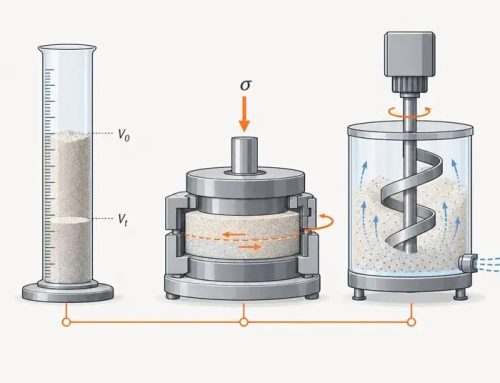
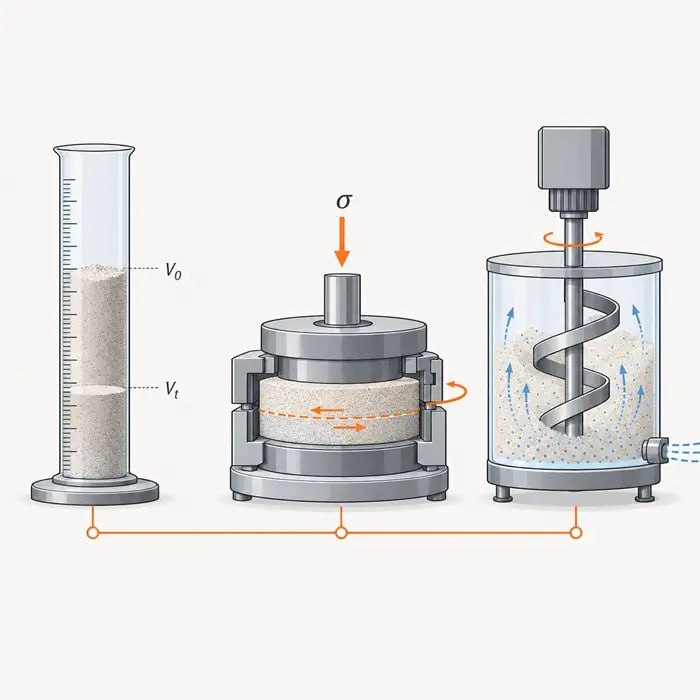
Two DMUs can run the same formulation, the same nominal equipment model, and the same written procedure, and still produce a blend, granule, or dried powder that behaves differently. Bulk powder behavior depends on how particles pack and transmit force through the contact network within the bed, not only on particle size and composition, and that network structure is sensitive to factors that a design specification does not fully capture, including fill history, vibration during transport to the site, and local handling sequence, as discussed in why bulk powder behavior depends on contact networks.
Several of the variables that separate nominally equivalent DMUs are ordinary process variables that happen to differ by geography rather than by design: incoming raw material lots sourced or blended differently per site, ambient humidity and seasonal climate at each location, equipment wear that accumulates independently once two identical machines start running separate production histories, and differences in conveying line length, bend count, or discharge chute angle even when the blender or granulator model is identical. None of these show up as a design nonconformance. All of them can shift how the powder actually flows, blends, or granulates.
This is a familiar pattern from single-site process transfer, where a formulation that runs acceptably in one process configuration can still fail once moved to a nominally similar but not identical configuration, as covered in why a good powder fails in the wrong process. Distributed manufacturing under a single registration multiplies that transfer risk across two or more concurrently qualified units instead of a single one-time changeover, and it does so continuously rather than as a one-off event.
Blend Uniformity Verification When Blending Happens at More Than One Site
Blend uniformity testing exists to catch a specific failure mode: a mixture that looks homogeneous in bulk but contains local pockets of drug substance or excipient concentration that fall outside the intended range. ASTM E2810 describes a stratified sampling practice for demonstrating capability to comply with uniformity testing, and the same stratified logic, deliberately sampling from multiple locations and phases of the process rather than relying on a single composite sample, applies whether the blend is made at one site or several. What changes in a hub-and-spoke setup is that the sampling plan now has to answer a comparative question as well as an absolute one: does each DMU’s blend meet the uniformity target, and does it meet that target the same way as the other DMUs.
Blend uniformity at the mixing step is a different question from finished-dose content uniformity, which USP General Chapter 905 addresses at the level of the individual dosage unit. A DMU can pass content uniformity on finished units while still carrying a segregation tendency upstream that a stratified blend sample would catch earlier and more directly. That distinction matters more in a distributed setup, because a downstream content uniformity result at one spoke does not confirm that the blending step at a different spoke is behaving the same way.
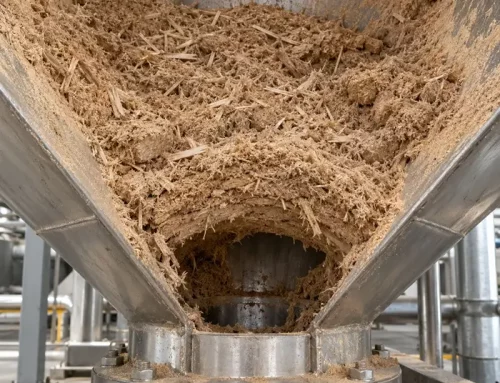
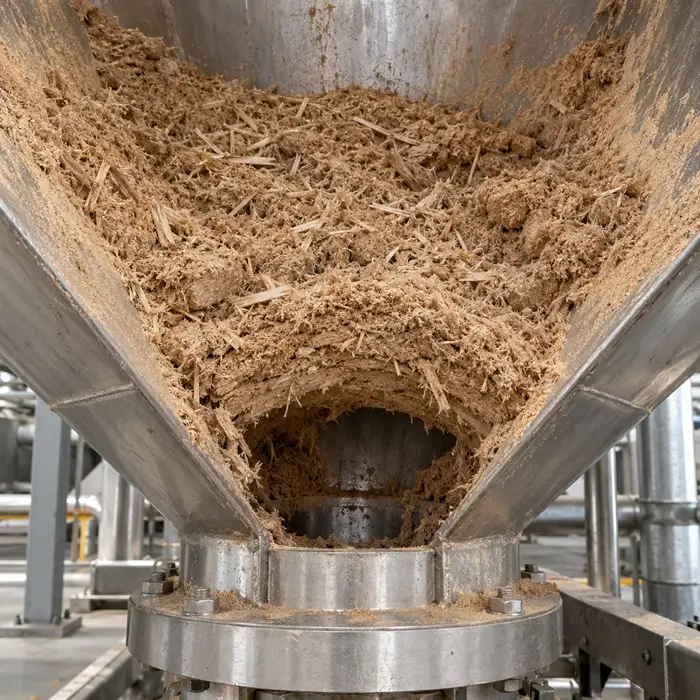
Segregation is the mechanism most likely to differ between otherwise matched DMUs, because it depends heavily on how material moves after blending, not just on the blender itself. Transfer distance, discharge chute geometry, and the number of direction changes between the blender and the next unit operation all influence segregation risk, and none of these are guaranteed to be identical between two spokes even when the blender model is, as discussed in powder segregation diagnosis during mixing, conveying, and filling and segregation mechanisms and prevention in blending and transport. A quick comparative check such as the 20 minute bottle segregation test is a useful low-cost screening step for flagging a spoke whose material transfer path behaves differently before it shows up in a formal blend uniformity failure.
Granulation Endpoint Verification Across Physically Separate Equipment
A granulation endpoint is defined functionally, by the target granule attributes it is meant to produce, not by a fixed process time. Two granulators of the same nominal design can reach a visually similar processing time while producing granules with different density, strength, or size distribution, because the endpoint is governed by how the powder bed actually responds to shear, moisture addition, and impeller or fluidizing air energy, not by the clock. Roller compaction work has shown that the same nominal roll force can produce ribbons with different solid fraction depending on feed behavior and gap control, illustrating how sensitive a granulation-type endpoint is to conditions that a written setpoint does not fully constrain, as described in roller compaction ribbon solid fraction.
In-process monitoring signals such as power or torque consumption, and increasingly particle-level process analytical technology, give a more direct read on the endpoint than elapsed time alone, as discussed in real-time particle characterization and process control. For a distributed manufacturing establishment, the practical question is whether the same monitoring signal and the same trigger threshold transfer cleanly between two physically distinct pieces of equipment. A power consumption curve calibrated on one granulator is a decision input for confirming endpoint equivalence at a second unit; it is not, by itself, proof that the two units are producing equivalent granules, because impeller wear, fill level, and blade clearance can all shift the absolute signal even when the relative endpoint behavior is similar.
Downstream flow behavior of the granulated material offers a complementary check. Dynamic and aerated flow testing captures how a powder behaves under conditions closer to actual processing than a static bulk density or Hausner ratio measurement, and comparing that flow energy profile between DMUs producing the same granulation gives an additional, independent line of evidence for equivalence beyond the granulation signal itself, as outlined in dynamic and aerated powder testing.
Moisture Consistency Between Sites
Moisture-related risk in distributed manufacturing involves three distinct kinds of quantity that are easy to blur together but should be tracked separately. In-process moisture content of the powder at a given point in the process is a state variable. The critical relative humidity or moisture sorption behavior of the formulation is a material property, generally consistent across sites because it depends on the formulation rather than the location. Local relative humidity and dew point inside a given DMU’s processing room are environmental conditions, and these can differ meaningfully between geographically separated spokes even under nominally matched HVAC specifications, particularly in climates with different seasonal humidity swings.
A bulk average in-process moisture reading that matches the target at both DMUs does not confirm that local environmental conditions at each site stay below the material’s caking or stability threshold throughout handling and storage, since an average measurement can mask local variation that a spot environmental reading would catch. Distinguishing dew point control from water activity control, and understanding what each one actually measures, matters more once two sites are expected to reach the same practical outcome by potentially different environmental control strategies, as covered in dew point vs water activity in powder processing and moisture control for powders.
Because moisture sensitivity interacts with caking risk, cohesion, and flow behavior simultaneously, a moisture consistency check between DMUs is best treated as one input into a broader comparability assessment rather than a standalone pass or fail criterion, an approach discussed in more general terms in water activity in powders: why moisture content misleads.
What a Unified Quality System Needs From Powder Testing Data
A unified pharmaceutical quality system spanning a hub and several DMUs has to make an ongoing comparability argument, not a one-time qualification argument. Flow function and shear cell data, gathered at each DMU at qualification and repeated periodically rather than once, gives an objective basis for tracking whether two units are drifting apart in bulk behavior over time, as described in shear cell testing: the key to understanding and controlling powder flow. Simpler indices such as the Hausner ratio can flag a change worth investigating, but they compress a great deal of flow behavior into a single number and should not be treated as a substitute for shear cell characterization when the equivalence claim is a formal one, a limitation discussed in Hausner ratio and Carr index: what the numbers tell you and where they break down.
Particle size distribution comparisons between DMUs, read in process context rather than as a single pass or fail spec, add another independent line of evidence, particularly for catching a fines or oversize drift that would not necessarily show up in a bulk density check, as outlined in particle size distribution interpretation. None of these measurements alone proves that two DMUs are equivalent in the sense the proposed rule requires. Each is a decision input, and the case for equivalence is built from agreement across several of them rather than from any single test result.
ICH Q13 already establishes precedent for building a control strategy that supports equivalence and comparability claims, in that case for continuous manufacturing rather than hub-and-spoke distributed manufacturing specifically, and the ICH Q13 guideline on continuous manufacturing of drug substances and drug products is a useful reference point for how a control-strategy-based comparability argument is typically structured, even though it does not govern the hub-and-spoke model directly.
Where internal comparison data across DMUs is limited, particularly during initial equivalence qualification, independent bulk solids testing can provide a shared reference measurement across sites. Laboratories such as Delft Solids Solutions can support that comparison where the required testing is not available in-house.
Building the Equivalence File Before It Is Requested
The proposed rule is not final, and FDA has not yet published the promised cGMP-specific guidance for distributed manufacturing, so no acceptance criteria for blend uniformity, granulation endpoint agreement, or moisture consistency between DMUs currently exist in a form that can be cited as a requirement. What sponsors preparing for a hub-and-spoke registration can reasonably do now is build the comparability evidence base ahead of the requirement rather than after it: stratified blend uniformity sampling at each DMU rather than at a single representative site, in-process granulation monitoring data collected in a form that can be compared across units rather than only judged against a single site’s historical range, shear cell and particle size data gathered at each DMU on a repeating schedule rather than once at qualification, and environmental humidity and dew point logging kept separate from in-process moisture readings so the two do not get conflated when a deviation investigation eventually asks which one moved first.
The registration change itself is close to a formality once a DME meets the eligibility criteria. The harder, and more useful, work is the same work that has always underpinned reliable process transfer: characterizing how the powder actually behaves at each location, not just confirming that the equipment and the paperwork match.