
Table of contents: real-time particle characterization
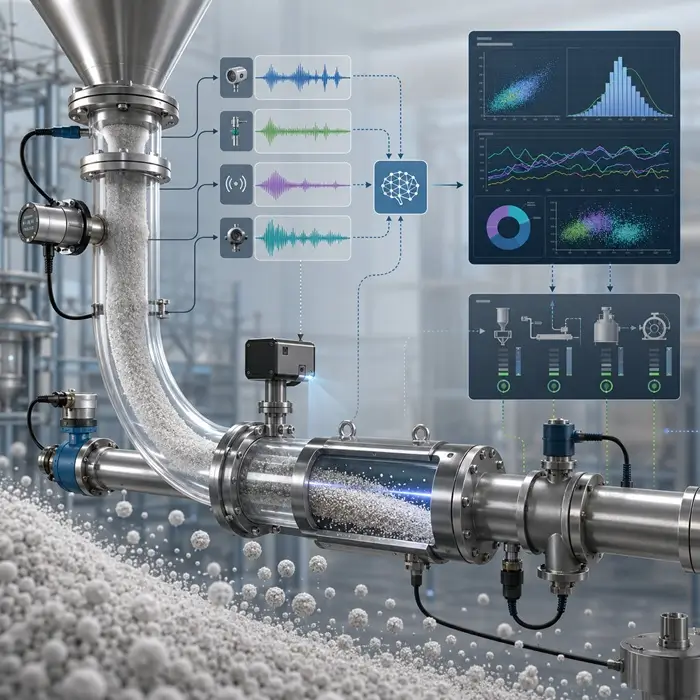
Real-time particle characterization is changing how powder processes are monitored and controlled. Inline sensors, soft sensors, hybrid models, and digital twins now help engineers connect particle-scale behavior to process decisions while production is still running.
The practical value does not come from data collection alone. It comes from interpreting sensor signals in a way that supports process control, quality decisions, and troubleshooting.
Why Real-Time Particle Characterization Matters
Take a sample. Send it to the lab. Sieve it, measure it, wait for the result, and then adjust the process based on data from material that has already moved through the line. In many plants, that remains the operating reality. The problem is clear. By the time the result comes back, the deviation has already happened. The process is being corrected after the fact. Powder characterization still provides the foundation for reliable process decisions. However, real-time particle characterization shortens the delay between material behavior and process action.
Pressure drop, vibration, acoustic emission, image data, thermal data, and flow signals can help engineers understand what is happening while the process is still running. In some cases, these signals can also be linked to particle-scale mechanisms. That makes them useful for monitoring, troubleshooting, and eventually process control.
Why Offline Testing Creates a Control Delay
Offline particle testing still matters. It provides validation, method comparison, reference data, and detailed investigation. No serious process team should remove laboratory testing from the quality system.
However, offline testing creates a timing problem. Sampling, preparation, measurement, review, and correction all take time. During that time, the process continues.
A laboratory result may confirm that a deviation occurred. A real-time sensor can show that the deviation is developing. A hybrid model can estimate which particle-level mechanism is driving it.
This changes the role of characterization. Measurement no longer confirms quality only after production has moved on. It starts to support live decisions about correction, control, and process stability.
What Changed in Process Measurement Over the Last Decade?
The main change over the last decade is practical. Particle measurement has moved closer to the process decision.
Traditional characterization separates the measurement from the line. Inline and online systems reduce that separation by placing measurement directly into the production environment.
That is why conveyor-based granule measurement in steel sintering, online particle sizing in dry process lines, and process-connected particle analysis in milling or classification matter. They change when information becomes available.
The technical value sits in the shorter feedback loop between process behavior, measurement, interpretation, and action.
Inline Sensors Move Measurement Closer to the Decision
Inline particle size measurement has moved from niche use to serious industrial adoption in selected high-value processes.
JFE Steel’s online granule measurement system is a useful example. It measures granule size distribution on moving conveyors in sintering operations using lasers and cameras above the belt [4].
The measurement matters because granule size distribution becomes visible while it can still support decisions about productivity, permeability, and bed stability.
Online particle size analyzers follow the same logic. Bettersize Instruments describes the BT-Online1 as an online particle size analyzer for dry process lines and continuous particle size monitoring [1].
These systems do not remove the need for laboratory validation. They reduce the gap between process behavior and measurement feedback.
Soft Sensors Estimate What Cannot Be Measured Directly
Some particle properties cannot be measured directly, continuously, or economically during production. In those cases, a soft sensor can estimate the hidden variable from available process data.
Wet bead milling for long-acting injectable nanosuspensions shows the principle. Gudena and co-workers developed a model-based soft sensor that forecasts particle size distribution from process parameters such as agitator speed and inlet and outlet temperatures [5].
The important point is that particle size distribution becomes part of the live process model.
That changes the role of process data. Temperature, torque, speed, pressure, flow, and other variables can help estimate a particle-level state that would otherwise arrive too late.
Sensor Fusion Makes Hidden Process States More Visible
Many powder and particle processes cannot be understood through one signal. A pressure sensor may show instability. A camera may show surface or shape changes. Acoustic emission may carry information about particle impacts. Thermal imaging may reveal heat transfer, melt behavior, or drying effects.
Sensor fusion combines these signals. The goal is useful interpretation, not more data for its own sake.
In robotic laser-directed energy deposition, Chen and colleagues fused data from a coaxial melt pool camera, microphone, infrared thermal camera, and robot motion to predict local quality in the deposited part [3].
That type of approach matters because powder processes are often only partly observable. Multiple weak signals can become useful when they are interpreted together.
Why Hybrid Modeling Is the Real Bridge
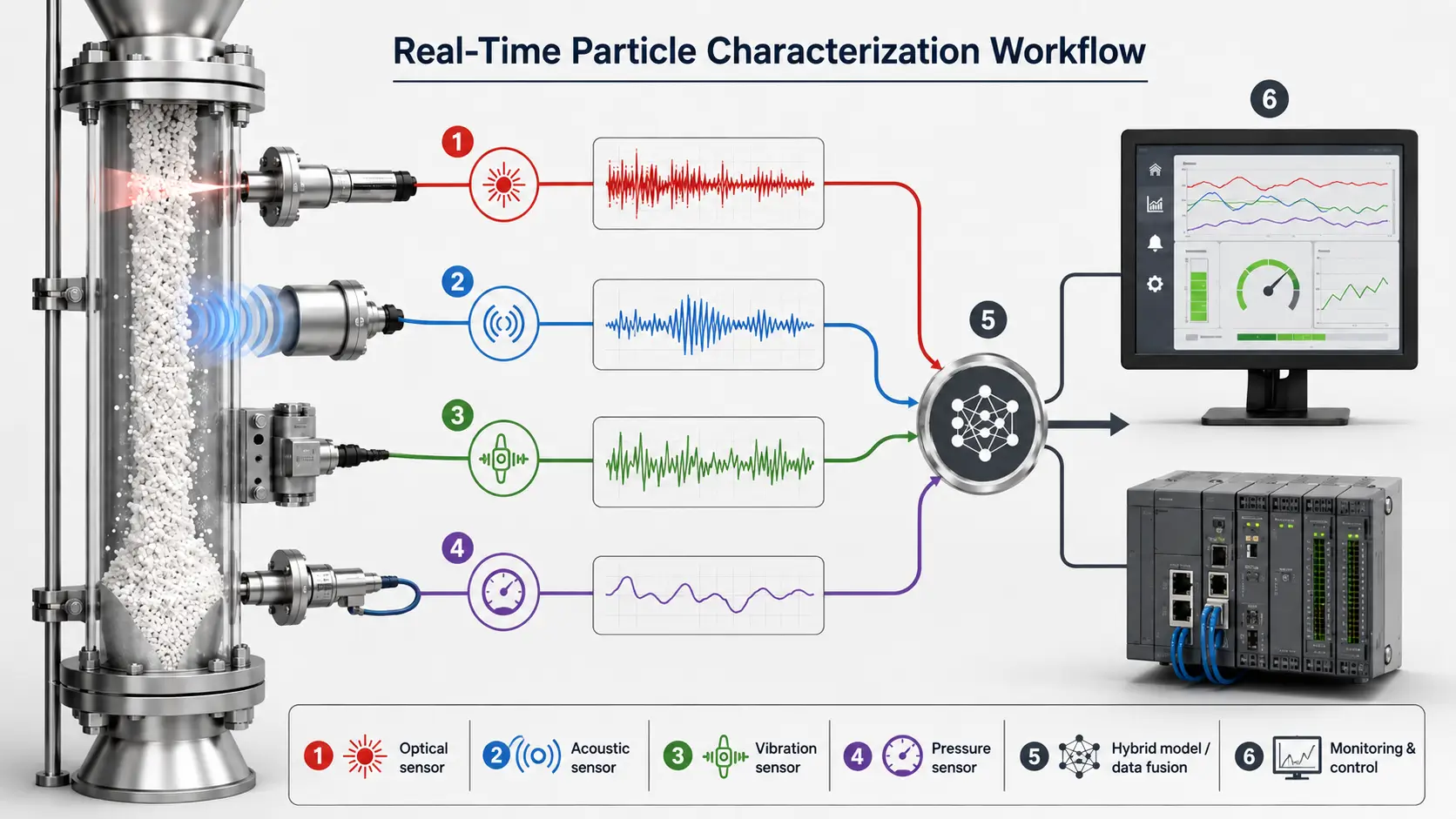
Hybrid modeling is the mechanism that makes real-time particle characterization useful for control.
A sensor measures a signal. That signal may be optical intensity, sound, vibration, pressure drop, temperature, torque, image texture, or flow response. The signal is not the particle property itself. It is a process signature.
A microphone does not directly measure particle size. A vibration signal does not directly measure flow stability. A pressure fluctuation does not automatically identify concentration, permeability, air retention, blockage formation, or feeder instability.
The engineering value lies in the translation step. A pressure fluctuation, acoustic shift, vibration pattern, or thermal anomaly becomes useful when it can be connected to a likely mechanism and a clear control action.
To turn that signature into particle size, concentration, flow state, defect risk, or process stability, the system needs interpretation. Hybrid models provide that bridge by combining physical understanding with data-driven prediction.
Why Pure Data Models Are Not Enough
Purely empirical models can help when the process stays inside a familiar operating window. They learn relationships between input data and measured outcomes.
Powder processes rarely stay perfectly stable. Raw material changes, moisture shifts, equipment wears, batches vary, and operating conditions drift.
A model trained only on historical correlations may perform well during validation and poorly when the process moves into a less familiar region.
That is a serious limitation. The model may still produce confident predictions, even when the underlying process mechanism has changed.
Why Pure Physics Models Are Difficult to Use in Real Time
Pure physics-based models have the opposite problem. They can describe mechanisms with greater transparency, but they are often too slow or too simplified for direct real-time use.
A detailed DEM simulation, CFD model, population balance model, or powder bed fusion simulation can reveal important behavior. However, it may not run fast enough to support live control.
It may also need material properties that are difficult to measure continuously. Particle shape, cohesion, restitution, surface state, moisture sensitivity, and packing behavior can all affect the model.
Therefore, physics alone rarely solves the real-time control problem.
How Hybrid Models Improve Interpretation
Hybrid models sit between these limits. They use physical understanding to guide the data-driven model.
The physics may appear as constraints, model structure, simulated training data, feature selection, correction factors, or mechanistic submodels.
This reduces the risk that the model becomes a black box that only works under narrow conditions. It also helps the system judge whether a predicted state is physically plausible.
That matters in powder processing because the same signal can have different meanings depending on the material. A change in acoustic emission may indicate particle breakage in one formulation, altered impact behavior in another, and a change in flow regime in a third. This is where hybrid modeling becomes practical. It helps the process team separate signal, material response, and process condition.
Acoustic Emission Shows the Principle
Acoustic-emission work on twin-screw granulation illustrates the value of mechanism-based interpretation.
The method links impact sounds to particle mechanics and particle size distribution. When material response becomes more inelastic, the model must account for that behavior.
Abdulhussain’s thesis reports that incorporating the Walton and Braun micromechanical model reduced error from 8 wt% to 2.75 wt% in the acoustic-emission PAT approach [6].
That movement matters. It shifts the method from signal correlation toward mechanism-based interpretation.
Powder Bed Fusion Shows Why One Signal Is Not Enough
Powder bed fusion presents a different version of the same challenge.
Final part quality depends on powder spreading, melt pool dynamics, thermal history, residual stress, and defect formation. No single sensor captures all of those effects.
A digital twin must connect thermal signals, optical data, process parameters, and physics-based understanding. A 2026 review in Materials describes this movement from physics-based simulations toward AI-augmented digital twins for powder bed fusion [8].
The lesson applies beyond additive manufacturing. Complex powder processes need models that combine measurement with mechanism.
For a broader additive manufacturing context, see metal powder feedstock quality in additive manufacturing and smart powder processing in additive manufacturing.
Hybrid Thinking Also Applies to Separation Processes
Hybrid thinking is also relevant outside additive manufacturing and granulation.
In solid bowl centrifuges, particle size, shape, roughness, structure, composition, and liquid properties influence separation behavior. Gleiss and Nirschl describe how modeling, optimization, grey-box approaches, and online or in-situ analytics can support better centrifuge operation [9].
This matters because many powder and particle processes involve incomplete measurement. The operator may know the feed rate, torque, temperature, pressure, or liquid content. Yet the particle-level state remains partly hidden.
Hybrid models help connect those visible process variables to hidden material behavior.
Edge AI Moves Interpretation Closer to the Sensor
Edge AI will also become more common in powder processing. Instead of streaming every raw signal to a central server, edge systems can process sensor data locally. They can then send exceptions, trends, or control-relevant summaries.
The POWDER-IQ initiative from Globus Metal Powders is an example of this direction. According to EPMA, the initiative uses a pressure-rated collar fitted to a hopper and an edge-AI module that compares powder traces against qualified reference signatures [10].
The broader trend is clear. Intelligence is moving closer to the measurement point.
Where the Evidence Is Strongest
The clearest evidence comes from processes where particle behavior can be tied to a measurable signal and specific process decisions.
Hydrocyclone control in mineral processing shows how soft sensing and adaptive control can support classification performance when feed density becomes part of the control strategy [2].
Steelmaking offers a different example. Conveyor-based granule measurement makes size distribution visible during sintering, which gives operators earlier information about bed permeability, productivity, and process stability [4].
Additive manufacturing pushes the same principle further. Multisensor fusion and digital twins help connect thermal, acoustic, optical, and process signals to defect risk before inspection occurs at the end of the build [3], [8].
Pharmaceutical processing benefits when PAT and soft sensors bring particle size, blend state, granule size, and quality-by-design workflows closer to the running process [5], [6].

What This Means for Quality Control
For quality control, real-time particle characterization reduces the delay between deviation and correction. That does not mean every measurement should become a control variable. It means the process team can identify which particle-level properties influence product quality and then decide where faster measurement adds value.
Relevant properties may include particle size distribution, concentration, blend uniformity, granule size, air retention, fines generation, defect formation, or flow behavior. The benefit depends on the decision. A sensor is useful when it improves the timing, reliability, or accuracy of that decision.
For static reference testing and method selection, the foundation remains powder characterization techniques. Real-time systems make those measurements more useful when they connect them to the running process.
What This Changes for Troubleshooting
Troubleshooting improves when signals can be linked to mechanisms.
A pressure fluctuation may point toward concentration changes, permeability shifts, air retention, or incipient blockage. A vibration pattern may suggest screen loading, flow instability, or equipment-particle interaction. Acoustic emission may indicate particle impacts, breakage, or altered collision behavior.
Without interpretation, these signals remain symptoms. With interpretation, they can guide the next test, adjustment, or investigation.
Predictive fault models follow the same logic. Arifuzzaman and co-workers combined DEM simulation and machine learning to classify choking risk in vibrating screens [7]. The useful point is that the model links operating conditions, particle behavior, and screen performance to a decision about safe process operation.
This also connects to practical screening problems such as <a href=”https://powdertechnology.info/sieve-blinding-powder-screening/”>sieve blinding</a>, where particle behavior changes the material stream before downstream quality issues become obvious.
This is the practical value of real-time characterization. It does not replace engineering judgment. It gives that judgment better timing and better evidence.
Which Industries Benefit Most?
Pharmaceutical manufacturing is one of the clearest beneficiaries. Particle size, blend uniformity, granule size, dissolution behavior, and content uniformity all influence product quality. PAT and soft sensors fit naturally into continuous manufacturing and quality-by-design strategies.
Additive manufacturing is another strong fit. Powder bed fusion and directed energy deposition depend on powder quality, thermal behavior, melt pool stability, and defect formation. Digital twins and multisensor fusion are attractive because build failures are expensive and late inspection can come too late.
Metal powder production can also benefit. Real-time powder monitoring can act as a quality gate before powder reaches downstream additive manufacturing or near-net-shape production. The POWDER-IQ initiative is one example of how hopper-based monitoring may become part of powder qualification workflows [10].
Steel, minerals, cement, and other high-throughput powder sectors may also benefit when product quality, productivity, or energy use depends on particle size, fineness, classification, or flow stability.
What Still Limits Real-Time Particle Control?
This field still has hard limits.
Computational cost remains a major barrier. Multi-scale simulations are expensive, especially when a model must connect particle contacts, flow behavior, heat transfer, phase change, and equipment-scale dynamics.
Data quality is another constraint. Many plants do not have clean, labeled, high-frequency datasets. Sensor drift, maintenance events, material changes, sampling errors, and undocumented operator interventions all affect model reliability.
Model transfer is also difficult. A model built on one line, formulation, powder grade, or equipment geometry may not work elsewhere without recalibration.
These limits do not weaken the direction of travel; they define where implementation work is still needed.
Why Interpretation and Trust Matter
Operators and process engineers will not trust a black box when the recommended action affects product quality, safety, or production continuity. Hybrid models are more likely to be adopted because they can connect predictions to known mechanisms. They also make it easier to ask better questions.
Does the signal match the expected particle behavior? Has the material changed? Is the sensor drifting? Has the operating window shifted? Does the recommended control action make physical sense? Those questions matter because process control is not only a data problem. It is also an engineering judgment problem.
Why Instrumentation Must Be Designed Into the Process
Real-time particle characterization works best when measurement is part of the process design.
Retrofitting sensors onto a line that was never built for measurement often creates compromises. Sampling position, sensor fouling, representative flow, calibration access, data architecture, and control-system integration all affect the result.
A good sensor in the wrong location may create weak data. A strong model built on weak data will still give weak decisions.
For new processes, measurement strategy should be part of the design phase. For existing plants, the starting point should be the decision that currently arrives too late.
What This Means for Powder Processing
The loop between particle-scale behavior and process control is closing. It has not closed everywhere, and it will not close at the same speed in every industry. Still, the direction is clear. Inline sensors can measure important particle and process signals continuously. Soft sensors can infer variables that physical sensors cannot easily measure. Hybrid models can combine process data with physical understanding. Digital twins can connect sensor data, simulation, and process decisions.
For engineers designing new powder processes, the message is straightforward. Design for measurement from the start. Decide which particle-level mechanisms matter. Select sensors that can observe the right process signatures. Build the data infrastructure before the first serious optimization campaign. Validate soft sensors against physical measurements. Keep the model connected to process physics.
For broader context on particle behavior and measurement strategy, see The Ultimate Guide to Powder Technology.
Where Existing Plants Should Start
For existing plants, the practical starting point is smaller.
Identify the process variable that most often arrives too late. That may be particle size, moisture, blend state, concentration, fines generation, air retention, or defect formation.
Then work backward from the decision that needs to be made. Which signal appears before the problem becomes visible? Where can it be measured? How will the signal be validated? Which action should follow when the model detects a change?
A sensor is only useful when it improves a decision.
The old workflow was sample, wait, react. The emerging workflow is measure, infer, control. That shift will define the next generation of powder processing.
FAQ: Real-Time Particle Characterization
References and Further Reading
[1] Bettersize Instruments. BT-Online1 Online Particle Size Analyzer.
https://www.bettersizeinstruments.com/products/bt-online1-online-particle-size-analyzer/
[2] Wang, L., Zhang, C., Wang, H., Nan, J., Gui, X., & Dai, W. (2025). Intelligent measurement and control of hydrocyclone feed density based on multi-head attention and compensated adaptive control. Powder Technology, 469, 121845.
https://doi.org/10.1016/j.powtec.2025.121845
[3] Chen, L., Bi, G., Yao, X., Tan, C., Su, J., Ng, N. P. H., Chew, Y., Liu, K., & Moon, S. K. (2023). Multisensor fusion-based digital twin for localized quality prediction in robotic laser-directed energy deposition. Robotics and Computer-Integrated Manufacturing, 84, 102581.
https://doi.org/10.1016/j.rcim.2023.102581
[4] JFE Steel Corporation. (2025). JFE Steel deploys sensor for measuring granules size on conveyors to enhance sintering productivity.
https://www.jfe-steel.co.jp/en/release/2025/12/251218.html
[5] Gudena, K., Guner, G., Clancy, D., Macinnes, E. D., Bellamy, L., Rhodes, B., & Chattoraj, S. (2025). Development of a model-based soft-sensor for real time forecasting of particle size distribution during wet bead milling of concentrated nanosuspension-based long acting injectable drug product. International Journal of Pharmaceutics, 683, 126064.
https://doi.org/10.1016/j.ijpharm.2025.126064
[6] Abdulhussain, H. (2024). Developing a process analytical technology for monitoring the particle size distribution in twin screw granulation. McMaster University thesis.
http://hdl.handle.net/11375/29885
[7] Arifuzzaman, S. M., Dong, K., Zou, R., & Yu, A. (2025). A classification AI model to predict choking of vibrating screen based on DEM and machine learning. Powder Technology, 460, 121063.
https://doi.org/10.1016/j.powtec.2025.121063
[8] Łach, Ł., & Svyetlichnyy, D. (2026). Advanced numerical modeling of powder bed fusion: From physics-based simulations to AI-augmented digital twins. Materials, 19(2), 426.
https://doi.org/10.3390/ma19020426
[9] Gleiss, M., & Nirschl, H. (2024). About modeling and optimization of solid bowl centrifuges. KONA Powder and Particle Journal, 41, 58–77.
https://doi.org/10.14356/kona.2024010
[10] EPMA. (2025). Globus Metal Powders launches POWDER-IQ initiative to reduce waste.
https://www.epma.com/globus-launches-powder-iq/