
Table of contents: metal powder feedstock quality
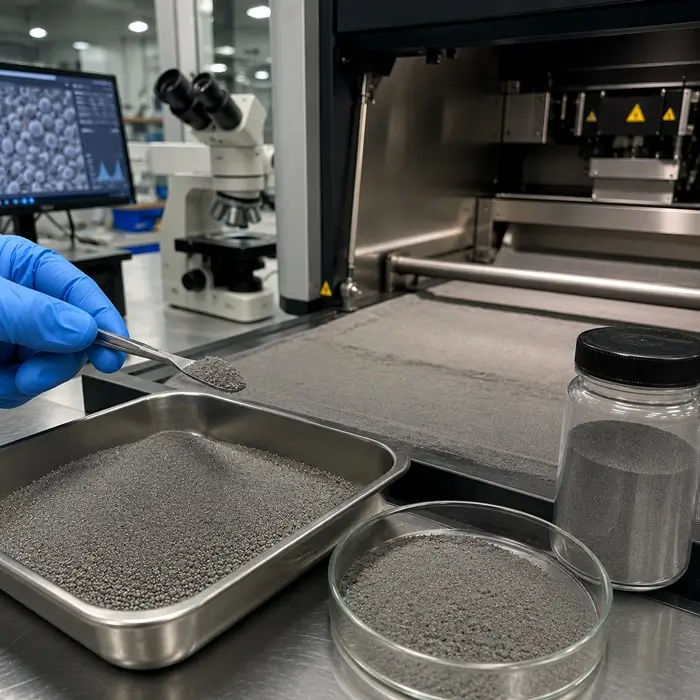
Metal powder feedstock quality has become one of the practical control points in additive manufacturing. The alloy may define the intended performance, but the powder determines how consistently that alloy can be processed.
Particle size distribution, morphology, oxygen level, surface condition, flow behavior, packing density, and reuse history all influence layer formation, melting, porosity, and final part quality. A powder can meet its nominal composition and still create defects when its physical condition has changed.
Advanced metal powders have widened the material options for additive manufacturing. Spherical metal powders, high-entropy alloy powders, refractory alloy powders, multi-material systems, and nanostructured powders make it possible to process compositions and geometries that conventional casting or machining may struggle to deliver.
That potential only becomes useful when the feedstock behaves predictably. Poor layer formation, unstable flow, oxygen pickup, particle degradation, spatter contamination, or inconsistent packing can turn a promising material into a difficult production route.
In production, the label “advanced” matters less than the measured behavior of the powder. The feedstock must remain processable, traceable, reusable within defined limits, and stable enough to support repeatable part quality.
From Alloy Concept to Processable Powder
Advanced metal powders often begin with demanding material goals. Aerospace components may require low weight, high temperature stability, oxidation resistance, and fatigue strength. Energy systems may need corrosion resistance and thermal stability. Medical implants may require biocompatibility, controlled porosity, and long-term mechanical reliability.
Several powder families sit behind this shift, but they do not all solve the same problem. High-entropy alloy powders open a wider chemistry space by moving away from a single dominant base element. Refractory powder systems are used when temperature becomes the limiting condition, with elements such as niobium, molybdenum, tantalum, tungsten, or hafnium chosen for thermal stability rather than easy processing. Multi-material powders add another route, especially when composition, phase balance, or local function needs to vary within the part. Nanostructured powders bring the focus to grain size and interfaces, where strengthening, diffusion, and phase stability can change significantly.
In each case, the material concept is only useful if the powder can still be produced, handled, spread, melted, and qualified within a realistic process window.
Alloy chemistry defines the possible performance window. Powder properties determine whether that window can be reached during manufacturing.
In additive manufacturing, each particle becomes part of a dynamic process. The powder must move, spread, pack, absorb energy, melt, solidify, and interact with surrounding particles under strict thermal and atmospheric conditions. Small changes in feedstock quality can shift the process from stable consolidation to lack-of-fusion defects, porosity, cracking, poor surface finish, or inconsistent mechanical properties.
Feedstock characterization therefore belongs close to production, not at the edge of the paperwork. Standards such as ISO/ASTM 52907 help structure metallic powder characterization for additive manufacturing, including sampling, particle size distribution, chemical composition, density, morphology, flowability, contamination, packaging, and storage.
Particle Size Distribution Controls Layer Formation
Particle size distribution is one of the first powder properties engineers usually check. It strongly influences flow, packing density, layer thickness, surface finish, and melt behavior.
In powder bed fusion, the powder layer is often where feedstock problems first become visible. The recoater needs a powder that can move across the bed and settle into a consistent layer without dragging, clumping, dusting, or leaving local thin spots.
Fines can help fill voids, but too many fines increase cohesion. The powder may spread unevenly, form small agglomerates, or become more sensitive to humidity and electrostatic effects. Coarse particles create a different risk. They can disturb thin layers, reduce surface quality, or create local defects when they sit too high in the powder bed.
The best distribution is therefore not always the narrowest one. A very narrow distribution may look controlled on a certificate, while still packing less efficiently than a broader but well-managed distribution. The useful range depends on the machine, layer thickness, alloy system, recoater design, part geometry, and required surface quality.
D10, D50, and D90 values are useful starting points, but the tails of the distribution deserve just as much attention. A small fines fraction or oversize fraction can influence spreading behavior more than the median particle size suggests.
Useful measurements include laser diffraction, sieve analysis where appropriate, dynamic image analysis, microscopy, and supplier batch documentation. NIST has also shown that particle size, morphology, roughness, and chemical composition can affect final AM part properties such as surface texture, density, tensile strength, and hardness.
For critical applications, particle size data should be compared with spreadability, apparent density, tap density, and build results. A particle size result should support a process decision rather than carry the full acceptance decision by itself.
Morphology Changes Flow, Packing, and Defect Risk
Spherical powders are often preferred in powder bed fusion because they tend to flow, pack, and spread more predictably than irregular powders. However, satellites, fines, surface roughness, hollow particles, and reuse history can still dominate layer behavior.
Gas atomization and plasma spheroidization are common production routes when a high degree of sphericity is required. These processes can improve flow and layer consistency, but they do not remove the need for detailed powder characterization.
Particle shape affects the way powder moves, packs, and responds to the recoater. A spherical powder generally gives the process a better starting point, but spherical does not automatically mean clean, consistent, or easy to process.
Satellites, fused particles, angular fragments, hollow particles, rough surfaces, and agglomerates all change the way particles interact. Satellites can raise friction between particles. Angular or irregular particles can resist smooth spreading. Hollow particles may contribute to porosity or unstable melt behavior. Rougher surfaces can change both packing and flow, especially when the powder already contains fines.
Reuse makes this more complicated. A powder that started as a clean, spherical feedstock may return from the build with spatter, surface oxidation, attached debris, or a shifted size distribution. Sieving removes part of that problem, especially larger particles and spatter. It does not restore the original surface condition of the powder.
Morphology checks should therefore do more than confirm that the powder “looks spherical.” Microscopy, dynamic image analysis, or targeted SEM work should show whether the powder has changed in ways that matter for spreading, packing, melting, or defect formation.
Surface Chemistry Can Become a Hidden Failure Source
The surface of a metal powder particle is often more important than it looks. Oxides, absorbed moisture, nitrogen pickup, carbon contamination, and process residues can all influence additive manufacturing performance.
Reactive alloys are especially sensitive. Titanium, aluminum, magnesium-containing systems, and some refractory compositions can respond strongly to oxygen and moisture exposure. Even when the bulk chemistry remains within specification, surface chemistry can affect melting, wetting, fusion behavior, and final mechanical properties.
Oxide films can change how particles absorb energy, wet, melt, and fuse into the surrounding material. In some alloys, that can contribute to inclusions, unstable melt behavior, or weaker local bonding.
Moisture can increase gas-related porosity or handling problems, especially in powders where hydrogen pickup, oxidation, or reactive surface behavior is a known concern. Spatter and condensate from previous builds can introduce chemically different particles into reused powder. These changes may not appear in particle size data.
Oxygen, nitrogen, hydrogen, and carbon analysis can therefore be critical for metal powder qualification. SEM-EDS, XPS, or related surface analysis methods may also be useful when surface contamination or oxidation is suspected. Storage conditions, container handling, inert gas quality, humidity control, and open exposure time should be treated as part of powder quality management.
A powder specification that ignores surface condition leaves a major source of process variation uncontrolled.
Flowability Is Not the Same as Spreadability
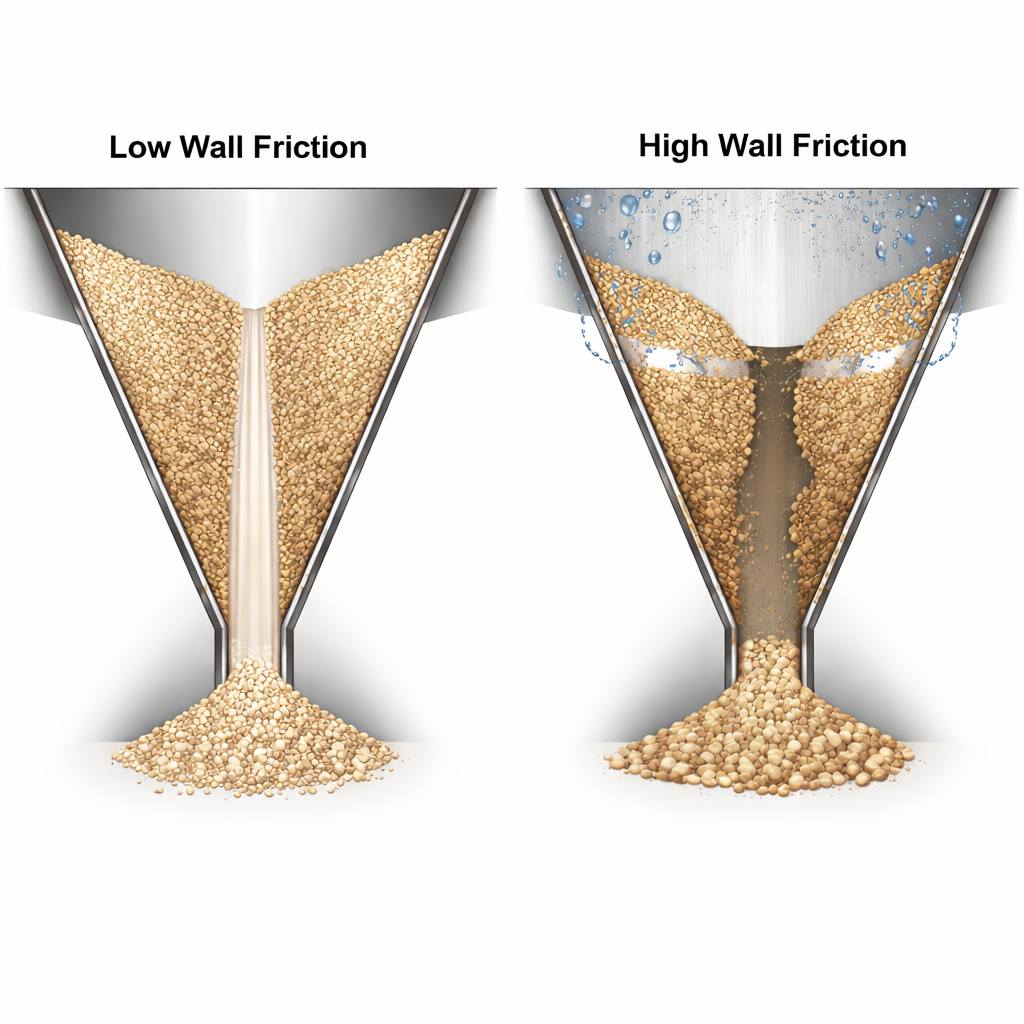
Many powders are described as free-flowing because they pass through a funnel or show acceptable Hall flow behavior. That can be useful for basic comparison, but it does not fully describe how powder behaves in an additive manufacturing system.
A powder may flow through a funnel and still spread poorly in a thin layer. A powder with marginal bulk flow behavior may also perform acceptably under a specific recoater setup. Powder bed formation depends on stress conditions, layer thickness, particle cohesion, recoater speed, surface roughness, humidity, electrostatics, and the interaction between powder and machine hardware.
This distinction matters in production. Powder bed fusion requires consistent layer deposition at low stress. Directed energy deposition requires stable powder feeding through nozzles. Binder jetting requires powder spreading and packing before binder interaction. Each process exposes the powder to different mechanical and environmental conditions.
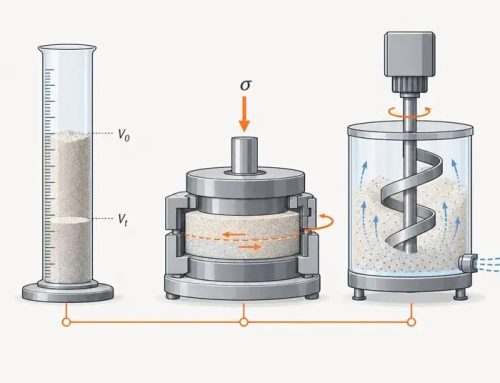
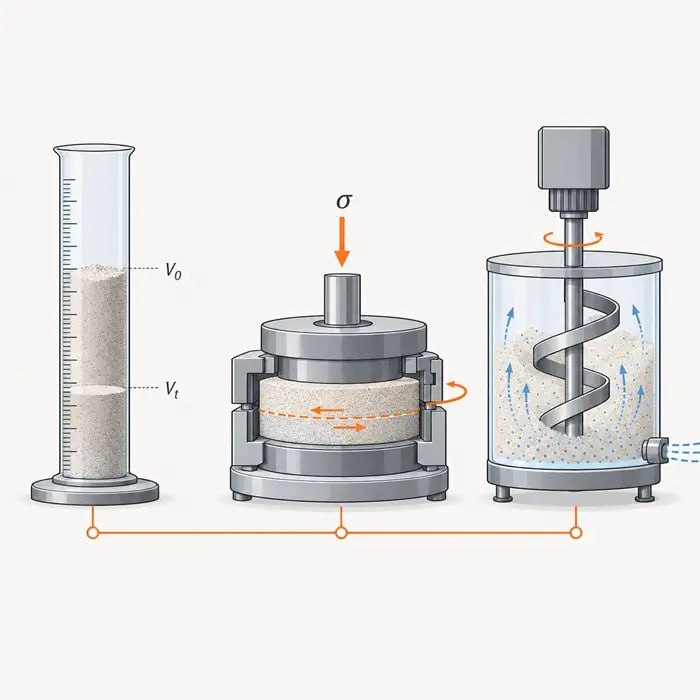
Useful tests may include apparent density, tap density, angle of repose, Hall or Carney flow, powder rheology, shear testing under relevant stress conditions, and direct spreadability tests. For additive manufacturing, layer density and visual layer quality can be especially valuable because they connect powder behavior to the actual process condition.
Reviews on powder spreading and spreadability in metal additive manufacturing also show why flowability tests alone cannot describe every recoating risk.
Standard powder tests are useful, but they become much stronger when they are checked against process-specific evidence. The test should reflect the failure mode the team needs to avoid.
Powder Reuse Needs Condition-Based Control
Powder reuse is attractive because metal powders are expensive, especially for high-value alloys. Reuse can reduce waste and improve material efficiency. It also introduces risk.
Each build cycle can change the powder. Thermal exposure, oxygen pickup, spatter formation, fines loss, particle deformation, contamination, and repeated handling can all shift powder behavior. Virgin top-up powder may dilute these changes, but it does not automatically reset the batch.
A fixed maximum number of reuse cycles is easy to manage, but it is not always technically meaningful. The condition of the powder matters more than the number of times it has been used. Two powders with the same reuse count can differ significantly if build temperature, oxygen exposure, part geometry, sieving practice, storage conditions, and top-up ratio differ.
A condition-based reuse strategy should track the powder lot through its full history. That includes virgin batch data, number of builds, machine exposure, sieving records, top-up percentage, oxygen and nitrogen levels, particle size distribution, morphology, apparent density, and observed build defects.
Reuse decisions should be tied to measured changes in the powder, not to appearance alone, especially when spatter contamination in laser powder bed fusion is part of the failure risk. Rising oxygen, loss of fines, spatter accumulation, reduced spreadability, or a clear morphology shift should trigger a defined action. That action may be blending with virgin powder, reducing the reuse window, downgrading the batch, reprocessing it, or rejecting it entirely.
A powder can still look acceptable in a container while its process behavior has already changed. Visual inspection is useful as a first screen, but it cannot carry a reuse decision on its own.
Advanced Alloy Powders Are Harder to Qualify
High-entropy alloys, refractory alloy powders, and multi-material powders bring useful design freedom, but they also reduce the margin for assumption. The chemistry is wider, the process response is less familiar, and small differences in thermal history can have larger consequences.
That matters in laser powder bed fusion. Multi-element systems may contain elements with very different melting points, densities, vapor pressures, and diffusion behavior. During rapid heating and cooling, those differences can lead to segregation, evaporation losses, residual stress, cracking, or unexpected phase formation. The same thermal cycle that creates useful non-equilibrium structures can also create defects when the process window is too narrow.
Pre-alloyed spherical powders usually give better chemical uniformity, but they are expensive and require specialized production. Blended elemental powders are more flexible during development, although they carry a different risk. The process has to melt and homogenize different particles within a very short thermal cycle. If that does not happen consistently, the final part may contain local composition differences and uneven properties.
These materials should therefore stay in process development until the evidence supports routine production. Powder chemistry, morphology, melt behavior, phase formation, porosity, and mechanical performance all need to be connected before the route can be qualified.
How to Assess Metal Powder Feedstock Quality
A practical qualification program should connect powder measurements to production decisions, starting with representative powder sampling before the data are interpreted. The aim is not to collect more data. The aim is to understand which powder changes affect spreading, melting, reuse, and part quality.
Particle size distribution
Particle size distribution shows whether the powder fits the intended layer thickness, packing behavior, and process route. The median is useful, but it is not enough. Fines and oversize particles often explain process problems that D50 alone will miss.
Particle morphology
Morphology shows whether the powder contains satellites, irregular particles, hollows, rough surfaces, spatter, or agglomerates. These features can change flow, packing, recoating behavior, and melt consistency.
Chemical composition
Chemical analysis confirms whether the alloy still matches the specification. For advanced alloy powders, this also means watching elements that may segregate, evaporate, oxidize, or drift during repeated processing.
Oxygen, nitrogen, hydrogen, and carbon levels
These values help track contamination, oxidation, moisture-related risk, and reuse effects. They become especially important for reactive alloys and for parts where mechanical reliability depends on tight chemistry control.
Apparent density and tap density
Apparent and tap density give indirect evidence of packing behavior and lot-to-lot consistency. They should be read together with particle size, morphology, flow behavior, and actual spreading performance.
Flow and spread behavior
Flow tests show how powder moves under defined conditions. Spreadability checks show whether the same powder can form a uniform layer in the process. Both are useful, but neither should be treated as universal proof of printability.
Moisture and storage condition
Storage data matters when powders are sensitive to oxidation, hydrogen pickup, or gas-related porosity. Open exposure time, humidity, container handling, and inert gas quality can all become part of the feedstock history.
Reuse history
Reuse history should show how the powder has moved through builds, sieving, top-up, storage, and machine exposure. Without that history, later powder changes become difficult to interpret.
Build coupon results
Build coupons connect feedstock data to part behavior. They can show whether powder changes translate into density loss, lack-of-fusion defects, gas porosity, cracking, rougher surfaces, or mechanical scatter.
Together, these checks give engineers a stronger basis for accepting, reusing, blending, or rejecting a powder batch. For a broader overview of test methods, see this guide to powder characterization techniques.
Turning Feedstock Data Into Process Decisions
Powder data only earns its place when it changes a decision. That decision may involve batch acceptance, reuse limits, storage practice, sieving, blending, or machine parameters.
If a batch shows higher fines content, the process may require adjusted handling, tighter humidity control, or rejection. A clear morphology shift after reuse may justify a higher virgin top-up ratio, a shorter reuse window, or a full review of sieving and storage practice. If oxygen increases, the investigation may move toward storage, inerting, exposure time, or powder transfer practice. If layer density declines, recoater settings, particle size distribution, morphology, and powder conditioning all become relevant.
For production environments, powder specifications should not be copied from generic supplier ranges. They should be built around the process window, part requirements, and known failure modes. A non-critical prototype part may tolerate a wider feedstock range than a fatigue-loaded aerospace component or medical implant.
The practical aim is to define which powder changes matter, how they are measured, and what action follows when they move outside the accepted range.
That action may include supplier rejection, additional sieving, blending with virgin powder, drying, improved storage, altered machine parameters, reduced reuse, or full lot quarantine. Without predefined decisions, testing can produce data without control.
Closing Perspective on metal powder feedstock quality
Advanced metal powders are useful when their behavior can be controlled through the full route from powder production to part qualification.
High-entropy alloys, refractory alloys, spherical powders, nanostructured powders, and multi-material systems all expand the design space for additive manufacturing. Their value depends on practical feedstock control. Particle size distribution, morphology, surface chemistry, oxygen level, flow behavior, packing density, and reuse history determine whether the material can form stable layers, melt consistently, and produce reliable parts.
For engineers and QA teams, metal powder feedstock quality should be treated as a process-critical control point. The powder specification should describe more than what the material is. It should help define whether the measured powder behavior supports stable spreading, controlled melting, repeatable reuse, and consistent part performance.
That is where advanced powder development becomes useful manufacturing knowledge rather than future-facing material language.