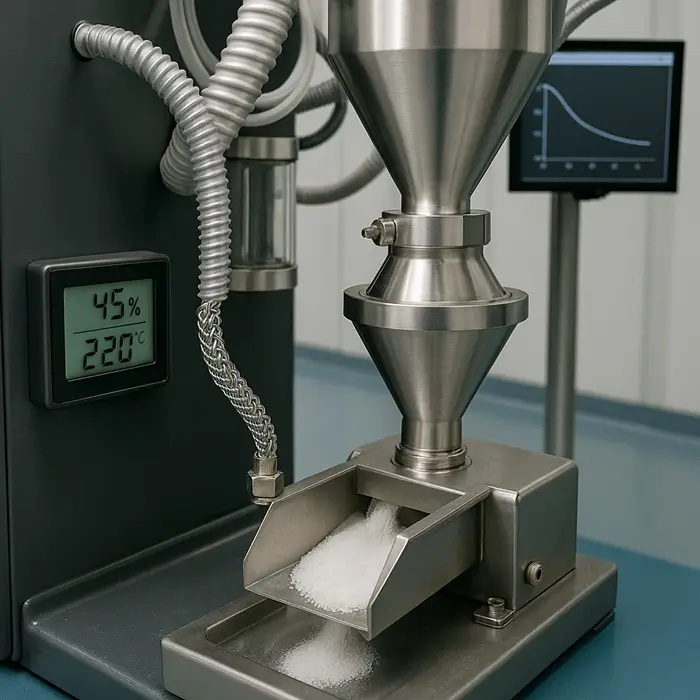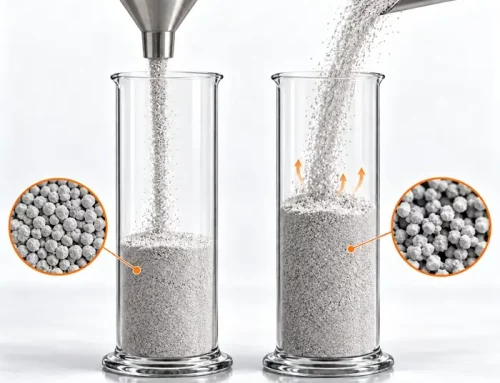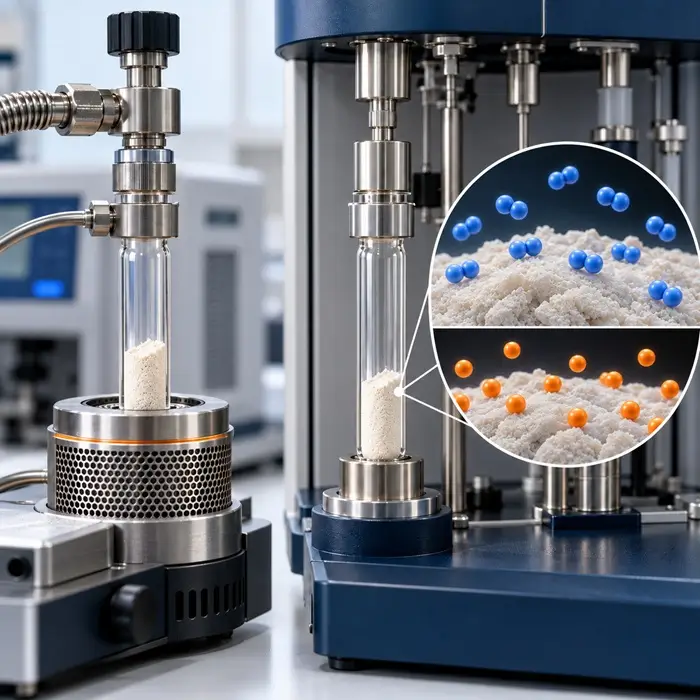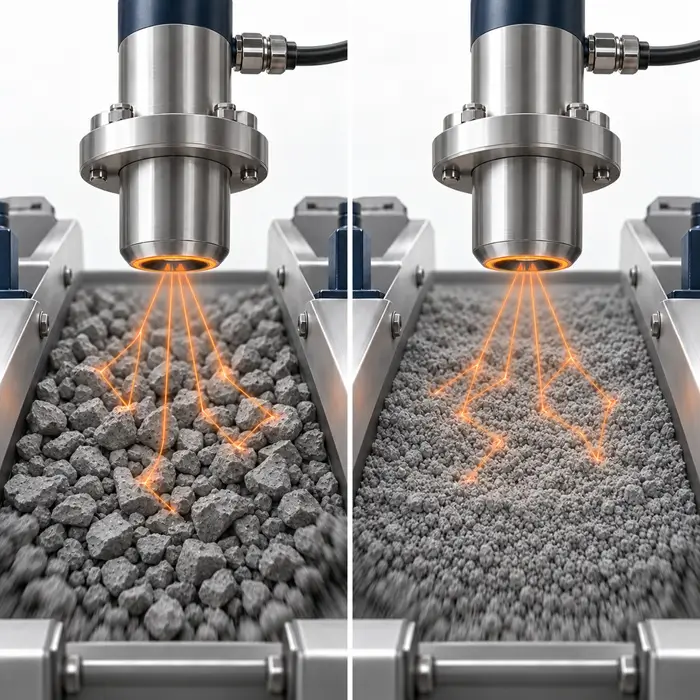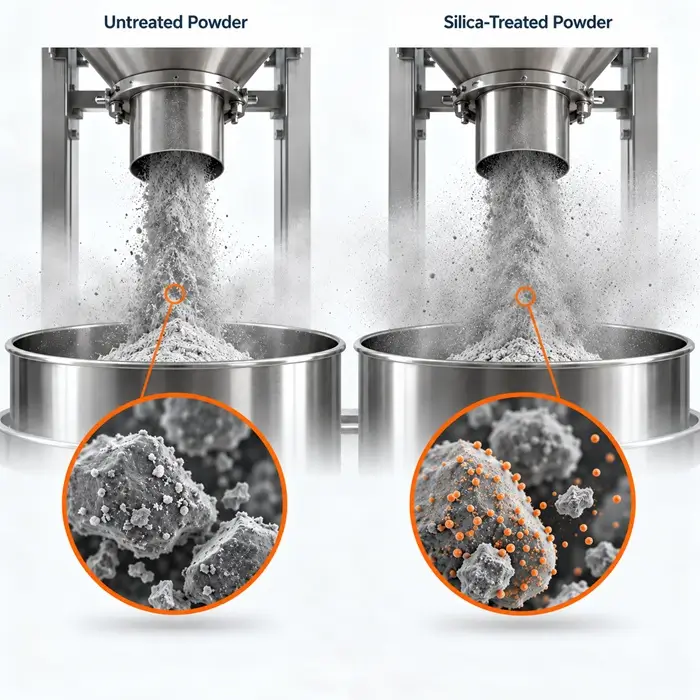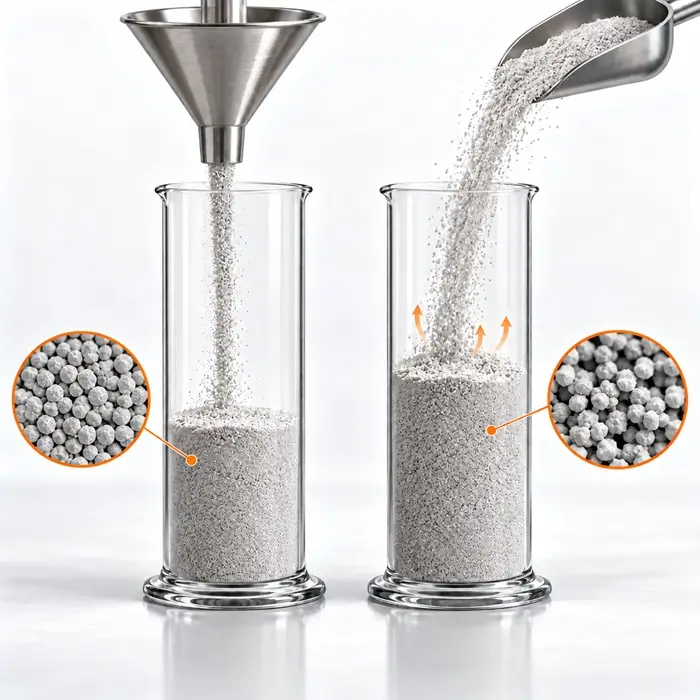
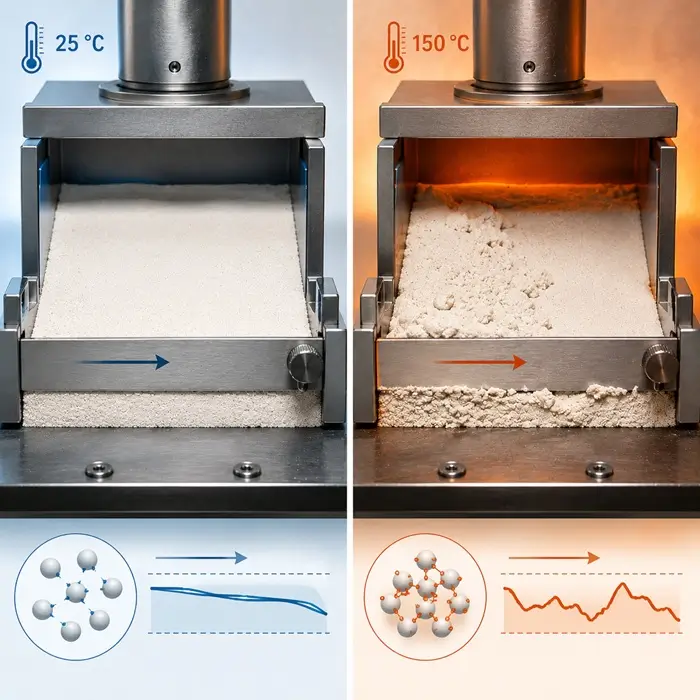
Most powder flowability testing takes place at ambient conditions, typically 20 to 25°C with defined relative humidity. That protocol produces reproducible, comparable results. It also applies directly to one temperature window. When the process operates outside that window, the characterization can guide or mislead depending on how far conditions diverge.
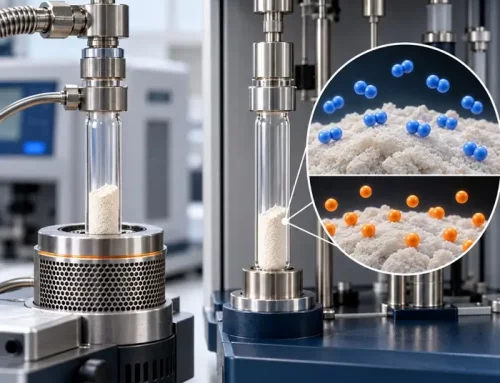
Three mechanisms shift as temperature rises: surface energy, particle contact compliance, and residual moisture state. They do not move in parallel or in the same direction. The combination determines whether elevated-temperature flow is better, worse, or simply different from the ambient result.
Three Mechanisms Temperature Shifts
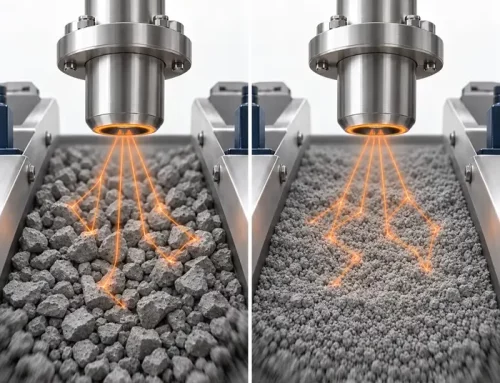
In some dry, non-softening systems, higher temperature can reduce the adhesive contribution of surface forces. In many process powders, however, that effect is overtaken by moisture loss, softening, glass-transition behavior, or increased real contact area. For polymeric powders, the picture changes near the glass transition region: particles become more compliant under the same normal load, real contact area grows, and adhesion does not fall as simple surface-energy arguments would predict. Research on glass transition and powder flowability in amorphous systems shows that cohesive behavior can shift substantially as powders approach Tg. Residual moisture adds a third variable. Elevated temperature desorbs surface water, which may improve or worsen cohesion depending on the initial moisture state and how much cohesion is driven by capillary forces. For materials where moisture distribution around a threshold governs behavior, see the discussion of water activity in powders for how moisture thresholds shape this effect.
What the Temperature Range Reveals About the Dominant Effect
In the mild elevation range, roughly 40 to 80°C, moisture desorption typically dominates, and cohesion often falls below the ambient value, as documented in studies on the effects of temperature and relative humidity on food powder flowability. From 80°C to 150°C, surface energy and contact compliance effects compete: semi-crystalline polymers and amorphous excipients can initially improve flow and then worsen as particle deformability increases. In polymer powder-bed processes, temperatures above roughly 150°C may move the powder toward the sintering window, where contact-point necking or thermal aging can begin before full bulk melting.
What Elevated-Temperature Measurement Produces
Temperature-controlled shear cells produce flow function (ffc) curves at the target process temperature. Results can differ substantially from ambient: a powder classified as easy-flowing at 25°C can test as cohesive or very cohesive at 150°C. Research on elevated-temperature flowability of polymer powders for additive manufacturing demonstrates that ambient measurements can systematically misrank powders relative to their behavior under preheat conditions. Heated rotating drum instruments add dynamic avalanche characterization at temperature. For selecting and comparing powder flow test methods, heated ring shear and blade shear configurations extend the same core methodology to process-relevant temperatures, while the drum result maps more directly to bed-spreading performance.
Three Processes Where the Measurement Gap Is Consequential
SLS and MJF Powder Bed Preheat
PA12 powder beds in selective laser sintering and multi-jet fusion are preheated well above 150°C, approaching the melt onset near 176°C, where interparticle neck formation begins during bed conditioning. A powder that tests as free-flowing at 25°C can show sharply reduced spreadability at preheat temperature, a discrepancy documented in studies of rheology and agglomeration behavior of semi-crystalline polyamide powders in SLS. Layer quality and part density depend on hot-state flow behavior, not ambient characterization. The same quality-to-process principle extends across powder bed technologies and is covered further in the context of metal powder feedstock quality in additive manufacturing.
Spray Dryer Outlets and Cyclone Discharge
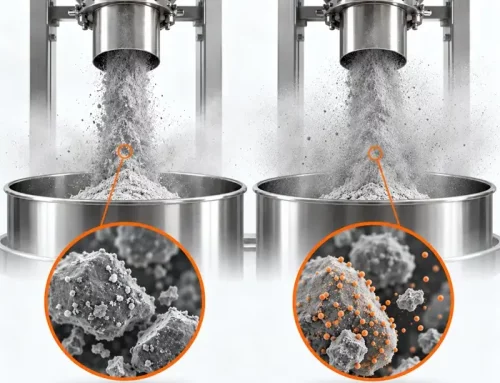
Powder exiting a spray dryer above its sticky point adheres to cyclone walls and bridges discharge valves. The sticky point is material-specific, typically lower than the melting point, and closely tied to the glass transition temperature, as formalized in Tg-based stickiness models for spray drying and extended to production-scale systems in sticky-point models for nutritional powder spray drying. Room-temperature characterization of the collected product does not reproduce the outlet condition. The spray drying process determines both outlet temperature and the thermal history of the material, both of which affect downstream handling.
High-Temperature Conveying and Transfer Lines
In heated transfer lines and jacketed screws operating at 80 to 130°C, wall friction can increase sharply as particles deform against metal surfaces at elevated temperature. This raises plugging risk in restricted or tapered sections. Characterization at the operating temperature on representative wall material is required; the room-temperature wall friction result does not transfer to these conditions.
When Elevated-Temperature Flow Data Is Worth Requesting
Consider temperature-specific characterization when the process preheats the powder above 60°C before handling or discharge, when the material is an amorphous or semi-crystalline polymer with a glass transition temperature below 200°C, when wall adhesion is a reported problem and plant temperature varies seasonally, or when ambient flowability results do not correlate with observed process behavior. Ambient data that fails to correlate with process performance is itself a diagnostic signal. Reviewing it alongside the powder operating window concept typically helps frame where temperature sits among the variables driving the discrepancy.
Ambient data is still useful, but only inside its temperature window
Room-temperature flowability data is not wrong. It is a controlled description of powder behavior under ambient conditions. The mistake is using that result as if temperature does not change the powder state. When the process operates outside the ambient test window, elevated-temperature testing turns flowability from a general material property into a process-relevant measurement.